

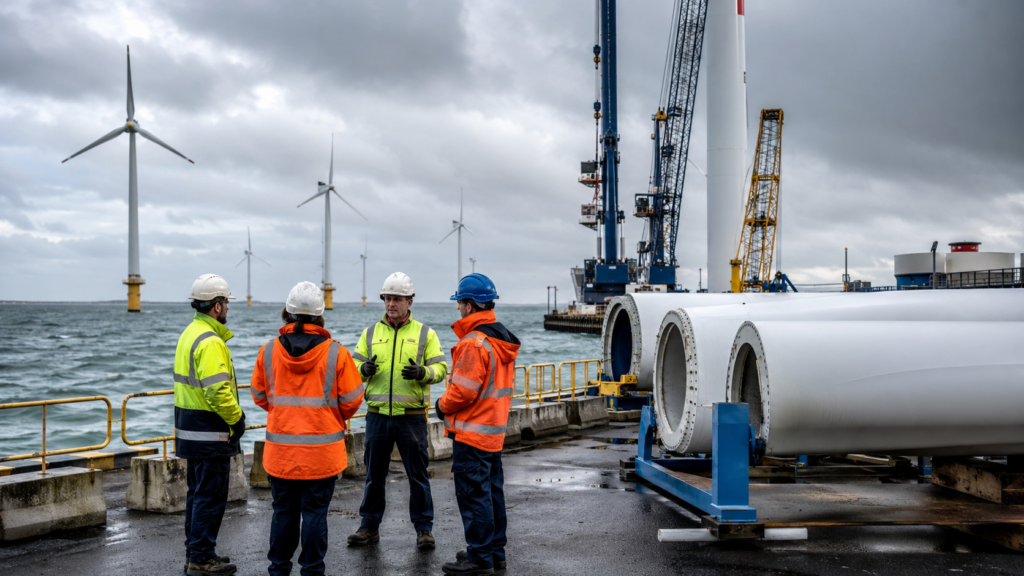
The UK government has secured backing from 37 offshore wind supply chain companies and six trade unions for the Offshore Wind Fair Work Charter, linking Britain’s clean energy buildout with stronger worker protections across the sector. The charter gives trade unions improved access to workplaces and opportunities to engage directly with staff, while setting expectations on health and safety standards, fair terms and conditions, apprenticeships and inclusive workplaces. The agreement covers companies across ports, cables, marine services, engineering, construction, offshore logistics and turbine supply chains, including Associated British Ports Holdings Limited, Belfast Harbour, Hitachi Energy UK Ltd, Navantia UK Ltd, SeAH Wind Ltd, Siemens Energy Limited, Siemens Gamesa Renewable Energy Limited, Van Oord Offshore Wind UK Ltd and Vestas Celtic Wind Technology Ltd. For the UK clean energy sector, the charter turns labour standards into a strategic test for whether offshore wind can scale quickly without recreating the insecure employment patterns that have weakened trust in earlier industrial transitions.
Why does the UK Offshore Wind Fair Work Charter matter for clean energy jobs and supply chains?
The Offshore Wind Fair Work Charter matters because the United Kingdom’s clean energy ambitions depend not only on project approvals and grid connections, but also on whether the offshore wind supply chain can build a stable, skilled and trusted workforce. Offshore wind is one of Britain’s most important energy transition sectors, yet rapid growth can expose tensions around contract labour, safety standards, skills shortages, regional employment and union access. The charter attempts to address those tensions before they become a drag on project delivery.
The agreement gives trade unions better access to workplaces and opportunities to speak directly to staff. That is significant because offshore wind work is spread across ports, fabrication yards, vessels, cable systems, turbine components, construction sites and operations teams. Without structured workforce engagement, labour concerns can become fragmented and reactive. By bringing companies and unions into a shared framework, the government is trying to create a more predictable industrial relations model for a sector expected to grow quickly.
The charter also reflects a wider shift in how clean energy policy is being framed. The UK government is no longer presenting offshore wind only as a climate or electricity supply story. It is presenting offshore wind as an industrial jobs story, a coastal regeneration story and a worker-rights story. That shift matters because public support for energy transition is easier to maintain when communities can see not only turbines in the sea, but also pay packets, apprenticeships and durable employment onshore.
How could stronger union access reshape employment standards in UK offshore wind?
Stronger union access could reshape employment standards by giving workers a clearer route to raise concerns, negotiate conditions and engage with employers across the offshore wind supply chain. The charter could also pave the way for trade union recognition across parts of the sector, with future agreements expected to include commitments on fair terms and conditions, apprenticeships and more inclusive workplaces.
This is important because offshore wind supply chains are complex. A single offshore wind project can involve developers, ports, marine contractors, cable suppliers, fabrication companies, vessel operators, engineering firms, maintenance providers and specialist subcontractors. Employment standards can vary across that chain. If workforce protections are applied only at the top level, gaps can remain further down the contracting structure. A charter approach gives the government, unions and companies a framework for pushing standards deeper into the supply chain.
For companies, stronger engagement with unions may create short-term negotiation obligations, but it can also reduce long-term delivery risk. Large infrastructure and energy projects are vulnerable to disruption when workforce concerns are not addressed early. Clearer terms, better safety standards and structured engagement can support retention and productivity. In a sector already competing for skilled labour, fair work is not a sentimental extra. It is part of the project execution toolkit.
Why are offshore wind supply chain companies signing up to the UK government charter?
The 37 companies signing the charter appear to be responding to several pressures at once: government policy expectations, labour market competition, project delivery risk and reputational scrutiny. Offshore wind companies need political support, port access, planning coordination, grid investment and industrial policy alignment. Signing a fair work charter helps companies show that they are not only asking for public support, but also accepting responsibilities around workforce standards.
The company list is broad. It includes ports such as The Port of Aberdeen, Associated British Ports Holdings Limited, Belfast Harbour, Forth Ports Limited and Great Yarmouth Port Company Ltd. It includes engineering and infrastructure firms such as Bilfinger UK Limited, Jones Bros Ruthin (Civil Engineering) Co Limited, OCU Utility Services Ltd, Severfield Nuclear and Infrastructure Ltd, Taylor Woodrow Infrastructure Limited and VolkerFitzpatrick Limited. It also includes offshore wind and energy supply chain names such as Cadeler UK Limited, Hitachi Energy UK Ltd, JDR Cable Systems Ltd, Navantia UK Ltd, Nexans Norway AS, SeAH Wind Ltd, Siemens Energy Limited, Siemens Gamesa Renewable Energy Limited, Van Oord Offshore Wind UK Ltd and Vestas Celtic Wind Technology Ltd.
That breadth matters because offshore wind is not one industry in the narrow sense. It is an ecosystem. Ports, vessels, cables, steel structures, substations, turbine systems and civil works must all align. If labour standards improve only in one part of the chain, the wider employment model remains uneven. By securing a broad first wave of signatories, the government is trying to make fair work a supply chain norm rather than a company-by-company public relations choice.
How does the charter connect offshore wind to Britain’s industrial heartlands and coastal towns?
The charter directly connects offshore wind to Britain’s coastal towns and industrial heartlands because many offshore wind jobs are located in regions that have long histories in manufacturing, ports, shipbuilding, steel, heavy engineering and maritime services. These communities have often experienced industrial decline, underinvestment or insecure employment as older sectors have contracted. Offshore wind offers a chance to create new industrial activity, but only if projects generate local, high-quality jobs.
This is why the charter is politically important. Clean energy transitions can face resistance when workers fear that old jobs will disappear while new jobs arrive elsewhere, on weaker terms or through temporary subcontracting. Stronger workplace rights, apprenticeships and union engagement can help reduce that concern. The message is that offshore wind should not only decarbonise the power system, but also deliver credible employment outcomes in the places expected to host and support the sector.
The regional angle also supports the UK government’s wider industrial and energy strategy. Offshore wind projects require port upgrades, fabrication capacity, vessel support, electrical infrastructure and skilled technicians. If coastal and industrial regions capture more of that value, the sector can become a regeneration tool. If not, the UK risks building more clean power while importing too much of the economic upside. That would be an awkwardly windy version of missing the boat.
What does the Offshore Wind Fair Work Charter mean for apprenticeships and skills?
The charter’s reference to apprenticeships is central because offshore wind expansion will require a much larger skilled workforce. The sector needs welders, engineers, electricians, marine specialists, project managers, safety professionals, port workers, vessel crews, cable technicians, turbine maintenance teams and digital monitoring specialists. These skills cannot be assembled overnight, especially when other sectors such as defence, nuclear, construction and grid infrastructure are competing for similar workers.
Apprenticeships help address the skills pipeline problem by creating structured entry routes into offshore wind and related supply chain roles. They also help local communities connect with the economic benefits of clean energy projects. Without apprenticeships and training pathways, offshore wind could become dependent on a smaller pool of mobile specialists, leaving local workers watching projects happen around them rather than participating in them.
The government has linked the charter to a broader youth employment package, including 300,000 new work experience and training placements across sectors such as construction, health, social care and hospitality. For offshore wind, that wider skills agenda matters because the sector will need both highly specialised technical roles and broader operational support. Training policy and energy policy are increasingly becoming the same conversation, just with different hard hats.
Why does this agreement matter for the UK’s clean power mission after energy market shocks?
The agreement matters because the UK government is trying to accelerate clean power delivery while reducing exposure to global fossil fuel shocks. Offshore wind is central to that strategy because it offers domestic renewable generation at scale. However, expanding offshore wind requires strong supply chains, reliable construction capacity, grid coordination and workforce stability. Labour standards are therefore indirectly linked to energy security.
Energy Secretary Ed Miliband has framed stronger worker protections as part of the clean power mission, arguing that a more secure and stable energy system should go hand in hand with stronger workers’ rights. That framing is politically useful because it avoids presenting climate policy as separate from everyday employment concerns. It also suggests that the government wants clean energy projects to be judged not only by megawatts, but by the quality of work created.
The policy signal is clear. Britain wants offshore wind to be both an energy security asset and an industrial employment platform. That ambition will be tested by project economics, planning timelines, supply chain costs, port readiness, grid delays and competition from other markets. The charter cannot solve all those issues, but it does address one core risk: whether the workforce sees the clean energy transition as something done with them or to them.
What risks could limit the impact of the Offshore Wind Fair Work Charter?
The biggest risk is implementation. A charter can set expectations, but its real value depends on whether companies embed fair work principles into contracts, procurement, site practices and subcontractor relationships. If the charter remains a voluntary statement without consistent enforcement, workers may see limited change. Trade unions have already indicated that implementation and enforcement will be the key test.
Another risk is supply chain complexity. Offshore wind companies often rely on multi-layered contractor models. Even if major companies commit to fair work standards, those standards must travel through smaller suppliers, specialist subcontractors and project-specific arrangements. That is harder than signing a public document. It requires procurement rules, monitoring, reporting, worker engagement and consequences for poor practice.
There is also a cost question. Stronger conditions, training commitments and union engagement may increase near-term labour costs for some firms. However, the alternative can be worse if poor standards lead to churn, disputes, safety incidents or skills shortages. The economic case for fair work depends on whether companies treat it as productivity infrastructure rather than compliance garnish.
How could the charter influence future clean energy supply chain policy in the UK?
The Offshore Wind Fair Work Charter could become a model for other clean energy supply chains if it proves credible. Sectors such as hydrogen, carbon capture, grid construction, battery manufacturing, nuclear supply chains and port decarbonisation all face similar questions around skills, safety, regional jobs and labour standards. If offshore wind can show that industrial growth and stronger worker protections can move together, the approach may be replicated.
The charter also gives the government a tool to connect public support with workforce commitments. Clean energy projects often depend on government-backed auctions, planning support, public infrastructure and policy certainty. It is reasonable for government to expect that publicly supported sectors deliver not only capacity, but also decent work. That linkage could become more important as industrial strategy becomes more interventionist.
For investors and companies, the message is that labour standards are becoming part of energy transition risk management. A company’s ability to win contracts, secure political goodwill and retain workers may increasingly depend on how it handles workforce relations. In the next phase of the clean energy buildout, social licence may matter almost as much as grid connection. And unlike a turbine blade, social licence cannot simply be imported and bolted on.
What are the key takeaways from the UK Offshore Wind Fair Work Charter?
- The UK government has secured backing from 37 offshore wind supply chain companies and six trade unions for the Offshore Wind Fair Work Charter, creating a new framework for stronger worker protections in clean energy.
- The charter gives trade unions improved access to workplaces and opportunities to speak directly to staff, while setting expectations around health and safety, fair terms and conditions, apprenticeships and inclusive workplaces.
- Signatories include ports, engineering firms, cable suppliers, marine service providers, offshore wind contractors and energy technology companies, showing that the charter is aimed at the wider supply chain rather than only project developers.
- The agreement links offshore wind expansion with coastal towns and industrial heartlands, where the government wants clean energy investment to create skilled, secure and locally meaningful employment opportunities.
- Apprenticeships are a key part of the charter’s wider value because the offshore wind sector will need a larger skilled workforce as projects scale and competition for engineers, technicians and maritime specialists increases.
- The charter supports the UK government’s clean power mission by treating workforce stability, industrial relations and safety standards as part of the delivery model for a more secure energy system.
- The main execution challenge will be ensuring that charter commitments are implemented across complex contractor and subcontractor chains, rather than remaining limited to headline corporate signatories.
- If the model works, the Offshore Wind Fair Work Charter could influence labour standards in other clean energy sectors, including grid construction, hydrogen, carbon capture, battery manufacturing and port decarbonisation.
Share this:
Discover more from Business-News-Today.com
Subscribe to get the latest posts sent to your email.