



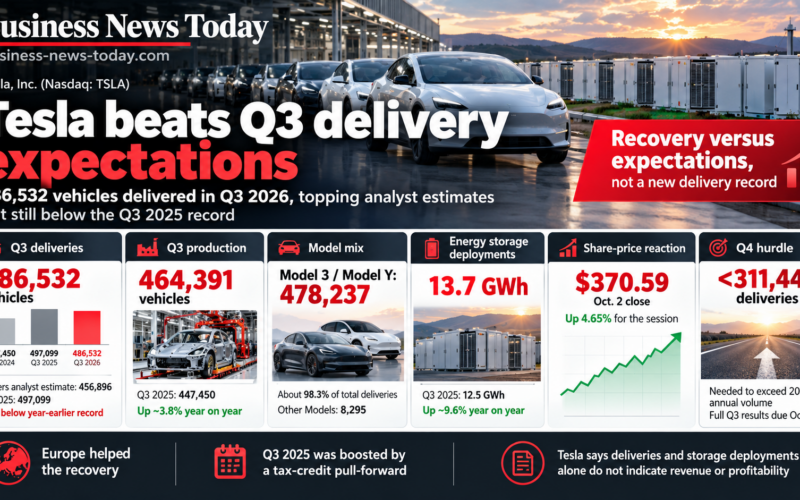
Tesla, Inc. (Nasdaq: TSLA) delivered 486,532 vehicles during the third quarter of 2026, exceeding the 456,896 average analyst estimate cited by Reuters and putting the electric-vehicle manufacturer within striking distance of returning to annual delivery growth after two years of contraction. Deliveries were nevertheless 2.1% below the record 497,099 vehicles supplied in the third quarter of 2025, making the latest result a recovery relative to expectations rather than a year-on-year sales record.
Tesla produced 464,391 vehicles during the quarter, up approximately 3.8% from 447,450 a year earlier. Model 3 and Model Y accounted for 478,237 deliveries, or just over 98% of Tesla’s quarterly vehicle total, while the company’s aggregated Other Models category contributed 8,295 units.
The Energy Generation and Storage business provided another growth signal, with Tesla deploying 13.7 gigawatt-hours of energy-storage products compared with 12.5 GWh in the year-earlier quarter. That represents growth of approximately 9.6%, although Tesla explicitly cautions that vehicle deliveries and storage deployments alone should not be treated as indicators of quarterly financial performance because revenue and profitability also depend on pricing, cost, foreign exchange and product mix.
Tesla shares closed October 2 at $370.59, up 4.65% for the session after the delivery figures were released. The broader US equity market also advanced, but the stronger-than-expected Tesla numbers were widely cited as an important company-specific catalyst for the move.
Did Tesla actually return to vehicle-delivery growth in the third quarter?
Not on a year-on-year basis. The distinction matters because the 486,532 deliveries can sound like a return to growth when compared with Wall Street expectations, but Tesla delivered 497,099 vehicles during the corresponding quarter of 2025.
The year-earlier comparison was unusually demanding. US buyers had accelerated electric-vehicle purchases before the expiry of the federal EV tax credit in September 2025, contributing to Tesla’s record third-quarter volume. The latest period therefore compares against a quarter that benefited from a powerful policy-driven pull-forward in demand.
Tesla’s 2026 trajectory looks stronger when viewed across the full year. Reuters calculated that the company needs fewer than 311,448 fourth-quarter deliveries to surpass its 2025 annual volume. That creates a materially lower threshold than Tesla has normally produced in recent quarters and makes year-on-year annual growth achievable even if the fourth quarter is weaker than the third.
Achieving the threshold would matter symbolically after two consecutive years of shrinking annual deliveries. It would not by itself settle the argument over Tesla’s automotive growth rate, because investors would still need to separate sustainable demand from regional incentives, model launches and changes in pricing.
Why is Europe becoming important to Tesla’s delivery recovery?
Europe had become one of Tesla’s clearest weaknesses as competition intensified from European, Korean and Chinese electric-vehicle manufacturers. The company lost market share in several countries as rivals launched newer models and local consumers gained a wider range of battery-electric alternatives.
Reuters reported a recovery in markets including France and Denmark during the latest period, helping compensate for weaker US electric-vehicle conditions after the expiration of federal purchase incentives. Improving European registrations matter because Tesla needs broader geographic growth if it is to reduce dependence on price cuts or unusually strong performance in one region.
The competitive landscape remains difficult. BYD Company Limited has expanded rapidly outside China, while Volkswagen AG, BMW AG, Hyundai Motor Company, Kia Corporation and other manufacturers have widened their electric line-ups. Tesla therefore needs the refreshed Model Y, Model 3 and future lower-cost vehicles to compete in a market that is much more crowded than during its early growth phase.
Software could also influence vehicle demand, but regulatory progress must be described carefully. Reuters reported that Tesla’s Full Self-Driving technology has been approved for use in eight European countries under the applicable arrangements. That does not mean the system has become legally autonomous everywhere in Europe or that drivers can stop supervising it. Regulatory permissions and the capabilities marketed under the FSD name vary by jurisdiction.
How dependent is Tesla still on the Model 3 and Model Y?
Extremely. Model 3 and Model Y generated 478,237 of Tesla’s 486,532 third-quarter deliveries, equivalent to approximately 98.3% of the total.
That concentration is economically efficient because enormous production volumes can spread engineering and factory costs across fewer platforms. It is strategically riskier because weakness in either core model can affect almost the entire automotive business.
Tesla’s Other Models category contributed just 8,295 deliveries during the quarter. The company does not provide a model-by-model breakdown within that category, so it would be inappropriate to assign a precise number to Cybertruck, Semi or any other vehicle from the quarterly release alone.
The concentration also explains why new products matter. Cybercab, Semi and any future lower-cost platform need eventually to expand the revenue base rather than simply generate technology demonstrations.
The refreshed Model Y can support the existing franchise, but Tesla ultimately needs more than two high-volume passenger vehicles if management expects automotive output to support the much larger long-term valuation attached to autonomous transport, robotics and artificial intelligence.
Is Tesla’s energy-storage business becoming a meaningful second growth engine?
The 13.7 GWh third-quarter deployment figure shows that storage continues to scale, increasing from 12.5 GWh in the corresponding 2025 quarter.
Battery storage has become increasingly important as utilities, renewable-energy developers and data-centre operators require systems capable of shifting electricity across hours and providing grid stability. Tesla’s Megapack operation therefore gives the company exposure to an infrastructure market whose demand drivers differ from household vehicle purchases.
The economics also differ. Vehicle sales involve consumer financing, dealerships or direct distribution, model refreshes and intense brand competition. Grid storage is sold into industrial projects where project economics, electricity prices, interconnection and reliability become more important.
Tesla has not yet released third-quarter revenue, gross margin or cash-flow figures for the energy business. Deployment volume therefore shows physical scale but cannot establish how profitable the quarter was.
That information will become available when Tesla reports its full third-quarter financial results on October 21. Investors should compare storage revenue and margins with deployment growth rather than assuming a 9.6% increase in GWh produces the same percentage increase in earnings.
What does the Q3 delivery beat mean for Tesla’s broader valuation debate?
Tesla increasingly trades on more than car deliveries. Investors are assigning substantial value to autonomous driving, robotaxis, artificial intelligence and the Optimus humanoid-robot programme.
That makes the automotive business paradoxically both less dominant in the investment narrative and still financially crucial. Cars remain a major source of revenue and cash with which Tesla can finance expensive development programmes whose commercial outcomes remain uncertain.
A stronger delivery quarter reduces one immediate concern: the core automotive franchise does not appear to be deteriorating as quickly as some forecasts suggested. It does not establish what average selling prices or automotive margins were required to generate the volume.
October 21 will therefore be more informative than the delivery release alone. Investors need revenue, automotive gross margin, free cash flow, capital spending and management’s assessment of regional demand before determining whether the higher delivery volume created stronger economics.
The third quarter has nevertheless changed the near-term arithmetic. Tesla did not return to year-on-year quarterly delivery growth, but it came much closer than expected and now requires a comparatively modest fourth quarter to put annual growth back on the board.
Discover more from Business-News-Today.com
Subscribe to get the latest posts sent to your email.