




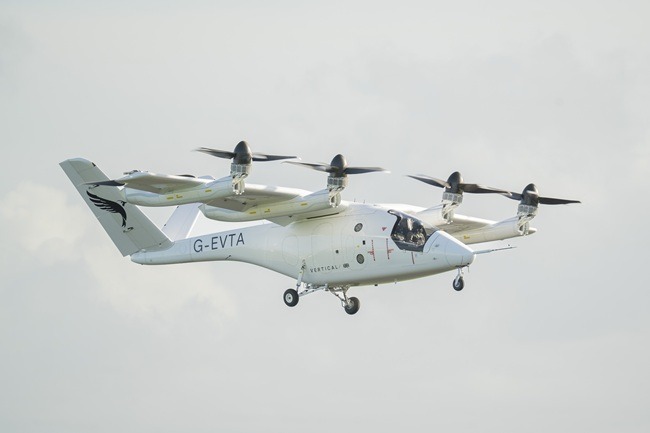
Vertical Aerospace Ltd. (NYSE: EVTL) has completed ten piloted test flights of its full-scale Valo prototype since receiving its Permit to Fly from the United Kingdom Civil Aviation Authority on November 13, 2025. The company now expects full transition flight to be achieved in early 2026, marking a pivotal milestone in the certification pathway for electric vertical take-off and landing (eVTOL) aircraft under UK and European regulatory regimes.
These latest flights have already validated a significant portion of the transition envelope, including tiltwing acceleration, deceleration, and propeller deployment sequences. Vertical Aerospace has also secured expanded regulatory privileges, allowing it to approve Flight Conditions and self-issue permits under specified conditions, further streamlining the path to commercial readiness.
How close is Vertical Aerospace to achieving full transition flight with the Valo eVTOL aircraft?
Vertical Aerospace is within 10 percent of completing the full piloted transition regime, with tiltwing behavior and high-speed control nearing validation. During the latest test campaigns, the team has successfully demonstrated in-flight stow and deployment of rear propellers, spin-up during wingborne flight, and use of prop-hold functionality—marking critical maturity milestones for the flight control system.
While early-stage tilt transitions have been completed, the final envelope closure depends on favorable weather and flight-test windows in early 2026. The progress underscores the structured nature of Vertical Aerospace’s test program, which has proceeded cautiously under full Civil Aviation Authority (CAA) oversight. According to Chief Executive Officer Stuart Simpson, these results affirm the engineering and systems integration approach pursued over several design generations.
This progress is also occurring in parallel with Vertical Aerospace’s broader certification and infrastructure strategy, including its announced plans to launch the United Kingdom’s first electric air taxi network in collaboration with Skyports Infrastructure and Bristow Group. Full transition capability is seen as a key technical milestone for validating this commercial pathway.
What does the CAA’s regulatory flexibility signal about the maturity of the UK eVTOL certification ecosystem?
In a notable development, the UK Civil Aviation Authority has granted Vertical Aerospace expanded privileges to approve Flight Conditions and issue its own Permits to Fly within defined regulatory boundaries. This delegation mirrors similar privileges afforded to more mature aerospace manufacturers and suggests increasing regulatory confidence in Vertical Aerospace’s engineering, documentation, and quality assurance frameworks.
This regulatory evolution is particularly significant given the high-stakes environment surrounding eVTOL certification, where safety parity with commercial aviation is a core mandate. Vertical Aerospace is pursuing concurrent certification pathways with both the UK CAA and the European Union Aviation Safety Agency (EASA), with both authorities expected to harmonize standards for eVTOLs over time.
Such delegated privileges can accelerate iteration cycles, reduce bureaucratic friction in early-stage testing, and help mitigate seasonal weather and scheduling risks—a known challenge in transition flight testing. However, they also raise the bar for internal governance, flight telemetry review, and system reliability, as the company takes on more first-party responsibility for compliance.
How is Vertical Aerospace positioning the Valo platform for commercial deployment by 2029?
The Valo is a four-passenger, piloted eVTOL aircraft designed to fly up to 100 miles at speeds of 150 miles per hour, with zero operating emissions. Beyond the pure-electric variant, Vertical Aerospace is also developing a hybrid-electric version to expand range and mission flexibility.
Valo sits at the heart of Vertical Aerospace’s urban air mobility strategy, with approximately 1,500 pre-orders across major markets and strategic partners, including American Airlines, Bristow Group, GOL, Japan Airlines, and Avolon. Notably, some of these pre-orders are expected to be fulfilled through third-party leasing or operator agreements, which could reduce capital intensity and de-risk early production scale-up.
In December 2025, Vertical Aerospace unveiled its air taxi network plan targeting high-density UK routes such as Canary Wharf to Heathrow, Gatwick, Oxford, and Cambridge, with commercial operations aimed for Q1 2029. The plan brings together aircraft (Valo), infrastructure (Skyports), and operational expertise (Bristow) into a unified ecosystem.
Valo is being positioned as a certifiable, airline-grade platform—emphasizing safety standards equivalent to those of modern commercial airliners. The production roadmap targets an initial run of 175 aircraft by 2030, ramping to 225+ annually by late 2030, which aligns with anticipated post-certification demand in key urban corridors.
What competitive and operational risks still remain for Vertical Aerospace in the global eVTOL race?
While Vertical Aerospace has achieved meaningful technical and regulatory milestones, significant hurdles remain on the path to commercial viability. Chief among them is certification execution—especially as regulatory frameworks for eVTOL aircraft continue to evolve in both Europe and the United States. Any shift in harmonization timelines or safety standards could delay entry-into-service or trigger costly redesigns.
Additionally, full transition flight, while close, is not yet complete. The remaining 10 percent of tilt envelope testing includes the most aerodynamically complex phases, where in-flight control system resilience and redundancy must be fully demonstrated. Software tuning, failure-mode analysis, and real-time telemetry diagnostics will be critical during this final stage.
On the competitive front, Vertical Aerospace faces strong pressure from U.S.-based Archer Aviation, Joby Aviation, and Embraer’s Eve Air Mobility, each of which is pursuing its own certification pathway and infrastructure alliances. Execution speed and first-mover advantage will be vital for commercial partnerships, particularly with airport authorities and vertiport developers.
Capital requirements also remain a persistent concern. While Vertical Aerospace has longstanding relationships with tier-one suppliers such as Honeywell, Syensqo, and Aciturri, sustained progress through 2026–2028 will likely require additional funding rounds, government grants, or customer deposits to support scaling and manufacturing.
What happens next and how should industry stakeholders interpret this milestone?
If Vertical Aerospace achieves full piloted transition in early 2026 as expected, it will join a select group of eVTOL developers globally to validate this capability under full regulatory oversight. This could catalyze further commercial confidence, unlock additional regulatory privileges, and strengthen its competitive standing in both capital and customer markets.
The next phase of development will likely include expanded envelope testing, system reliability trials, noise assessments, and simulated urban operations to demonstrate Valo’s readiness for real-world integration. Infrastructure deployment, pilot training protocols, and vertiport safety systems will also begin transitioning from paper to reality.
For industry stakeholders—including regulators, investors, and airport authorities—the milestone offers a litmus test of whether eVTOL platforms are approaching operational readiness or remain caught in prolonged prototype loops. It also provides early insight into how the UK may emerge as a regulatory leader in advanced air mobility, given its willingness to grant meaningful operational privileges during early-stage flight testing.
What are the key takeaways from Vertical Aerospace’s piloted transition testing milestone?
- Vertical Aerospace has completed 10 piloted transition flights of its full-scale Valo prototype and expects full transition by early 2026.
- The UK Civil Aviation Authority has granted Vertical additional regulatory privileges, allowing it to self-issue certain flight permits.
- Flight tests validated key behaviors including rear propeller deployment, spin-up in wingborne mode, and tiltwing control.
- Valo is central to a broader UK eVTOL strategy with planned 2029 air taxi routes between key cities like London, Oxford, and Cambridge.
- Vertical Aerospace is positioning Valo as a certifiable, commercial-grade platform with 1,500 pre-orders from major global partners.
- Competitive pressure from U.S. rivals, certification risk, and funding needs remain key execution challenges.
- Success in full transition flight could unlock further investor confidence and regulatory support for advanced air mobility in the UK.
Discover more from Business-News-Today.com
Subscribe to get the latest posts sent to your email.
