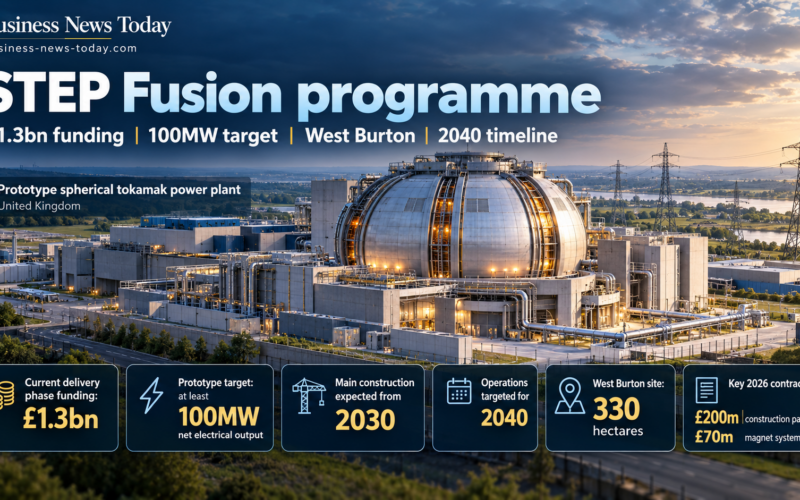
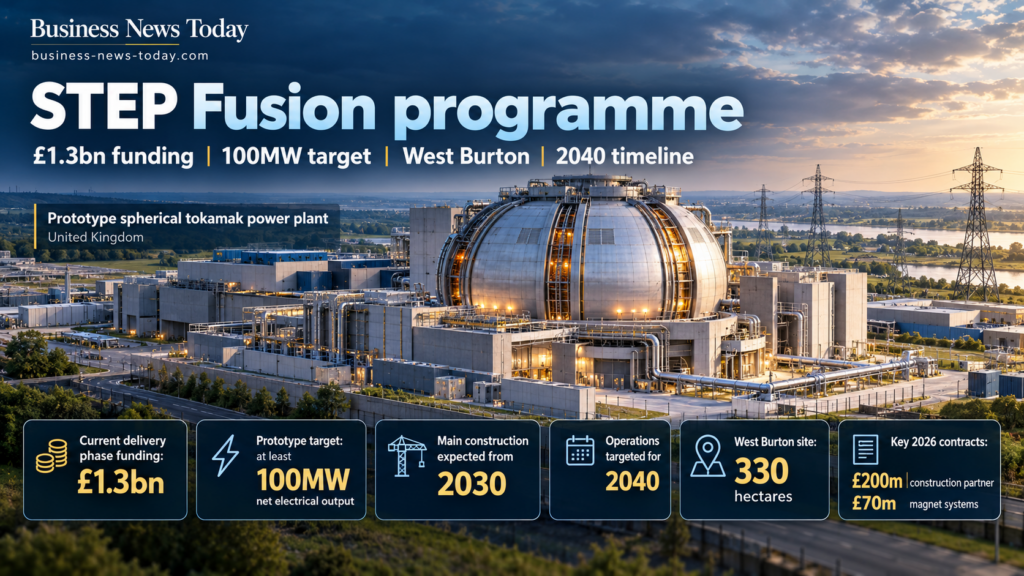
The United Kingdom’s STEP Fusion programme has moved from concept development into preliminary design as the government-backed project begins assembling the industrial, regulatory and physical infrastructure required to build a prototype fusion power plant at West Burton in Nottinghamshire. UK Fusion Energy Ltd is leading the programme, with approximately £1.3 billion allocated to the current phase and major contracts now placed for construction integration, high-temperature superconducting magnets and the digital engineering environment.
STEP, short for Spherical Tokamak for Energy Production, is intended to do considerably more than demonstrate another fusion experiment. Its current technical objectives include producing at least 100 megawatts of net electrical output, demonstrating a self-sufficient tritium fuel cycle, generating high-grade heat and establishing technologies and operating approaches that could support commercially deployable fusion plants. Operations at West Burton are targeted for 2040, while main plant construction is expected to begin from 2030 if the programme clears its design, planning, regulatory and technology milestones.
The physical site is also moving into project control. In March 2026, the UK Atomic Energy Authority acquired approximately half of the 330-hectare West Burton site and leased it to UK Fusion Energy for STEP, with the remainder expected to transfer after EDF completes decommissioning of the former coal-fired power station in 2028. The preferred location of the tokamak complex has been fixed in the southern part of the site, allowing master planning, infrastructure routing and Development Consent Order work to progress around a defined plant position.
Industrial mobilisation accelerated during 2026. The ILIOS consortium led by Kier and Nuvia was appointed construction partner under an initial £200 million, three-year contract, Tokamak Energy secured a £70 million contract to lead development of the magnet systems through March 2029, and Dassault Systèmes received a £30 million contract to expand the digital product-lifecycle infrastructure supporting STEP. These contracts do not mean the complete plant design has been frozen or that full construction has begun, but they shift the programme from research-led concept development toward an integrated industrial delivery model.
The commercial significance extends beyond the first plant. The government wants STEP to create design, manufacturing, construction and systems-integration capability that can eventually be applied to subsequent fusion power plants in the United Kingdom and international markets. Whether that ambition can be realised will depend on technical progress during the rest of the decade, particularly in plasma control, superconducting magnets, tritium breeding, materials, remote maintenance and the integration of systems that have never previously operated together in a commercial-scale fusion power plant.
What is the STEP Fusion programme and why is the United Kingdom building a prototype power plant at West Burton?
The STEP programme began in 2019 with a mission to design and build a prototype fusion power plant capable of demonstrating the characteristics required for commercial fusion energy. Unlike experimental fusion machines built primarily to investigate plasma physics, STEP is being designed as an integrated power plant incorporating the tokamak, fuel cycle, cooling, electrical generation, maintenance, waste management and site systems needed to demonstrate a route toward actual electricity production.
The government launched a nationwide site-selection process in December 2020. Fifteen locations were initially nominated before the field was reduced and subjected to more detailed technical, socioeconomic and delivery assessments. West Burton was selected in October 2022, with the former coal-generation site offering substantial land, existing industrial infrastructure, access to the electricity network and a long history as an energy-production location.
The programme received £220 million for its initial concept phase, during which engineers developed the plant architecture and investigated the technologies required to produce net electricity. Responsibility subsequently shifted from the UK Atomic Energy Authority into UK Fusion Energy, a wholly owned UKAEA subsidiary created to operate as the programme integrator and eventual plant operator.
UK Fusion Energy assumed responsibility for STEP in November 2024 and changed its name from UK Industrial Fusion Solutions in March 2026. The organisational change reflects a broader objective: rather than functioning only as a public research organisation, UK Fusion Energy is intended to integrate industrial partners and develop repeatable capabilities for designing and delivering future fusion plants.
How much funding has STEP Fusion received and why is £1.3 billion not the total cost of the West Burton plant?
The approximately £1.3 billion allocated to UK Fusion Energy for STEP is funding for the programme’s current development phase, not a published final construction cost for the completed fusion plant. It sits within a wider government commitment of more than £2.5 billion to fusion activity over the 2025/26 to 2029/30 period, covering STEP as well as research infrastructure, fuel-cycle technology, computing, industry support, international collaboration and skills.
UK Fusion Energy recorded £118.8 million of STEP programme expenditure in the 2025/26 financial year. Government plans indicate that a substantial part of the new £1.3 billion allocation will ultimately flow into private industry through construction, engineering, technology and supply-chain contracts as the design matures.
Individual contract announcements provide a clearer view of spending already entering the industrial base. ILIOS has an initial £200 million construction-partner contract covering three years, Tokamak Energy holds a £70 million magnet systems contract running to March 2029, and Dassault Systèmes has a £30 million agreement covering expansion of STEP’s digital product-lifecycle management environment.
None of those values represents the total project cost. Kier has referred to possible future programme opportunities valued at up to £10 billion, but that describes potential future contracting opportunity rather than an approved £10 billion STEP construction budget. A reliable total cost for delivering the complete West Burton plant has not yet been publicly established, which is unsurprising while the design remains in preliminary development and major construction packages are still years from final definition.
How does STEP’s spherical tokamak design aim to generate at least 100MW of net electricity?
STEP uses a spherical tokamak, a compact variation of the magnetic-confinement machines used in many fusion research programmes. A tokamak confines extremely hot plasma using powerful magnetic fields, allowing light atomic nuclei, principally the hydrogen isotopes deuterium and tritium, to fuse and release energy.
The STEP Prototype Powerplant has been designed around an objective of producing at least 100MW of net electrical output. Net output is a materially more demanding target than simply producing fusion energy because the plant itself consumes substantial electricity for magnets, heating, cooling, pumping, fuel processing and other systems. Demonstrating net electricity therefore requires the complete installation to export more electrical power than its internal systems consume.
The spherical geometry gives STEP a more compact central region than a conventional large-aspect-ratio tokamak. Published concept work has explored high plasma pressure relative to magnetic pressure, high plasma elongation and a high proportion of self-generated bootstrap current as ways to achieve the required plasma performance within a reduced radial footprint.
The current concept also uses a largely non-inductive plasma operating scenario, with the central solenoid primarily required during startup rather than sustaining the plasma continuously. STEP researchers have developed concepts involving microwave plasma heating, a Super-X divertor to manage exhaust heat and remountable magnet technologies intended to improve maintenance access.
These remain design features of an evolving prototype rather than specifications for a completed commercial product. Preliminary design will progressively determine whether the concepts can satisfy the combined requirements for plasma performance, maintainability, reliability, safety and power-plant economics.
Why are Tokamak Energy’s high-temperature superconducting magnets critical to the STEP Fusion design?
Magnetic confinement is one of STEP’s core engineering challenges because the plasma has to be controlled without allowing material structures to come directly into contact with its extreme-temperature interior. The magnet system must therefore produce powerful and accurately controlled magnetic fields while operating reliably within a complex plant exposed to substantial electromagnetic and thermal loads.
Tokamak Energy became STEP’s first system partner in April 2026 under a £70 million contract running through March 2029. Its work covers eight packages spanning magnets, tokamak systems and plasma integration, with delivery led through the company’s TE Magnetics division.
The programme is centred on high-temperature superconducting magnet technology. HTS materials can carry large electrical currents with very low resistance at cryogenic temperatures and offer the potential for stronger magnetic fields and more compact magnet systems than some conventional superconducting technologies.
Technology risk nevertheless remains substantial. A power-plant magnet must operate as part of an integrated system incorporating cryogenics, structural supports, electrical protection, joints, controls and maintenance arrangements. Tokamak Energy’s 2026 completion of a 14-month testing campaign on its Demo4 integrated magnet system provides development evidence that can feed into STEP, but it does not constitute qualification of the eventual power-plant magnet design.
The government’s technical roadmap therefore includes progressively larger magnet demonstrations. STEP is targeting completion of subscale model-coil testing during 2026, followed by further interface definition and construction of magnet-testing infrastructure at West Burton as the design matures.
How will STEP Fusion produce its own tritium fuel and why is fuel self-sufficiency one of the programme’s hardest targets?
Commercial deuterium-tritium fusion cannot depend indefinitely on existing external supplies of tritium because the isotope is scarce and radioactive, with limited global production. A future power plant therefore needs to generate much of its own tritium while operating.
STEP plans to demonstrate this through a breeding blanket surrounding parts of the fusion chamber. Neutrons released during fusion interact with lithium-containing blanket materials, creating tritium that can be recovered, processed and returned to the fuel cycle.
The engineering problem extends well beyond simply producing tritium. The blanket must withstand neutron bombardment and intense heat, transfer useful thermal energy, enable extraction of newly produced tritium and remain maintainable despite progressive radiation damage.
UKAEA is developing separate supporting infrastructure through the Lithium Breeding Tritium Innovation programme at Culham. The £180 million LIBRTI programme is intended to test breeder materials and engineering configurations under fusion-relevant neutron conditions, producing data that can support STEP and other fusion developers. LIBRTI is an enabling research programme rather than part of the £1.3 billion STEP allocation itself.
STEP’s objective of fuel self-sufficiency consequently links plant design to a broader technology-development network. Failure to establish a workable closed tritium cycle would materially weaken the commercial case for deuterium-tritium fusion regardless of how successfully the plasma itself performs.
Who is building STEP Fusion and what does the £200 million ILIOS construction partnership cover?
UK Fusion Energy selected ILIOS as construction partner following several years of market engagement and competitive dialogue. The consortium is led by a joint venture between Kier and Nuvia, with support from AECOM, AL_A Architects and Turner & Townsend.
The initial contract is valued at £200 million over three years. ILIOS is being integrated into STEP’s delivery organisation before main construction begins so that buildability, construction sequencing, cost, logistics and site requirements can influence the evolving preliminary design rather than being considered only after engineering decisions have been fixed.
Its remit extends across early enabling works, design integration, civil engineering, buildings, site infrastructure, logistics, supply chains and construction planning. This early-contractor involvement is particularly important for a first-of-a-kind plant containing large components that may require specialised manufacturing, transport, installation and maintenance routes.
UK Fusion Energy’s latest annual reporting indicates that integration of ILIOS into programme governance is well advanced. Recruitment activity by consortium members around West Burton during 2026 also shows the construction partnership developing its engineering and delivery organisation several years before the expected start of principal plant construction.
The programme currently does not have a separately appointed whole-plant engineering partner. UK Fusion Energy has instead been sourcing important technical capabilities through system-level relationships while retaining the option to test the market again for broader engineering support in later phases.
How is Dassault Systèmes building the digital engineering platform needed to integrate the STEP power plant?
Fusion power plants require thousands of technical interfaces across magnets, plasma systems, fuel handling, structures, cooling, electrical equipment, robotics and conventional power-generation systems. UK Fusion Energy is therefore treating digital integration as a core engineering capability rather than an administrative information-management function.
Dassault Systèmes secured a new £30 million contract in June 2026 to expand deployment of its 3DEXPERIENCE platform. The system forms a central element of STEP’s Plant Information Management System and is intended to create a unified digital environment for engineering data, configuration control and product lifecycle management.
The wider programme is also developing the concept of Virtual STEP, a digital architecture intended to support modelling and simulation of the plant throughout design, construction and eventual operation. This should allow engineers to test interfaces and operating scenarios before physical systems are manufactured or installed.
Digital integration has a commercial purpose beyond STEP itself. UK Fusion Energy wants to create systems-integration expertise that can be reused when future fusion plants are designed, making the project as much an exercise in developing engineering processes and intellectual property as in constructing one prototype facility.
What is happening at the 330-hectare West Burton site before main STEP Fusion construction begins?
West Burton is currently undergoing two overlapping transformations. EDF continues to decommission the former coal power station while UK Fusion Energy prepares other parts of the site for fusion development.
UKAEA acquired approximately half of the 330-hectare site in March 2026. UK Fusion Energy occupies the transferred land through a 99-year peppercorn lease, while the remaining land is expected to move into UKAEA ownership after EDF completes its decommissioning work in 2028.
Site characterisation is already under way, including ecological, hydrological, geotechnical and heritage investigations. The programme has also been assessing groundwater and flood risks, biodiversity requirements and the transport infrastructure required to bring large equipment and materials onto the site.
UK Fusion Energy selected the southern portion of West Burton as the preferred location for the tokamak complex in November 2025. Fixing that position allows the project to develop the surrounding masterplan, including roads, potential rail infrastructure, marine facilities, utilities, test facilities and supporting buildings.
Permanent construction of the main plant has not yet started. Current work is primarily about site preparation, surveys, temporary infrastructure, design development and enabling activities that reduce risk before large-scale construction begins.
What planning and regulatory approvals must STEP Fusion secure before construction can begin from 2030?
STEP remains in the pre-application phase of its principal planning and environmental approvals. UK Fusion Energy carried out its first non-statutory Development Consent Order consultation between January and March 2026 and plans a further formal consultation stage in 2027.
The government’s current fusion roadmap targets submission of the STEP Development Consent Order application by March 2029. Main plant construction is expected to begin from 2030, subject to the necessary planning, environmental, safety and other regulatory approvals.
UK Fusion Energy has also submitted an application to the Department for Environment, Food and Rural Affairs for Justification of Practice for fusion energy. The process forms part of the wider chain of permissions associated with activities involving ionising radiation.
Fusion facilities in Britain operate under a regulatory structure deliberately separated from the nuclear-fission site-licensing regime. The Energy Act 2023 confirmed that qualifying fusion energy facilities do not require a nuclear site licence under the Nuclear Installations Act 1965. The Health and Safety Executive and environmental regulators instead oversee relevant safety and environmental requirements.
For STEP, the Environment Agency says the project is currently in the pre-application stage rather than under operational environmental regulation. Future requirements are expected to cover areas including radioactive substances, waste disposal, water abstraction, discharges and other industrial activities.
What is the latest STEP Fusion programme status after the move from concept design into preliminary design?
UK Fusion Energy’s October 2026 annual report confirms that STEP has matured from concept into preliminary design. The programme now has a defined design baseline, a construction partner, its first system partner, a digital product-lifecycle partner and control of a substantial portion of the West Burton development site.
The 2025/26 programme deliberately prioritised de-risking rather than visible plant construction. Engineers refined the plasma scenario, tokamak architecture, remountable magnet concepts and breeder-blanket design while technology teams advanced testing, manufacturing-development programmes and materials work.
Commercial mobilisation is becoming much larger. UK Fusion Energy reported working with 371 UK suppliers during 2025/26, with about 80% of its spending retained in the United Kingdom and 49 suppliers located in the West Burton region. Those numbers describe the programme’s current supply-chain footprint rather than guaranteed future economic benefits.
The next design phase will have to establish a fuller requirement set, mature system interfaces and provide enough certainty to release long-lead materials and equipment. At the same time, system partners need to demonstrate that critical technologies can move from experimental or subscale conditions toward manufacturing and qualification at power-plant scale.
The programme is therefore substantially more mature than a fusion research proposal but remains well short of a construction-ready power station. Preliminary design is precisely the stage at which technical choices, interfaces and execution assumptions still have to survive progressively tougher engineering scrutiny.
Can STEP Fusion maintain its 2040 schedule as construction, tritium and materials risks move to the critical path?
The current roadmap places several major gates between preliminary design and first operations. Magnet and plasma-interface requirements must mature, breeder materials and tritium-recovery systems require further demonstration, digital plant architecture has to develop, system suppliers need to be qualified and planning work must reach a Development Consent Order application by 2029.
Main construction is expected from 2030, leaving roughly a decade for detailed engineering, manufacturing, construction, installation, commissioning and integrated plant testing before the targeted 2040 operating date. That is a substantial period, but STEP combines technologies that have not previously been assembled into an electricity-producing commercial-scale fusion plant.
The 100MW net electrical objective raises the challenge further. Successful plasma performance alone is insufficient because internal plant loads, heat conversion, fuel cycling, magnets, maintenance and availability all determine whether the facility can function as an integrated power plant.
STEP’s value therefore cannot be measured solely by whether it begins generating electricity on an exact calendar date. The programme is also intended to create UK capability in superconducting magnets, tritium technology, remote maintenance, fusion materials, digital engineering and complex plant integration that could support later commercial facilities.
The 2040 target nonetheless remains the programme’s defining execution test. With preliminary design under way, £1.3 billion allocated to the current phase and major industrial partners now embedded, the project has moved into a period when technical progress must increasingly translate into qualified systems, regulatory approvals and construction-ready engineering. The next four years will show whether Britain can convert decades of fusion research into a design robust enough to enter full-scale construction at West Burton.
Discover more from Business-News-Today.com
Subscribe to get the latest posts sent to your email.