


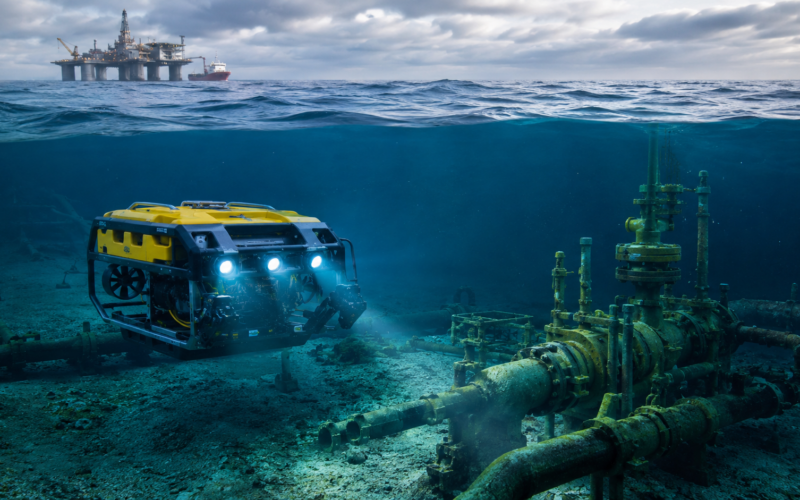
Saipem’s Hydrone-R has accumulated more than 500 days of subsea residency at Equinor’s Njord field in the Norwegian Sea, including a record 240-day continuous stay on the seabed. The all-electric underwater intervention drone has performed hundreds of missions without dedicated support vessels, and during late 2025 it was used for well commissioning work when wave heights reached 12.5 metres and conventional work-class remotely operated vehicle operations were not possible.
That achievement matters for offshore economics for a reason that extends well beyond robot endurance. Inspection, maintenance and intervention below the waterline have traditionally depended on an expensive chain of infrastructure above it, including dynamically positioned vessels, launch-and-recovery systems, offshore ROV pilots, technicians, marine crews and accommodation. If capable machines can remain close to subsea infrastructure and be controlled from shore or execute selected missions autonomously, operators no longer need to mobilise that entire chain for every task.
The shift is already visible beyond Njord. Reach Subsea says its Reach Remote platform had delivered more than 600 remote operational days by May 2026 and was in stable commercial operation across multiple geographies. Reach Remote 1, a 23.9-metre uncrewed surface vessel carrying a work-class electric ROV, subsequently made its first remotely operated port call in the United Kingdom, arriving in Aberdeen after operating in the North Sea for major energy customers.
The emerging commercial question is therefore no longer whether underwater robots can inspect offshore infrastructure. It is how much of the vessel, offshore labour and mobilisation structure surrounding those robots can eventually be removed.
What are resident subsea robots and how do they work in offshore oil and gas?
Traditional work-class remotely operated vehicles, or ROVs, are well-established offshore tools. They are normally connected by an umbilical to a vessel or offshore installation, allowing pilots to control the machine while supplying power, communications and access to cameras, sonar, manipulators and intervention tooling.
Autonomous underwater vehicles, or AUVs, remove the continuous tether and can follow programmed missions independently, making them useful for seabed mapping, pipeline inspection and other survey work. Their traditional limitation is that they still need to be launched, supported and recovered from the surface. Resident subsea systems attempt to remove that dependency by allowing the robot to remain underwater for extended periods and return to a subsea docking station to recharge, transfer data and receive new missions.
Hydrone-R combines ROV and AUV characteristics. Saipem says the system can operate at depths of up to 3,000 metres, has a range exceeding 10 kilometres and provides around 12 hours of battery operation when fully charged. It can perform autonomous inspection missions or be remotely controlled from shore and return to subsea infrastructure for charging and communications.
Its deployment at Njord is particularly significant because it is tied to a commercial service agreement rather than a short demonstration programme. Equinor awarded Saipem the contract in 2019 for an estimated fixed value of about €40 million. The initial term is ten years with five two-year extension options, creating the possibility of another decade of service.
The technology is consequently being tested not simply as equipment but as a different operating model for subsea asset management.

Where are resident subsea robots already being used commercially?
Njord provides one of the clearest examples of long-duration subsea residency moving into actual offshore operations. Equinor has used Hydrone-R for drilling support, production support, monitoring, inspection and selected autonomous activities at around 330 metres water depth. Equinor said after the robot’s earlier 165-day deployment that it had not needed to keep an additional vessel or crew on standby simply to monitor the system.
The operator’s ambitions extend beyond a single field. Equinor says it wants around 10 subsea drones working across the Norwegian Continental Shelf by 2030, although that remains a target rather than an achieved fleet size. The company also estimates that broad implementation of robots and drones across its overall operations could generate more than NOK 1 billion in annual savings. That figure covers robotics more widely and should not be interpreted as a Hydrone-R-specific saving.
Oceaneering International provides another form of subsea residency through its Liberty system. In 2020, a Liberty E-ROV remained at Equinor’s Snorre-A location for extended monitoring, completing 822 hours of monitoring and 110 top-to-bottom trips over 34 days. In 2022, Oceaneering used a resident battery-powered work-class ROV and shore-based personnel for a subsea pipeline isolation operation for Equinor, removing the requirement for the conventional ROV or diving vessel normally associated with that work.
Those deployments matter because they demonstrate that residency is progressing from observation into selected operational tasks. However, they do not mean all subsea maintenance can now be performed without vessels. Heavy construction, major repair campaigns, complex tooling and emergency intervention remain considerably more demanding.
How are offshore robots reducing the need for subsea support vessels?
The strongest challenge to the conventional vessel-led model may currently be taking place at the surface rather than on the seabed.
Reach Remote 1 is an uncrewed surface vessel designed around remotely operated survey and subsea work. The vessel is 23.9 metres long, has minimum endurance of 30 days and carries hull-mounted survey equipment alongside a ZEEROV work-class electric ROV. Its communications architecture includes VSAT, 5G, Iridium, point-to-point systems and Starlink, while vessel control and subsea operations can be conducted from shore.
Reach Subsea received Norwegian permission in October 2025 to operate Reach Remote 1 entirely remotely without an accompanying support vessel. Full flag-state approval for commercial European operations followed in February 2026. The importance of those milestones is that the offshore workers have not simply been moved from one vessel to another. Much of the control structure has moved ashore.
Commercial demand has followed. Equinor, acting on behalf of Gassco, awarded Reach Subsea an external inspection contract covering about 3,500 kilometres of pipeline in Norway and export routes towards Denmark, Germany and the United Kingdom, with options covering additional European countries. The programme combines Reach Remote 1 with a high-speed survey ROV operated from a conventionally crewed vessel where required, an important qualification because the contract itself still uses a mixed operating model.
Equinor then awarded two additional Reach Remote 1 call-offs in March 2026, covering reservoir monitoring at Troll and inspection, maintenance and repair work across multiple subsea assets. Reach Subsea said those awards brought the number of Equinor contracts using Reach Remote 1 to three and were expected to occupy most of the vessel spread’s capacity through the second and third quarters of 2026.
That repeat contracting is more commercially significant than a one-off technology demonstration. It suggests customers are beginning to buy remote operations as a service rather than merely helping qualify an experimental platform.
How much could subsea robotics reduce offshore inspection costs and vessel days?
Publicly available project disclosures rarely provide a clean comparison between the full cost of a conventional offshore campaign and an equivalent robotic operation. That makes broad claims of industry-wide percentage savings difficult to defend.
Reach Subsea has previously estimated that the Reach Remote concept could lower customer costs by 20% to 30% and reduce emissions by 90% to 100% compared with traditional approaches. Those numbers are company estimates and should not be treated as independently validated savings applicable to every project.
More useful evidence comes from the mechanics of the operating model. A 24-metre uncrewed vessel has fundamentally different personnel, accommodation and energy requirements from a large conventional subsea support vessel carrying dozens of people. A resident robot can also remain near an asset between tasks rather than requiring repeated mobilisation from port.
The value becomes especially clear when an inspection is urgent. During poor weather, the economic benefit is not merely the daily charter cost avoided but potentially the production or commissioning delay avoided because a resident machine is already subsea. Saipem’s late-2025 Njord operation during 12.5-metre waves illustrates that distinction: residency can change when an operator is able to act, not just how much the inspection vessel costs.
This also changes maintenance planning. More frequent robotic inspections can create denser asset-condition data, potentially allowing operators to move from calendar-driven inspection towards more condition-based maintenance. The commercial benefit would then extend beyond vessel savings into better scheduling of intervention and reduced exposure to unexpected equipment deterioration, although the size of that benefit will vary by asset and remains difficult to generalise.
How is AI being used in subsea pipeline inspection and offshore robotics?
Artificial intelligence in subsea operations is most valuable when it reduces the amount of human intervention required to navigate, identify an asset or determine what information should be collected.
Oceaneering International’s Freedom AUV illustrates that progression. Freedom entered commercial pipeline operations in September 2023 and is designed to perform close-proximity inspection while collecting high-resolution sensor and camera data. Its COMPASS software processes sonar and computer-vision information onboard to support navigation, touch-free cathodic-protection measurement and hydrocarbon leak detection.
Freedom’s present commercial pipeline proposition should nevertheless be described carefully. Oceaneering markets the system as resident-capable, but its current pipeline inspection service is also explicitly vessel-supported. Residency is therefore a technical capability, not evidence that every commercial Freedom deployment is currently vessel-free.
In a 2024 industrial pilot for TotalEnergies, Freedom autonomously followed subsea pipelines while using laser scanning, multibeam sonar and other sensors to collect external inspection data. Oceaneering reported that the system produced detailed information at significantly higher speed than legacy ROV inspection methods. The TotalEnergies work remains correctly classified as a pilot, however, rather than a wholesale commercial replacement of the operator’s conventional inspection programme.
Oceaneering also says conventional AUV inspection may require two or three passes over the same pipeline to collect data that Freedom is designed to acquire in one. Its onboard software can recognise features such as free spans, burials and crossings and trigger closer inspection activity, potentially reducing the risk that an operator has to mobilise another campaign because an anomaly was discovered only after the first survey ended.
The economic value of AI is therefore less about automating video analysis for its own sake and more about converting sensing into decisions while the vehicle is still underwater.
Why are subsea docking and charging systems critical for resident robots?
A robot cannot become genuinely resident simply because it has a large battery. Long-duration subsea operations require an ecosystem of power, communications, navigation, data transfer and docking infrastructure.
Equinor’s Njord deployment uses a subsea docking station for data transmission and induction charging. Saipem’s Hydrone-R can return to this infrastructure between missions, allowing the vehicle to remain near the asset rather than being repeatedly recovered to the surface.
Oceaneering’s Liberty Resident System demonstrates a different architecture. The company describes Liberty as a self-contained docking system with 550 kWh of battery capacity that can communicate with an Onshore Remote Operations Center through an integrated buoy, rig connection or subsea infrastructure link. It is designed to support continuous operations while reducing reliance on vessel port calls.
This infrastructure layer could become strategically important. If offshore operators eventually want fleets of resident robots rather than one-off proprietary installations, they will need interoperable docking interfaces, reliable subsea electrical supply, communications and software capable of managing multiple machines.
Equinor is already working on standardised subsea docking stations, underwater intervention drones, robotics software, digital mission planning and communications infrastructure. The bigger technology race may consequently shift from who has the best individual robot toward who controls the operating platform connecting robots to offshore assets.
Can autonomous subsea robots perform maintenance and intervention as well as inspection?
Inspection remains the easiest part of the subsea workload to automate because the robot can gather information without physically changing the asset. Intervention requires contact, tooling, force control and much greater certainty about what the machine is doing around high-value infrastructure.
Oceaneering’s 2022 pipeline-isolation project demonstrates that remote resident systems can move beyond passive inspection. Working with Equinor and T.D. Williamson, the company used its battery-powered resident work-class ROV to support subsea pipeline isolation from shore. Oceaneering described it as the first use of a resident battery-powered work-class ROV system for such remotely executed isolation activities.
Saipem’s Hydrone family similarly separates different robotic roles. Hydrone-R supports autonomous inspection and lighter operations, while Hydrone-W is an electric work-class ROV designed for more demanding subsea work. That division itself shows why a single autonomous vehicle is unlikely to replace every conventional ROV task.
Saipem’s FlatFish system sits further along the autonomy path but remains in qualification. In March 2026, FlatFish completed functional acceptance testing for Petrobras in a controlled environment in Trieste, demonstrating autonomous structure and pipeline inspection, cathodic-protection measurement and wall-thickness assessment. Petrobras approved progression to a final phase intended to implement the technology in a real ultra-deepwater environment in Brazil.
That distinction is important. FlatFish has demonstrated autonomous functionality and is progressing towards offshore deployment, but it should not yet be described as an established Petrobras commercial fleet.
What are the biggest barriers to autonomous offshore and subsea operations?
Reliability becomes more important as vessel dependence falls. A conventional offshore team can investigate an unexpected problem locally. A resident system may instead require robust fault detection, redundancy and the ability to recover from errors remotely or autonomously.
Communications are another constraint. Surface-based remote vessels such as Reach Remote can use several satellite and terrestrial systems for redundancy, but underwater vehicles cannot rely on ordinary broadband radio links through seawater. Resident systems therefore depend on combinations of subsea infrastructure, acoustic communications, tethered connections, surface buoys and local autonomy.
Cybersecurity also becomes part of operational safety when vessel manoeuvring, robotic control and subsea intervention are connected to remote operations centres. The objective is not simply to keep hackers away from information systems. Operators must protect systems that can physically move vessels and machinery around offshore infrastructure.
Regulation is beginning to catch up. The International Maritime Organization adopted its first non-mandatory Maritime Autonomous Surface Ships Code in May 2026, and the MASS Code took effect on July 1, 2026. It provides a global framework for autonomous and remotely controlled cargo-ship operations while allowing governments and industry to build experience before a mandatory regime is developed.
DNV has also developed Autonomous and Remotely Operated Ships class notations covering onboard functions, remote operating centres and the connectivity required for remote vessel operations. Reach Remote 1’s certification process shows how robotics companies now need to prove not only that the hardware functions, but that the entire remote operating system reaches an acceptable safety standard.
Will subsea robots eventually replace offshore support vessels?
The evidence so far argues against a simple replacement story.
Large construction vessels will still be required for installing equipment, lifting heavy structures, laying pipelines and performing complex intervention. Conventional work-class ROV spreads will also remain important where high power, heavy tooling or immediate human support is necessary.
The disruption is more selective. Resident robots can attack routine inspection and monitoring. Autonomous vehicles can increase the speed and frequency of pipeline surveys. Uncrewed surface vessels can remove offshore personnel and reduce the size of the surface platform supporting an ROV. Remote operations centres can shift expertise ashore, while subsea docking stations can remove repeated launch and recovery from the operating cycle.
That combination changes where economic value sits. Offshore contractors with large conventional vessel fleets may face pressure in work categories where vessel days cease to be mandatory. At the same time, companies controlling robotics, electric ROVs, autonomous navigation, docking systems, sensors, remote operations and subsea data could capture a larger share of inspection and maintenance spending. Saipem, Oceaneering International and Reach Subsea illustrate how traditional offshore service businesses themselves are trying to lead that transition rather than simply be disrupted by it.
The most important indication of maturity is increasingly repeat use rather than technical spectacle. Hydrone-R is operating under a long-term service contract and has spent hundreds of days resident subsea. Reach Remote 1 has moved through qualification into multiple commercial contracts and more than 600 remote operational days. Freedom is conducting commercial pipeline operations, although still commonly vessel-supported, while FlatFish remains one step earlier in the maturity curve as it progresses towards its first real ultra-deepwater Petrobras implementation.
Offshore robotics is therefore not eliminating vessels. It is starting to make the industry justify every vessel day.
For asset owners, that could ultimately be the more consequential disruption.
Discover more from Business-News-Today.com
Subscribe to get the latest posts sent to your email.