
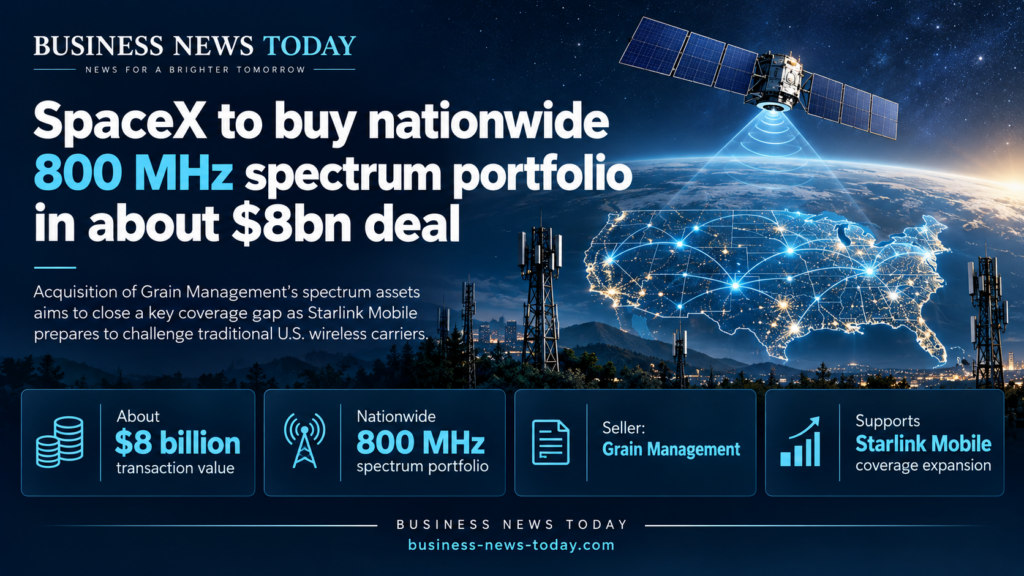
Space Exploration Technologies Corp. (NASDAQ: SPCX) has agreed to acquire Grain Management’s nationwide portfolio of low-band 800 MHz wireless spectrum in a transaction valued at approximately $8 billion, giving Starlink Mobile a critical terrestrial asset it needs to compete more directly with established United States telecom operators. The portfolio includes up to 14 megahertz of paired spectrum with nationwide reach and is designed to complement SpaceX’s existing satellite and 2 GHz mobile spectrum holdings. The strategic significance is unusually large for a spectrum acquisition because low-band frequencies can travel long distances and penetrate buildings more effectively than the higher-frequency spectrum that underpins much of satellite-to-phone connectivity. The market recognised that competitive threat immediately, sending AT&T Inc. (NYSE: T), Verizon Communications Inc. (NYSE: VZ) and T-Mobile US, Inc. (NASDAQ: TMUS) sharply lower in extended trading while SpaceX shares rebounded after the announcement.
The transaction is subject to final Federal Communications Commission approval and expands a spectrum strategy that has already made SpaceX one of the most aggressive buyers of wireless frequencies in the United States. SpaceX previously agreed to acquire 65 megahertz of spectrum from EchoStar through transactions worth $19.6 billion, while the latest 800 MHz purchase gives Starlink Mobile a coverage layer suited to conventional terrestrial wireless architecture as well as direct-to-device connectivity. SpaceX did not disclose the purchase consideration in its own announcement, although the transaction has been valued at approximately $8 billion.
This is not simply another satellite broadband acquisition. SpaceX is assembling spectrum, satellites and terrestrial network capability in a way that increasingly resembles the architecture of a national mobile carrier, raising the possibility that Starlink Mobile evolves from a service designed primarily to fill cellular dead zones into a direct competitor for mainstream wireless subscribers.
Why does SpaceX need Grain Management’s 800 MHz spectrum to turn Starlink Mobile into a national carrier?
The technical value of low-band spectrum explains why the transaction matters more than its 14-megahertz headline capacity might suggest. Starlink Mobile already has access to mid-band frequencies capable of delivering comparatively high data capacity, but satellite signals face physical limitations when customers move indoors or behind obstacles. The newly acquired 800 MHz spectrum provides a stronger coverage layer because lower frequencies generally travel farther and penetrate walls, foliage and other obstructions more effectively.
That changes Starlink Mobile’s potential service proposition. A network capable of reaching a user outdoors through satellite coverage but losing reliability inside buildings would remain complementary to conventional cellular networks. Combining satellite connectivity with terrestrial 800 MHz deployment gives SpaceX a pathway toward providing more continuous service across rural areas, suburbs and indoor environments.
The portfolio also benefits from widespread handset compatibility. The 800 MHz band is already supported by many conventional mobile devices, reducing the need for consumers to purchase specialist satellite phones if SpaceX can integrate the frequencies into its network effectively. That matters commercially because the largest barrier to mass-market satellite mobile adoption is not only network capability but friction for the consumer.
SpaceX therefore appears to be designing Starlink Mobile around ordinary smartphones rather than a niche satellite communications market. If execution matches that ambition, the competitive comparison moves away from legacy satellite operators and increasingly toward Verizon Communications Inc., AT&T Inc. and T-Mobile US, Inc.
How does the $8 billion Grain Management deal fit SpaceX’s much larger spectrum acquisition strategy?
The Grain Management purchase is the latest stage in a rapid accumulation of spectrum assets rather than an isolated transaction. SpaceX has already committed billions of dollars to frequencies acquired from EchoStar, giving the company substantial direct-to-device capacity and reducing dependence on spectrum borrowed through partnerships with terrestrial carriers.
That progression matters strategically. SpaceX originally entered direct-to-cellular services largely through partnerships, including its relationship with T-Mobile US, Inc., where satellite capability could extend coverage beyond the carrier’s terrestrial footprint. Owning more spectrum allows SpaceX to control a larger share of the network economics and potentially compete for subscribers directly rather than remaining primarily an infrastructure partner.
The latest frequencies have an unusual history. The Federal Communications Commission approved an exchange in July under which T-Mobile US, Inc. transferred certain 800 MHz licenses to Grain Management while receiving 600 MHz spectrum in return. The regulator attached buildout requirements and incentives intended to encourage intensive terrestrial use and partnerships supporting direct-to-device services.
SpaceX is now acquiring those 800 MHz licenses from Grain Management. In strategic terms, spectrum that recently sat within the orbit of T-Mobile US, Inc. is moving into the hands of a company openly preparing to challenge the traditional carrier model, illustrating how rapidly competitive boundaries between satellite operators and telecom companies are changing.
Why did AT&T, Verizon and T-Mobile shares fall about 6% after the SpaceX spectrum acquisition?
The stock-market reaction reflects concern about future competitive economics rather than an immediate loss of customers. AT&T Inc. closed the regular October 8 session at $24.87 before dropping to roughly $23.24 in overnight trading, a decline of about 6.6%. Verizon Communications Inc. had closed at $46.35 before falling to approximately $43.71, while T-Mobile US, Inc. moved from a $171.31 regular-session close to around $161 in extended trading.
Those moves effectively erased gains recorded earlier in the regular session. T-Mobile US, Inc. had risen 5.9% across the five sessions through October 8, while AT&T Inc. had gained about 2.4%. Verizon Communications Inc. had been approximately flat over the same period and was already down about 8% over the previous month.
The sharp after-hours repricing indicates that investors interpreted the transaction as a change in competitive probability. SpaceX has discussed ambitions in mobile connectivity before, but spectrum capable of supporting a terrestrial coverage layer moves the strategy closer to something that can compete with conventional networks rather than merely supplement them.
The reaction should nevertheless be kept in perspective. T-Mobile US, Inc., AT&T Inc. and Verizon Communications Inc. operate enormous networks, possess national distribution systems, control extensive spectrum portfolios and serve hundreds of millions of connections collectively. SpaceX acquiring frequencies does not instantly recreate decades of terrestrial network investment.
What changed on October 8 is the credibility of the threat. Investors are no longer assessing whether SpaceX might eventually enter traditional wireless. They are increasingly assessing how much capital, infrastructure and time the company would require to become a meaningful fourth national competitor.
Why did SpaceX stock rebound after hours despite falling 4.2% during the regular trading session?
Space Exploration Technologies Corp. shares closed October 8 at $160.57, down 4.2% during regular trading amid broader weakness across technology and growth stocks. The shares then rose more than 3% in extended trading after the spectrum acquisition became public, reversing a meaningful portion of the session decline.
The stock had already gained approximately 8.4% across the previous five trading sessions and was about 4.6% higher over one month despite considerable volatility. Its 52-week trading range extends from $104.83 to $225.64, illustrating how aggressively investors continue to debate the appropriate valuation for a company simultaneously funding launch systems, Starlink, satellite-to-device connectivity and other capital-intensive programmes.
The positive transaction reaction suggests investors see strategic value in owning spectrum rather than relying indefinitely on carrier partnerships. Spectrum is scarce, regulated and difficult to replicate, which means buying licenses can create a durable barrier to entry in a way that simply launching additional satellites cannot.
There is a balance-sheet question attached to that strategy. SpaceX has already committed very substantial capital to spectrum, satellite manufacturing, launches and network expansion, while its ambitions in artificial intelligence infrastructure add another significant call on funding. The strategic logic of vertical integration is strong, but each additional layer raises the amount of capital required before Starlink Mobile reaches nationwide commercial scale.
Could Starlink Mobile genuinely compete with Verizon, AT&T and T-Mobile for mainstream subscribers?
The answer depends on how SpaceX chooses to deploy the acquired spectrum. The company has indicated that Starlink Mobile will combine its satellite-to-mobile constellation with terrestrial infrastructure rather than attempting to serve every user directly from orbit. That hybrid model is important because satellites and towers solve different network problems.
Satellite coverage is particularly strong where terrestrial infrastructure is economically unattractive, including remote highways, rural communities, wilderness areas and disaster zones. Conventional towers remain more efficient for dense urban environments where thousands of users may demand large amounts of capacity within a small geographic area.
A hybrid Starlink Mobile network could therefore combine broad satellite coverage with terrestrial low-band frequencies where buildings, congestion or indoor use make space-based connectivity less effective. SpaceX could then add higher-frequency capacity selectively in areas with greater demand.
That architecture could lower the cost of constructing a fourth national network because SpaceX would not necessarily need to match every existing carrier tower for tower. It would still require substantial terrestrial infrastructure, backhaul, retail support, customer service and regulatory compliance, however, making the transition from technical capability to a national consumer telecom business far from automatic.
The biggest advantage may be SpaceX’s ability to design the terrestrial and satellite networks as one system from the beginning. Incumbent carriers are generally adding satellite capability onto networks originally engineered around towers, while SpaceX can potentially optimise both layers around a single architecture.
Why could the SpaceX spectrum deal unexpectedly benefit American Tower, Crown Castle and other tower operators?
One of the more interesting second-order consequences is that a company positioning itself as a satellite disruptor may ultimately become a major customer of terrestrial tower infrastructure. Building nationwide 800 MHz coverage requires physical antennas and network equipment, even if satellites handle part of the traffic.
Constructing an entirely independent portfolio of tens of thousands of tower sites would be expensive, slow and complicated by local planning restrictions. Leasing space from existing tower operators would allow SpaceX to deploy more rapidly while avoiding much of the upfront cost associated with acquiring land and building structures.
That explains why tower stocks strengthened as traditional carriers sold off following the announcement. The market is effectively considering whether SpaceX could become another large tenant for infrastructure providers even as it becomes a competitive threat to the wireless operators that already account for much of tower-company revenue.
The distinction matters for telecom-sector capital allocation. Starlink Mobile may reduce the economic value of some incumbent carrier market share while simultaneously increasing overall demand for network infrastructure. Disruption rarely destroys every layer of an industry at once. Sometimes it simply moves the toll booth.
How does Federal Communications Commission policy strengthen SpaceX’s direct-to-device strategy?
The regulatory environment is becoming increasingly supportive of direct-to-device connectivity. The Federal Communications Commission has authorised SpaceX to deploy an additional 7,500 second-generation Starlink satellites, bringing the authorised Gen2 constellation to 15,000 satellites, while allowing expanded technical capabilities intended to support broadband and mobile coverage.
The regulator has also been developing frameworks that make it easier for satellite systems and terrestrial spectrum to coexist. Direct-to-device services have shifted from experimental emergency connectivity toward an emerging commercial market, and regulators increasingly view satellite integration as a potential mechanism for closing coverage gaps.
That does not mean the Grain Management transaction is assured. The spectrum transfer still requires final approval, and the Federal Communications Commission will examine ownership, competition, technical conditions and compliance with existing license obligations.
Regulatory scrutiny could become more important as SpaceX accumulates more frequencies. A company combining one of the world’s largest satellite constellations with substantial terrestrial spectrum raises competition questions in both the space and telecom markets, particularly if continued acquisitions make spectrum access harder for emerging direct-to-device competitors.
What does the SpaceX acquisition mean for AST SpaceMobile and other satellite-to-phone challengers?
The competitive consequences extend beyond traditional carriers. AST SpaceMobile and other satellite communications companies are pursuing direct-to-device strategies that depend on access to spectrum through ownership, leases or partnerships with mobile operators.
SpaceX’s financial capacity gives it an important advantage in a market where suitable frequencies are scarce. Buying spectrum outright reduces dependence on counterparties and allows the company to determine how frequencies are integrated across terrestrial and satellite systems.
AST SpaceMobile shares weakened after the transaction because Grain Management’s 800 MHz portfolio had been viewed as strategically relevant to the broader satellite-to-device market. SpaceX securing the assets reduces the number of obvious nationwide spectrum opportunities available to competing platforms.
The counterweight is that traditional telecom operators have powerful incentives to support alternatives to SpaceX. If Starlink Mobile increasingly competes for retail subscribers, Verizon Communications Inc., AT&T Inc. and other carriers may become more motivated to deepen relationships with rival satellite providers rather than allow one space operator to dominate direct-to-device connectivity.
Competition could therefore evolve into two overlapping battles: SpaceX against established wireless carriers for subscribers, and SpaceX against other satellite operators for the spectrum and partnerships required to reach those subscribers.
How much execution and capital risk remains before Starlink Mobile can disrupt the US wireless market?
Spectrum ownership solves only part of the problem. Building a national wireless service requires network equipment, towers or leased tower capacity, fibre and backhaul, billing systems, customer support, handset certification, retail distribution and sophisticated network management.
SpaceX has advantages in several of these areas because Starlink already serves millions of broadband customers and operates a large global communications network. It also controls launch capability, satellite manufacturing and orbital infrastructure internally, reducing dependence on suppliers that would constrain a conventional new entrant.
The terrestrial buildout remains expensive. Even using existing tower infrastructure rather than constructing sites from scratch could require tens of billions of dollars over time, particularly if SpaceX wants enough capacity to compete for high-usage urban subscribers rather than limiting Starlink Mobile to coverage-led propositions.
The economics will depend on whether the company can reuse Starlink infrastructure across multiple services. If satellites, ground stations, customer systems and terrestrial spectrum support broadband, mobile connectivity, enterprise communications and government contracts simultaneously, SpaceX may be able to spread investment across a larger revenue base than a conventional wireless entrant.
That is the strategic advantage investors are now trying to price. SpaceX is not entering telecom with a blank sheet of paper. It is adding terrestrial spectrum to an already enormous communications platform.
What happens next if SpaceX successfully integrates 800 MHz spectrum with Starlink Mobile?
The immediate milestone is Federal Communications Commission approval of the license transfer. Once secured, attention will turn to how rapidly SpaceX begins terrestrial deployment and whether it leases existing tower infrastructure, builds selected sites independently or uses a combination of both.
Commercial positioning will be equally important. SpaceX could initially use Starlink Mobile as an additional service bundled with Starlink broadband, target areas where existing carrier coverage remains weak or launch more directly against conventional national wireless plans.
Pricing will determine how disruptive the service becomes. A premium satellite-enhanced mobile service would compete primarily on coverage and resilience, while aggressive consumer pricing could force Verizon Communications Inc., AT&T Inc. and T-Mobile US, Inc. to respond through lower prices, greater satellite integration or larger network investment.
The broader strategic implication is that the dividing line between satellite communications and terrestrial telecom is disappearing. Spectrum, satellites and towers are increasingly becoming layers of the same connectivity architecture rather than separate industries.
SpaceX’s approximately $8 billion acquisition of Grain Management’s frequencies is therefore important not because 14 megahertz suddenly makes Starlink Mobile equivalent to an incumbent carrier. It matters because the deal removes one of the clearest technical obstacles preventing SpaceX from attempting to become one.
Key takeaways on what SpaceX’s spectrum acquisition means for Starlink Mobile and US telecom competition
- SpaceX is moving beyond supplemental satellite coverage: The 800 MHz portfolio gives Starlink Mobile a terrestrial coverage layer that could support a genuine national wireless strategy rather than remaining primarily a dead-zone solution.
- The roughly $8 billion valuation reflects spectrum scarcity: Nationwide low-band frequencies are difficult to replicate, making ownership strategically more valuable than simply purchasing additional network equipment.
- AT&T, Verizon and T-Mobile face a more credible competitive threat: Their roughly 6% extended-session declines show investors are beginning to price Starlink Mobile as a potential retail competitor rather than only a satellite partner.
- SpaceX’s spectrum strategy is becoming vertically integrated: The company now controls increasingly important pieces across satellites, launch infrastructure, spectrum and customer connectivity.
- The Grain portfolio solves an important indoor-coverage weakness: 800 MHz frequencies can travel farther and penetrate buildings more effectively than the mid-band spectrum central to SpaceX’s existing mobile strategy.
- Traditional telecom infrastructure could still benefit: A Starlink terrestrial rollout may require substantial tower leasing, potentially creating additional demand for companies such as American Tower and Crown Castle.
- Federal Communications Commission policy is accelerating direct-to-device competition: Expanded satellite authorisations and evolving spectrum rules are making hybrid terrestrial and space networks commercially more realistic.
- AST SpaceMobile and other satellite challengers face greater spectrum pressure: SpaceX’s financial capacity allows it to acquire scarce frequencies outright while competitors remain more dependent on partnerships and leases.
- Capital intensity remains the largest constraint: Spectrum is only one component of a national mobile network, and terrestrial deployment could still require tens of billions of dollars before Starlink can challenge incumbents at scale.
- The strategic endgame is convergence: The transaction reinforces a future in which satellite operators and terrestrial carriers increasingly compete within the same mobile communications market rather than occupying separate industries.
Discover more from Business-News-Today.com
Subscribe to get the latest posts sent to your email.