




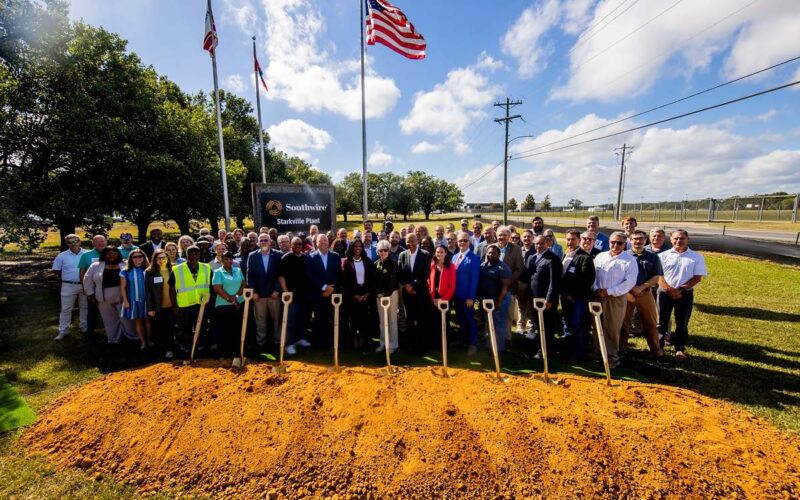
Southwire has broken ground on a more than $256 million expansion of its Starkville, Mississippi manufacturing operations, moving one of the largest investments in the site’s history from planning toward construction. The privately held wire and cable manufacturer plans to add approximately 380,000 square feet to the Starkville footprint, install new manufacturing machinery and related equipment, and create 128 jobs, a figure the company rounded to approximately 130 in its latest groundbreaking update. Construction is expected to proceed during late 2026, with the expanded operations targeted to reach full capacity in 2028. The project is part of Southwire’s broader commitment of more than $2 billion to modernize its manufacturing network, making Starkville one component of a much larger effort to position production capacity for future electrical infrastructure demand.
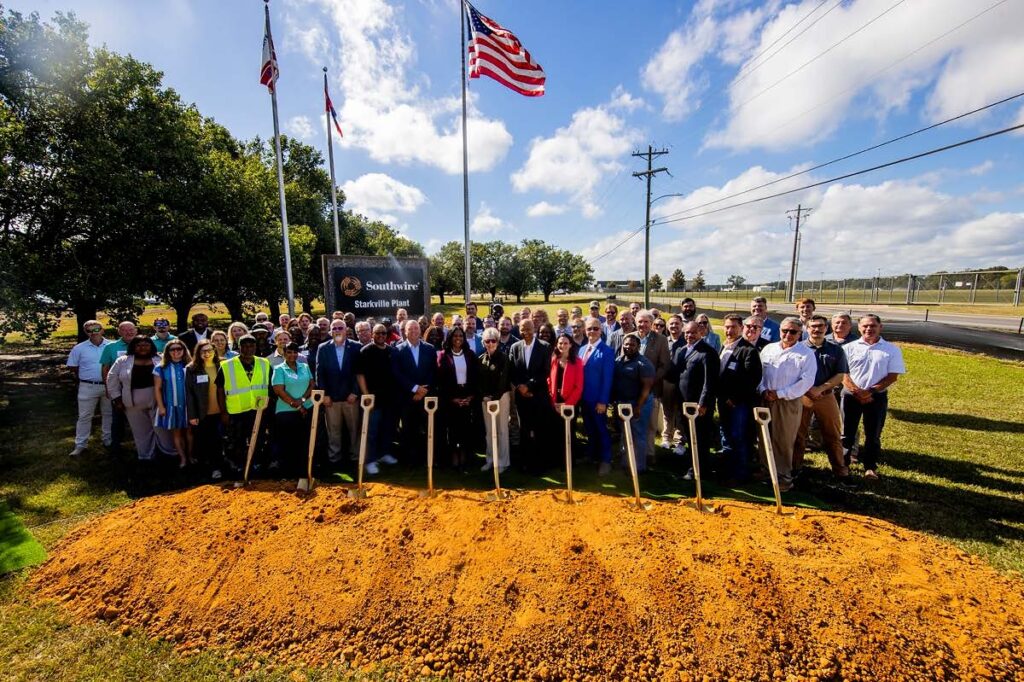
Southwire held the groundbreaking on October 1, bringing together company representatives and members of the Starkville community after formally announcing the project in August. Executive Vice President of Operations Veronica Braker said the investment is intended to improve safety, efficiency and manufacturing capability while strengthening Southwire’s ability to serve customers across its markets. Plant Manager Erik Adams similarly linked the project to both operational growth and new employment opportunities. The larger strategic question is how quickly Southwire can translate that additional physical capacity into productive output as demand grows across utility, construction, industrial, electrification and increasingly power-intensive digital infrastructure markets.
Why is Southwire investing more than $256 million in its Starkville manufacturing operations?
The scale of the Starkville project suggests Southwire is preparing the facility for considerably more than routine maintenance or incremental debottlenecking. Approximately 380,000 square feet of additional space, combined with new manufacturing machinery and supporting equipment, represents a substantial increase in the physical capability of a site that has operated for decades. Mississippi Development Authority said the new equipment will help Southwire respond to growing market demand, while Southwire has framed the investment as part of its wider manufacturing modernization strategy.
Southwire has not disclosed the exact incremental production capacity, product volumes or revenue potential associated with the Starkville expansion. That limits any attempt to convert the $256 million investment directly into future sales or earnings. The available disclosures instead point to three immediate objectives: increasing operational capacity, improving efficiency and quality, and creating a plant capable of supporting customer requirements over a longer planning horizon.
The timing also reflects a broader shift in North American electrical infrastructure. Southwire serves utility, residential and commercial construction, industrial, electric vehicle charging and data center markets, all of which require significant quantities of electrical wire, cable and associated products. Grid modernization, new generation capacity, construction activity and rapidly expanding electricity demand from data centers create reasons for manufacturers to evaluate whether existing factories can support the next stage of demand.
Southwire has not specifically attributed the Starkville expansion to any one customer segment, so the project should not be characterized as a dedicated data center, utility or artificial intelligence capacity investment. Its significance comes from increasing manufacturing flexibility across a company whose products sit upstream of several infrastructure investment cycles.
How does the Starkville project fit into Southwire’s more than $2 billion modernization strategy?
The Starkville investment becomes more consequential when viewed as part of Southwire’s companywide capital program. The company says it has committed more than $2 billion to modernization initiatives across its footprint, meaning the Mississippi project represents more than 12% of that stated investment commitment if compared directly with the $2 billion threshold.
Southwire’s modernization strategy involves more than simply increasing building area. Newer manufacturing equipment can potentially improve throughput, reduce material handling, enhance quality control, improve worker safety and make plants more responsive to changing product requirements. At a wire and cable manufacturer operating at substantial scale, improvements in production efficiency can have meaningful effects because copper, aluminum, polymers, energy and logistics all contribute to manufacturing costs.
Starkville is particularly suited to modernization because Southwire is building on an established production and distribution base rather than creating an entirely new industrial footprint. The plant was originally opened by Phelps-Dodge in 1979 and acquired by Southwire in 1989. Southwire expanded the campus in 2010 by adding an onsite distribution center, and the latest investment marks the second major expansion under its ownership.
That operating history reduces some development uncertainty compared with a greenfield project. Southwire already has a workforce, local supplier relationships, distribution infrastructure and decades of operating experience at the site. The company still faces construction, equipment-installation and ramp-up risk, but it is expanding a functioning manufacturing platform rather than establishing one from scratch.
What does the 380,000-square-foot expansion mean for production capacity and customer service?
Southwire has not disclosed the current square footage of the entire Starkville campus or the percentage increase represented by the additional 380,000 square feet. It has also not published a production-volume target for the completed investment. Those missing figures mean physical expansion should not automatically be translated into a proportional increase in manufacturing output.
The new area nevertheless gives Southwire room to reorganize production and install machinery that would be difficult to accommodate within the existing footprint. Factory modernization can increase capacity through several mechanisms, including additional production lines, higher-speed equipment, better internal logistics and reduced bottlenecks between manufacturing and distribution. Southwire has specifically said the project is intended to improve efficiency, safety and quality while strengthening customer service.
The onsite distribution infrastructure created during the 2010 expansion could also become more valuable if manufacturing output rises. Integrating production and distribution at the same campus can shorten internal handling requirements and provide greater flexibility in moving finished products into Southwire’s broader supply network. The commercial benefit will depend on utilization, because additional factory capacity produces attractive returns only when customer demand is sufficient to absorb the output.
Full capacity is expected in 2028, leaving Southwire with a multi-year construction, equipment installation and ramp-up period. That timetable suggests the company is investing against medium-term demand rather than responding solely to a temporary increase in orders.
Why could rising power and data center investment support demand for Southwire’s cable products?
Electricity infrastructure is becoming a larger constraint across parts of the United States as utilities respond to load growth, generation additions, manufacturing investment and increasingly energy-intensive data center development. New facilities require utility connections, substations, distribution infrastructure, electrical systems and large quantities of cable before they can operate. Upgrades to existing grids can create additional requirements for transmission and distribution products.
Southwire already identifies utilities and data centers among its target markets, alongside residential and commercial construction, electric vehicle charging and other electrical applications. A diversified customer base can help manufacturing investments serve multiple demand drivers rather than depending entirely on one end market.
Data center construction is particularly relevant because the physical infrastructure behind artificial intelligence extends well beyond semiconductors and servers. Large campuses require substantial electrical distribution systems, backup power, cooling infrastructure and connections to regional grids. Manufacturers supplying the electrical components behind those facilities can therefore participate indirectly in artificial intelligence infrastructure investment without producing computing hardware themselves.
Southwire has not disclosed whether any Starkville output has been contracted specifically for data center projects, and the expansion should not be presented as an AI-focused plant. The broader implication is that electrical infrastructure intensity is increasing across several markets simultaneously, creating a potentially supportive environment for manufacturers with sufficient production capacity and customer relationships.
How important are the 128 new jobs and Mississippi incentives to the project economics?
The Mississippi Development Authority says the expansion is expected to create 128 jobs, while Southwire’s groundbreaking announcement described the employment impact as approximately 130 new positions. The difference reflects rounding rather than a change in the underlying project plan.
The Mississippi Development Authority is supporting the expansion through the Mississippi Flexible Tax Incentive, known as MFLEX, while the City of Starkville and Oktibbeha County are also providing assistance. Public disclosures reviewed for the project do not specify the total dollar value of those incentives, so they cannot be reliably deducted from Southwire’s stated corporate investment or used to calculate a net private capital commitment.
The employment impact is meaningful for Starkville because manufacturing projects can generate indirect economic activity through contractors, logistics providers, maintenance services and employee spending. Starkville officials have described the expansion as the largest single economic development project undertaken in the city, placing Southwire’s investment well beyond a routine plant upgrade in local economic terms.
For Southwire, the workforce component creates a parallel execution challenge. Expanding a highly automated manufacturing facility still requires qualified operators, technicians, engineers, maintenance personnel and supervisors. Hiring and training must therefore progress alongside construction and equipment commissioning if the company is to reach its targeted 2028 operating capacity.
What could determine whether Southwire earns an attractive return on the Starkville investment?
The investment case for a manufacturing project of this size ultimately depends on utilization and operating efficiency. A modernized plant can offer better productivity and higher capacity, but the return on more than $256 million of capital will depend on customer demand, manufacturing yields, commodity-cost management and the pace at which the new equipment reaches efficient production.
Copper is particularly relevant to Southwire’s business because it is a major raw material for electrical conductors. Higher copper prices can increase working-capital requirements and the nominal value of sales even when underlying unit volumes change more modestly. Southwire therefore benefits from efficient material management and pricing mechanisms that allow commodity movements to be reflected appropriately in customer economics.
Construction performance is another measurable variable. The company expects construction activity in late 2026 and full capacity during 2028, leaving significant work between the ceremonial groundbreaking and commercial completion. Delays in building, equipment installation or commissioning could push revenue benefits further into the future, while a smooth ramp could allow the new facility to participate in expected infrastructure demand as it develops.
Southwire’s private ownership means investors do not receive the quarterly disclosures that would make the project’s financial return easier to track. Future company updates on construction progress, equipment commissioning, employment and the start of expanded production will therefore provide the clearest external indicators of execution.
What does Southwire’s Starkville expansion signal about US electrical manufacturing investment?
Southwire’s decision to commit more than a quarter of a billion dollars to an existing Mississippi factory shows that electrical infrastructure investment is creating capital requirements well upstream of utilities and construction projects. Generators, data centers, manufacturing plants and grid upgrades cannot be built without substantial quantities of electrical equipment, creating demand for the companies that manufacture the physical components connecting those assets.
The Starkville project also illustrates why established industrial sites can attract repeated reinvestment. Southwire has operated the facility since acquiring it in 1989, expanded distribution capacity in 2010 and is now preparing another major enlargement. Existing workforce knowledge and infrastructure can make such sites suitable platforms for large capital programs when demand justifies expansion.
Southwire’s $256 million commitment does not guarantee that every anticipated end market will grow at the pace currently expected. It does, however, represent a tangible capital-allocation decision backed by new floor space, manufacturing equipment and a multi-year operating plan rather than a preliminary concept.
The next measurable milestones are now construction progress, installation of the new production equipment and the transition toward full capacity in 2028. If Southwire can complete the project on schedule and fill the expanded plant with sufficient customer demand, Starkville could become a larger component of the company’s North American manufacturing network and a practical example of how electrification-led infrastructure investment is flowing into US industrial capacity.
What are the key takeaways from Southwire’s $256 million Starkville expansion?
- Southwire held a groundbreaking on October 1, 2026 for the expansion of its Starkville, Mississippi manufacturing operations.
- The project represents a corporate investment of more than $256 million.
- Southwire plans to add approximately 380,000 square feet to the Starkville site.
- Mississippi Development Authority says the expansion will create 128 jobs, which Southwire subsequently described as approximately 130 positions.
- The project includes new manufacturing machinery and related equipment intended to support growing demand.
- Construction is expected to progress during late 2026, with full capacity targeted for 2028.
- The investment forms part of Southwire’s companywide modernization commitment exceeding $2 billion.
- Southwire acquired the Starkville plant in 1989 after the facility originally opened under Phelps-Dodge in 1979.
- Mississippi is supporting the project through its MFLEX incentive program, with additional local assistance from Starkville and Oktibbeha County.
- Construction progress, equipment commissioning and capacity utilization will determine how effectively Southwire converts the investment into higher manufacturing output.
Discover more from Business-News-Today.com
Subscribe to get the latest posts sent to your email.


