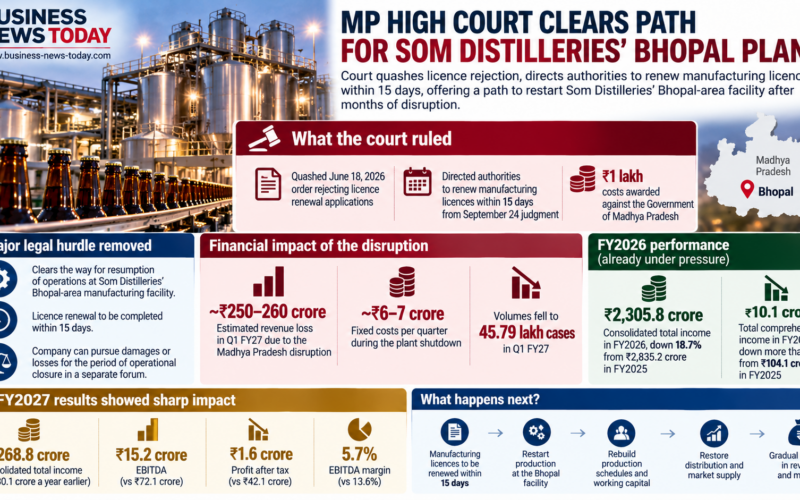
Som Distilleries and Breweries Limited (NSE: SDBL), the Indian beer and spirits manufacturer, has received a Madhya Pradesh High Court judgment that could clear the way for resumption of operations at its Bhopal-area manufacturing facility after months of licence-related disruption. The court quashed a June 18, 2026 order rejecting the company’s applications for renewal of its excise licences and directed the relevant authorities to renew the manufacturing licences within 15 days from the September 24 judgment. Som Distilleries and Breweries Limited said the ruling represents an important step toward restoring normal operations in Madhya Pradesh, a market whose disruption materially damaged its recent financial performance. The immediate commercial question is no longer simply whether the company can regain its licences, but how quickly renewed licences translate into production, distribution recovery and restoration of revenue lost during the shutdown.
The court also awarded ₹1 lakh in costs payable by the Government of Madhya Pradesh and preserved the company’s right to pursue damages or losses associated with the period of operational closure before an appropriate forum. Som Distilleries and Breweries Limited described the judgment as validating its position during the dispute, although any potential damages should be treated separately from the operational value of the licence-renewal order because no damages recovery has yet been realised. The company said it would work with the relevant authorities to complete the renewal process within the court-directed timeframe and restore normal operations at the Bhopal plant.
Why does the Madhya Pradesh High Court ruling matter so much for Som Distilleries’ Bhopal plant?
The importance of the judgment becomes clearer when the length and financial cost of the disruption are considered. Som Distilleries and Breweries Limited first disclosed in February that the Madhya Pradesh Excise Department had suspended the manufacturing licence connected with its Rojrachak facility in Raisen district, triggering a temporary cessation of production. The company contested the regulatory action through the courts, while the operating consequences increasingly became visible in subsequent earnings.
By the first quarter of fiscal 2027, management estimated that the Madhya Pradesh disruption had cost roughly ₹250 crore to ₹260 crore in revenue during the quarter alone. The idle operation was also carrying approximately ₹6 crore to ₹7 crore of fixed costs per quarter, while consolidated volumes fell to 45.79 lakh cases. That combination meant the licence issue was no longer simply a legal overhang or governance matter; it had become one of the most important variables affecting Som Distilleries and Breweries Limited’s income statement.
The latest judgment therefore removes a major legal obstacle to restarting the facility, but it should not yet be confused with a fully normalised operating position. The exchange disclosure says the authorities have been directed to renew the relevant manufacturing licences within 15 days, meaning licence issuance and the subsequent physical restart remain measurable steps still to be completed. After that, Som Distilleries and Breweries Limited must rebuild production schedules, working-capital flows and market supply sufficiently quickly for the restored capacity to influence revenue and margins.

How badly did the Bhopal licence disruption affect Som Distilleries’ recent earnings?
Som Distilleries and Breweries Limited entered fiscal 2027 from an already weakened earnings base. The company’s fiscal 2026 consolidated total income was approximately ₹2,305.8 crore, down from about ₹2,835.2 crore in fiscal 2025, while total comprehensive income attributable to the year fell to roughly ₹10.1 crore from ₹104.1 crore. Those figures imply declines of about 18.7% in consolidated total income and more than 90% in total comprehensive income, demonstrating that operating leverage had already moved sharply against the company before the first-quarter disruption was fully reflected.
The deterioration became still more pronounced in the June 2026 quarter. Som Distilleries and Breweries Limited reported consolidated total income of ₹268.8 crore, compared with ₹530.1 crore a year earlier, while EBITDA fell to about ₹15.2 crore from ₹72.1 crore. Profit after tax dropped to approximately ₹1.6 crore from ₹42.1 crore, and the EBITDA margin contracted to roughly 5.7% from 13.6%. Management connected much of that pressure to the inability to operate normally in Madhya Pradesh, alongside input-cost pressure and reduced operating leverage.
Those numbers explain why the High Court order carries more economic significance than the ₹1 lakh cost award or the potential damages claim. A successful restart could remove continuing idle-plant costs, bring lost Madhya Pradesh sales back into the revenue mix and allow the group to spread fixed costs across a larger production base. The financial benefit, however, will depend on how quickly volume returns rather than simply on the legal restoration of the licence.
Can renewed Madhya Pradesh production change Som Distilleries’ fiscal 2027 revenue trajectory?
Management had already adjusted expectations to reflect the disruption. During its August earnings discussion, Som Distilleries and Breweries Limited indicated fiscal 2027 revenue guidance of roughly ₹1,000 crore to ₹1,100 crore, below an earlier range of ₹1,400 crore to ₹1,500 crore, with the outlook heavily dependent on resolution of the Madhya Pradesh problem. The court decision therefore arrives at a point where the difference between licence restoration in the near term and another prolonged delay could materially influence the company’s ability to deliver even against its reduced expectations.
There is also more manufacturing capacity available elsewhere in the group than there was when the disruption began. Som Distilleries and Breweries Limited commenced commercial production at its new Uttar Pradesh brewery in June, adding approximately 10 million cases of annual beer capacity after an investment of close to ₹300 crore. Management also reported stronger volume trends in Karnataka and Odisha during the first quarter, meaning the group has been attempting to compensate for Madhya Pradesh weakness through a broader manufacturing footprint.
The Bhopal restart could therefore improve the balance between capacity availability and market coverage rather than simply restoring a single plant. Uttar Pradesh gives Som Distilleries and Breweries Limited additional manufacturing scale in North India, while renewed Madhya Pradesh operations could restore access to an important established market and reduce the need to reroute supply. The more useful measure over the coming quarters will be consolidated volume and EBITDA recovery, because those figures will show whether reopening converts physical capacity into profitable sales.
Why did Som Distilleries shares jump before the formal September 26 NSE filing?
Som Distilleries and Breweries Limited shares closed at ₹74.36 on the National Stock Exchange of India on September 25, up 10.59% from the previous session’s ₹67.24 close. Trading volume reached approximately 22.8 million shares, compared with just 207,968 shares on September 24, indicating a sharp rise in market activity around the time of the court judgment.
The timing deserves careful interpretation. The High Court judgment was dated September 24 and Som Distilleries and Breweries Limited said it received the judgment on September 25, while the formal Regulation 30 exchange communication was dated September 26. The September 25 rally therefore cannot accurately be described as a response to the September 26 NSE filing itself, although the sharp move occurred immediately after the date of the judgment and on the day the company said it received the order. The first trading session after the formal disclosure will provide a cleaner market test of how investors process the full details released to the exchanges.
The one-day surge also needs perspective. At ₹74.36, Som Distilleries and Breweries Limited remained well below its 52-week high even after Friday’s rally. Compared with the August 25 close of ₹72.73, the stock was only modestly higher over one month, indicating that the September 25 move represented a dramatic single-session recovery rather than a complete reversal of the longer valuation decline.
What did the High Court actually decide beyond ordering renewal of the excise licences?
The wider judgment provides an important qualification to the company’s exchange communication. The September 24 Madhya Pradesh High Court decision partly allowed the writ petitions, quashed the June 18 licence-renewal rejection and directed the State to renew the relevant licences within 15 days. The court also awarded costs and preserved the petitioners’ ability to pursue damages or losses through appropriate proceedings.
At the same time, the court did not unwind concluded liquor tender awards made during the period in which Som-related entities lacked operational licences. Challenges connected with tender conditions, rejection of bids and completed supply orders did not result in reversal of those concluded commercial arrangements. That means the judgment materially improves Som Distilleries and Breweries Limited’s prospective operating position without automatically restoring every commercial opportunity lost during the closure.
This distinction also matters when considering the company’s preserved right to claim damages. A right to bring a claim is not equivalent to a recognised receivable, awarded compensation or cash recovery, and no such amount should be incorporated into the company’s financial value until a claim is successfully determined or settled. For the near-term business case, renewed production and restored sales are considerably more tangible catalysts than potential litigation proceeds.
What should show whether the Som Distilleries Bhopal plant recovery is genuinely working?
The first measurable milestone is administrative rather than financial: completion of the manufacturing-licence renewals within the 15-day period directed by the High Court. The second will be confirmation from Som Distilleries and Breweries Limited that production and dispatches have actually resumed at the Madhya Pradesh facility, since the court order alone does not generate revenue. The third will appear in operating data, particularly Madhya Pradesh sales volumes, consolidated capacity utilisation and the extent to which quarterly fixed costs at the previously idle facility decline.
There is also a balance-sheet dimension. Despite the first-quarter disruption and commissioning of the Uttar Pradesh plant, management reported gross debt to equity of about 0.31 times, only slightly above 0.30 times at March 2026, while operating cash generation was approximately ₹28 crore during the quarter. A recovery that brings Bhopal revenue back without requiring a disproportionate increase in debt or working capital would strengthen the economics of the restart considerably more than a simple licence announcement.
Som Distilleries and Breweries Limited has now obtained the legal outcome needed to move from defending its licence position toward rebuilding operations. The court decision materially improves the operating pathway, but the next phase is more demanding commercially: renewed licences must become production, production must become market supply, and restored supply must convert into enough revenue and margin to reverse the sharp deterioration visible in fiscal 2026 and the June quarter. The clearest confirmation will come when the company reports that the licences have been issued, the Bhopal-area facility is operating again and Madhya Pradesh begins contributing meaningfully to consolidated volumes.
Key takeaways from the Som Distilleries Madhya Pradesh licence-renewal ruling
- Som Distilleries and Breweries Limited received a September 24 Madhya Pradesh High Court judgment quashing the June 18 rejection of its licence-renewal applications.
- The relevant authorities have been directed to renew the manufacturing licences within 15 days.
- The ruling moves the Bhopal-area plant closer to resuming production after a disruption that began in February 2026.
- Management previously estimated that the Madhya Pradesh disruption cost approximately ₹250 crore to ₹260 crore of revenue in the first quarter of fiscal 2027.
- Quarterly fixed costs associated with the idle operation were estimated at roughly ₹6 crore to ₹7 crore.
- First-quarter consolidated total income fell to ₹268.8 crore and EBITDA to about ₹15.2 crore as the disruption weighed on operating leverage.
- The High Court preserved the company’s right to pursue damages, but no compensation should be treated as realised value at this stage.
- SDBL shares closed 10.59% higher at ₹74.36 on September 25, before the company’s formal September 26 exchange filing.
- The court did not unwind concluded liquor tender awards, meaning the ruling restores the operating pathway without automatically reversing every commercial loss suffered during the closure.
- Licence issuance, confirmation of resumed production and recovery in Madhya Pradesh volumes are now the most important measurable operating milestones.
Discover more from Business-News-Today.com
Subscribe to get the latest posts sent to your email.