
Contemporary Amperex Technology Co. Limited (CATL) has signed a three-year agreement with Beijing HyperStrong Technology covering 60 GWh of sodium-ion battery supply for energy storage, the largest such agreement disclosed by CATL to date. The agreement was signed on April 27, 2026 and represents a potentially enormous commercial pipeline for a technology whose actual near-term shipments remain comparatively small.
CATL expects its first TENER Sodium energy-storage systems to begin reaching Chinese customers in September 2026 and forecasts cumulative sodium-ion storage shipments of only around 1 GWh by the end of this year. International deliveries are scheduled to begin in June 2027.
The contrast is revealing. If the 60 GWh HyperStrong agreement were spread evenly across three years, it would equate to about 20 GWh annually, roughly 20 times CATL’s stated 2026 sodium-ion storage shipment target. The actual delivery schedule has not been disclosed and is unlikely to be perfectly even, so that comparison should be treated as an illustration rather than a forecast. It nevertheless shows how quickly commercial commitments are running ahead of current shipment volumes.
CATL says it has invested RMB 5 billion to add 40 GWh of annual sodium-ion production capacity at its Fuding base. It has also identified 160 GWh of planned sodium-ion capacity at Jining in Shandong, but that much larger figure is planned capacity and should not be confused with operating production today. CATL says mass-production lines are commissioned and that it has established manufacturing capability across sodium-ion cathode and anode materials as well as cells.
Outside China, Peak Energy has already moved sodium-ion into a U.S. grid pilot and is preparing a dedicated manufacturing plant in Sacramento, while General Motors is applying its battery-development capabilities to sodium-ion cells designed specifically for stationary storage rather than electric vehicles. The market is therefore beginning to answer an important question: does sodium-ion have to beat lithium-ion inside cars to become commercially important?
Increasingly, the answer appears to be no.

What is a sodium-ion battery and how is it different from lithium-ion?
Sodium-ion and lithium-ion batteries operate according to similar electrochemical principles. During charge and discharge, ions move between the cathode and anode through an electrolyte, allowing electrical energy to be stored and released.
The crucial difference is the ion and the surrounding material system. Sodium replaces lithium as the principal charge carrier, while commercially emerging sodium-ion designs use cathodes including layered oxides, polyanionic compounds and Prussian-blue analogues. Hard carbon is commonly used as the anode material instead of the graphite dominant in lithium-ion batteries.
This familiarity matters industrially because sodium-ion manufacturers can draw on decades of lithium-ion cell-production knowledge, equipment design and battery-management experience rather than developing an entirely new manufacturing paradigm.
Sodium-ion also removes lithium and graphite from the cell chemistry, although that does not make every sodium battery free of critical-mineral dependencies. The International Energy Agency notes that some sodium-ion cathodes still depend on materials such as nickel, manganese or vanadium, depending on the chemistry selected.
That makes sodium-ion diversification more nuanced than simply replacing scarce lithium with common salt.
Why could grid storage become sodium-ion batteries’ biggest opportunity?
Stationary storage has fundamentally different engineering priorities from an electric vehicle.
Every kilogram added to an EV affects vehicle efficiency and potentially driving range. A battery container installed beside a substation, solar farm or data centre does not have to move itself, making lower gravimetric energy density much less damaging.
That allows grid developers to concentrate on other variables including cycle life, calendar life, thermal management, maintenance, auxiliary electricity consumption, safety architecture and lifetime cost per unit of delivered energy.
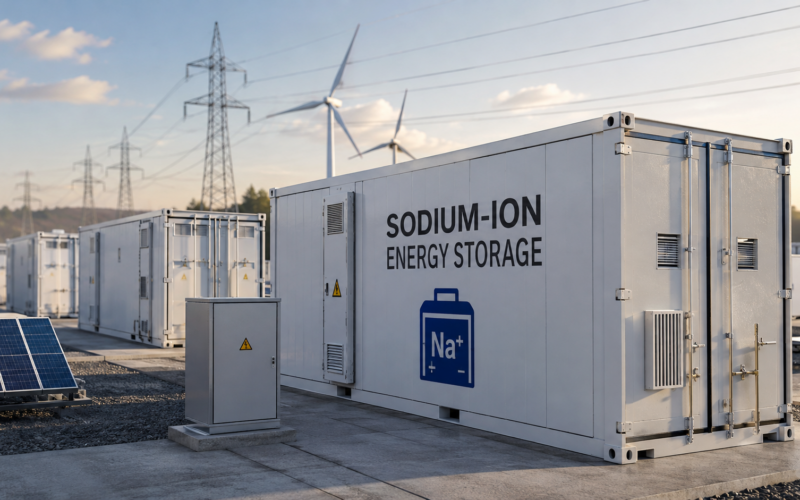
CATL is explicitly targeting that opportunity with TENER Sodium. The company describes the product as a commercially mature sodium-ion energy-storage platform designed around wide-temperature operation and simplified system integration. Initial Chinese deliveries are scheduled for September 2026.
Peak Energy has taken the system-level argument further. Its sodium-ion architecture uses passive cooling instead of conventional active thermal-management equipment. The company claims this can eliminate pumps, chillers and other moving components while lowering auxiliary electricity use and maintenance requirements. These remain manufacturer claims rather than independently established industry averages.
The distinction is important. Sodium-ion does not necessarily need to contain more energy per kilogram than LFP if a storage developer ultimately pays less for the complete operating system over 20 years.
Where are sodium-ion batteries already operating commercially?
The answer depends strongly on what is meant by commercial.
Peak Energy announced in July 2025 that it had shipped what it described as the first grid-scale sodium-ion battery storage system deployed to the U.S. electricity grid. The system was operated as a shared pilot involving nine utility and independent-power-producer customers rather than as a massive merchant battery plant.
That pilot matters because it provides actual grid-operating experience rather than laboratory cycling alone. Peak now describes its technology as having accumulated operating experience while it prepares larger commercial deployments.
Its agreement with Jupiter Power is the clearest scale-up example. Peak is scheduled to deliver approximately 720 MWh in 2027, while Jupiter holds an option or capacity reservation for another 4 GWh between 2028 and 2030. If fully exercised, the total programme could reach approximately 4.75 GWh and exceed $500 million in contract value.
That structure is more precise than calling 4.75 GWh a guaranteed deployment. The first 720 MWh is the identified initial delivery, while the additional 4 GWh depends on the later option.
Peak also signed an agreement with RWE Americas in March 2026 to pilot its passively cooled sodium-ion system at an RWE laboratory in eastern Wisconsin. The company describes it as the first planned sodium-ion grid-storage deployment in the Midcontinent Independent System Operator region. It remains a pilot programme rather than a utility-scale fleet rollout.
Can sodium-ion batteries actually become cheaper than LFP?
This remains the technology’s hardest commercial problem.
Sodium is abundant, but battery economics are not determined by the price of sodium alone. Cathodes, anodes, electrolytes, separators, cell manufacturing, factory utilisation, power electronics, packaging, thermal management and installation all contribute to delivered storage cost.
At the same time, lithium iron phosphate batteries continue to become cheaper. The International Energy Agency says LFP battery prices fell by more than 15% during 2025 and that LFP represented more than 90% of global battery-energy-storage-system deployment. LFP battery packs were more than 40% cheaper on average than nickel-rich NMC alternatives.
The IEA’s February 2026 sodium-ion assessment therefore explicitly warns that sodium-ion does not currently undercut LFP in most applications at prevailing lithium prices. LFP retains advantages in energy density, manufacturing scale, supply-chain maturity and cost.
Sodium-ion becomes more compelling where other operating characteristics have economic value, particularly cold climates, applications with less sensitivity to battery volume, or systems where passive cooling and reduced auxiliary loads can lower lifetime costs.
That turns the competition from cell price into total cost of ownership.
Why could cold weather become sodium-ion’s strongest technical advantage?
Low-temperature performance is one area where the technology already has a clear technical case.
The International Energy Agency says the latest sodium-ion cells can retain roughly 90% of their nominal capacity at temperatures as low as minus 40 degrees Celsius and operate at temperatures as high as 70 degrees Celsius.
CATL claims even stronger performance for its Naxtra cells. The company says Naxtra maintains more than 90% capacity at minus 40 degrees Celsius, can continue providing power at minus 50 degrees Celsius and delivers almost three times the discharge power of an equivalent LFP battery at minus 30 degrees Celsius. Those are CATL-reported results and should not be presented as independent validation across commercial fleets.
The advantage matters beyond electric-vehicle range. Grid-storage installations in very cold climates may consume electricity simply keeping lithium-ion batteries within their preferred operating temperature.
If sodium-ion reduces heating requirements, some of its economic value may come from equipment and electricity that never have to be installed or consumed.
Are sodium-ion batteries already being mass-produced for electric cars?
This section requires more caution than the earlier version suggested.
CATL and Changan Automobile unveiled what they described as the world’s first mass-production sodium-ion passenger vehicle in February 2026. CATL said at the time that the vehicle was expected to reach the market by mid-2026 and that its 175 Wh/kg Naxtra cells could support more than 400 kilometres of pure-electric range.
However, that original commercialization schedule should no longer be treated as current. In April 2026, Changan subsequently indicated that two fully electric sedans powered by CATL sodium-ion batteries were planned for launch in 2027. That later guidance suggests the initial mid-2026 market timetable shifted.
CATL itself said in April that Naxtra would enter full-scale mass production by the end of 2026.
The appropriate August 2026 description is therefore that CATL and Changan have unveiled a production-intent sodium-ion passenger vehicle and are industrialising the chemistry, but large-scale customer deployment in passenger cars has not yet been demonstrated at anything approaching lithium-ion volumes.
Automotive sodium-ion remains commercially earlier than stationary storage.
Why does lower energy density still matter for sodium-ion vehicles?
The gap has narrowed but has not disappeared.
The International Energy Agency puts leading sodium-ion cells at approximately 175 Wh/kg, compared with up to 205 Wh/kg for advanced LFP cells and around 265 Wh/kg for nickel-manganese-cobalt cells.
The sodium-ion disadvantage can be even greater volumetrically, meaning a vehicle may need a larger battery enclosure to store the same amount of energy.
For passenger cars, every extra litre competes with passengers, luggage, crash structures and vehicle design. That makes sodium-ion a harder proposition for premium long-range vehicles.
The IEA therefore sees shorter-range cars, urban commercial vehicles, two- and three-wheelers, industrial vehicles such as forklifts, cold-climate mobility and stationary storage as more plausible early markets.
The technology does not have to outperform NMC in a 600-kilometre premium electric SUV if it can produce better economics in a delivery van operating predictable urban routes at minus 20 degrees Celsius.
Could sodium-ion and lithium-ion batteries work together instead of competing?
That may ultimately become one of the most commercially realistic outcomes.
CATL has been developing multi-chemistry battery architectures that combine cells with different characteristics inside broader energy systems. Sodium-ion can contribute low-temperature performance and diversification from lithium, while lithium-ion provides superior energy density.
The International Energy Agency similarly identifies hybrid lithium-ion and sodium-ion packs as a promising application, particularly where sodium cells can reduce cold-weather range losses.
This is consistent with how battery markets have evolved previously. LFP did not eliminate nickel-rich chemistries. Instead, LFP captured applications where cost, safety and cycle life mattered more than maximum energy density, while NMC and related chemistries retained positions where range and packaging were more valuable.
Sodium-ion may add a third major branch rather than replace either one.
Why are General Motors and data-centre developers interested in sodium-ion?
General Motors provides an unusually revealing signal because it is applying battery expertise developed for vehicles to a chemistry currently being designed around the grid.
In June 2026, General Motors said it was developing next-generation sodium-ion cells with Peak Energy for grid-scale storage, backed by an investment from General Motors Ventures. Prototyping is taking place at the Wallace Battery Cell Innovation Center.
General Motors explicitly distinguishes stationary-storage requirements from those of electric vehicles. Grid batteries place greater emphasis on long calendar life, cycle life, cost and thermal behaviour while being much less constrained by weight and packaging.
That same logic makes sodium-ion relevant to data centres.
Energy Vault and Peak Energy announced a 1.5 GWh sodium-ion supply and development arrangement aimed partly at AI-first data-centre operators. Energy Vault’s subsequent investor reporting describes it as a definitive 1.5 GWh supply agreement.
Peak argues that its passive architecture is especially useful for data centres because cooling hardware consumes space and electricity and introduces additional potential failure points. Those performance and cost benefits remain supplier claims that need independent validation across large commercial deployments.
How quickly is U.S. sodium-ion manufacturing scaling?
Peak Energy selected Sacramento, California, in July 2026 for a dedicated sodium-ion grid-storage manufacturing facility.
The 183,000-square-foot site is planned to produce up to 4 GWh of battery systems annually. Peak says production and shipments are expected to begin in the first quarter of 2027, correcting earlier expectations that implied U.S. manufacturing would begin during 2026.
Peak says it already has more than 6 GWh of customer commitments supporting the plant. The project involves up to $71 million of capital investment and is expected to create 239 jobs over its initial expansion period.
The U.S. Department of Energy has also funded sodium-ion manufacturing research. A 2024 battery-manufacturing programme included projects targeting sodium-ion electrode processing, hard-carbon manufacturing and cathode-material production as part of a broader $25.54 million programme covering next-generation battery manufacturing technologies.
That is still tiny compared with the industrial scale already emerging in China.
Is Europe beginning to commit to sodium-ion battery storage?
European activity accelerated sharply in July 2026.
CATL and Alfen announced a cooperation covering 5 GWh of sodium-ion battery energy-storage deployment across Europe. The companies intend to use the programme to adapt sodium-ion systems to European grid codes and accumulate operating experience.
CATL separately signed a 2 GWh sodium-ion strategic cooperation agreement with Solarpro covering Central and Eastern Europe. The partners intend to develop region-specific applications and commission what they describe as the first sodium-ion energy-storage project in Central and Eastern Europe.
Those agreements represent 7 GWh of prospective European activity, not 7 GWh of installed sodium-ion batteries.
That distinction is critical. Neither framework should be counted as operating storage capacity today.
The commercial signal is nevertheless important because established system integrators are beginning to reserve sodium-ion capacity before the technology has achieved LFP-like manufacturing scale.
Does sodium-ion really diversify the global battery supply chain?
At the mineral level, potentially.
At the manufacturing level, not yet.
Sodium-ion avoids lithium and graphite, while some sodium chemistries can reduce exposure to other critical materials as well. But the International Energy Agency says almost all existing sodium-ion cell manufacturing capacity is currently located in China. When installed and announced projects are combined, China accounts for more than 95% of projected global sodium-ion manufacturing capacity through 2030.
Hard-carbon supply is also relatively immature and concentrated.
Sodium-ion therefore presents an unusual paradox. It can reduce geological dependence on lithium while potentially reinforcing industrial dependence on Chinese battery manufacturing unless significant capacity is built elsewhere.
Peak Energy’s Sacramento project and General Motors’ development programme are strategically important precisely because they attempt to solve that second problem.
Will sodium-ion batteries actually replace lithium-ion batteries?
The evidence does not support that conclusion, and replacement is probably the wrong test.
Lithium-ion manufacturing has reached enormous scale. LFP prices continue to decline, supply chains are mature and the latest LFP cells still hold a meaningful energy-density advantage over sodium-ion. The International Energy Agency estimates current global sodium-ion manufacturing capacity at only a little over 1% of lithium-ion cell capacity.
Yet sodium-ion has crossed an important threshold.
CATL has signed a 60 GWh supply framework with HyperStrong, added 40 GWh of annual production capacity at Fuding and plans much more. Peak Energy has a grid-operating pilot, a 720 MWh initial Jupiter Power deployment scheduled for 2027, a possible additional 4 GWh under reservation, a 1.5 GWh Energy Vault agreement and a new U.S. manufacturing facility scheduled to begin shipments next year. General Motors is designing sodium-ion cells specifically for stationary storage, while CATL has signed another 7 GWh of prospective European cooperation with Alfen and Solarpro.
That is enough commercial activity to stop treating sodium-ion as merely a laboratory alternative.
The real test now is whether those agreements become delivered systems and whether those systems can produce lower lifetime electricity costs than LFP once degradation, cooling, auxiliary consumption, maintenance and financing are included.
Sodium-ion does not have to kill lithium-ion to matter.
Its disruptive potential lies in forcing the battery industry to stop assuming that one chemistry should dominate electric cars, grid storage, data centres, industrial vehicles and cold-climate applications simultaneously.
Lithium-ion built the modern battery economy.
Sodium-ion now has its first credible opportunity to divide it.
Discover more from Business-News-Today.com
Subscribe to get the latest posts sent to your email.