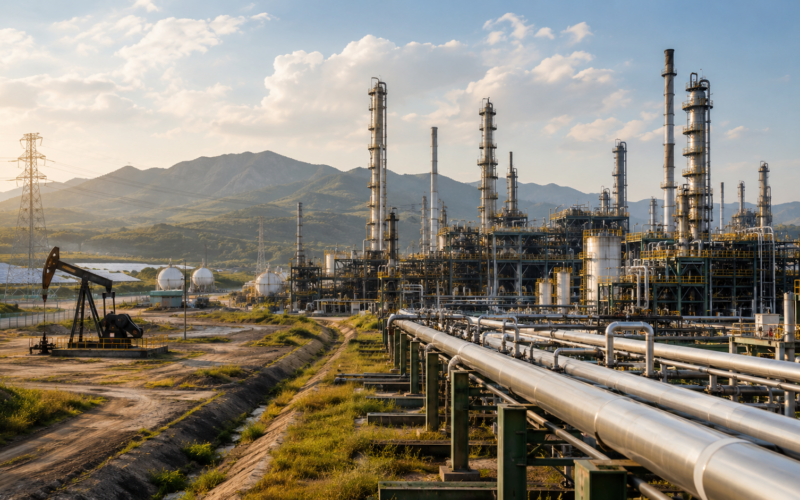
China Petroleum & Chemical Corporation, or Sinopec Corp. (HKEX: 0386; SSE: 600028), reported first-half 2026 revenue of approximately RMB1.44 trillion and IFRS profit attributable to shareholders of RMB26.57 billion, up 11.9%. Under Chinese accounting standards, net profit increased 19.3% to RMB25.63 billion and earnings per share rose to RMB0.212.
The improvement arrived despite a difficult demand backdrop. Domestic refined-product consumption declined 8.6%, including a 7.9% drop in gasoline and an 11.5% decline in diesel, while Sinopec processed approximately 113.3 million tonnes of crude, down 5.6%.
Sinopec nevertheless improved refining margins by 44.1%, supported by strategic crude sourcing, purchasing decisions and optimisation of its product mix. Refining operating profit increased 381.5%, helping offset an RMB16 billion inventory writedown linked to extreme oil-price volatility.
How did Sinopec earn more profit while processing less crude?
Refining profitability depends not only on throughput but also on the spread between crude input costs and the value of refined products.
Sinopec used sourcing and inventory management to improve those economics even as total processed volumes fell. The 44.1% increase in refining margin therefore produced substantially more segment profit from fewer tonnes of crude.
That is a powerful example of margin outweighing volume. A refinery running at lower throughput can still earn more if crude procurement becomes sufficiently favourable relative to controlled domestic fuel prices.
The RMB16 billion inventory writedown shows the other side of that volatility. Sudden changes in oil prices can reduce the accounting value of crude and products already held in inventory.
Sinopec absorbed that charge and still increased group profit, highlighting the strength of the refining-margin improvement.
Is China’s fuel-demand decline becoming structural?
The fall in gasoline and diesel consumption reflects more than a weak economic quarter. Electric-vehicle penetration, improving fuel efficiency and structural changes in freight and mobility are increasingly reducing growth in conventional road-fuel demand.
Jet-fuel demand performed better, increasing modestly as aviation activity remained stronger.
For Sinopec, this creates a long-term strategic challenge. Refining assets built for decades of growing gasoline and diesel consumption need to adapt to a market where road-fuel demand may plateau or decline.
The company expects full-year crude processing to remain under pressure and is increasingly redirecting capital toward chemicals, materials, hydrogen and other lower-carbon businesses.
Why is the chemicals business still struggling?
China’s petrochemical industry faces substantial overcapacity, weak product pricing and intense competition from newer private-sector complexes.
Sinopec’s chemicals segment remained loss-making during the first half, although the loss narrowed substantially compared with the prior year. Ethylene production declined around 15.5%.
That creates a contrast with refining. Better feedstock economics and sourcing dramatically improved refinery profitability, while chemicals continue facing structural excess capacity.
The long-term portfolio challenge is therefore not merely replacing oil with chemicals. Sinopec needs to concentrate investment on chemical and material products with better differentiation and demand characteristics rather than simply adding commodity capacity.
How meaningful is the interim dividend?
Sinopec declared an interim dividend of RMB0.105 per share. Against Chinese-accounting EPS of RMB0.212, that represents a payout ratio of approximately 49.5%.
The company also plans another round of share repurchases, combining dividends and buybacks as tools for returning capital.
Operating cash flow of approximately RMB62.5 billion supports those distributions, although Sinopec continues to fund one of the world’s largest integrated energy and chemicals networks.
The payout therefore reflects strong cash generation despite the relatively thin consolidated earnings margin. IFRS attributable profit of RMB26.57 billion on approximately RMB1.44 trillion of revenue equates to a net margin of only about 1.8%.
That thin margin demonstrates how small changes in crude prices, product spreads and operating efficiency can create large percentage movements in earnings.
Why did Sinopec shares rise almost 6% after the result?
Sinopec’s Hong Kong shares closed around HK$4.67 on August 24, up approximately 5.9%, as investors responded to the stronger-than-expected profitability and refining performance.
The reaction suggests the market was prepared for the weak demand numbers but not for the scale of margin improvement.
Investors also gained evidence that management can protect earnings during a volatile crude environment through sourcing and operational decisions.
The larger structural concern remains unchanged. China is consuming less gasoline and diesel, and Sinopec cannot depend indefinitely on refining-margin optimisation to offset shrinking fuel demand.
That explains the company’s intention to invest more than RMB30 billion annually between 2026 and 2030 in new energy and advanced materials. If maintained, that implies more than RMB150 billion of investment across the five-year period.
Sinopec’s H1 result therefore captures both sides of China’s energy transition. The old refining system is still capable of generating substantial profit when procurement and margins align, but the demand data increasingly explain why one of the world’s largest oil refiners is allocating tens of billions of yuan toward businesses designed for a future with less road-fuel growth.
Discover more from Business-News-Today.com
Subscribe to get the latest posts sent to your email.