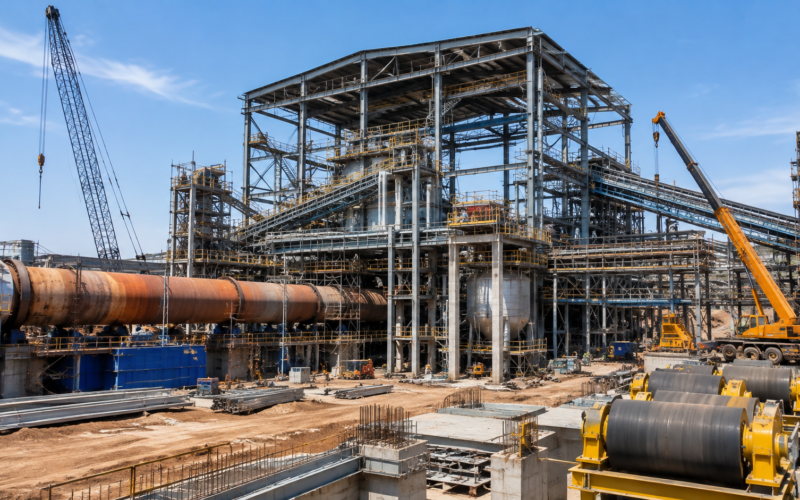
SEPC Limited (NSE: SEPC) has secured an ₹854.57 crore contract from Steel Authority of India Limited for balance-of-plant, civil and structural works associated with the pellet plant being developed as part of the 4.08 million tonnes per annum crude-steel expansion of IISCO Steel Plant at Burnpur in West Bengal. SEPC received the Letter of Acceptance from SAIL-IISCO Steel Plant for Pellet Package-2, turning one of the company’s recent industrial-sector pursuits into a sizeable executable order.
The order deserves attention not simply because it is large in rupee terms, but because of SEPC’s own scale. The company’s market capitalisation was only around ₹1,109 crore at the August 21 close, meaning the gross contract value is equivalent to roughly 77% of its current equity-market value. That comparison is not a measure of project profitability or valuation, but it illustrates why execution of the SAIL package could become an important contributor to SEPC’s revenue base over the contract period.
How large is SEPC’s ₹854.57 crore SAIL order relative to the company’s current business?
The ₹854.57 crore award substantially raises the economic importance of industrial EPC work within SEPC’s pipeline. Large EPC orders generate revenue over construction milestones rather than at award, while actual profit depends on material costs, subcontracting, labour productivity, working capital and contractual provisions. SEPC consequently needs to convert the headline award into disciplined execution before the order translates into meaningful shareholder value.
The contract also needs to be viewed against a company that has gone through a prolonged financial and operational restructuring. SEPC’s share price remains around half the level recorded a year earlier, despite strong investor attention around the SAIL announcement. The shares closed at ₹5.79 on August 21, down 3.02% for the session and around 5% over one month, with a 52-week range of ₹4.65 to ₹13.73.
The immediate market reaction when the contract was announced was considerably stronger. SEPC shares gained more than 6% on August 5 after disclosure of the award and another 3.5% the following session, with trading volume rising sharply. That initial enthusiasm subsequently faded, suggesting investors are distinguishing between winning the order and demonstrating profitable execution of it.
Where does SEPC’s pellet package sit inside SAIL’s 4.08 MTPA Burnpur expansion?
SEPC is not building the entire IISCO expansion. Its scope covers the balance-of-plant, civil and structural works for Pellet Package-2 within the much larger project through which SAIL intends to expand crude-steel capacity at the Burnpur complex by 4.08 MTPA. The distinction matters because the ₹854.57 crore figure is SEPC’s package value rather than the total cost of the steel expansion.
The Burnpur programme forms part of SAIL’s broader ambition to increase group crude-steel capacity from roughly 20 MTPA to around 35 MTPA by 2030-31 through expansion at integrated plants including Burnpur, Durgapur, Bokaro, Rourkela and Bhilai. The Ministry of Steel reported that SAIL’s board had approved the 4.08 MTPA IISCO Steel Plant expansion in January 2024 and that 13 of 14 technological packages had subsequently been awarded, with the remaining package progressing through approval.
That programme provides useful context for SEPC because its package is tied to a sanctioned capacity expansion rather than a speculative investment announcement. Burnpur’s eventual production increase will require coordinated completion of multiple interdependent packages, however, so SEPC’s construction schedule can also be influenced by interfaces with other contractors and technological suppliers.

Why is the pellet plant important to IISCO Steel Plant’s new capacity?
Pellets provide a consistent iron-bearing feedstock for integrated steelmaking and can improve the efficiency with which iron ore is prepared for use in downstream ironmaking facilities. Expanding crude-steel capacity by more than four million tonnes annually therefore requires corresponding investment across raw-material handling, ironmaking, steelmaking, utilities and supporting infrastructure rather than merely installing another steelmaking unit.
SEPC’s balance-of-plant responsibility becomes important in that context because civil foundations, structures and supporting systems have to be delivered in step with process equipment. The commercial attractiveness of the order will ultimately depend on the extent to which SEPC can control construction costs while meeting the interfaces and milestones required by SAIL.
Steel Authority of India Limited’s decision to push ahead with expansion also reflects India’s wider steel-capacity ambitions under the National Steel Policy. Domestic steelmakers are positioning for longer-term growth in infrastructure, construction, manufacturing and capital goods, creating a multi-year EPC opportunity across integrated steel plants even though individual projects remain exposed to commodity cycles and capital-cost inflation.
Can SEPC convert the SAIL order into a stronger industrial EPC franchise?
The strategic opportunity extends beyond the revenue associated with one package. Successful execution at a major operating steel complex can strengthen SEPC’s credentials for subsequent industrial, metals and process-plant packages, particularly because large public-sector customers place considerable weight on prior experience and delivery records.
The challenge is that large EPC orders can strain working capital before they improve earnings. Contractors frequently have to mobilise labour, equipment and materials ahead of milestone payments, while delays can extend receivable cycles and increase financing requirements. For a company of SEPC’s size, an ₹854.57 crore project therefore creates both revenue opportunity and execution exposure.
SEPC’s next quarterly disclosures should make the picture clearer by showing mobilisation progress, order-book conversion and whether margins improve as the project moves deeper into execution. The SAIL order is economically large enough to matter, but the more important measure will be how much cash and operating profit SEPC ultimately extracts from the package rather than the size of the Letter of Acceptance itself.
What should SEPC investors watch as the Burnpur package moves into execution?
The first indicators will be mobilisation and commencement of revenue recognition. Investors should also watch whether SEPC receives additional industrial orders that diversify its backlog and reduce dependence on a small number of unusually large contracts.
The company’s share-price performance reinforces that distinction. SEPC finished August 21 at ₹5.79, around 58% below its 52-week high of ₹13.73 and roughly 24% above the 52-week low. The stock’s one-year decline of about 50% suggests that the market is demanding considerably more than order announcements before assigning the company a sustained rerating.
The ₹854.57 crore SAIL contract nevertheless gives SEPC a material opportunity to change that operating narrative. Its value is approaching the company’s current market capitalisation, it sits inside a sanctioned 4.08 MTPA steel expansion and it links SEPC with one of India’s largest public-sector steel investment programmes. The decisive question is now execution: how rapidly the order converts into revenue, what margins SEPC earns and whether successful delivery becomes a platform for further industrial EPC wins.
Discover more from Business-News-Today.com
Subscribe to get the latest posts sent to your email.