

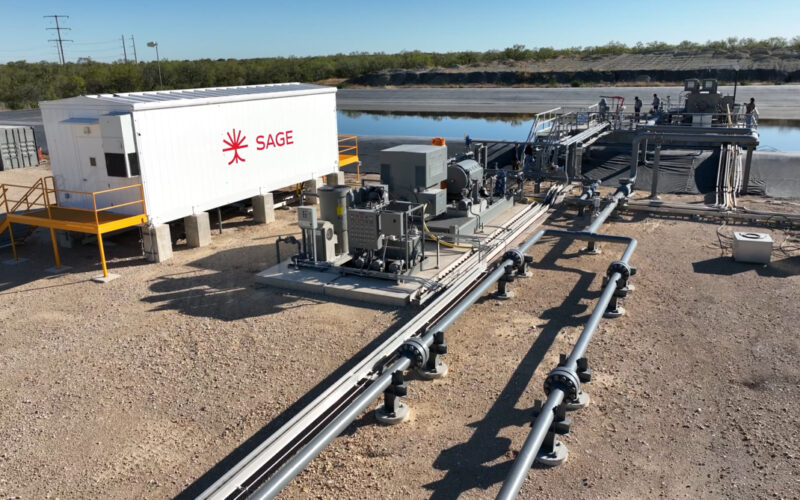
Sage Geosystems has placed its SMECI facility in South Texas into service after more than 120 days of grid-connected operations, giving the Houston-based developer its strongest operating evidence yet that its pressure-based geothermal technology can deliver repeatable underground performance. The 3 MW facility began selling electricity during the second quarter of 2026 and has since generated data on reservoir pressure response, injection and production performance, water retention, system efficiency and subsurface behaviour. Sage said the results met or exceeded its objectives, including water losses below 10% across multiple operating cycles and reservoir behaviour that broadly matched predictions from its GeoTwin modelling system. The milestone strengthens the technical case for Sage’s next project with Ormat Technologies in Nevada, although the more important commercial question remains whether performance demonstrated at a relatively small Texas facility can be replicated economically at the scale required for continuous geothermal power.
SMECI was originally conceived principally as a geopressured energy-storage project capable of storing electricity underground through pressurised water and returning that energy to the Electric Reliability Council of Texas grid. Its strategic role has since expanded. Sage is now using the operating data to validate core elements of its Pressure Geothermal architecture, which seeks to use engineered subsurface reservoirs not merely for energy storage but for 24/7 geothermal electricity production. That makes the Texas facility less important for the amount of electricity it sells today than for the engineering information it can provide about reservoirs Sage intends to reproduce at much larger commercial developments.
What did Sage Geosystems actually prove during more than 120 days of operations in South Texas?
The most consequential result is not simply that SMECI generated electricity. Sage has now accumulated more than four months of operating data across repeated injection and production cycles, allowing the company to observe whether the engineered reservoir responds consistently as pressure changes, water is circulated and electricity is dispatched over an extended period.
That distinction matters because creating an underground fracture network once is very different from proving that the same reservoir can be operated repeatedly without significant degradation or unexpected behaviour. A geothermal system that performs strongly during an initial demonstration can still encounter commercial problems if pressure response becomes unpredictable, water migrates beyond the intended reservoir or actual performance differs substantially from engineering models used to size wells and surface equipment.
Sage said GeoTwin, its reservoir modelling platform, anticipated the behaviour observed during SMECI operations. If that relationship between modelling and field performance continues across larger and geologically different projects, it could improve the company’s ability to design future reservoirs before committing substantial drilling capital. For developers, lenders and power purchasers, predictable subsurface performance is essential because uncertainty underground eventually becomes uncertainty around generation, operating costs and project returns.
The Texas results therefore reduce one category of technical risk without resolving the broader commercial question. Sage has demonstrated that its engineered reservoir can operate repeatedly over a meaningful period, but it must now show that the same engineering principles can be transferred into hotter formations, larger well systems and continuous commercial power production.
Why does Sage Geosystems’ sub-10% water loss matter for enhanced geothermal economics?
Water retention is an important economic variable in Sage’s technology because fluid that escapes permanently into surrounding formations must eventually be replaced, while the associated pressure and thermal energy can no longer be recovered through the production cycle. Higher losses can therefore increase operating requirements while reducing the amount of energy available from the engineered reservoir.
Sage reported water losses below 10% across multiple operating cycles at SMECI and said it sees a path toward reducing losses below 5%. The company had originally discussed still lower targets when the Texas project was framed predominantly as an energy-storage development, so the latest figures should be regarded as evidence of meaningful operating progress rather than the endpoint of optimisation.
The significance is ultimately cumulative. Reducing water losses improves resource efficiency, but it can also support more predictable reservoir pressure, decrease replacement-water requirements and strengthen assumptions used in long-term project modelling. Those benefits become increasingly important as Sage moves from a 3 MW facility toward projects where dozens or potentially hundreds of megawatts depend on multiple wells behaving consistently.
For commercial geothermal development, the relevant benchmark is therefore not whether SMECI has already achieved the lowest theoretically possible water loss. The stronger test is whether continued engineering can bring actual field performance progressively closer to the levels required for reliable and financially competitive power generation.
Why is Sage shifting its commercial emphasis from underground storage toward 24/7 geothermal power?
When Sage and San Miguel Electric Cooperative announced the South Texas project in 2024, the commercial proposition focused heavily on long-duration energy storage. The EarthStore configuration was designed to use electricity to inject water underground, store energy through pressure in engineered fractures and subsequently release that water through generating equipment when the grid required electricity. Sage originally targeted six to 10 hours of storage duration and round-trip efficiency of roughly 70% to 75%.
The electricity market surrounding the technology has since changed rapidly. Texas has added large quantities of conventional battery storage, while the emerging shortage of dependable generation for data centres and other large industrial loads has increased the potential value of resources capable of supplying electricity continuously. That has encouraged Sage to place greater strategic emphasis on using similar subsurface engineering for geothermal baseload generation rather than pursuing standalone underground storage as its primary near-term market.
The technological bridge between the two applications is significant. Both require Sage to create and control engineered fracture networks, inject and recover water, manage subsurface pressure and predict reservoir behaviour. A geothermal generation project adds heat from deep rock to the system, allowing circulating fluid to carry thermal energy to the surface and support electricity production without depending primarily on electricity purchased earlier from the grid.
This shift potentially moves Sage into a larger and more valuable market. Solar and wind can supply low-cost electricity when natural resources are available, while lithium-ion batteries are increasingly effective at moving energy across several hours. Firm geothermal generation competes in a narrower category of resources capable of providing low-carbon electricity continuously, an attribute becoming more important as power systems absorb large loads that cannot simply stop operating when renewable output falls.
How does the South Texas operating data reduce risk for Sage’s commercial project with Ormat Technologies?
The next stage of Sage’s development programme moves beyond another small standalone demonstration. The company is applying operating lessons from SMECI to an enhanced geothermal project planned at an existing Ormat Technologies geothermal facility in Nevada, where the partners are advancing permitting, drilling procurement and engineering work for a two-well system.
The structure is commercially important because Sage does not need to reproduce every element of a complete greenfield power development merely to validate its subsurface technology at the next scale. Integration with an existing Ormat facility can provide established generation infrastructure and operating expertise, allowing the partners to concentrate more directly on whether Sage can create a predictable commercial reservoir in hot dry rock and deliver geothermal fluid into a functioning power-generation environment.
Ormat has also committed capital directly to Sage. The geothermal developer invested $25 million as part of Sage’s Series B financing of more than $97 million and secured rights, subject to successful technology validation, to develop, build, own and operate projects incorporating Sage technology. The relationship therefore extends beyond a conventional pilot partnership because successful performance could create a pathway through which Sage’s subsurface intellectual property is combined with Ormat’s experience developing and operating geothermal assets.
That combination could shorten the distance between technical validation and repeatable project deployment. Sage brings the engineered-reservoir architecture, while Ormat already possesses capabilities in geothermal plant design, construction, operations, permitting and project development. If Nevada produces satisfactory technical and economic results, the partnership could offer a substantially more scalable commercial route than Sage attempting to develop every downstream capability internally.
Why could the Ormat partnership ultimately matter more than Sage’s $97 million Series B financing?
The Series B financing gives Sage capital to drill wells, develop modelling tools and move its Pressure Geothermal system toward commercial deployment, but capital alone does not solve the execution challenges associated with building utility-scale energy infrastructure. Larger geothermal developments require drilling contractors, turbines, power-conversion equipment, grid interconnections, regulatory approvals, operating expertise, long-duration power contracts and ultimately project-level financing.
Ormat potentially supplies several of those missing capabilities. The company operates a large global portfolio spanning geothermal generation and energy storage and has decades of experience turning subsurface heat resources into operating power plants. It has also been expanding its exposure to enhanced geothermal systems, including work with Sage and other technology partners, suggesting that it sees engineered geothermal as a possible extension of its established development platform rather than merely an experimental research programme.
For Sage, that creates leverage beyond the value of Ormat’s initial $25 million equity investment. A successful Nevada demonstration could provide an experienced owner-operator capable of taking Sage technology into multiple projects, while Ormat would gain access to a subsurface approach that could broaden geothermal development beyond locations where naturally occurring hydrothermal resources already provide commercially accessible heat and fluid.
The decisive issue is whether those capabilities can be combined at a competitive cost. A technically effective geothermal reservoir does not automatically become an attractive power project if drilling, completion and surface infrastructure costs remain too high. Nevada will therefore test both engineering performance and the beginnings of a repeatable commercial model.

Can Sage’s Texas results support its much larger 150 MW geothermal ambition with Meta Platforms?
Sage’s agreement associated with Meta Platforms creates a dramatically larger benchmark for the technology. The companies have outlined plans that could eventually support as much as 150 MW of new geothermal baseload capacity for Meta’s data-centre electricity requirements, placing the proposed development at a scale far beyond the 3 MW SMECI facility.
The progression between those projects is precisely why the Texas operating result needs to be interpreted carefully. SMECI is not evidence that Sage can already deliver 150 MW of geothermal capacity. Instead, it provides operating data about reservoir behaviour that can inform the Nevada project, where the company intends to demonstrate its approach in a commercial geothermal setting before attempting the much larger replication required for a hyperscale customer.
Each stage therefore tests a different dimension of the commercial proposition. Texas provides evidence about whether the engineered reservoir behaves repeatedly and broadly in line with modelling assumptions; Nevada will test whether those subsurface principles can be integrated effectively into commercial geothermal generation; and a future Meta-related development would test whether the entire architecture can be replicated across enough wells and surface infrastructure to deliver dependable power at hyperscale. The sequence reduces risk progressively rather than allowing any single demonstration to establish that every remaining engineering and economic problem has already been solved.
That progression is also likely to matter for project financing. Investors and lenders evaluating a 150 MW development would have substantially more operating evidence if Sage first demonstrates a successful commercial system in Nevada than if financing depended primarily on the original Texas pilot. Each project can therefore become part of the technical record supporting the next and larger capital commitment.
What does Ormat Technologies’ market position suggest about investor expectations for next-generation geothermal?
Ormat Technologies is the publicly listed company with the clearest direct financial exposure to Sage through its equity investment and commercial relationship. Its existing earnings, however, remain dominated by conventional geothermal generation, product sales and energy-storage operations, meaning Sage currently represents a strategic option rather than a material contributor to reported results.
That distinction is important when interpreting market sentiment. The commercial value of enhanced geothermal could become substantial if technologies such as Sage’s enable developers to build projects in locations that lack conventional hydrothermal resources, but the investment case still depends on proof that drilling costs, reservoir productivity and long-term operating performance can support competitive electricity economics.
Ormat’s willingness to invest capital and contribute an operating project in Nevada indicates meaningful strategic interest, but it does not amount to validation of commercial success. The upcoming drilling programme will provide much stronger evidence because Ormat will be able to compare actual reservoir behaviour, output and integration requirements with expectations formed during engineering.
For investors, that creates a relatively clear progression of evidence. Successful drilling would strengthen the case for additional Sage-Ormat projects, whereas disappointing reservoir performance would slow the path toward wider adoption without materially undermining Ormat’s much larger existing business.
What still needs to be proven before Sage Geosystems can call Pressure Geothermal commercially scalable?
The Texas milestone removes some technical uncertainty, but several major tests remain before Sage can demonstrate a repeatable commercial power platform. The company first needs to reproduce predictable reservoir behaviour in Nevada under conditions designed specifically for geothermal electricity generation, while continuing to improve water retention toward its targeted levels and demonstrating that GeoTwin remains accurate as geology, reservoir size and operating duration change.
Drilling economics will be equally important. Enhanced geothermal systems promise to expand geothermal development beyond relatively scarce naturally occurring hydrothermal resources, but that advantage only becomes commercially meaningful if engineered wells can be drilled and completed at costs compatible with competitive electricity prices. Improvements in drilling speed, well design and reservoir productivity therefore matter just as much as the ability to produce geothermal fluid.
Sage must ultimately demonstrate replication as well. A hyperscale project cannot depend on a single unusually productive well or uniquely favourable reservoir. Multiple wells must deliver sufficiently consistent performance for developers to forecast total plant output, schedule construction and obtain project financing with confidence.
That is why the SMECI milestone deserves attention without requiring exaggerated conclusions. Sage has progressed from short-duration experimentation to more than 120 days of operating data from a grid-connected facility, giving its engineers evidence about pressure behaviour, water recovery and model accuracy that can now be incorporated into the Nevada design.
The next test will be considerably harder because Nevada must convert that reservoir knowledge into commercial geothermal production. If Sage can demonstrate predictable performance there, the argument that Pressure Geothermal can support larger projects will become materially stronger. If reservoir behaviour, drilling costs or integration requirements disappoint, the Texas achievement will remain valuable technically without yet establishing a scalable electricity business.
The important development on August 19 is therefore not that Sage has solved enhanced geothermal power. It is that the company now possesses enough sustained operating evidence to move the central question from whether its engineered reservoir can function to whether the same engineering can be reproduced economically at commercial scale.
Key takeaways from Sage Geosystems’ 120-day Texas geothermal operating test
- Sage Geosystems has placed its 3 MW SMECI facility in South Texas into service following more than 120 days of operations.
- The facility began selling electricity during the second quarter of 2026 and has produced operating data covering pressure response, water management, efficiency and reservoir behaviour.
- Sage reported water losses below 10% across multiple cycles and sees a pathway toward reducing losses below 5%.
- The company said its GeoTwin modelling system broadly predicted the reservoir behaviour observed during operations, strengthening the case for using modelling to design future projects.
- SMECI originated principally as an underground energy-storage development but is increasingly being used to validate subsurface technology for continuous geothermal power generation.
- Sage is incorporating the Texas data into a planned two-well enhanced geothermal development at an existing Ormat Technologies facility in Nevada.
- Ormat invested $25 million as part of Sage’s Series B financing of more than $97 million and could develop and operate future projects using Sage technology following successful validation.
- A potential geothermal development associated with Meta Platforms could eventually reach 150 MW, making repeatability across multiple wells a much larger test than the Texas demonstration.
- Texas validates reservoir behaviour, while Nevada must demonstrate commercial geothermal integration before Sage can credibly approach hyperscale deployment.
- The next decisive evidence will come from Nevada drilling, reservoir performance, water retention and the economics of converting Sage’s subsurface architecture into reliable commercial electricity.
Discover more from Business-News-Today.com
Subscribe to get the latest posts sent to your email.