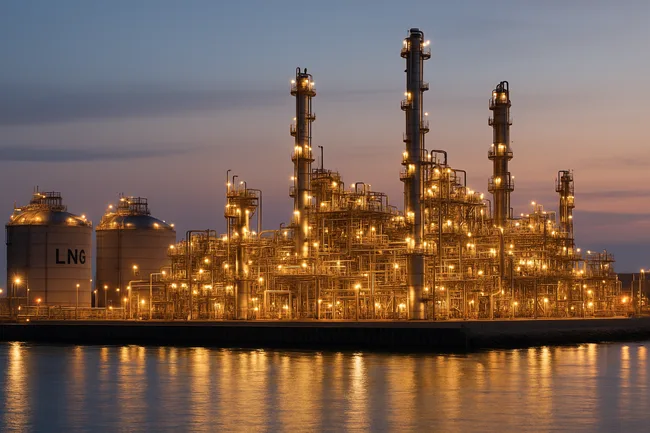
The Abadi LNG Project is a large-scale, integrated liquefied natural gas (LNG) development located in the Masela Block offshore eastern Indonesia. Designed to produce 9.5 million metric tons per annum (Mtpa) of LNG, along with domestic pipeline gas and condensate, the project also features one of Southeast Asia’s most advanced carbon capture and storage (CCS) integrations. As a result, Abadi is viewed as a cornerstone of both Indonesia’s domestic gas ambitions and Japan’s long-term LNG supply security.
Operated by Inpex Corporation, Japan’s largest upstream oil and gas company, the Abadi LNG Project is backed by state-owned Indonesian energy major Pertamina and Malaysia’s Petronas. The project aims to monetize the substantial gas reserves of the Abadi field, supply eastern Indonesia with pipeline gas, and export LNG across Asia—primarily to Japan, Taiwan, and China. Its inclusion of CCS makes it a climate-aligned model for future LNG megaprojects.
Where is the Abadi LNG Project located and what makes the Masela Block resource significant
The project is located in Indonesia’s Masela Block, which lies approximately 150 kilometers south of the Tanimbar Islands in the Arafura Sea. The offshore Abadi gas field, discovered by Inpex in 2000, contains an estimated 18.8 trillion cubic feet (Tcf) of recoverable natural gas. This makes it one of the largest undeveloped offshore gas fields in Indonesia and a major opportunity for monetization within Southeast Asia.
The Masela Block’s geographic location offers a unique strategic advantage. It is positioned within a stable maritime zone with access to both domestic and export markets. Gas from the field will support economic development in Indonesia’s underserved eastern provinces while enabling seaborne LNG exports to major demand centers in East Asia. The resource’s high methane purity also supports cost-effective processing and reduces emissions intensity.
Who owns and operates the Abadi LNG Project and how has the ownership structure evolved over time
The Abadi LNG Project is operated by Inpex Masela Ltd., a subsidiary of Inpex Corporation, which holds a 65% participating interest and is responsible for project execution. In October 2023, Royal Dutch Shell officially exited the project, divesting its 35% stake to two regional energy firms—Indonesia’s Pertamina and Malaysia’s Petronas. As a result, Pertamina Hulu Energi Masela now holds 20%, while Petronas Masela Sdn. Bhd. owns 15%.
This ownership structure blends Japanese capital and operating expertise with Southeast Asian national oil company (NOC) involvement. The partnership strengthens regional energy integration and facilitates government support across all three countries. It also provides financial and political alignment for the project’s long development timeline and complex infrastructure goals.
Inpex’s leadership in Ichthys LNG in Australia has also served as a model for Abadi, reinforcing investor confidence in its ability to deliver large, remote LNG infrastructure.
What is the project design of Abadi LNG and how does it integrate carbon capture and storage (CCS)
Abadi LNG follows an integrated offshore-to-onshore design. Gas from the Abadi field will be produced via a subsea well network and sent to a floating production, storage and offloading (FPSO) unit for initial processing. From there, the gas will be transported via a gas export pipeline (GEP) to an onshore LNG terminal to be constructed on Yamdena Island in the Tanimbar archipelago.
The onshore LNG plant will house two liquefaction trains with a combined capacity of 9.5 Mtpa. It will also deliver around 150 million standard cubic feet per day (mmscfd) of pipeline gas for Indonesia’s domestic market and yield approximately 35,000 barrels per day of condensate.
Critically, Abadi is the first major Indonesian LNG project to incorporate CCS as part of its base development plan. In April 2023, Inpex submitted a revised Plan of Development (PoD) to Indonesia’s government, including full CCS integration. This plan was officially approved in December 2023. Under the design, CO₂ separated during gas processing will be captured and reinjected into subsurface formations offshore, minimizing the project’s greenhouse gas emissions from day one.
This early integration of CCS aligns with both Japan’s 2050 net-zero commitment and Indonesia’s national target of reaching carbon neutrality by 2060. It positions Abadi as a trailblazer for climate-conscious LNG infrastructure in Asia.
What is the expected production capacity, infrastructure layout, and LNG offtake strategy of the Abadi LNG terminal
At full capacity, Abadi LNG is expected to produce 9.5 Mtpa of LNG, deliver 150 mmscfd of pipeline gas to domestic markets, and generate 35,000 barrels per day of condensate. The field development plan includes approximately 30–35 production wells, tied to subsea infrastructure feeding the FPSO.
Gas is stabilized offshore and then piped approximately 175 km to the onshore LNG plant at Yamdena Island. The liquefied gas will be stored in large tanks and shipped to international buyers using dedicated LNG carriers. A marine terminal with deepwater access will be built to accommodate loading operations.
On the offtake front, Inpex has reported that non-binding buyer interest for Abadi’s LNG already exceeds its nameplate output capacity. Potential customers include utilities and trading houses in Japan, Taiwan, and China. Given Inpex’s long-term offtake ties with Japanese buyers, the project is expected to enjoy stable commercial demand, which will support its eventual project financing strategy.
What major contractors, FEED participants, and engineering firms are involved in the Abadi LNG development
The project’s execution strategy emphasizes competitive engineering and local content. Inpex has adopted a dual Front-End Engineering and Design (FEED) approach for the onshore LNG plant (OLNG), inviting two consortia to submit competing designs and cost proposals.
One consortium consists of Technip Energies and JGC Corporation, two of Japan and Europe’s leading LNG EPC firms. The second includes KBR (USA), Samsung Engineering (South Korea), and Adhi Karya, an Indonesian state-backed infrastructure group. Both consortia are developing full FEED deliverables for the OLNG, and one will be selected for full Engineering, Procurement, and Construction (EPC) contracts.
Other major contractors have been assigned key roles across the Abadi LNG Project’s offshore and onshore infrastructure. Technip Energies, in partnership with Saipem and Indonesia’s Tripatra, has been selected for the FPSO design and offshore integration scope, bringing deep experience in floating gas systems and modular execution. Worley has been engaged to lead engineering for the subsea umbilicals, risers and flowlines (SURF) systems, as well as the gas export pipeline (GEP) that will connect the offshore production to the onshore LNG terminal. Additionally, Subsea 7 and several Indonesian fabrication and marine contractors are expected to handle offshore installation scopes, contributing to local supply chain participation and regional capability building.
This structure encourages international best practices while building Indonesian fabrication and execution capabilities, especially across the Tanimbar region.
How the Abadi LNG Project aligns with Japan’s energy security and Indonesia’s regional development goals
The Abadi LNG Project directly supports Japan’s energy security by offering a long-term, geographically proximate, and politically stable source of LNG. Once operational, it is expected to supply more than 10% of Japan’s annual LNG imports, reducing dependence on distant or politically sensitive suppliers.
The project also represents a shift in Japan’s overseas energy strategy. Following disruptions in Russian LNG supply and increased volatility in the global gas market, Japan has prioritized bilateral, Asia-centric LNG relationships. Inpex’s control of the Abadi asset provides both supply security and pricing visibility for Japanese utilities.
For Indonesia, Abadi is a flagship development under the country’s National Strategic Projects (PSN) framework. It delivers energy access to eastern provinces via pipeline gas, unlocks local employment through fabrication and logistics, and generates long-term export revenue. The integration of CCS enhances Indonesia’s credentials as a climate-conscious resource exporter and could position the country as a model for low-emissions LNG development.
What are the long-term prospects, challenges, and regional impact of the Abadi LNG Project by 2030 and beyond
If executed as planned, the Abadi LNG Project could begin production in the early 2030s and operate for multiple decades as a cornerstone of Asia’s energy infrastructure. Its successful integration of CCS, alignment with Japanese and Indonesian policy goals, and stable commercial offtake make it one of the region’s most forward-leaning LNG developments.
However, challenges remain. The project’s capital cost is estimated to exceed USD $20 billion, and financing will likely require a mix of equity, export credit agency support, and long-term offtake contracts. Regulatory and permitting coordination between Indonesian ministries and provincial authorities must remain on schedule to avoid delays.
Market-wise, LNG demand remains strong in Asia, but long-term pricing dynamics, carbon policy, and geopolitical factors could affect trade flows. Abadi’s early adoption of CCS may give it a competitive edge in carbon-constrained markets, especially if carbon border taxes or emissions scoring frameworks are applied to LNG imports in the future.
In a global LNG landscape increasingly shaped by sustainability, resilience, and regional alignment, Abadi LNG stands out as a next-generation model — built for scale, stability, and climate readiness.
Share this:
Discover more from Business-News-Today.com
Subscribe to get the latest posts sent to your email.