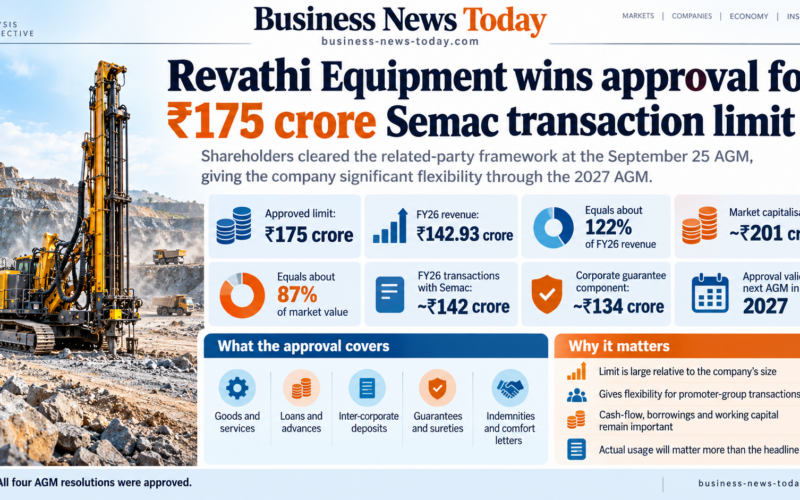
Revathi Equipment India Limited (NSE: RVTH), the Coimbatore-based manufacturer of drilling equipment for mining, construction, exploration and water-well applications, has secured shareholder approval for material related-party transactions of up to ₹175 crore with Semac Construction Limited. Shareholders approved all four resolutions placed before the company’s seventh Annual General Meeting held on September 25, with voting results and the scrutiniser’s report subsequently filed with the National Stock Exchange of India. The ₹175 crore related-party transaction ceiling is particularly significant because it is equivalent to approximately 122% of Revathi Equipment India Limited’s ₹142.93 crore consolidated revenue from operations in fiscal 2026 and about 87% of the company’s latest NSE market capitalisation. Approval does not mean the entire ₹175 crore will necessarily be transacted, but it gives the company substantial flexibility for transactions with a promoter-group entity at a time when working capital, borrowings and cash generation have become increasingly important financial variables.
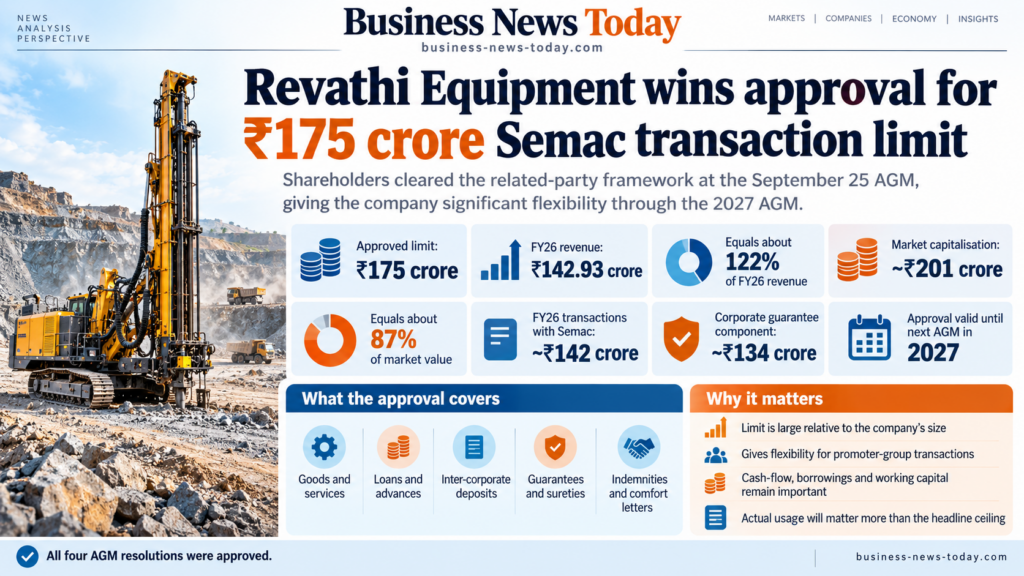
The approved framework covers potential sale, purchase or supply of goods and services, loans and advances, inter-corporate deposits, guarantees, sureties, indemnities and comfort letters involving Semac Construction Limited. The authorisation runs from the date of the September 25 AGM until the next Annual General Meeting in 2027. Semac Construction Limited is part of the same promoter group and is under common management, making the transaction framework subject to the related-party safeguards under securities regulations.
How large is Revathi Equipment India’s Rs 175 crore Semac transaction limit compared with its business?
The ₹175 crore ceiling is unusually large when measured against Revathi Equipment India Limited’s current operating scale. Consolidated revenue from operations fell to ₹142.93 crore in fiscal 2026 from ₹178.53 crore in fiscal 2025, a decline of roughly 20%. The newly approved annual related-party transaction capacity therefore exceeds an entire year of the company’s latest consolidated operating revenue.
The comparison with market value is similarly substantial. Revathi Equipment India shares closed at ₹654.60 on the National Stock Exchange of India on September 25. With paid-up equity capital of approximately ₹3.07 crore divided into shares with a ₹10 face value, the closing price implies an equity-market value of roughly ₹201 crore. The ₹175 crore related-party transaction ceiling is therefore equivalent to nearly nine-tenths of that quoted equity value.
Neither comparison means ₹175 crore will flow out of Revathi Equipment India Limited or that shareholders will incur a corresponding financial loss. The resolution establishes an overall permissible limit covering several possible forms of transaction, including ordinary commercial dealings and financial support arrangements. The actual balance-sheet effect will depend on which transactions are entered into, their duration, pricing, security structure and whether amounts such as guarantees ever translate into cash obligations.
Revathi Equipment India Limited disclosed that transactions with Semac Construction Limited during fiscal 2026 totalled approximately ₹142 crore under the relevant framework. A major component was a corporate guarantee of around ₹134 crore, alongside inter-corporate deposits and related interest transactions. The newly approved ₹175 crore ceiling is lower than the ₹300 crore limit previously approved, but it continues to provide considerable financial flexibility between the related companies.
What kinds of transactions can Revathi Equipment undertake with Semac Construction under the approval?
The shareholder resolution is deliberately broad. Revathi Equipment India Limited can engage with Semac Construction Limited for the purchase, sale or supply of goods and services as well as financial transactions such as loans, advances and inter-corporate deposits. The framework also allows guarantees, sureties, indemnities and comfort letters, subject to the overall approved limit and applicable regulatory requirements.
The company indicated that the corporate-guarantee component may extend up to ₹150 crore. That is particularly relevant because guarantees do not initially have the same cash-flow impact as a loan or deposit but create contingent exposure if the underlying borrower fails to meet its obligations and the guarantee is subsequently invoked. Investors therefore need to distinguish between approved exposure, outstanding guarantees and actual cash payments.
Inter-corporate deposits carry a more immediate financing dimension. The disclosed framework contemplates interest rates broadly between 8% and 15% per annum depending on the relevant transaction, while Revathi Equipment India Limited has indicated a borrowing rate from its bankers of around 9.5%. Whether an inter-company financing transaction is economically beneficial will therefore depend on whether the company is borrowing from or lending to Semac Construction, the actual interest rate and the alternative cost of funding available to each party.
The ₹175 crore figure should consequently be treated as a maximum approval envelope rather than a forecast of transaction volume. The more useful disclosures will be the related-party balances reported in subsequent quarterly and annual accounts, which should reveal how much of the authorised capacity is actually being used.
Why does Revathi Equipment’s cash-flow position make the related-party approval important?
Revathi Equipment India Limited generated accounting profit during fiscal 2026 but experienced significant pressure in operating cash flow. Consolidated profit after tax was ₹13.84 crore for the year, down from ₹20.18 crore in fiscal 2025, while net cash used in operating activities reached approximately ₹30.15 crore compared with positive operating cash flow of ₹27.88 crore a year earlier.
Working-capital movements explain much of that deterioration. Consolidated trade receivables increased to approximately ₹61.06 crore at March 31, 2026 from ₹25.15 crore a year earlier, an increase of more than 140%. Inventories remained elevated at approximately ₹71.94 crore, while other working-capital movements also absorbed cash.
Short-term borrowings increased sharply in response. Consolidated current borrowings reached approximately ₹67.65 crore at the end of fiscal 2026 compared with ₹35.93 crore at March 2025, an increase of about 88%. Finance costs remained around ₹9.37 crore for the year, consuming a meaningful proportion of operating earnings.
Those figures make financial transactions with related companies more consequential than they might appear from the AGM resolution alone. Inter-corporate deposits, guarantees or other support can influence liquidity and borrowing flexibility, particularly when the underlying business is already carrying substantial inventory and receivable requirements. The central financial test is whether related-party arrangements improve capital efficiency without weakening Revathi Equipment India Limited’s ability to fund its own manufacturing operations.
Why did Revathi Equipment India’s FY26 profit fall despite a strong March quarter?
Fiscal 2026 was highly uneven. Consolidated revenue from operations declined approximately 19.9% to ₹142.93 crore from ₹178.53 crore, while consolidated profit after tax fell about 31.4% to ₹13.84 crore from ₹20.18 crore. Total consolidated income declined to ₹156.29 crore from ₹188.84 crore.
The fourth quarter was considerably stronger than the full-year trend. March-quarter consolidated revenue from operations reached ₹65.61 crore compared with ₹64.50 crore a year earlier, while quarterly profit after tax increased to approximately ₹14.25 crore from ₹9.34 crore. The company therefore generated more profit in Q4 alone than it reported across the entire fiscal year, reflecting losses or very weak profitability in earlier quarters.
That volatility is important when valuing Revathi Equipment India Limited. The drilling-equipment business can experience significant variation depending on the timing of machine deliveries, customer acceptance, product mix and procurement schedules. A strong quarter can therefore materially change full-year profitability without necessarily establishing a new quarterly run rate.
The company’s customer base includes large mining businesses such as Coal India Limited, Tata Steel, NMDC Limited and Vedanta Limited, while its equipment has also been supplied into international markets. Large-ticket capital equipment orders can create greater quarterly revenue variability than businesses built around continuously recurring consumer transactions.
What does Revathi Equipment’s Q1 FY27 performance indicate about the September-quarter outlook?
The June 2026 quarter produced moderate revenue growth but much weaker profitability than the exceptionally strong March quarter. Standalone revenue from operations reached approximately ₹29.48 crore, compared with roughly ₹22 crore in the corresponding period a year earlier, while total income was ₹31.48 crore.
Profit before tax was approximately ₹0.81 crore and profit after tax was ₹0.70 crore. That represented a sharp sequential decline from the March quarter, when Revathi Equipment India Limited generated standalone profit after tax of ₹14.10 crore. The difference demonstrates the extent to which quarterly delivery schedules affect reported earnings.
Finance costs of approximately ₹2.35 crore in the June quarter also remained substantial compared with pre-tax profit. The September-quarter results will therefore need to show whether the company can generate enough operating margin to absorb financing costs more comfortably while managing its enlarged working-capital base.
Revathi Equipment India Limited has already announced closure of its trading window for the quarter ending September 30. Q2 revenue, profit, receivables, inventory and borrowings should provide a useful indication of whether the weaker Q1 earnings were mainly a function of delivery timing or reflect continued pressure on operating economics.
How does Semac Construction fit into Revathi Equipment India’s corporate structure?
Revathi Equipment India Limited emerged from a restructuring of the former Revathi Equipment business. Under a composite scheme approved by the National Company Law Tribunal in 2023, the drilling-equipment business of the former company was transferred to Renaissance Corporate Consultants Limited, which was subsequently renamed Revathi Equipment India Limited.
Shares in the resulting drilling-equipment company were allotted to eligible shareholders under the scheme and Revathi Equipment India Limited was listed on the National Stock Exchange of India and BSE Limited in September 2024. The company operates its manufacturing plant at Malumachampatti near Coimbatore, where it has installed capacity to manufacture approximately 100 drill machines annually.
Semac Construction Limited, formerly known as Semac Consultants Limited, remains within the same promoter group. The common promoter and management connections are the reason transactions between the companies are governed by related-party rules and, once prescribed thresholds are crossed, require approval from shareholders who are eligible to vote.
The relationship does not make every commercial transaction inappropriate. Companies within the same industrial group can share services, financing or guarantees for legitimate commercial reasons. The governance issue is whether transactions are transparently disclosed, fairly priced and structured in a manner that protects the interests of Revathi Equipment India Limited and its non-promoter shareholders.
What does Revathi Equipment’s mining-equipment business actually manufacture?
Revathi Equipment India Limited designs and manufactures drilling equipment used across mining, quarrying, construction, exploration and water-well applications. Its product portfolio includes rotary and down-the-hole blast-hole drills, jackless drills, exploratory drilling equipment, hydro-fracturing units and deep water-well drilling systems.
The company also provides maintenance and repair services for drilling fleets, giving it an aftermarket opportunity alongside equipment sales. Its manufacturing history stretches back several decades, while the present listed structure resulted from the more recent corporate demerger.
The company has supplied drilling machines to customers across India as well as international markets including Australia, Brazil, Indonesia, South Africa and the United States. Mining customers use such equipment across commodities including coal, iron ore, copper, gold, zinc, limestone and bauxite.
That underlying industrial exposure means Revathi Equipment India Limited can benefit from capital expenditure by mining companies, quarry operators and infrastructure businesses. It also means demand can be cyclical and influenced by customer investment budgets, commodity markets and the timing of major equipment replacement programmes.
Why has the Revathi Equipment share price fallen sharply from its 52-week high?
Revathi Equipment India Limited shares closed at ₹654.60 on September 25, down 0.97% during the session. The stock was approximately 10.4% lower over the preceding month and around 44% lower over one year.
The share price has traded across an unusually wide 52-week range of approximately ₹491 to ₹1,300. At the latest NSE close, the stock remained roughly 50% below the upper end of that range while standing about one-third above the annual low.
Trading liquidity is also limited. Only around 874 Revathi Equipment India shares changed hands on the National Stock Exchange of India on September 25, meaning relatively modest buying or selling activity can sometimes produce larger percentage moves than would typically occur in more liquid large-cap stocks.
The September 25 closing price implies a market capitalisation of approximately ₹201 crore. Against that value, the company generated ₹13.84 crore of consolidated fiscal 2026 profit after tax, but earnings were heavily concentrated in the March quarter. The valuation therefore depends substantially on whether future quarters produce more consistent profitability.
What should investors monitor after approval of the Rs 175 crore related-party transaction limit?
Actual utilisation of the ₹175 crore authority should be the first measurable variable. Quarterly related-party disclosures will show whether new inter-corporate deposits, guarantees, goods transactions or service arrangements are entered into with Semac Construction Limited and how large the outstanding balances become.
Cash flow is equally important. Revathi Equipment India Limited’s ₹30.15 crore negative operating cash flow in fiscal 2026 contrasted sharply with positive accounting profit and resulted partly from the large increase in trade receivables. A reversal of those working-capital outflows would strengthen the company’s ability to fund operations internally.
Borrowings provide another test. Current borrowings almost doubled during fiscal 2026 to ₹67.65 crore, while finance costs remained significant relative to earnings. Stronger collections and higher operating cash generation could reduce dependence on short-term financing, while continued working-capital expansion would keep liquidity management central to the investment case.
The September-quarter results will provide the next operating evidence. Revathi Equipment India Limited needs to demonstrate that the weak Q1 profit was a timing issue rather than the beginning of another prolonged period of low earnings. Revenue conversion, margin recovery, receivable collection and borrowing levels will provide clearer evidence than AGM approvals alone.
Shareholders have now provided Revathi Equipment India Limited with substantial flexibility to transact with Semac Construction Limited through the next AGM. The ₹175 crore ceiling is large relative to both revenue and market capitalisation, but its ultimate significance depends on how much of that capacity is actually used and for what purpose. The most constructive outcome would combine transparent related-party dealings with stronger equipment deliveries, improved operating cash flow and reduced reliance on short-term borrowing.
Key takeaways from Revathi Equipment India’s AGM and Rs 175 crore Semac transaction approval
- Revathi Equipment India Limited shareholders approved all four resolutions at the company’s seventh Annual General Meeting.
- The most financially significant resolution authorises material related-party transactions with Semac Construction Limited of up to ₹175 crore.
- The ₹175 crore ceiling equals approximately 122% of Revathi Equipment India Limited’s fiscal 2026 consolidated revenue from operations.
- The limit also represents roughly 87% of the company’s approximately ₹201 crore market capitalisation at the September 25 NSE closing price.
- The approved framework can include goods, services, loans, advances, inter-corporate deposits and guarantees.
- A corporate-guarantee component of up to approximately ₹150 crore can fall within the approved related-party framework.
- Fiscal 2026 consolidated revenue fell about 20% to ₹142.93 crore and consolidated profit after tax declined about 31% to ₹13.84 crore.
- Consolidated operating cash flow was negative ₹30.15 crore in FY26 as trade receivables rose sharply.
- Current borrowings increased to approximately ₹67.65 crore from ₹35.93 crore a year earlier.
- Revathi Equipment India shares closed at ₹654.60 on September 25, roughly 50% below the upper end of their 52-week trading range.
Discover more from Business-News-Today.com
Subscribe to get the latest posts sent to your email.