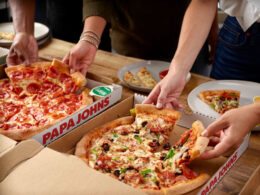




RAVE Restaurant Group Inc. shares plunged more than 23% after the Pizza Inn and Pie Five franchisor reported higher annual revenue, improved profitability and its strongest pre-tax earnings in 23 years, but also disclosed weaker fourth-quarter comparable sales and continued deterioration at Pie Five. Fiscal 2026 revenue increased 7.2% to $12.9 million, net income rose to $2.88 million from $2.70 million and adjusted EBITDA increased to $3.9 million from $3.6 million. Operating income reached $3.47 million, while pre-tax income climbed to $3.88 million, a level management described as the company’s highest in more than two decades. The stock nevertheless closed near $2.11, down approximately 23%, after touching a new 52-week low as investors digested softer recent restaurant trends and a governance disclosure involving Chief Executive Officer Brandon Solano and the board.
The results show a business that has become significantly more profitable over the past several years even though revenue remains modest and growth is heavily dependent on Pizza Inn. Domestic Pizza Inn comparable sales increased 2.4% for the full year and its buffet count expanded for a fifth consecutive fiscal year, while RAVE signed a 10-restaurant development agreement that could accelerate unit expansion. Pie Five moved in the opposite direction, with annual comparable sales falling 9.9% and its domestic unit count declining to 13. The combination leaves RAVE with a healthier balance sheet and stronger cash generation but also a widening performance gap between its two restaurant concepts.
Pizza Inn delivers a fifth year of growth as RAVE prepares for faster franchise expansion
Pizza Inn remains the central driver of RAVE’s turnaround. Domestic comparable store retail sales increased 2.4% during fiscal 2026, marking a fifth consecutive year of same-store sales growth alongside a fifth consecutive year of net growth in buffet restaurant count.
The domestic Pizza Inn system ended the year with 91 restaurants, including 80 buffet locations, four delivery and carryout units and seven express restaurants. Another 18 locations operate internationally, bringing the overall Pizza Inn system to 109 franchised restaurants.
Management wants fiscal 2027 to produce a more meaningful increase in openings after several years of relatively modest expansion. Pizza Inn opened another restaurant after year-end and signed a 10-buffet development agreement with an experienced multi-brand restaurant operator that is new to the Pizza Inn system, with the first five locations expected to open during the current fiscal year.
That agreement could materially increase unit growth for a brand whose domestic footprint remains relatively small. Because RAVE operates primarily as a franchisor rather than owning large numbers of restaurants directly, new units can expand royalty and supplier-related revenue without requiring the company to fund the full restaurant construction cost.
Franchise royalties totaled $4.68 million during fiscal 2026, up modestly from $4.62 million, while supplier and distributor incentive revenue rose more substantially to $5.73 million from $4.94 million. Those two sources together account for most of RAVE’s revenue and demonstrate why higher franchise sales and a larger restaurant network can create operating leverage at the corporate level.
The challenge is that Pizza Inn momentum weakened late in the year. Domestic comparable sales fell 2.8% during the fourth quarter after increasing 6.3% in the prior-year comparison, making the upcoming quarters an important test of whether the annual growth streak can continue.
RAVE is responding with new marketing and menu initiatives, including another partnership with Dr Pepper and the Southeastern Conference and additional products scheduled to receive increased media support. Those initiatives may help traffic, but sustained franchise expansion will depend on restaurant-level economics remaining attractive enough for existing and new operators to commit capital.
Pie Five continues shrinking as its 17% fourth-quarter comparable sales decline deepens the strategic divide
Pie Five remains the weak point in the portfolio. Domestic comparable store retail sales declined 9.9% for the full fiscal year and fell 17.3% during the fourth quarter, extending a multi-year period of pressure for the fast-casual pizza concept.
The domestic Pie Five system finished the year with only 13 restaurants after a net reduction of four units during fiscal 2026. RAVE also closed the remaining Pie Five ghost kitchen during the year and states in its annual report that it expects Pie Five unit count to decline further in future periods.
That trajectory contrasts sharply with Pizza Inn’s renewed franchise development. RAVE is therefore increasingly becoming a Pizza Inn-led business, with Pie Five contributing a smaller share of royalties while occupying management and marketing resources.
Pie Five royalty revenue fell to approximately $497,000 from $632,000, while Pizza Inn royalties increased to $4.18 million from $3.99 million. The divergence highlights how the stronger Pizza Inn brand is offsetting contraction elsewhere rather than both concepts participating in the recovery.
For investors, the strategic question is whether RAVE can stabilize Pie Five without diverting capital and attention away from the better-performing Pizza Inn franchise. Continued unit closures could reduce revenue further, but a smaller and more rationalized Pie Five footprint may also limit losses if management concentrates on stronger locations.
The company has already discontinued several non-core formats. Its final Pizza Inn Express kiosk closed during fiscal 2026, and management said it does not currently plan to reopen that concept, suggesting RAVE is becoming more selective about where it deploys franchise-development resources.
Record pre-tax profit and a debt-light balance sheet strengthen RAVE’s financial position
RAVE’s financial position is considerably stronger than the small revenue base might suggest. Net income rose 6.5% to $2.88 million while operating income increased to $3.47 million from $3.25 million, continuing a multi-year improvement in corporate profitability.
Management said operating income has grown at a compound annual rate of nearly 17% over the past five years. That performance reflects the economics of a franchising model where incremental royalty and supplier revenue can carry relatively high margins once corporate overhead is covered.
RAVE also ended the year with $1.1 million of cash and $12.5 million invested primarily in U.S. Treasury bills, bringing combined cash and short-term investments to approximately $13.6 million. That was up $3.7 million during the fiscal year and represents a substantial liquidity position relative to the company’s market capitalization.
Total liabilities were only about $2.2 million, including lease and deferred-revenue obligations, while the balance sheet showed no conventional long-term borrowings. The absence of meaningful financial debt reduces refinancing risk and gives management flexibility to support franchise development, marketing or shareholder returns.
Operating cash flow increased to $3.6 million from $3.4 million. That amount exceeded annual net income, reinforcing the cash-generative nature of the franchise model even though absolute earnings remain small.
The company’s fourth-quarter performance was less impressive than the annual figures. Revenue increased 8.8% to $3.4 million and adjusted EBITDA rose 4.9% to $1.2 million, but net income declined 6.2% to $800,000 and pre-tax income fell 7.3%.
That deceleration helps explain why investors may have focused less on the full-year profit record than on what the quarter suggests about current trading conditions. Pizza Inn and Pie Five both reported negative comparable sales in the quarter, making restaurant-level momentum the most important metric heading into fiscal 2027.
CEO complaint adds governance uncertainty as shares fall to a new 52-week low
RAVE’s annual filing also introduced a governance issue unrelated to restaurant operations. Chief Executive Officer Brandon Solano formally complained to the chairman of the audit committee about alleged workplace harassment and discrimination by the board in connection with assertions involving intimidation, threats and the company’s failure to increase his annual base salary.
The board said it takes the claims seriously and retained Hagan Law Group to conduct an investigation. The disclosure does not establish that the allegations are substantiated, and the investigation remains the appropriate process for determining the facts.
The timing nevertheless adds uncertainty because Solano has led RAVE during the period in which Pizza Inn returned to positive comparable sales growth and corporate profitability improved materially. Any prolonged disagreement between the chief executive and board could become a distraction as management tries to accelerate franchise openings. The stock reaction was severe. RAVE closed around $2.11 after falling approximately 23%, with trading volume far above recent averages and the shares finishing near a fresh 52-week low.
A single session does not establish why every shareholder sold, and there is no basis to attribute the entire decline to any one item in the report. Investors were presented simultaneously with weaker fourth-quarter comparable sales, continued Pie Five contraction, a slower recent profit comparison and the board dispute, despite otherwise positive annual earnings and liquidity trends.
The selloff leaves RAVE with a market capitalization of roughly $30 million based on approximately 14.2 million shares outstanding, while the company holds $13.6 million in cash and short-term investments. That unusually large liquidity position relative to equity value may attract attention if Pizza Inn’s expansion plan succeeds, although small-cap restaurant stocks can remain volatile and thinly traded.
Fiscal 2027 therefore becomes an important proof point. RAVE needs to demonstrate that Pizza Inn’s five-year recovery can survive the recent comparable-sales slowdown, translate the 10-unit development agreement into actual openings and prevent Pie Five weakness from consuming the benefits of the stronger brand.
Key takeaways from RAVE Restaurant’s record profit, Pizza Inn growth and stock selloff
- Fiscal 2026 revenue increased 7.2% to $12.9 million, while net income rose to $2.88 million from $2.70 million.
- Pre-tax income reached $3.88 million, which management described as RAVE’s strongest pre-tax profitability in 23 years.
- Pizza Inn domestic comparable sales increased 2.4% for the full year, marking a fifth consecutive year of same-store sales growth.
- Pizza Inn buffet restaurant count also increased for a fifth consecutive fiscal year.
- RAVE signed a 10-buffet development agreement, with the first five restaurants expected to open during fiscal 2027.
- Fourth-quarter Pizza Inn comparable sales fell 2.8%, creating an important near-term test for the brand’s recovery.
- Pie Five comparable sales declined 9.9% annually and 17.3% in the fourth quarter as the domestic network contracted to 13 units.
- Cash and short-term investments increased to approximately $13.6 million, while the company carries no meaningful conventional debt.
- RAVE disclosed that CEO Brandon Solano filed a complaint involving alleged harassment and discrimination by the board, which is being investigated by outside counsel.
- Shares fell roughly 23% as investors weighed record annual profitability against weaker recent restaurant trends, continued Pie Five contraction and new governance uncertainty.
Discover more from Business-News-Today.com
Subscribe to get the latest posts sent to your email.