
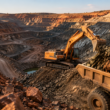


Ramelius Resources Limited (ASX: RMS) has raised its FY30 gold production outlook to between 560,000 and 610,000 ounces while setting FY27 growth capital expenditure at A$480 million to A$570 million, laying out the scale of investment required to transform the Western Australian producer into a substantially larger mining group.
The FY30 target represents an 11% increase from the company’s October 2025 plan and approximately 205% growth compared with FY26 production. Ramelius Resources Limited expects FY30 all-in sustaining costs of A$2,100-A$2,400 an ounce, while FY27 guidance has been set at 205,000-225,000 ounces at A$2,150-A$2,350 an ounce.
Investors initially welcomed the enlarged production pathway. Ramelius Resources Limited shares traded around A$3.85 late in the morning on September 21, approximately 7.5% higher, indicating that the market was focusing on the scale of future production and the company’s financing capacity despite a notable rise in near-term capital requirements.
How does Ramelius Resources Limited plan to reach 610,000 ounces a year?
The growth plan is centred on Ramelius Resources Limited’s Mt Magnet production hub and the development of Rebecca-Roe, creating a portfolio with significantly greater throughput and geographic diversification than the company operated only a few years ago.
At Mt Magnet, Ramelius Resources Limited has selected Primero as engineering, procurement and construction contractor for a new three-million-tonne-per-year second processing circuit. The expanded infrastructure is intended to lift processing capability while allowing future capacity beyond the planned 4.3 million tonnes per year, giving the company greater ability to process ore from its growing resource base around Mt Magnet, Galaxy and Cue.
Rebecca-Roe adds another major production platform. The project gives Ramelius Resources Limited a pathway toward a multi-hub gold business rather than relying disproportionately on one processing centre, but it also increases simultaneous development requirements and the amount of capital being deployed before FY30 output reaches its intended level.
The production target is supported heavily by higher-confidence material, although Ramelius Resources Limited has noted that a portion of the Mt Magnet outlook includes Inferred Mineral Resources, which by definition carry lower geological confidence. The company has consequently warned that there is no certainty every component of the production target will be realised exactly as modelled.
Why has the Mt Magnet expansion become more expensive?
The estimated total expenditure for the Mt Magnet plant expansion has increased to approximately A$280 million from A$223 million, a rise of about 26%. Ramelius Resources Limited attributed the increase to inflation, greater fixed-price coverage and additional infrastructure designed to support processing capacity above the currently planned level.
That distinction matters because not every dollar of the increase represents simple cost overrun. Some spending is intended to create additional operating flexibility and potentially avoid another expensive capacity expansion later. Nevertheless, shareholders still have to fund the expenditure before those benefits arrive.
FY27 growth capital of A$480 million-A$570 million is therefore the number sitting beside the larger production target. The investment spans plant expansion, project development and other growth work necessary to convert Ramelius Resources Limited’s enlarged resource and reserve base into physical ounces.
The company argues that the programme is fully funded. Cash, gold and investments exceed A$1 billion, giving Ramelius Resources Limited an unusually strong liquidity position for a gold producer embarking on such a large development cycle.
What do Ramelius Resources Limited’s FY26 results say about its ability to fund growth?
Ramelius Resources Limited entered the new investment cycle from a strong operating position. FY26 underlying EBITDA reached A$765.4 million at a record 74% margin, while underlying net profit after tax was A$319.9 million.
Full-year production reached 192,182 ounces at an all-in sustaining cost of A$1,983 an ounce. The June quarter alone produced 53,466 ounces at A$1,973 an ounce, while the company continued generating substantial operating cash flow.
Those results matter because the production-growth strategy is being pursued from a cash-generative base rather than being funded entirely ahead of first production. Ramelius Resources Limited can use earnings from existing mines while constructing the assets designed to take output beyond half a million ounces annually.
Gold prices provide another cushion. Management’s FY30 free-cash-flow scenario points to as much as A$1.5 billion at a gold price of A$5,500 an ounce, although commodity assumptions should not be treated as guaranteed realised prices.
Why did Ramelius Resources Limited shares jump despite higher capital expenditure?
The September 21 rally suggests investors attached considerable value to the higher production trajectory and the company’s assertion that it can fund the programme internally from its existing financial position.
A higher capital bill often pressures mining shares when financing uncertainty rises. Ramelius Resources Limited is in a different position because more than A$1 billion of cash, gold and investments provides a substantial buffer, while existing operations are already profitable and generating cash.
The market is also comparing the additional expenditure with the scale of output it may unlock. Moving from 192,182 ounces in FY26 to a FY30 range of 560,000-610,000 ounces would fundamentally alter Ramelius Resources Limited’s production profile and potentially the peer group against which investors value the company.
That does not make execution risk disappear. New processing infrastructure must be built on schedule, mining operations have to supply the required ore, Rebecca-Roe must progress successfully and cost inflation needs to remain contained enough for the A$2,100-A$2,400 FY30 AISC range to remain realistic.
What should investors watch as Ramelius Resources Limited enters its heavy-spending phase?
The most immediate indicator will be capital discipline during FY27. With a A$90 million spread between the low and high ends of growth expenditure guidance, even performance within guidance can produce significantly different cash outcomes.
Progress on the new Mt Magnet circuit will be equally important. Primero’s EPC appointment adds execution structure, but processing-plant expansions remain exposed to labour, procurement, commissioning and ramp-up risk.
Rebecca-Roe development will provide another critical test because the company’s FY30 ambitions depend on production growth across more than one hub. The stronger the reserve conversion and development execution, the more confidence investors can place in the outer-year production profile.
Ramelius Resources Limited has effectively moved the market conversation from whether it can become a larger gold producer to how efficiently it can deliver the transformation. The 7.5% share-price response indicates investors liked the September 21 answer, but the next several years will determine whether 610,000 ounces becomes operating reality rather than an attractive number on a production chart.
Discover more from Business-News-Today.com
Subscribe to get the latest posts sent to your email.