
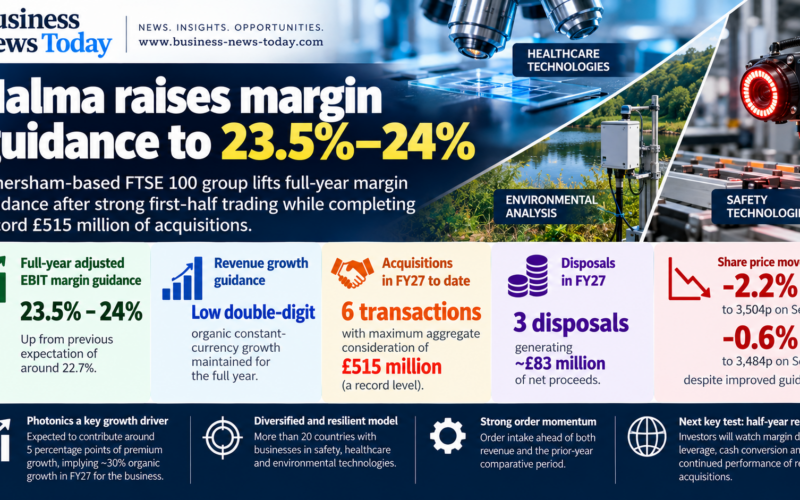
Halma plc (LSE: HLMA), an Amersham-based FTSE 100 group of safety, environmental-analysis and healthcare technology companies operating across more than 20 countries, has increased its full-year adjusted EBIT margin guidance after strong first-half trading. Management now expects a margin of 23.5% to 24%, compared with its previous expectation of around 22.7%, while continuing to forecast low double-digit organic constant-currency revenue growth. Halma shares closed 2.2% lower at 3,504p on September 24 and slipped another 0.6% to 3,484p the following session despite the improved guidance.
The margin upgrade arrives during one of Halma’s busiest acquisition periods. The company has completed six transactions in FY27 to date with maximum aggregate consideration of £515 million, a record level of deployment, while also completing three disposals that generated approximately £83 million of net proceeds. Halma says its acquisition pipeline remains healthy across all three operating sectors.
Why is Halma raising margins while continuing to buy businesses aggressively?
Halma’s decentralised model allows acquired companies to retain operational independence while gaining access to group capital, management expertise and international networks. This reduces the need for expensive central integration programmes and is one reason the company has historically been able to complete multiple acquisitions without disrupting the broader portfolio.
The latest trading update suggests the model is continuing to produce operating leverage. Order intake remained ahead of both revenue and the prior-year comparable period, while stronger performance across the portfolio prompted management to raise margin expectations rather than simply maintain them.
This is particularly relevant after £515 million of acquisition spending because investors need to distinguish value-creating M&A from revenue purchased at any price. Higher group margins while integrating new assets provide one early indication that recent deals are not immediately dilutive to overall profitability.
The more demanding test will arrive over several years. Halma typically acquires specialised companies with attractive margins and niche leadership positions, but paying premium multiples only creates shareholder value if those businesses continue compounding after joining the group.
How important has photonics become to Halma’s growth rate?
Photonics is expected to provide around five percentage points of premium growth in FY27, implying approximately 30% organic constant-currency growth for that business. Halma defines the premium as the incremental growth above the group’s long-term 7% organic-growth benchmark, making photonics one of the largest contributors to this year’s acceleration.
The business benefits from applications in areas such as medical diagnostics, life-science instrumentation and advanced optical systems, markets that fit Halma’s broader focus on safety, healthcare and environmental technologies. Rapid growth in one specialised division can have a meaningful effect on a diversified group when the starting margins are attractive.
Investors should nevertheless distinguish a temporary growth burst from a permanent group growth rate. Halma is still guiding to low double-digit organic revenue growth overall rather than 30%, and photonics eventually faces more difficult comparisons as the base becomes larger.
The value lies in portfolio diversification. A high-growth photonics business can offset slower conditions elsewhere without requiring Halma to change its long-term acquisition model or depend on a single end market.
Is £515 million of M&A too much for Halma to absorb at once?
The number is large even for Halma. Recent acquisitions include businesses across healthcare and analytical technologies, and several individual transactions carry purchase prices well into nine figures. Such deployment can accelerate earnings, but it also raises integration, valuation and capital-allocation risk.
Halma’s response is its operating architecture. Acquired management teams generally retain substantial autonomy, reducing the complexity of forcing each business onto a uniform operating structure. Central management instead concentrates on capital allocation, leadership development and portfolio discipline.
Disposals are another important part of the model. The company has generated about £83 million of net proceeds from three disposals this year, demonstrating a willingness to recycle assets rather than allowing the portfolio only to become larger.
Investors should still monitor leverage when the half-year balance sheet becomes available. Record acquisition spend can remain attractive only if cash generation and financial flexibility continue supporting the group’s ability to invest through future cycles.
Why did Halma shares fall despite upgraded guidance?
The September 24 session was volatile. Halma traded as high as 3,726p but closed at 3,504p, down 2.2%, and then finished September 25 around 3,484p. The movement demonstrates that stronger guidance does not automatically translate into a higher share price when valuation expectations are already demanding.
Halma had previously traded above 4,900p in June, meaning the shares had already undergone a substantial de-rating before the September update. Investors may therefore be balancing improved operational performance against acquisition expenditure, currency headwinds and the valuation multiple typically attached to a high-quality compounder.
Currency is not insignificant. Halma estimated that prevailing sterling exchange rates, if maintained, could reduce reported full-year revenue by approximately £8 million and profit by around £2 million. That impact is modest against group scale but demonstrates how international exposure can dilute strong constant-currency growth.
The correct conclusion is not that investors rejected the trading update. The stock remains subject to broader valuation and portfolio considerations that can overwhelm a single guidance upgrade over one or two sessions.
What should Halma investors watch when the half-year results arrive?
First, the accounts need to show how record M&A deployment has affected leverage and cash conversion. Halma has historically earned investor confidence through disciplined balance-sheet management, so maintaining that reputation is important after £515 million of transactions.
Second, the photonics growth rate needs to demonstrate enough durability to justify its substantial contribution to FY27 organic growth. Order intake being ahead of revenue provides support, but investors will eventually want the revenue converted into operating profit and cash.
Third, the raised 23.5%–24% margin guidance becomes a measurable benchmark. If Halma delivers that range while maintaining double-digit organic growth, the company will have produced stronger underlying economics at the same time as absorbing its largest acquisition spend to date.
The share-price weakness therefore creates a useful contrast. Operational guidance has improved while valuation has fallen from its earlier peak. The next results will show whether the earnings trajectory is strong enough to narrow that gap.
Discover more from Business-News-Today.com
Subscribe to get the latest posts sent to your email.