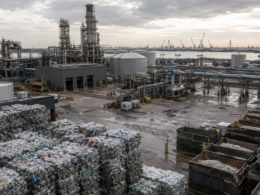





Petronet LNG Limited (NSE: PETRONET; BSE: 532522) delivered one of the more counterintuitive Q1 FY27 results in India’s energy sector, with consolidated revenue from operations falling 53.2% year on year to ₹5,557.84 crore while consolidated net profit increased 34.4% to ₹1,108.27 crore. On a standalone basis, profit before tax increased 33% to ₹1,514.43 crore and profit after tax rose to ₹1,132.72 crore despite lower LNG throughput and sharply weaker terminal utilisation. The explanation sits partly in unusually favourable commercial economics, including ₹301 crore of trading gains and ₹193 crore of inventory gains, which together contributed ₹494 crore during the quarter. The central question for investors is therefore not whether Petronet LNG remained profitable through the disruption, because it clearly did, but how much of Q1’s earnings strength can persist once those gains normalise and QatarEnergy LNG supplies recover.
The operating backdrop was substantially weaker than the profit number suggests. Total LNG processed declined to 207 trillion British thermal units from 220 trillion British thermal units a year earlier, while Dahej processed 192 trillion British thermal units compared with 207 trillion British thermal units in Q1 FY26. Dahej utilisation fell to 66% from 92%, although that comparison is complicated by the commissioning of Petronet LNG’s capacity expansion from 17.5 million tonnes per annum to 22.5 million tonnes per annum. At the same time, Qatar’s force majeure has affected 56 cargoes linked to Petronet LNG, leaving management without definite visibility on September supplies as of its post-results update.
How did Petronet LNG profit rise 34% when Q1 FY27 revenue collapsed by more than half?
The divergence between revenue and profit is the defining feature of the quarter. Consolidated revenue from operations fell from ₹11,879.86 crore in Q1 FY26 to ₹5,557.84 crore, a reduction of approximately ₹6,322 crore. Consolidated net profit nevertheless increased from ₹824.44 crore to ₹1,108.27 crore, meaning Petronet LNG produced approximately ₹284 crore more profit on less than half the previous year’s revenue base.
That does not mean Petronet LNG suddenly became structurally twice as profitable. Revenue in an LNG business can move dramatically with the value and mix of gas being bought and sold, while regasification economics are not directly proportional to the commodity value passing through the terminal. The June quarter also contained particularly favourable trading conditions because spot LNG prices were substantially higher than prices associated with some long-term supplies available to the company. Management disclosed ₹301 crore of trading gains alongside ₹193 crore of inventory gains, taking the combined benefit to ₹494 crore.
Business News Today calculates that the ₹494 crore combined gain was equivalent to approximately 32.6% of Petronet LNG’s ₹1,514 crore standalone profit before tax. That does not mean one-third of PBT can simply be removed to arrive at a recurring earnings number, because underlying trading economics, inventory movements and comparable-period effects also need to be considered. It does, however, establish that Q1’s headline profit growth was materially supported by commercial gains that should not automatically be extrapolated at the same level into every subsequent quarter.
Nomura’s post-results analysis makes the distinction clearer. The brokerage estimated Q1 EBITDA at approximately ₹1,630 crore but placed EBITDA adjusted for trading and inventory gains at about ₹1,260 crore. It also estimated adjusted profit after tax at around ₹840 crore, which was approximately 9% lower year on year even though reported PAT increased sharply. Nomura nevertheless said adjusted EBITDA exceeded its forecast and retained its Buy recommendation with a ₹345 target price.
That difference between reported and adjusted earnings is not necessarily negative. Profiting from favourable LNG trading spreads is part of commercial execution, particularly for a company with access to long-term contracts, storage infrastructure and one of India’s largest LNG import platforms. The more useful question is whether the underlying regasification and contracted business remains sufficiently profitable when those gains return to normal levels.
Why does Dahej’s fall from 92% to 66% utilisation look worse than the actual LNG volume decline?
Petronet LNG’s Dahej terminal utilisation fell dramatically from 92% in Q1 FY26 to approximately 66% in Q1 FY27. At first glance, a 26 percentage-point decline might suggest a severe collapse in physical operations. The underlying throughput numbers tell a more nuanced story.
Dahej processed 192 trillion British thermal units during Q1 FY27 compared with 207 trillion British thermal units a year earlier. Business News Today calculates that physical throughput therefore declined by approximately 7.2%, considerably less than the utilisation-rate comparison might imply. Total company LNG throughput similarly fell approximately 5.9%, from 220 trillion British thermal units to 207 trillion British thermal units.
The reason is the denominator. Petronet LNG completed expansion of Dahej from 17.5 million tonnes per annum to 22.5 million tonnes per annum in March 2026, increasing nameplate capacity by approximately 28.6%. The same level of physical LNG throughput would therefore produce a substantially lower utilisation percentage after expansion than before it.
This does not remove the operational concern. Petronet LNG now owns more regasification capacity but is currently processing less LNG through it than a year ago. The strategic challenge is consequently larger than restoring the previous absolute throughput level. Management ultimately needs sufficient additional LNG demand and reliable supply to fill part of the five-million-tonne expansion and generate an adequate return on the extra infrastructure.
The utilisation comparison nevertheless needs to be framed correctly. Dahej’s decline from 92% to 66% combines two simultaneous developments: physical volumes fell about 7%, while available capacity rose almost 29%. Treating the entire fall in utilisation as evidence of equivalent demand deterioration would materially overstate the underlying change.
How serious is the QatarEnergy LNG force majeure for Petronet LNG’s FY27 volume recovery?
Qatar has become the biggest external variable in Petronet LNG’s near-term operating outlook. Managing Director and Chief Executive Officer Akshay Kumar Singh said after the Q1 results that Petronet LNG had not received a definite Qatar LNG supply plan for September. Qatar has been assessing force majeure on a month-to-month basis following disruption to its LNG industry during the regional conflict, and 56 Petronet LNG cargoes had been affected by the time of the August 13 update.
The scale matters because Qatar has historically been Petronet LNG’s principal long-term source. Under the existing arrangement, delayed cargoes can still be supplied through April 2028, when the present long-term contract expires. That provides contractual flexibility but does not immediately solve the utilisation problem because cargoes delivered much later cannot replace regasification volumes lost during the current quarter.
Petronet LNG has also suspended operations involving three chartered vessels, Disha, Raahi and Aseem, that were used for Qatar-linked LNG imports. Indian buyers have responded to the supply disruption by sourcing gas from markets including Oman, the United States, Nigeria and Angola.
Australia provides another diversification route. Petronet LNG is already importing approximately 1.42 million tonnes annually from the Gorgon project under an existing long-term arrangement with Exxon Mobil Corporation and is progressively adding supplies under another contract that ultimately covers 1.2 million tonnes annually. Management said around 600,000 tonnes are now expected under the newer arrangement during 2026.
For shareholders, the key issue is not simply whether alternative LNG is physically available. Replacement gas sourced from different suppliers can carry different economics from contracted Qatar volumes. Q1 demonstrated that dislocation can occasionally create profitable trading opportunities, but persistent disruption can also reduce terminal throughput and weaken predictability.
Nomura expects Petronet LNG’s volumes to recover fully from Q4 FY27 if QatarEnergy’s force majeure is lifted during Q3 FY27. That remains a brokerage forecast rather than company guidance, but it identifies a useful timetable against which actual recovery can be measured.
Can Petronet LNG fill 22.5 MMTPA of Dahej capacity once Qatar LNG supplies normalise?
The expanded Dahej terminal gives Petronet LNG significantly more physical capacity just as India continues trying to increase the role of natural gas in its energy mix. The timing, however, has been awkward. The expansion reached 22.5 million tonnes per annum in March, immediately before Q1 was heavily affected by the Qatar supply disruption.
This creates an important distinction between short-term and structural utilisation. A terminal operating at 66% because its principal supply corridor is temporarily disrupted presents a different investment case from a terminal operating at 66% because customers no longer require the gas. Current evidence supports a combination of supply disruption and softer demand from some sectors rather than a simple collapse in the commercial relevance of Dahej. Management has cited weaker demand from power and fertiliser users alongside geopolitical supply constraints.
There is already some contracted support for future utilisation. Petronet LNG has continued signing long-term regasification agreements with large industrial and energy customers, while management remains focused on increasing utilisation as supply normalises. The terminal also benefits from existing pipeline connectivity and an established customer base that would be difficult for a new competing facility to replicate immediately.
The critical metric over the remainder of FY27 is therefore not a return to the old 90%-plus utilisation number. Because the denominator has expanded, reaching 90% of 22.5 million tonnes per annum would require substantially greater absolute throughput than reaching 90% of the previous 17.5-million-tonne capacity. A sustained recovery into the 70% to 80% range on the enlarged terminal could still represent considerably more physical LNG than investors might assume from a simple comparison with historical percentages.
CRISIL Ratings highlighted this issue in May, saying maintenance of overall capacity utilisation above 70% in FY27 remained contingent on geopolitical conditions and the timing of QatarEnergy supply resumption. The rating agency nevertheless described Petronet LNG’s financial risk profile as strong, supported by substantial liquidity and high debt-protection metrics.
Why does Petronet LNG’s ₹30,000 crore capex programme make normalised cash generation more important?
Petronet LNG is not merely waiting for LNG volumes to recover. The company is simultaneously moving through one of the largest investment programmes in its history, with management describing a roughly ₹30,000 crore capital-expenditure pipeline centred on petrochemicals and additional infrastructure. Around ₹5,000 crore of spending is targeted during the current financial year.
The largest project is the Dahej petrochemical complex. Petronet LNG has approved approximately ₹20,685 crore for a 750,000-tonne-per-annum propane dehydrogenation unit and associated 500,000-tonne-per-annum polypropylene facility. The company has arranged a ₹12,000 crore secured rupee term-loan facility led by State Bank of India and Bank of Baroda to help finance the project.
CRISIL said in May that the ₹12,000 crore facility had not yet been drawn and noted that the petrochemical project carries execution risk because it represents a large investment in a product-manufacturing business outside Petronet LNG’s traditional regasification model. At the same time, the project is designed to exploit integration benefits at Dahej through shared infrastructure, cold energy and utilities.
Petronet LNG is also pursuing a 5-million-tonne-per-annum land-based LNG terminal at Gopalpur in Odisha. The overall approved value is approximately ₹6,354.8 crore, creating a third major LNG-terminal platform alongside Dahej and Kochi.
These investments change the significance of Q1’s unusual profit composition. A company with limited investment requirements could reasonably allow quarterly trading gains to flow through to cash or shareholder distributions without changing much strategically. Petronet LNG is preparing to deploy tens of thousands of crores into petrochemicals and new LNG infrastructure, meaning recurring operating cash generation becomes increasingly important.
The investment case therefore depends on two transitions occurring simultaneously. Existing LNG assets need to restore utilisation and maintain cash generation, while new projects need to reach commissioning without eroding the financial strength that has historically distinguished Petronet LNG.
What is PETRONET stock signalling after Q1 earnings and the Qatar supply update?
Petronet LNG shares were trading around ₹283.65 at approximately 1:22 p.m. IST on August 17, giving the company a market capitalisation of about ₹42,600 crore. The stock had closed at ₹279.85 on August 12 before the market fully processed the results, slipped marginally to ₹279.30 on August 13 and then gained 1.18% to ₹282.60 on August 14.
The reaction has therefore been relatively restrained despite the unusual earnings profile. Using the August 10 close of approximately ₹280, the stock is up only around 1.3% over five trading sessions. Compared with ₹273.80 on July 17, it has gained approximately 3.6% over one month.
PETRONET remains around 13% below its 52-week high of ₹326.40 and approximately 21% above its ₹235.35 low. That positioning is consistent with a market that recognises Petronet LNG’s strong balance sheet and cash-generating capacity but has not fully dismissed the Qatar volume risk or the execution requirements associated with the petrochemical expansion.
Institutional opinion also remains divided enough to reflect the competing arguments. Nomura retained its Buy rating and ₹345 target after Q1, while its analysis acknowledged that adjusted PAT declined year on year after stripping out trading, inventory and other specified effects. Motilal Oswal subsequently initiated coverage with a Buy rating and ₹362 target, while broader analyst consensus compiled by Trendlyne stood near ₹315. These targets are forecasts rather than independently validated values and depend on assumptions about volume recovery, utilisation, capex and future earnings.
At roughly 10 times trailing earnings according to current market-data services, Petronet LNG is not carrying a valuation that assumes uninterrupted high growth. The question is whether that multiple adequately compensates for near-term Qatar uncertainty while recognising the potential earnings contribution from expanded Dahej capacity and longer-term projects.
What are the key takeaways from Petronet LNG Q1 FY27 results and Qatar supply disruption?
- Petronet LNG Limited reported consolidated Q1 FY27 revenue from operations of ₹5,557.84 crore, down approximately 53.2% year on year.
- Consolidated net profit increased approximately 34.4% to ₹1,108.27 crore despite the sharp decline in revenue and LNG throughput.
- Standalone profit before tax rose 33% to ₹1,514.43 crore and standalone profit after tax increased to ₹1,132.72 crore.
- Trading gains of ₹301 crore and inventory gains of ₹193 crore contributed a combined ₹494 crore during Q1.
- Business News Today calculates that those combined gains were equivalent to approximately 32.6% of standalone profit before tax, making earnings normalisation an important future test.
- Dahej utilisation fell from 92% to 66%, but physical Dahej LNG throughput declined only about 7.2% because nameplate capacity increased 28.6% to 22.5 million tonnes per annum.
- Overall LNG throughput declined approximately 5.9% to 207 trillion British thermal units from 220 trillion British thermal units.
- Qatar’s force majeure had affected 56 Petronet LNG cargoes by August 13, and management did not yet have definite visibility on September Qatar supplies.
- Petronet LNG is simultaneously progressing a roughly ₹30,000 crore investment programme that includes the ₹20,685 crore Dahej petrochemical complex and the ₹6,354.8 crore Gopalpur LNG terminal.
- PETRONET was trading around ₹284 on August 17, approximately 13% below its 52-week high, leaving volume recovery, normalised earnings and capital-project execution as the key rerating variables.
What would prove that Petronet LNG’s Q1 profit strength can survive after trading gains normalise?
Petronet LNG’s Q1 FY27 result should not be read simply as a 34% profit-growth quarter or a 53% revenue-collapse quarter. Both numbers are accurate, but neither captures the economics on its own. Physical LNG volumes declined by only about 6% across the company, Dahej utilisation was distorted downward by a 29% increase in nameplate capacity, and favourable trading and inventory conditions delivered ₹494 crore of additional earnings support.
The immediate risk is Qatar. Fifty-six affected cargoes demonstrate that the force majeure is no longer a minor scheduling issue, and management still lacked firm September supply visibility after the results. Alternative LNG from Australia and other global suppliers reduces dependence on a single source, but restoring the economics of long-term Qatar flows would provide a much clearer path toward higher utilisation at the expanded Dahej terminal.
The longer-term test is capital allocation. Petronet LNG is moving from a predominantly LNG-terminal business into a period that includes a ₹20,685 crore petrochemical investment, a major Gopalpur terminal and other infrastructure spending. Q1’s unusually high margins demonstrate the commercial value of having long-term LNG positions during a dislocated market, but the next phase requires recurring operating cash flows capable of funding large projects and protecting shareholder returns as debt begins to be drawn.
The clearest evidence would therefore be a recovery in Dahej throughput, visibility on Qatar cargoes, EBITDA remaining resilient after trading and inventory gains moderate, and the petrochemical project progressing without weakening Petronet LNG’s traditionally strong liquidity position. If those conditions emerge together, Q1 FY27 will look less like an exceptional trading quarter and more like evidence that Petronet LNG can absorb geopolitical disruption while financing its next stage of growth.
Discover more from Business-News-Today.com
Subscribe to get the latest posts sent to your email.