




Abundia Global Impact Group, Inc. (NYSE American: AGIG) appointed Keith Berger as chief commercial officer on July 21, 2026, giving him responsibility for strategic partnerships and commercial relationships across the company’s waste-to-fuels value chain. Berger will report to Chief Executive Officer Ed Gillespie and work across engineering, finance, operations and project development as Abundia targets a final investment decision for its first Baytown facility by the end of 2026. The appointment is strategically relevant because the renewable-energy business remains pre-revenue, requires substantial additional capital and must turn preliminary project relationships into binding commercial arrangements. For investors, the central question is whether Berger can reduce those execution gaps quickly enough to support financing without another heavily dilutive capital raise.
Why is Abundia Global Impact Group appointing a chief commercial officer at this stage?
Berger is joining as Abundia moves beyond assembling the components of its development platform. The company has secured a site, selected technology providers, appointed a front-end engineering contractor, acquired additional technical capabilities and announced a long-term feedstock arrangement. What it has not yet demonstrated is a completed financing package or an operating commercial-scale renewable-fuels facility.
That distinction explains the timing of the appointment. A development-stage energy company can accumulate technically credible partnerships while still lacking the bankable contracts required by lenders, infrastructure investors and strategic partners. Berger’s role appears designed to connect those technical components with customers, feedstock providers, capital partners and potential product buyers.
Abundia said Berger would lead commercial strategy as the waste-to-fuels and renewable-chemicals business moves from project development toward deployment. He will also coordinate commercial objectives with engineering and financial execution, indicating that the role extends beyond conventional sales.
The appointment therefore creates a clear accountability point. If Abundia’s partnerships progress into definitive supply, engineering, financing and offtake agreements, Berger’s arrival may be viewed as an important organisational step. If those milestones remain preliminary, the additional executive position will have limited significance for valuation.
What commercial execution experience does Keith Berger bring to Abundia’s project pipeline?
Berger brings more than 25 years of experience across industrial technology, energy infrastructure and operational transformation. His earlier public-company roles included positions at General Electric Company, BlackBerry Limited, Nokia Corporation and Booz Allen Hamilton Holding Corporation.
His energy experience may be particularly relevant to Abundia. Berger co-founded and served as chief operating officer of Velo Solar, which developed commercial and utility-scale solar projects across the southeastern United States. He later founded an electric-vehicle charging infrastructure company serving multifamily and hospitality properties, where his responsibilities included raising institutional capital and negotiating agreements with investment funds and property owners.

Berger also led a post-acquisition transformation at Endeavor Telecom while working as a private-equity operating executive. That experience involved rebuilding operations, business systems and leadership structures while diversifying revenue. At HealPros, he worked with national health insurers as the business expanded into more than 15 states.
The common thread is not one particular technology. It is the ability to coordinate technical, commercial and financial parties around businesses requiring external capital and scalable operating systems. That experience fits Abundia’s immediate challenge, although renewable-fuels project financing remains a more capital-intensive test than building a service or software-led commercial organisation.
Berger’s engineering and financial education may also help him communicate across Abundia’s internal functions. He holds engineering qualifications in mechanical engineering and metallurgy, alongside a Master of Business Administration in finance. The practical question is whether that range can help convert development-stage opportunities into contracts carrying sufficient duration, volume and credit quality to support investment.
How does the Cedar Port renewable-energy complex define Berger’s immediate mandate?
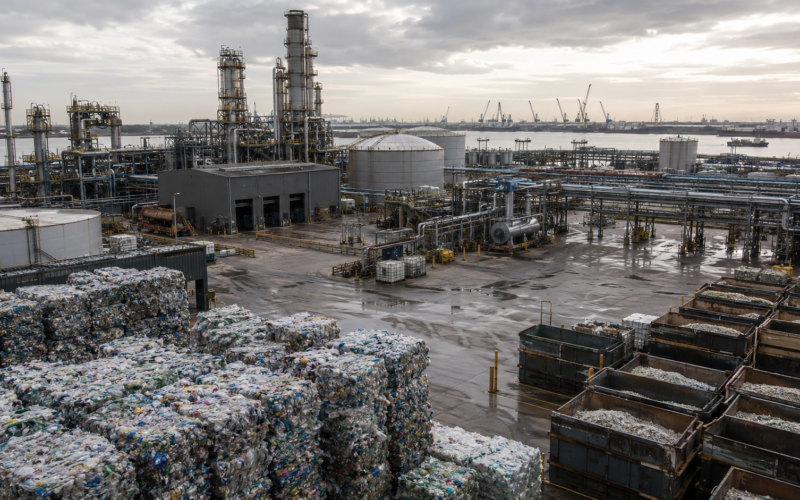
Abundia’s flagship development is located on a 25-acre site at Cedar Port in Baytown, Texas. The site is intended to become the company’s operating headquarters, innovation centre, research and development facility and first commercial waste-plastics-to-fuels complex.
The development has been divided into phases. The first phase establishes the innovation and research platform. A later phase is expected to deploy plastics-pyrolysis technology combined with upgrading systems capable of producing renewable fuels and chemical feedstocks. Future phases may incorporate biomass-based pathways, including potential sustainable aviation fuel production.
Burns & McDonnell was selected in February to complete front-end engineering and design work for the initial commercial facility. Abundia has said that completing this engineering stage is necessary to reach its targeted final investment decision by the end of 2026.
The company has also selected Topsoe’s HydroFlex technology for three proposed North American plastic-waste-to-fuel facilities. The first would be developed in Baytown, with each planned facility expected to produce approximately 1,500 barrels per day when fully operational. Operations at the first facility have been projected for 2029, subject to financing, engineering, construction, permitting and commissioning.
Berger consequently inherits a mandate governed by a relatively short corporate timetable and a substantially longer construction timetable. Reaching a final investment decision in 2026 does not mean commercial production is imminent. It means Abundia must demonstrate that the project’s engineering, capital cost, supply arrangements, product economics and financing structure are sufficiently developed to justify committing capital.
Can existing technology and feedstock partnerships make the Baytown project financeable?
Abundia has assembled several relationships intended to reduce technology and supply-chain risk. Its plastics-to-liquids strategy includes licensed technology from Alterra Energy, while Topsoe’s HydroFlex platform is intended to upgrade liquefied plastic waste into specification-grade fuels and chemical products.
These relationships give Abundia access to established external technology platforms rather than requiring it to develop every component internally. That approach may reduce certain technical risks, but integrating multiple technologies into a commercial plant remains a demanding engineering exercise. Performance warranties, throughput assumptions, product yields, maintenance requirements and operating costs will matter more than the number of announced partnerships.
Feedstock availability is another central issue. In June, Abundia announced commercial terms with Frankfort Plastics covering up to 40,000 tonnes per year of waste-plastic feedstock for ten years. The arrangement also allows Abundia to purchase additional volumes.
The announced commercial terms were described as binding, while broader definitive agreements were expected during the third quarter of 2026. Berger will need to ensure that final documentation adequately addresses pricing, quality specifications, delivery obligations, contamination thresholds and remedies for supply interruptions.
A ten-year supply relationship can improve project credibility, but investors should distinguish nominal capacity from delivered, specification-compliant feedstock. Waste-processing economics can deteriorate quickly when transportation distances, preparation costs or contamination levels rise.
The commercial mandate must also extend to the output side. Abundia will require dependable customers for renewable diesel, chemical feedstocks, sustainable aviation fuel or other planned products. Binding offtake agreements with creditworthy counterparties could materially strengthen the project’s financing case.
Does the RPD Technologies acquisition give Abundia enough internal operating capability?
Abundia completed its acquisition of RPD Technologies Americas on April 1, 2026. RPD provides project development, pilot-plant design, engineering, construction and scale-up services across refining, petrochemicals and renewable energy.
The acquisition was intended to bring more project-development capability inside Abundia while creating a services-based revenue stream. RPD’s operations are expected to support third-party customers as well as Abundia’s internal development pipeline.
That combination could be strategically useful. A technical-services subsidiary may provide market intelligence, engineering talent and customer relationships while the larger renewable-fuels facilities are being developed. It may also reduce Abundia’s reliance on external consultants for certain activities.
However, the financial contribution has not yet been demonstrated in consolidated quarterly results. Because the transaction closed after March 31, RPD was not included in Abundia’s first-quarter operating performance. The next financial disclosure should provide the first clearer evidence of RPD’s revenue, expenses, integration costs and cash contribution.
The transaction also requires careful governance scrutiny because RPD was acquired from Abundia Financial, the company’s controlling shareholder. The consideration included a $4.04 million senior secured convertible promissory note carrying annual interest of 10%. Abundia said the transaction would be accounted for as a business combination under common control.
Berger will therefore need to show that the acquired platform is producing measurable commercial benefits. Integration should be assessed through contracted third-party work, qualified opportunities, project delivery, revenue and cash generation rather than broad references to strategic capability.
Why does Abundia’s financial position make commercial milestones particularly urgent?
Abundia reported $16.2 million of cash and $6.6 million of working capital at March 31, 2026. Those figures represented a substantial improvement from $4.6 million of cash and negative working capital of approximately $1 million at the end of 2025.
The improvement was largely financed externally. Abundia raised approximately $17.1 million through financing activities during the first quarter, primarily following a registered direct offering completed in February. Operating activities used $3.8 million of cash, while investing activities consumed another $1.8 million, partly because of construction spending at Baytown.
The company recorded a first-quarter net loss of $5.23 million, compared with a loss of approximately $1.01 million in the corresponding 2025 period. General and administrative expenses climbed to $4.58 million from $992,599, reflecting higher public-company compliance, legal and investor-relations spending.
Revenue during the quarter was just $132,965 and came from legacy oil and gas operations. Abundia’s renewable-energy segment remained pre-revenue. Management has acknowledged that the segment will not generate product revenue unless the company successfully constructs and commissions its planned plastics-recycling facility.
Abundia also said it would require substantial additional funding to continue operations and pursue its growth strategy. Possible sources include equity, debt, strategic alliances, collaboration agreements and product pre-sales. Each route carries different consequences for shareholders and project control.
This is where Berger’s mandate becomes financially important. Commercial agreements can potentially reduce the cost of capital by demonstrating predictable feedstock supply and future product demand. Without such contracts, investors may continue to treat the project as a speculative development proposition dependent on repeated equity financing.
What dilution and governance risks should AGIG shareholders monitor after the appointment?
Abundia had 44.02 million common shares outstanding at March 31, 2026, up from 36.92 million at the end of 2025. The increase primarily reflected equity financing and the exercise of pre-funded warrants.
The February offering included approximately 4.13 million common shares and pre-funded warrants covering another 1.8 million shares. Abundia also issued shares through an equity line of credit during the first quarter. These transactions strengthened liquidity but expanded the share count, spreading any future project value across a larger ownership base.
Additional capital may be required before the Baytown facility reaches a final investment decision, and considerably more would likely be needed for construction. Project-level debt, infrastructure capital, strategic investment or joint-venture financing could reduce dependence on parent-company equity, but none should be assumed until binding terms are disclosed.
Governance remains another consideration. Abundia Financial held approximately 63% of the outstanding common stock when the RPD acquisition was disclosed. Concentrated control can support faster strategic execution, but minority investors need transparent disclosure around related-party transactions, executive incentives and capital allocation.
Berger’s appointment does not change those structural risks. It creates an opportunity to reduce them by securing third-party commercial validation and capital partners on terms that do not place the entire burden on public shareholders.
What does AGIG’s latest stock performance indicate about investor sentiment?
Abundia shares closed at approximately $1.03 on July 21, down roughly 1.9% from the previous session. Trading activity remained light, indicating that the chief commercial officer appointment did not produce a strong immediate market reaction.
The shares were down approximately 2.8% over five trading days but remained about 6% higher over one month. AGIG was still down roughly 48% in 2026 and traded near the lower end of a 52-week range extending from approximately $0.84 to $11.85.
At the July 21 close, Abundia carried a market value of roughly $45 million. The scale of the decline from the 52-week high reflects concerns extending beyond the latest appointment, including the company’s development-stage profile, continuing losses, financing requirements, dilution and uncertainty surrounding commercial deployment.
Short-term gains should also be interpreted carefully because AGIG has a relatively small public float and limited daily liquidity. Modest trading volumes can produce unusually large percentage movements without representing a durable change in institutional sentiment.
Current sentiment appears cautious rather than decisively bullish or bearish. Investors recognise the potential value of Abundia’s site, partnerships and renewable-fuels strategy, but the market is waiting for evidence that these assets can support a financed and economically competitive project.
Which milestones would prove that Abundia’s new commercial leadership is delivering?
The first milestone should be completion of definitive documentation for the Frankfort Plastics feedstock relationship. Investors will want clarity around committed annual volumes, pricing mechanisms, feedstock specifications and the obligations of both parties.
The second will be progress on front-end engineering. Abundia must demonstrate that the Baytown project has a credible capital-cost estimate, operating model and integration plan across its selected technologies.
The third milestone concerns product demand. A binding offtake agreement with a financially credible customer would provide stronger commercial validation than a memorandum of understanding or broadly described partnership.
Financing will be the decisive test. A credible package should identify how much capital will come from Abundia, strategic investors, project lenders or infrastructure partners. It should also show whether future funding is expected to occur at the parent-company level or within a project subsidiary.
The targeted final investment decision by the end of 2026 creates a useful accountability date. If the timetable changes, management should explain whether the cause relates to engineering, permitting, feedstock, customer commitments or capital availability.
Berger’s appointment makes strategic sense because Abundia now requires commercial coordination as much as technical development. The title alone cannot rerate AGIG shares. The investment case will strengthen only if the new chief commercial officer converts preliminary relationships into contracts, contracts into financing and financing into a facility capable of operating at competitive economics.
Key takeaways on Abundia’s chief commercial officer appointment and AGIG outlook
- Abundia Global Impact Group appointed Keith Berger as chief commercial officer on July 21, giving him responsibility for commercial strategy and partnerships across the waste-to-fuels value chain.
- Berger will report to Chief Executive Officer Ed Gillespie and coordinate with engineering, finance, operations and project-development teams.
- His background includes leadership experience at General Electric Company, BlackBerry Limited, Nokia Corporation, Booz Allen Hamilton Holding Corporation and Velo Solar.
- Abundia is targeting a final investment decision for its first Baytown waste-plastics-to-fuels facility by the end of 2026, with operations projected for 2029.
- The company has selected technologies from Alterra Energy and Topsoe and appointed Burns & McDonnell to complete front-end engineering.
- A ten-year feedstock arrangement contemplates annual supply of up to 40,000 tonnes, but broader definitive documentation remains an important commercial milestone.
- Abundia’s renewable-energy segment remained pre-revenue in the first quarter, while the company recorded a $5.23 million net loss and used $3.76 million of cash in operations.
- The company had $16.2 million of cash at March 31 after raising substantial equity capital, but it expects to require additional funding to execute its strategy.
- AGIG shares showed little positive reaction to the appointment and remain roughly 48% lower in 2026, indicating cautious investor sentiment.
Discover more from Business-News-Today.com
Subscribe to get the latest posts sent to your email.