
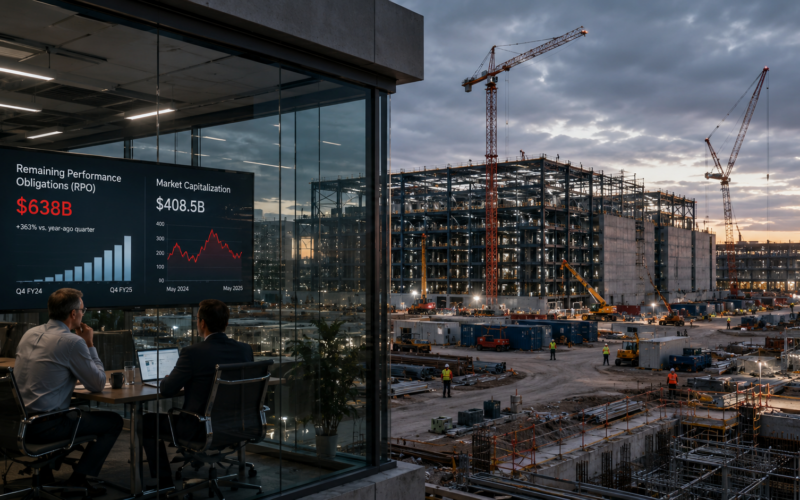
Oracle Corporation (NYSE: ORCL) has amassed $638 billion in remaining performance obligations, the company’s term for contracted future revenue, a figure that now exceeds Oracle’s own market capitalization of approximately $408.5 billion and stands 363% higher than the year-ago quarter. Despite that historic backlog and fiscal fourth-quarter results that beat both revenue and earnings estimates, Oracle shares closed their most recent regular session at $140.27, down 1.56% and sitting just 4.2% above a 52-week low of $134.57, roughly 59% below the stock’s 52-week high of $345.72 reached earlier in the year. The disconnect between a backlog large enough to represent one of the biggest contracted revenue commitments in corporate history and a share price languishing near 18-month lows captures a genuine and unresolved tension at the center of Oracle’s AI infrastructure strategy: the company has convinced customers, chiefly OpenAI, to commit hundreds of billions of dollars to future cloud computing capacity, but converting that backlog into cash requires Oracle to spend tens of billions of dollars building data centers years before the associated revenue materializes, and investors are increasingly focused on whether Oracle’s balance sheet can absorb that gap without meaningful dilution or credit deterioration.
What is actually driving the $638 billion backlog and how concentrated is the risk
Oracle’s remaining performance obligations reached $638 billion in the quarter ended May 2026, up from $553 billion the prior quarter, with growth driven overwhelmingly by Oracle Cloud Infrastructure, the company’s cloud computing segment, which saw revenue surge 93% year over year to $5.8 billion as demand from AI training and inference workloads from customers including OpenAI and Meta Platforms overwhelmed Oracle’s existing data center capacity. More than half of the total $638 billion RPO figure is reportedly tied to a single agreement: a five-year commitment from OpenAI worth more than $300 billion, beginning in 2027, that represents by a wide margin the largest cloud computing contract Oracle has ever signed and one of the largest such commitments in the industry’s history.
That concentration is the central risk embedded in Oracle’s current investment case, and it cuts in two directions simultaneously. On one hand, a single customer committing $300 billion over five years to Oracle’s cloud infrastructure is a powerful validation of Oracle’s technical competitiveness in a market previously dominated by Amazon Web Services, Microsoft Azure, and Google Cloud, and it is difficult to imagine a sophisticated buyer like OpenAI making a commitment of that scale without genuine confidence in Oracle’s ability to deliver the underlying compute capacity reliably. On the other hand, when more than half of a company’s forward-looking revenue backlog depends on the financial health and continued strategic commitment of one customer, any disruption to that relationship, whether from OpenAI’s own funding difficulties, a strategic pivot toward other cloud providers, or broader financial stress at OpenAI itself, would represent a genuinely seismic impact on Oracle’s revenue trajectory rather than a manageable, diversified setback.
Oracle management has been transparent that the backlog will convert to actual revenue only gradually rather than immediately. Roughly 12% of the total $638 billion, approximately $76 billion, is expected to convert into recognized revenue over the next twelve months, with the remainder stretching across multiple future years as data center capacity comes online and contracted workloads ramp. Approximately $75 billion of the backlog also includes customer prepayments for GPUs and customer-supplied hardware baked directly into these AI infrastructure deals, a structural detail that somewhat reduces Oracle’s own capital burden for that portion of the buildout but also means a meaningful share of the headline RPO figure represents hardware Oracle’s customers are effectively financing themselves rather than pure Oracle-generated service revenue.
Why capital spending and financing needs are weighing on the stock more than the backlog is lifting it
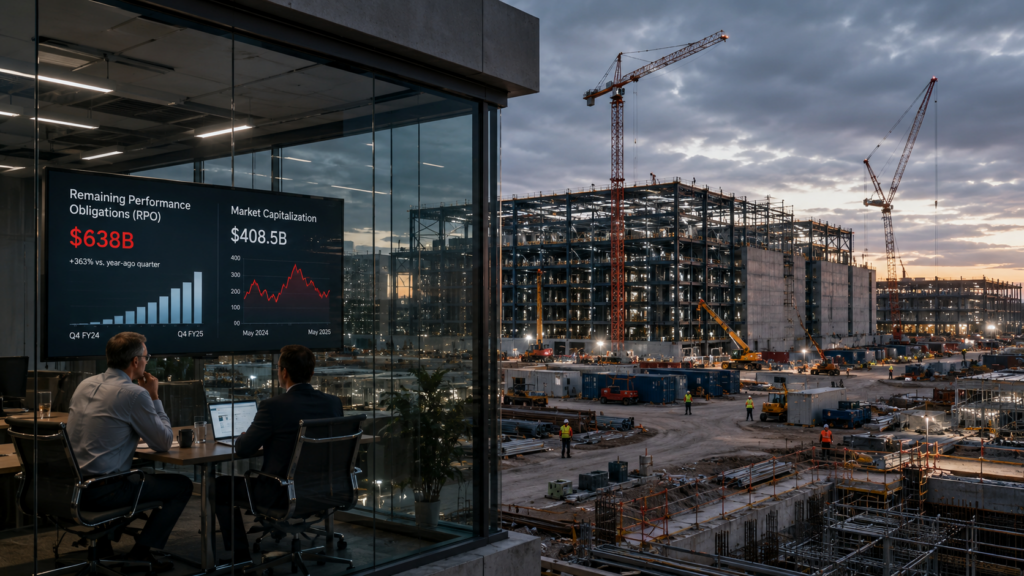
Oracle’s capital expenditures reached $55.7 billion for the full fiscal year, and the company has signaled that current fiscal year capital spending could climb toward an estimated $95 billion as it races to build the data center capacity needed to service its contracted backlog, particularly the OpenAI commitment beginning in 2027. To fund that spending, Oracle has announced plans to raise approximately $40 billion through a combination of debt and equity issuance, a move that would push the company’s long-term debt above $100 billion and represents a meaningful escalation of Oracle’s balance sheet leverage relative to its historical capital structure. Free cash flow turned negative during the most recent fiscal year for the first time in years, a direct consequence of capital spending running well ahead of the cash Oracle is currently collecting from its still-maturing cloud infrastructure business.
This capex-ahead-of-revenue dynamic is not unique to Oracle among companies building AI infrastructure at scale, but the degree to which Oracle’s backlog has outpaced its balance sheet capacity to fund the associated buildout appears more pronounced than at some larger, better-capitalized peers. Co-Chief Executive Officer Clay Magouyrk addressed the timing mismatch directly on Oracle’s most recent earnings call, stating that his role includes trying to “spend the money a little bit faster” so Oracle can bring contracted revenue online sooner rather than later, an acknowledgment that the pace of capital deployment, not the underlying demand captured in the RPO figure, is the binding constraint on how quickly Oracle can convert its backlog into recognized revenue. Chief Financial Officer Maxson has emphasized that the company remains focused on maintaining a strong balance sheet and preserving Oracle’s investment-grade credit rating even as leverage climbs, a commitment that will be tested directly as the company executes on its planned $40 billion capital raise over the coming fiscal year.
The market’s skepticism reflected in Oracle’s depressed share price appears to center on two distinct, unresolved questions rather than doubt about the underlying demand environment itself. First, can the companies committing to spend hundreds of billions of dollars with Oracle, principally OpenAI, actually meet those contractual obligations over a multi-year horizon, given the well-documented capital intensity and cash burn characteristic of frontier AI labs generally. Second, can Oracle successfully execute the capital raising and data center construction required to deliver on this backlog without eroding its financial position to a degree that damages its credit profile or dilutes existing shareholders more than the market currently anticipates. Neither question has a clear answer yet, and Oracle’s stock price appears to be pricing meaningful uncertainty on both fronts even as the underlying revenue growth and backlog figures continue to set records.
How the reported OpenAI IPO delay compounded pressure on Oracle shares
Oracle’s recent stock decline was significantly amplified by reporting, roughly a week before this most recent quarterly update, that OpenAI plans to delay its previously anticipated confidential U.S. initial public offering, a development that several analysts and financial commentators identified as the primary catalyst behind Oracle’s worst single week of stock performance in years. The connection between an OpenAI IPO delay and Oracle’s own share price is not immediately obvious on its face, since Oracle’s contracted revenue from OpenAI does not depend mechanically on OpenAI completing a public listing. The market’s reaction instead reflects a more indirect but genuine concern: OpenAI’s ability to fund its enormous multi-year infrastructure commitments, including the $300 billion Oracle contract, depends heavily on continued access to capital markets, and a delayed IPO removes one significant, near-term funding mechanism OpenAI might otherwise have used to strengthen its balance sheet ahead of ramping those obligations.
This dynamic illustrates how tightly Oracle’s near-term stock performance has become linked to sentiment around OpenAI’s own financial health and capital-raising trajectory, a linkage that mirrors similar concerns weighing on SoftBank Group given its own large OpenAI-related financial commitments, and on other companies whose AI infrastructure narratives depend heavily on OpenAI specifically rather than a more diversified customer base. For Oracle, the practical risk is not that OpenAI abandons its contracted commitment, since the five-year, $300 billion agreement is a binding contract rather than a memorandum of understanding, but rather that any visible deterioration in OpenAI’s financial position or fundraising capacity would understandably increase market anxiety about counterparty risk on the single largest contract underpinning Oracle’s entire backlog narrative, regardless of whether that anxiety proves justified once OpenAI’s actual funding situation becomes clearer over time.
What Oracle’s growth rate reveals about its competitive position against the established hyperscalers
Despite the balance sheet concerns weighing on its stock, Oracle’s underlying growth metrics compare favorably against its much larger cloud computing competitors on a relative basis. Oracle posted 21% total revenue growth in its most recent quarter, ahead of Amazon’s 17% and Microsoft’s 17% growth rates over the same period, and Oracle Cloud Infrastructure’s 93% growth rate specifically outpaces the cloud segment growth rates reported by any of the three established hyperscalers, Amazon Web Services, Microsoft Azure, or Google Cloud, during the comparable period. That outperformance reflects Oracle’s later, more concentrated entry into large-scale AI infrastructure provisioning, a smaller existing revenue base against which percentage growth rates naturally appear larger, and the disproportionate impact of a small number of enormous individual contracts, principally OpenAI, on a company whose overall cloud infrastructure revenue remains considerably smaller in absolute dollar terms than its hyperscaler competitors.
Wall Street’s own positioning on Oracle reflects a genuine split reminiscent of the tension between the backlog bulls and the balance sheet skeptics described above. Sell-side coverage currently shows 36 buy ratings against just 7 hold ratings and no meaningful sell-rated coverage, a heavily bullish tilt that reflects analyst confidence that the $638 billion RPO and its roughly 12% near-term conversion rate represent revenue that is effectively locked in contractually regardless of near-term capital expenditure pressures. The more cautious minority view, reflected in the hold ratings, treats the planned $40 billion fiscal year fundraising effort as a genuine dilution and credit risk that the current depressed share price does not yet fully discount, a disagreement that will likely persist until Oracle demonstrates several consecutive quarters of successfully converting backlog into recognized revenue without the kind of credit rating pressure or dilutive equity issuance the more skeptical analysts are flagging as a live risk.
What Oracle’s Stargate involvement adds to the balance sheet risk picture
Oracle’s financial commitments extend beyond its direct customer contracts through its participation in the Stargate joint venture alongside OpenAI, SoftBank, and MGX, a consortium building data center infrastructure at a scale that requires tens of billions of dollars in committed capital from each participant. That participation adds a further layer of capital commitment on top of Oracle’s own direct data center buildout, meaning the $95 billion in estimated current-year capital expenditure and the associated $40 billion financing plan likely understate Oracle’s total capital exposure once Stargate-related commitments are fully accounted for. Investors evaluating Oracle’s credit profile and dilution risk should recognize that the company’s AI infrastructure exposure runs through multiple parallel channels, direct customer contracts like the OpenAI RPO commitment and joint venture participation through Stargate, both of which draw on the same underlying balance sheet capacity Oracle is simultaneously trying to preserve at investment-grade credit quality.
For long-term investors, Oracle’s reaffirmed fiscal year 2027 cloud infrastructure revenue target of $90 billion provides a concrete, near-term benchmark against which to judge whether the company’s capital-intensive strategy is translating contracted backlog into actual recognized revenue at the pace management has projected. A revenue trajectory tracking toward or exceeding that target over the coming several quarters would meaningfully strengthen the bull case that Oracle’s depressed valuation represents a disconnect between price and fundamentals rather than an accurate reflection of genuine balance sheet and counterparty concentration risk. A trajectory that falls short, particularly if accompanied by any signs of strain in Oracle’s relationship with OpenAI or further deterioration in Oracle’s own credit metrics as the $40 billion financing plan is executed, would tend to validate the more skeptical analyst view currently reflected in Oracle’s share price.
Key takeaways on what Oracle’s record backlog and depressed valuation mean for AI infrastructure investing
- Oracle’s remaining performance obligations reached $638 billion, up 363% year over year and now exceeding Oracle’s own $408.5 billion market capitalization, with more than half tied to a single five-year, $300 billion commitment from OpenAI beginning in 2027.
- Despite the record backlog, Oracle shares trade just 4.2% above a 52-week low and roughly 59% below their 52-week high, reflecting investor focus on capital spending and financing risk rather than the headline contracted revenue figure.
- Only about 12%, or roughly $76 billion, of the total RPO is expected to convert into recognized revenue over the next twelve months, with the bulk of the backlog stretching across multiple future years as data center capacity is built.
- Oracle’s capital expenditures reached $55.7 billion in the most recent fiscal year and could climb toward an estimated $95 billion in the current year, funded partly through a planned $40 billion debt and equity raise that would push long-term debt above $100 billion.
- Free cash flow turned negative for the first time in years, illustrating the direct financial cost of building data center capacity years ahead of the revenue that capacity is contracted to eventually generate.
- More than half of Oracle’s backlog depending on a single customer, OpenAI, represents significant concentration risk, and reports of OpenAI’s IPO delay were identified as the primary catalyst behind Oracle’s worst single week of stock performance in years.
- Oracle Cloud Infrastructure’s 93% revenue growth rate outpaces the cloud segment growth reported by Amazon, Microsoft, and Google over the same period, reflecting genuine competitive momentum even as absolute revenue scale remains smaller than the established hyperscalers.
- Wall Street coverage remains heavily bullish with 36 buy ratings against 7 holds, though the minority skeptical view treats Oracle’s planned $40 billion capital raise as a dilution and credit risk not yet fully priced into the stock.
- Oracle’s participation in the Stargate joint venture alongside OpenAI, SoftBank, and MGX adds further capital commitments beyond direct customer contracts, meaning total AI infrastructure capital exposure likely exceeds the headline capex and financing figures.
- Oracle’s reaffirmed fiscal year 2027 cloud infrastructure revenue target of $90 billion provides the clearest near-term benchmark for whether the company’s backlog is converting into recognized revenue at the pace needed to validate its current AI infrastructure investment thesis.
Discover more from Business-News-Today.com
Subscribe to get the latest posts sent to your email.