



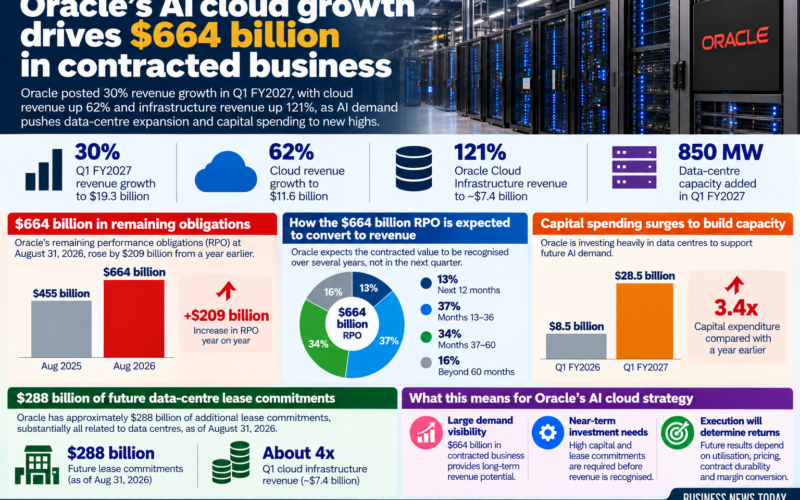
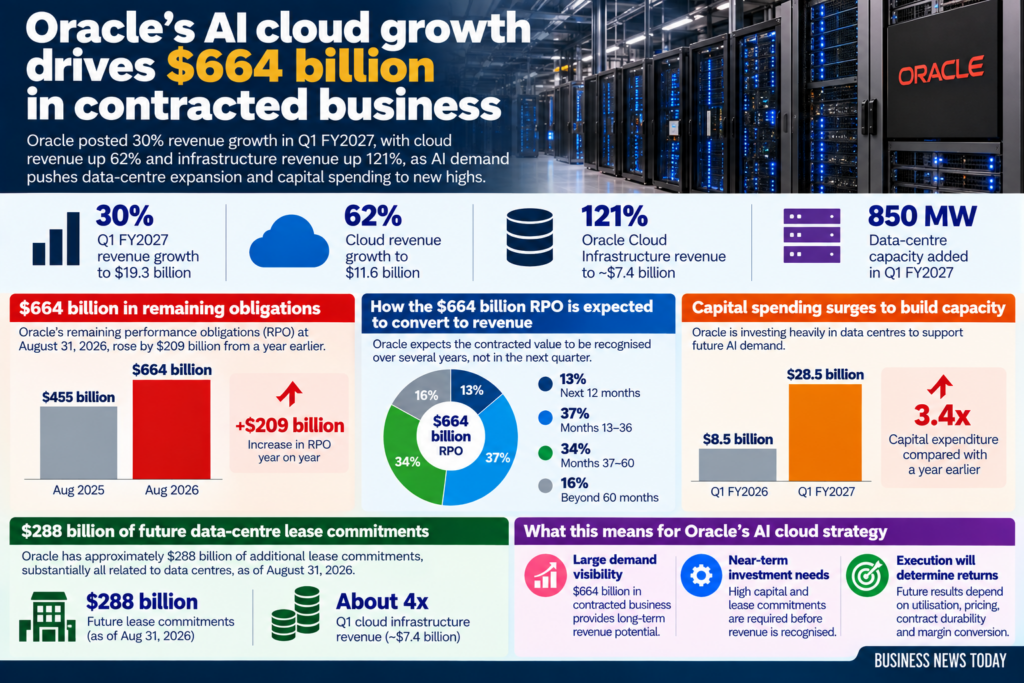
Oracle Corporation (NYSE: ORCL) has reached a point where demand is no longer the only important question surrounding its artificial-intelligence cloud strategy. First-quarter fiscal 2027 revenue rose 30% to $19.3 billion, cloud revenue climbed 62% to $11.6 billion and Oracle Cloud Infrastructure revenue increased 121% to approximately $7.4 billion. Oracle also said it delivered another 850 megawatts of data-centre capacity during the quarter as AI training and inference demand continued to expand.
The headline number sitting behind that expansion is Oracle Corporation’s $664 billion of remaining performance obligations, or RPO, at August 31, 2026. That figure increased by $209 billion from a year earlier and provides unusually large contractual visibility relative to Oracle Corporation’s current annual revenue base. However, RPO is not the same thing as revenue sitting ready to appear in the next quarter, and treating the two figures as interchangeable would materially exaggerate the near-term economics of the backlog.
Oracle Corporation expects approximately 13% of the $664 billion to be recognised as revenue during the following 12 months, 37% during months 13 through 36 and another 34% during months 37 through 60, with the remainder later. That schedule means much of the contracted value stretches across several years, while the computing infrastructure required to serve those contracts may have to be financed and deployed earlier. The resulting mismatch between front-loaded infrastructure spending and multi-year revenue recognition is becoming one of the defining financial questions around Oracle Corporation’s AI cloud expansion.
Why does Oracle Corporation need to spend so much before its AI contracts become revenue?
Cloud infrastructure is unusually capital intensive because a provider cannot simply sign a large AI contract and begin recognising the full value immediately. Data centres require buildings or leases, power infrastructure, networking equipment, cooling systems and large quantities of computing hardware before customers can consume the contracted services.
Oracle Corporation spent $28.5 billion on capital expenditure during the three months ended August 31, 2026, compared with $8.5 billion in the corresponding period a year earlier. The company attributed the increase primarily to data-centre expansion and said fiscal 2027 capital expenditure is expected to exceed fiscal 2026 as it increases existing capacity and establishes data centres in additional locations.
The sheer difference between expenditure and current cloud revenue illustrates why the AI infrastructure cycle cannot be analysed like a conventional software subscription business. Oracle Corporation generated approximately $7.4 billion of infrastructure-as-a-service revenue during the quarter, yet its capital expenditure was almost four times that amount because the company is building capacity intended to support future demand rather than only the workloads already being billed.
That does not make the spending economically unattractive. It means returns depend heavily on utilisation, pricing, contract durability and how quickly installed infrastructure becomes revenue-producing capacity, making future conversion efficiency at least as important as the headline size of the RPO balance.
Why should investors not treat Oracle’s $664 billion RPO as conventional backlog?
Remaining performance obligations represent contracted amounts that have not yet been recognised as revenue, but the timing and economics of those obligations vary. Oracle Corporation’s cloud contracts can run for multiple years, while usage-based arrangements are recognised as customers consume the services rather than immediately when the contract is signed.
This distinction becomes particularly important when comparing Oracle Corporation with companies whose backlog converts more directly into product deliveries. A cloud contract may require substantial infrastructure investment before revenue is recognised and can include complex payment structures, capacity commitments or customer prepayments.
Oracle Corporation disclosed that working-capital movements in the first quarter included $11.4 billion of cash inflows from customer prepayments containing a significant financing component. Those upfront customer funds strengthened operating cash flow, but the related services still have to be delivered according to the underlying contracts before the corresponding obligations are fully satisfied.
The better way to interpret RPO is therefore as evidence of future demand visibility rather than as immediate revenue. Its quality will ultimately be demonstrated through actual service consumption, capacity utilisation, margins and the amount of capital Oracle Corporation must commit to deliver against those obligations.
What do Oracle’s $288 billion of future data-centre lease commitments reveal?
Oracle Corporation’s infrastructure commitments extend far beyond capital expenditure already visible in the cash-flow statement. As of August 31, the company reported approximately $288 billion of additional lease commitments, substantially all related to data-centre arrangements expected to commence between the second quarter of fiscal 2027 and fiscal 2029. Those arrangements generally run for 15 to 19 years and had not yet been reflected on Oracle Corporation’s condensed consolidated balance sheet at the reporting date because the leases had not commenced.
The figure deserves careful interpretation because it is not $288 billion of current debt and should not be presented as such. It is nevertheless a substantial long-duration contractual commitment that provides a sense of the physical infrastructure Oracle Corporation expects to require as its cloud business expands.
Long leases can make economic sense when the underlying capacity is backed by durable customer demand, particularly when building every data centre directly would consume even more capital. They can also create fixed obligations that persist if utilisation, technology requirements or customer demand develop differently from current expectations.
That means the economics of Oracle Corporation’s AI buildout depend on more than revenue growth. The company is increasingly matching multiyear customer obligations with multiyear infrastructure commitments, making contract duration, capacity deployment and asset utilisation central to the long-term return profile.
How is Oracle financing a cloud expansion this large?
Oracle Corporation generated $23.1 billion of operating cash flow during the first quarter of fiscal 2027, up from $8.1 billion a year earlier, but capital expenditure of $28.5 billion exceeded that operating inflow. Using Oracle Corporation’s own non-GAAP definition of free cash flow as operating cash flow less capital expenditure, first-quarter free cash flow was negative $5.4 billion compared with negative $362 million in the prior-year period.
The financing side of the cash-flow statement is therefore important. Oracle Corporation received approximately $19.9 billion of net proceeds from common stock issued through its at-the-market programme during the quarter, while customer prepayments also materially supported operating cash generation.
Equity issuance does not mean Oracle Corporation lacks other financing options, and the company told investors that its current cash resources, operating cash flows and available financing arrangements are sufficient for working capital, committed capital expenditure and contractual obligations for at least the next 12 months. Oracle Corporation also said it expects existing liquidity sources and potential additional financing to remain sufficient thereafter and retains flexibility over the timing of some discretionary capital expenditure.
The strategic issue is nevertheless clear. AI cloud growth is moving Oracle Corporation toward a financial model in which balance-sheet capacity, external financing, customer prepayments and infrastructure planning become increasingly important alongside traditional software economics.
Is Oracle’s cloud growth already putting pressure on margins?
Oracle Corporation’s first-quarter cloud-and-software segment illustrates the trade-off. Revenue for that reporting segment increased substantially, but total segment margin as a percentage of revenue declined to 55% from 60% in the prior-year quarter as infrastructure expenses increased. Oracle Corporation specifically attributed the lower percentage margin partly to higher infrastructure expenses required to support cloud infrastructure growth.
That does not necessarily mean the long-term economics are deteriorating because early infrastructure investment can depress margins before utilisation catches up. If large clusters become heavily used and contracted demand converts into recurring revenue, fixed infrastructure costs can be spread across a larger revenue base.
The opposite scenario is equally important to monitor. If Oracle Corporation builds capacity faster than customers consume it, or if competition forces pricing lower, the capital and operating costs associated with data centres could remain elevated without producing the expected return.
Investors therefore need to distinguish between temporary margin compression caused by expansion and structural margin compression caused by weaker unit economics. Several more quarters of capacity additions, revenue conversion and infrastructure expense will be required before that distinction becomes clearer.
What does Oracle Corporation’s stock performance say about investor expectations?
Oracle Corporation shares closed at $142.30 on October 2, recovering 3.06% during that session but remaining approximately 12% below the September 9 close of $161.63 immediately before first-quarter results were released. The period included several large daily moves in both directions, indicating that the market has been reassessing the balance between extraordinary cloud growth and the capital required to support it rather than simply rewarding the revenue acceleration.
The share-price movement should not be attributed to one financial disclosure alone because Oracle Corporation traded through a broader flow of company and market news during the period. However, the valuation debate has clearly become more complicated as the cloud business moves deeper into physical infrastructure.
The next important evidence will come from the relationship among RPO conversion, cloud infrastructure growth, capital expenditure, free cash flow and margins. Rising RPO is attractive only if Oracle Corporation can convert those commitments into profitable revenue without requiring an ever-larger amount of capital for every incremental dollar of business.
Oracle Corporation’s AI opportunity may therefore be larger than the company has ever faced, but so is the infrastructure obligation sitting behind it. The defining question is no longer whether customers want Oracle Cloud Infrastructure; it is whether Oracle Corporation can turn an extraordinary volume of contracted demand into returns that justify the extraordinary buildout required to serve it.
Discover more from Business-News-Today.com
Subscribe to get the latest posts sent to your email.