

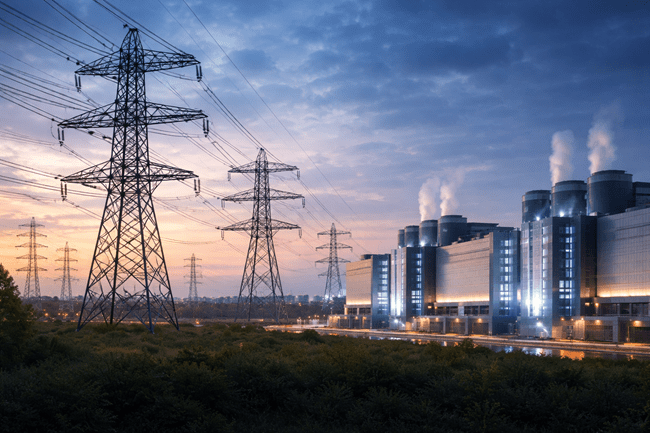
NTPC Limited, listed on the National Stock Exchange of India under the ticker NTPC and on BSE Limited under scrip code 532555, has outlined a ₹16.86 lakh crore capital expenditure programme through FY2037. India’s largest power producer is targeting 150 GW of installed capacity by FY2032 and 250 GW by FY2037, compared with approximately 91 GW operational in June 2026. Renewables will receive the largest share of planned investment, while nuclear power, thermal generation, pumped storage and battery systems will form other major components of the portfolio. The roadmap represents an acceleration from NTPC’s earlier targets of 149 GW by FY2032 and 244 GW by FY2037. The central tension is whether NTPC can increase annual investment to almost three times its recent level without weakening returns, increasing leverage excessively or allowing simultaneous projects across several technologies to overwhelm execution capacity.
Why does NTPC’s ₹16.86 lakh crore roadmap represent more than another capacity target?
The size of the proposed investment changes the strategic profile of NTPC Limited. The company is no longer planning primarily as a coal generator adding renewable assets around an established thermal fleet. It is attempting to become an integrated power group spanning thermal generation, solar, wind, hydroelectricity, pumped storage, battery storage, nuclear energy, mining, green hydrogen and power trading.
NTPC’s operational portfolio stood at approximately 91 GW in June 2026, while another 36 GW was under construction, giving the group a combined operational and construction portfolio of about 127 GW. Reaching 150 GW by FY2032 would require approximately 59 GW of additional operating capacity from the June 2026 base. Reaching 250 GW by FY2037 would then require another 100 GW within the following five years.
The implied delivery pace becomes considerably more demanding after FY2032. NTPC would need to move from adding roughly 10 GW annually during the first stage to around 20 GW annually during the second stage, although acquisitions and joint ventures could supplement organically constructed capacity.
That acceleration explains why the investment programme is heavily weighted toward the later years. NTPC plans approximately ₹1.08 lakh crore of spending during FY2026 and FY2027, followed by ₹5.97 lakh crore between FY2028 and FY2032 and ₹9.81 lakh crore between FY2033 and FY2037.
Average annual capital expenditure would rise from approximately ₹54,000 crore during the initial period to ₹1.19 lakh crore during FY2028 to FY2032 and ₹1.92 lakh crore during FY2033 to FY2037. The complete programme implies average annual investment of about ₹1.4 lakh crore.
The roadmap is therefore not simply a declaration of long-term ambition. It requires a structural increase in NTPC’s ability to identify projects, secure land, arrange financing, procure equipment, manage contractors, obtain regulatory approvals and commission capacity.
How will the ₹16.86 lakh crore investment be divided across different power technologies?
Renewable energy receives the largest allocation at ₹7.24 lakh crore, representing approximately 43% of the planned capital expenditure.
Nuclear power receives ₹4.63 lakh crore, or 27%, while conventional thermal generation accounts for ₹3.09 lakh crore, equivalent to 18%. Hydro and pumped-storage projects receive ₹1.28 lakh crore, or 8%, while battery energy storage systems receive ₹52,000 crore, or 3%. Mining accounts for the remaining ₹10,000 crore, or approximately 1%.
The distribution provides a more accurate picture of NTPC’s transition than the headline capacity target alone.
Renewables will become the largest contributor to installed capacity, but NTPC is not planning to abandon thermal generation. Nuclear power will receive more capital than thermal generation despite contributing only 6 GW of capacity by FY2037, reflecting the higher construction cost and longer development period associated with nuclear plants.
Battery storage receives a relatively small percentage of total expenditure, but its strategic importance is greater than the allocation suggests. Storage will determine how effectively NTPC can integrate large volumes of intermittent solar and wind generation and deliver electricity during peak-demand periods.
Pumped storage is similarly important because it can provide longer-duration flexibility and grid support. Hydro and pumped-storage projects require significant civil engineering, environmental approvals, land and long construction schedules, making execution more difficult than procuring solar modules for a standard photovoltaic project.
The capital mix shows that NTPC is building several power systems simultaneously. It must continue providing dependable thermal output while expanding variable renewables, developing storage and establishing an entirely new nuclear platform.
Can NTPC finance annual capital expenditure approaching ₹2 lakh crore without excessive leverage?
NTPC’s financial model provides several advantages. A substantial portion of its conventional generation portfolio operates under regulated frameworks designed to recover approved costs and provide returns on equity. Payment-security mechanisms, letters of credit and late-payment rules have also improved collections from electricity distribution companies.
The company reported more than 100% realisation of current bills during FY2026, with collections of approximately ₹1.56 lakh crore. This reduces working-capital pressure and supports access to debt markets.
NTPC Group spent ₹49,068 crore during FY2026 and ₹11,591 crore during the first quarter of FY2027. The ₹1.4 lakh crore average annual requirement under the new plan is almost 2.9 times the FY2026 capital expenditure level. The later-period target of ₹1.92 lakh crore annually is nearly four times FY2026 spending.
That comparison illustrates the scale of the funding challenge.
At June 30, 2026, NTPC Group reported long-term debt, including current maturities, of ₹2.34 lakh crore and short-term debt of approximately ₹38,398 crore. Combined borrowings were therefore about ₹2.72 lakh crore. Consolidated equity stood at ₹2.10 lakh crore, producing a debt-to-equity ratio of 1.30.
The ratio was broadly stable compared with the previous year, despite continued capacity expansion. NTPC’s consolidated profit increased to ₹6,896 crore during the first quarter of FY2027 from ₹6,108 crore in the corresponding period.
The company can also raise capital through subsidiaries and joint ventures. NTPC Green Energy Limited provides a listed vehicle for renewable investment, while project-level debt can reduce the amount funded directly by the parent company.
However, the balance sheet cannot be assessed only through the current debt-to-equity ratio. Future borrowing costs, project delays and the pace at which newly commissioned assets begin earning regulated or contracted returns will determine whether leverage remains manageable.
The funding model becomes stronger when capital is deployed into projects with assured tariffs, timely commissioning and predictable collection. It becomes weaker when projects require years of construction before revenue begins or when competitively bid tariffs leave little room for cost overruns.
Can renewables grow from 12 GW to 136 GW without creating underused generation assets?
Renewables are expected to rise from about 12 GW in FY2026 to 60 GW by FY2032 and 136 GW by FY2037. They would represent 40% of NTPC’s installed capacity in FY2032 and 54% by FY2037.
The expansion requires approximately 124 GW of additional renewable capacity over 11 years. That is more than ten times NTPC’s current renewable portfolio.
The company expects capacity to reach 20 GW by FY2027 and 28 GW by FY2028, indicating that a significant near-term pipeline already exists. The acquisition of Ayana Renewable Power, with about 2.1 GW of operational capacity, has supported that expansion.
Capacity alone will not determine the commercial outcome. Solar and wind output can become less valuable when many projects generate simultaneously, causing lower daytime prices, transmission congestion or curtailment.
NTPC’s answer is to combine renewables with battery storage, pumped storage and round-the-clock supply structures. The group has identified a battery storage portfolio of 38.9 GWh, including 6.62 GWh under construction and 32.28 GWh under planning.
The company also has an 18.01 GW pumped-storage portfolio. This includes 1 GW operational, 13.20 GW with firm allocation and 3.81 GW under planning.
These assets could allow NTPC to store electricity during periods of abundant renewable generation and release it during evening peaks or other high-value intervals.
The principal risk is timing. Renewable projects can often be built faster than large transmission lines, pumped-storage stations or nuclear plants. If solar and wind capacity arrives before the supporting grid and storage infrastructure, the company could experience curtailment or weaker realised tariffs.
The 136 GW renewable target will therefore be credible only when accompanied by grid access, storage availability, contracted demand and disciplined project selection.
Why is NTPC still expanding thermal capacity during a renewable-led investment programme?
NTPC’s strategy is a diversification plan rather than a coal-exit plan.
Thermal capacity, including coal and gas generation, is projected to rise from approximately 74 GW in June 2026 to 84 GW by FY2032 and 97 GW by FY2037. Reuters reported that coal-fired capacity alone could increase from about 67 GW to around 91 GW under the current plan.
Renewables will become the largest source of installed capacity, but thermal generation is expected to remain the largest source of electricity output.
NTPC projects generation of 943 billion units in FY2037. Thermal plants are expected to produce approximately 545 billion units, or 58% of the total, while renewables contribute 313 billion units, or 33%. Hydro would contribute 46 billion units and nuclear power 39 billion units.
This difference reflects capacity utilisation. Coal plants can generate for more hours when fuel and maintenance conditions permit, while solar and wind output depends on weather and time of day.
NTPC argues that coal, storage-backed renewables and nuclear power form three essential pillars of India’s energy security. The thermal expansion is intended to support a country where electricity demand is rising because of industrialisation, urbanisation, cooling loads, transport electrification and digital infrastructure.
India has already recorded peak electricity demand of approximately 271 GW, while policymakers have indicated that demand could approach 300 GW in the following year.
The risk is that thermal projects have long operating lives extending beyond India’s intermediate climate targets. New plants may face pressure from lower renewable tariffs, carbon constraints, environmental requirements and increasingly flexible operating patterns.
The strategic test is whether NTPC can build thermal capacity that remains economically useful as a grid-balancing and dependable-generation resource, rather than creating assets that operate below design assumptions.
Can NTPC convert a ₹4.63 lakh crore nuclear allocation into operating capacity by FY2037?
Nuclear power is the most capital-intensive and execution-sensitive part of the plan.
NTPC expects nuclear capacity to reach approximately 1 GW by FY2032 and 6 GW by FY2037. Its longer-term ambition is to contribute 30 GW toward India’s national target of 100 GW of nuclear capacity by 2047.
The first major development is the 2.8 GW Mahi Banswara nuclear project in Rajasthan, comprising four 700 MW pressurised heavy-water reactors. The project is being developed by Anushakti Vidhyut Nigam Limited, the joint venture between NTPC Limited and Nuclear Power Corporation of India Limited.
NTPC has also established NTPC Parmanu Urja Nigam Limited as a wholly owned subsidiary intended to build, own and operate nuclear power plants. More than 30 potential sites have been identified, with studies taking place at 10 locations. The company has signed memoranda with the governments of Madhya Pradesh and Chhattisgarh and is examining potential cooperation with technology providers.
The ₹4.63 lakh crore allocation represents approximately ₹77 crore for every kilowatt of targeted FY2037 nuclear capacity when divided directly by the 6 GW capacity objective. That simple comparison should not be interpreted as an expected project cost per kilowatt because spending could include projects that remain under construction beyond FY2037, supporting infrastructure and development work for the longer-term 30 GW ambition.
Nuclear projects require site approval, reactor technology selection, environmental clearance, specialised manufacturing, fuel arrangements, regulatory oversight and lengthy construction.
The large allocation is therefore concentrated mainly after FY2032, when NTPC expects nuclear power to become a more significant growth driver.
The opportunity is dependable low-carbon generation with high capacity utilisation. The risk is that delays could leave substantial capital tied up without revenue for extended periods.
Mahi Banswara’s excavation, construction and unit-commissioning schedule will become an important test of whether NTPC can transfer its large-project capabilities from thermal generation into nuclear power.
What execution risks emerge when NTPC develops coal, renewables, storage and nuclear together?
NTPC’s portfolio breadth reduces dependence on any single generation technology, but it increases organisational complexity.
Coal projects require mining links, rail logistics, water, emissions-control systems and long-term fuel arrangements. Renewable projects require land, transmission access, module and turbine procurement and competitive tariffs. Pumped storage involves large civil works and environmental approvals. Batteries require technology selection, safety systems, augmentation planning and active commercial management.
Nuclear energy adds an even more demanding regulatory and engineering framework.
NTPC must also manage subsidiaries, joint ventures, acquisitions and partnerships while maintaining performance across its existing stations.
The company has demonstrated an ability to expand. It added 9,618 MW during FY2026, the highest annual capacity addition in its history, taking group capacity to 89,108 MW at March 31, 2026. The total subsequently moved beyond 91 GW.
Maintaining that pace for several years would support the FY2032 target. Doubling it during the FY2033 to FY2037 period will be more difficult.
Equipment supply is another constraint. India must simultaneously expand domestic manufacturing of solar modules, cells, wind components, batteries, transformers, boilers, turbines and nuclear equipment. Competing developers will be seeking many of the same contractors, sites and transmission connections.
Cost inflation could affect returns when projects are awarded at fixed tariffs. Regulated thermal projects may provide greater protection because approved costs and returns can be recovered subject to regulatory rules, but delays can still postpone earnings and raise consumer tariffs.
NTPC’s selection of projects and contracting models will therefore matter as much as the headline capacity additions.
What does NTPC’s share-price performance indicate about investor confidence in the roadmap?
NTPC shares closed at ₹343.50 on July 29, 2026, down approximately 0.08% during the session.
The stock had declined about 2% over one week and 3.54% over one month. It remained approximately 17.1% below its 52-week high of ₹414.40 and around 8.9% above its 52-week low of ₹315.55. NTPC’s market capitalisation was approximately ₹3.33 lakh crore.
The muted response indicates that investors are not assigning immediate value to the entire ₹16.86 lakh crore programme.
That is reasonable because the capital expenditure will be deployed over more than a decade, while much of the highest spending occurs after FY2032. Shareholders must assess future funding costs, project returns and the amount of equity required long before they can estimate the earnings contribution.
The regulated nature of NTPC’s conventional assets provides earnings stability, while renewable and storage growth creates additional opportunity. Nuclear power introduces a potentially valuable long-term platform but also increases construction and schedule risk.
The market is therefore likely to reward measurable execution rather than the size of the ambition alone.
Capacity commissioning, regulated-equity growth, renewable project returns, storage contracts, debt trends and nuclear milestones will determine whether the roadmap eventually supports a higher valuation.
Which milestones will prove whether NTPC’s 250 GW plan is commercially credible?
The first test is whether NTPC can increase operational capacity from 91 GW toward 150 GW by FY2032 while maintaining project returns.
Annual capital expenditure must rise steadily from the current level. A rapid increase without matching commissioning would signal that capital is accumulating in construction work rather than producing revenue.
Renewable capacity must reach the interim targets of 20 GW in FY2027 and 28 GW in FY2028. These milestones will indicate whether the path toward 60 GW by FY2032 remains achievable.
Battery projects representing 6.62 GWh under construction must enter operation and demonstrate that storage improves renewable utilisation and earns adequate returns.
Pumped-storage projects with firm allocations must progress through approvals and construction. The 18.01 GW portfolio will create value only when a substantial portion becomes operational.
Thermal additions must secure fuel, offtake and regulated returns while maintaining tariffs acceptable to electricity distribution companies.
For nuclear power, progress at Mahi Banswara will provide the clearest near-term evidence. Site preparation, major equipment orders, construction milestones and reactor commissioning will show whether NTPC’s 6 GW FY2037 target is practical.
What has improved is strategic visibility. NTPC has provided a detailed capacity mix, capital allocation and investment schedule rather than a single headline target.
What remains unresolved is how the company will finance the steep post-FY2032 spending increase, how much capacity will be acquired rather than built and whether the portfolio can be delivered without cost overruns.
The investment case strengthens when annual commissioning rises alongside regulated equity, profit and operating cash flow. It weakens if debt grows materially faster than earning assets or if storage, transmission and nuclear development lag behind renewable capacity.
The next proof point is not the 250 GW target itself. It is whether NTPC can turn the existing 127 GW operational and construction portfolio into commissioned assets while building a sufficiently mature pipeline for the much larger second phase.
What are the key takeaways from NTPC’s ₹16.86 lakh crore investment roadmap?
- NTPC Limited plans ₹16.86 lakh crore of capital expenditure through FY2037.
- Group installed capacity is targeted to rise from approximately 91 GW to 150 GW by FY2032 and 250 GW by FY2037.
- Renewable energy receives the largest allocation at ₹7.24 lakh crore, or 43% of total planned expenditure.
- Nuclear power receives ₹4.63 lakh crore, followed by thermal generation at ₹3.09 lakh crore.
- Renewable capacity is expected to rise from about 12 GW to 60 GW by FY2032 and 136 GW by FY2037.
- Thermal capacity is still expected to increase to approximately 97 GW and provide 58% of projected FY2037 generation.
- NTPC has identified a 38.9 GWh battery-storage portfolio and an 18.01 GW pumped-storage portfolio.
- Nuclear capacity is targeted at 6 GW by FY2037 and 30 GW by 2047, beginning with the 2.8 GW Mahi Banswara project.
- Average annual capital expenditure must rise from ₹49,068 crore in FY2026 to approximately ₹1.4 lakh crore across the complete plan.
- Capacity commissioning, debt control, storage delivery and nuclear construction are the next measurable tests.
Discover more from Business-News-Today.com
Subscribe to get the latest posts sent to your email.