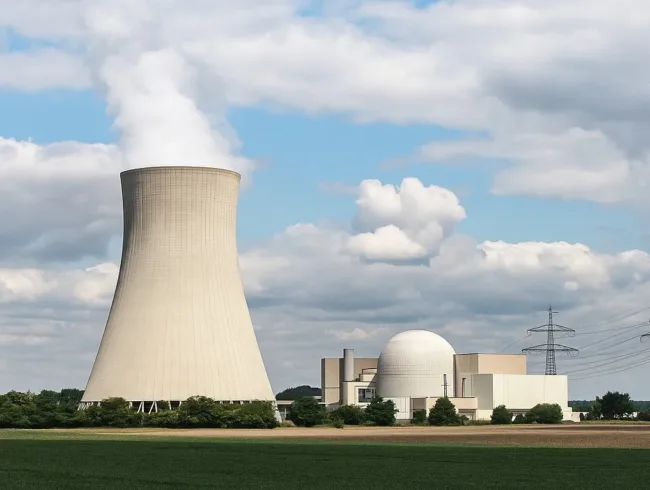
NTPC Limited (NSE: NTPC, BSE: 532555) and Nuclear Power Corporation of India Limited have moved the 2,800MW Mahi Banswara Rajasthan Atomic Power Project into a major procurement phase through their joint venture, Anushakti Vidhyut Nigam Limited (ASHVINI). The joint venture has opened bidding for the Nuclear Island Mega Engineering, Procurement and Construction Package covering four indigenous 700MW pressurised heavy water reactors, with the package expected to exceed ₹28,000 crore and bids due by September 30, 2026. The EPC tender sits within an overall project investment estimated at around ₹42,000 crore and represents one of the largest individual contracting opportunities in India’s power infrastructure market. The milestone matters because Mahi Banswara is the first nuclear project being implemented through the NTPC Limited and Nuclear Power Corporation of India Limited joint-venture model, making contractor selection, fleet standardisation and construction discipline critical to India’s wider nuclear expansion plans. NTPC Limited shares closed at ₹341.85 on July 17, around 0.8% lower over five sessions and approximately 3.7% lower over one month, while remaining 17.5% below their 52-week high of ₹414.40.
Why does the Mahi Banswara nuclear island EPC tender matter for India’s power strategy?
The Mahi Banswara tender matters because it moves the project beyond policy approval, site preparation and ceremonial construction milestones into the phase where engineering capability, procurement depth and contractor accountability begin to determine the delivery schedule. Anushakti Vidhyut Nigam Limited is no longer merely planning four reactors or seeking preliminary technical support. It is procuring the central nuclear island package that will contain many of the systems directly associated with reactor construction, safety, commissioning and long-term operation.
The package covers engineering, design, equipment supply, inspection, testing, transportation, civil construction, fabrication, erection, examination, commissioning and associated operating support. That breadth makes the contract strategically different from a conventional balance-of-plant tender. The selected contractor or consortium will need to coordinate nuclear-grade civil works, specialised manufacturing, quality assurance and regulatory documentation across four units that must eventually function as one integrated generating complex.
India’s wider power strategy gives the tender additional urgency. Electricity demand is rising through industrial growth, urbanisation, electrification, data centres and higher household consumption. Solar and wind generation are expanding rapidly, but the system also requires firm low-carbon capacity capable of operating independently of weather conditions. Nuclear generation offers that characteristic, although it carries longer development periods and greater upfront capital risk than most renewable projects.
Mahi Banswara is therefore both an electricity project and a test of whether India can deliver large nuclear capacity with greater predictability than earlier projects. A successful tender and construction programme would strengthen confidence in domestic nuclear expansion. Cost escalation or persistent delay would reinforce the argument that ambitious capacity targets are easier to announce than to convert into operating reactors.
How does ASHVINI’s ownership structure divide responsibility between NTPC and NPCIL?
Anushakti Vidhyut Nigam Limited is owned 51% by Nuclear Power Corporation of India Limited and 49% by NTPC Limited. The structure combines Nuclear Power Corporation of India Limited’s reactor technology, nuclear operations and regulatory experience with NTPC Limited’s project development, power generation, contracting and capital-raising capabilities.
Nuclear Power Corporation of India Limited remains central because the four 700MW pressurised heavy water reactors use an indigenous design developed within India’s nuclear establishment. Nuclear projects require specialist safety standards, quality controls and regulatory interaction that cannot be managed as ordinary thermal or renewable construction. Nuclear Power Corporation of India Limited provides the technical foundation and operating knowledge needed to guide that work.
NTPC Limited contributes a different form of scale. The company has decades of experience developing large power stations, managing EPC packages, financing infrastructure and selling electricity through long-term arrangements. Its participation also opens a pathway for India’s largest power producer to diversify further into nuclear generation rather than relying mainly on coal, gas, hydro and renewable assets.
The joint venture reduces the burden on Nuclear Power Corporation of India Limited to finance and manage every future reactor alone. It also gives NTPC Limited access to nuclear growth without requiring the company to independently recreate the full technical and regulatory organisation of a nuclear operator.
The governance challenge is ensuring that shared ownership accelerates decisions rather than creating additional approval layers. Engineering changes, contract claims, construction priorities and capital requirements will need close coordination between both shareholders. Joint ventures can combine strengths, but they can also combine calendars, committees and the occasional belief that one more meeting will solve the previous meeting.
Why are four identical 700MW PHWR units central to India’s fleet-mode nuclear strategy?
Mahi Banswara forms part of India’s fleet-mode programme for indigenous 700MW pressurised heavy water reactors. Fleet construction is intended to reduce repeated design work, consolidate procurement and create a more predictable delivery system across several reactor sites. Instead of treating every unit as a unique megaproject, the programme seeks to use standard reactor architecture, repeatable equipment and common operating experience.
The strategic logic is similar to industrial manufacturing. Suppliers can invest in capacity more confidently when they see a series of similar orders rather than one reactor followed by years of uncertainty. Engineering teams can reuse proven designs, while lessons from earlier units can be incorporated into later construction and commissioning work.
Three reactors based on the 700MW indigenous design have already entered commercial operation, giving the programme an operating reference rather than relying entirely on an unproven reactor concept. Mahi Banswara can build on that experience, but repeating the design does not automatically guarantee repeating the schedule or cost outcome. Site conditions, contractor performance, equipment delivery and workforce availability remain project-specific.
The four-unit structure creates potential economies of repetition within the site itself. Civil construction teams can move from one unit to another, manufacturing orders can be consolidated and commissioning knowledge can accumulate across the sequence. Later units should theoretically benefit from the experience gained on the first reactor.
The risk is that problems can also repeat. A design issue, supplier delay or quality-control weakness affecting one common component may influence several units. Fleet standardisation reduces unnecessary variation, but it increases the importance of identifying errors before they become standardised too.
What does the ₹28,000 crore nuclear island package reveal about project cost concentration?
The nuclear island package is expected to account for more than ₹28,000 crore of the approximately ₹42,000 crore overall project investment. This demonstrates how heavily nuclear project economics are concentrated in specialised reactor systems, safety infrastructure, precision manufacturing and nuclear-grade construction.
The package is large enough to influence India’s wider engineering and capital-goods market. Contractors will require support from equipment manufacturers, civil construction companies, instrumentation suppliers, electrical-system providers and specialist quality-control organisations. The resulting supply chain could create significant order opportunities beyond the lead EPC contractor.
The size of the package also concentrates risk. A delay or contractual dispute within the nuclear island can affect the critical path for all four units. Other infrastructure may be completed, but the plant cannot generate electricity until reactor construction, testing and regulatory approvals are successfully finished.
A quality-oriented procurement approach is therefore essential. Selecting the lowest headline bidder without adequately testing engineering capability, balance-sheet strength, nuclear experience and supplier readiness could create larger costs later. Nuclear projects are particularly vulnerable to the false economy of cheap initial contracting followed by expensive changes, claims and schedule extensions.
Anushakti Vidhyut Nigam Limited must also structure risk allocation carefully. Contractors can manage engineering, procurement and construction risks within their control, but they will price regulatory changes, owner-driven modifications and uncertain site conditions into their bids. Pushing every conceivable risk onto the contractor may create an attractive contract on paper but result in higher bid prices or disputes during execution.
Can India’s domestic nuclear supply chain support four reactors under one EPC package?
India has built substantial domestic capability in pressurised heavy water reactor technology, heavy engineering, reactor components, electrical systems and nuclear construction. However, developing four reactors under one large package will test whether this capability can operate at a scale and pace consistent with fleet-mode ambitions.
Specialised manufacturing capacity is not unlimited. Reactor equipment requires high-integrity materials, precision fabrication, extensive inspection and documentation that can extend production schedules. Suppliers may also be serving other nuclear projects progressing at Kaiga, Gorakhpur, Rawatbhata, Kudankulam and other locations.
The tender creates an opportunity for manufacturers to justify additional investment. A visible order pipeline allows companies to expand facilities, train workers and secure raw materials with greater confidence. If India maintains consistency across the fleet programme, the supply chain can move from project-by-project mobilisation toward sustained industrial production.
Workforce capacity will be equally important. Nuclear welding, quality assurance, non-destructive testing, reactor construction and commissioning require trained personnel who cannot be created overnight. Competition between projects for experienced engineers and technicians could become a bottleneck even when equipment capacity is available.
The project may therefore strengthen India’s nuclear manufacturing base, but it will also expose weaknesses. The most useful outcome from fleet procurement would be a durable supplier ecosystem capable of delivering repeated reactor orders. The less useful outcome would be four units competing with one another for the same limited group of specialists.
What could the Mahi Banswara project mean for NTPC’s long-term generation portfolio?
NTPC Limited operates more than 90GW of installed capacity across its group and aims to reach approximately 149GW by 2032 through a more diversified generation portfolio. Coal remains the largest part of the company’s operating base, but renewable energy, hydroelectric power, storage and nuclear development are becoming increasingly important to its long-term strategy.
Mahi Banswara gives NTPC Limited exposure to 1,372MW of attributable capacity based on its 49% interest in the 2,800MW project. That capacity will not contribute to earnings in the near term, but it can become a long-life regulated or contracted generation asset once the reactors enter operation.
Nuclear generation may complement NTPC Limited’s renewable expansion. Solar and wind provide lower-cost variable electricity, while nuclear plants can supply continuous output. A diversified portfolio can help the company meet demand across different hours without relying exclusively on coal-fired generation for firm power.
The financial trade-off is the long construction period. Nuclear projects consume capital for several years before producing revenue. Interest during construction, escalation and delays can materially affect the eventual cost of electricity. NTPC Limited must therefore balance the strategic value of nuclear participation against near-term capital demands across thermal, renewable, transmission and storage projects.
The company’s minority position limits its direct control but also limits its proportional funding burden. Investors will watch how much equity NTPC Limited must contribute, how the project debt is structured and whether the investment can earn returns consistent with the company’s broader regulated and contracted asset base.
Why has the Mahi Banswara tender not produced a clear positive re-rating for NTPC shares?
NTPC Limited shares closed at ₹341.85 on July 17, down from approximately ₹344.50 on July 10 and around ₹355 in mid-June. The stock has underperformed despite progress across nuclear, thermal, renewable and storage investments, suggesting investors are balancing growth opportunities against the scale of the company’s capital programme.
Mahi Banswara is strategically important but too distant from commercial operation to transform near-term earnings. The project must move through bidding, contractor selection, construction, commissioning and regulatory approval before electricity revenue begins. Equity markets generally place a lower present value on cash flows that remain many years away and carry substantial execution risk.
The stock remains around 17.5% below its 52-week high of ₹414.40 and approximately 8.3% above its 52-week low of ₹315.55. That position reflects cautious rather than deeply negative sentiment. Investors recognise NTPC Limited’s scale, regulated earnings and national role, but they also monitor debt, capital expenditure and the timing of returns from new projects.
The nuclear tender may improve long-term strategic confidence if it produces competitive bids and a credible schedule. The effect will be gradual unless NTPC Limited provides detailed guidance on capital contributions, commercial arrangements and expected returns.
For now, the project is more significant to India’s power infrastructure outlook than to NTPC Limited’s next quarterly earnings statement. The market is not ignoring Mahi Banswara. It is applying the traditional investor discount reserved for assets that require several governments, contractors and construction cycles before sending a bill to the first customer.
What regulatory, environmental and community risks could affect the Rajasthan project?
Nuclear construction requires approvals across siting, design, construction, commissioning and operation. Receiving environmental clearance and siting consent does not remove the need for continued regulatory oversight. The Atomic Energy Regulatory Board will review construction quality, safety systems and readiness before each unit progresses through major stages.
Water availability and management will remain important because pressurised heavy water reactors require cooling and supporting water systems. The project must maintain secure supply while managing environmental obligations and local demand. Climate variability may make long-term water planning more important over the reactor operating life.
Land acquisition, rehabilitation and community engagement can also affect execution. Mahi Banswara is located in a region with tribal communities and local economic sensitivities. Employment, compensation, infrastructure development and transparent communication about safety will influence the project’s social licence.
The project’s economic benefits could be substantial through construction employment, contractor activity, local services and long-term power infrastructure. However, these benefits must be distributed credibly. Communities asked to host major infrastructure will expect more than broad national-development language.
Nuclear safety communication requires particular care. Public concern cannot be dismissed as a technical misunderstanding, while exaggerated claims should not substitute for evidence. Anushakti Vidhyut Nigam Limited must provide consistent information on safety systems, emergency planning, radiation monitoring and environmental performance throughout construction and operation.
Could Mahi Banswara become a blueprint for private and public nuclear participation in India?
Mahi Banswara could become a blueprint because it demonstrates how Nuclear Power Corporation of India Limited can combine nuclear expertise with the balance sheet and project capabilities of another large power producer. If the model works, similar partnerships could accelerate capacity development beyond what one state-owned nuclear company can finance alone.
The immediate model remains a public-sector joint venture rather than private ownership of nuclear generation. However, successful project delivery could support a larger role for private companies in equipment manufacturing, engineering, construction, maintenance and specialised services.
India’s goal of expanding nuclear capacity will require capital, technology, regulatory capability and a deeper industrial supply chain. Public funding alone may not be sufficient for every future project, especially when the country is simultaneously investing in renewables, storage, grids, transport and industrial infrastructure.
The key question is whether the partnership structure improves accountability. A project with multiple public-sector participants can benefit from stronger capital support and government coordination, but it can also suffer when responsibility becomes diffuse. Mahi Banswara will be watched closely for evidence that the joint venture can make decisions faster than traditional project structures.
If Anushakti Vidhyut Nigam Limited selects a capable contractor, maintains standardised design, controls change orders and commissions the reactors predictably, the model could support broader replication. If the project encounters prolonged delay or cost escalation, policymakers may need to reconsider how responsibilities are divided before applying the structure elsewhere.
What are the key takeaways from the Mahi Banswara nuclear EPC tender?
- Anushakti Vidhyut Nigam Limited has opened a confirmed Nuclear Island Mega EPC tender for all four units of the Mahi Banswara Rajasthan Atomic Power Project.
- The tender is expected to exceed ₹28,000 crore, making it one of India’s largest current power infrastructure contracting opportunities.
- Bids are scheduled to close on September 30, 2026, after which technical evaluation and contractor selection will become the next major milestones.
- Mahi Banswara will contain four indigenous 700MW pressurised heavy water reactors with total installed capacity of 2,800MW.
- The overall project investment is estimated at around ₹42,000 crore, placing cost control and financing discipline at the centre of the development case.
- Nuclear Power Corporation of India Limited owns 51% of Anushakti Vidhyut Nigam Limited, while NTPC Limited holds the remaining 49%.
- Fleet-mode standardisation could reduce design repetition and procurement costs, but common suppliers and components could also create concentrated schedule risk.
- NTPC Limited gains long-life nuclear capacity and portfolio diversification, but the project is unlikely to contribute meaningful earnings for several years.
- Regulatory oversight, nuclear-grade quality control, water management, community engagement and skilled workforce availability remain important execution risks.
- Mahi Banswara will ultimately test whether India can convert its indigenous reactor design and public-sector partnership model into predictable fleet-scale nuclear construction.
Discover more from Business-News-Today.com
Subscribe to get the latest posts sent to your email.