
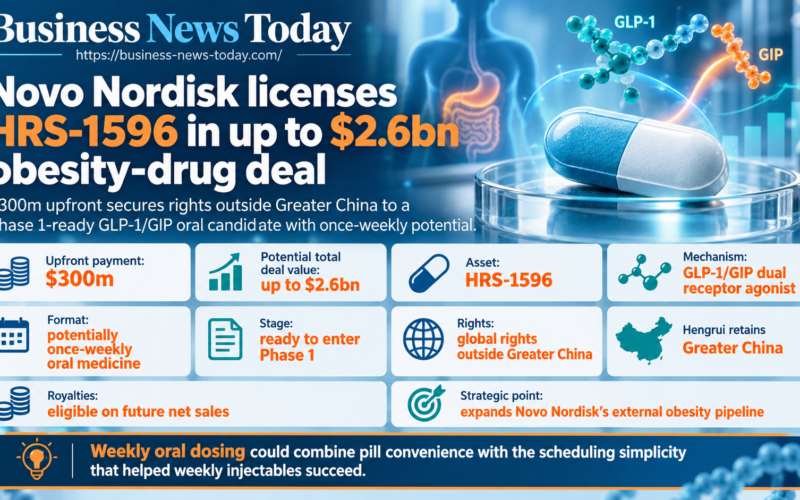
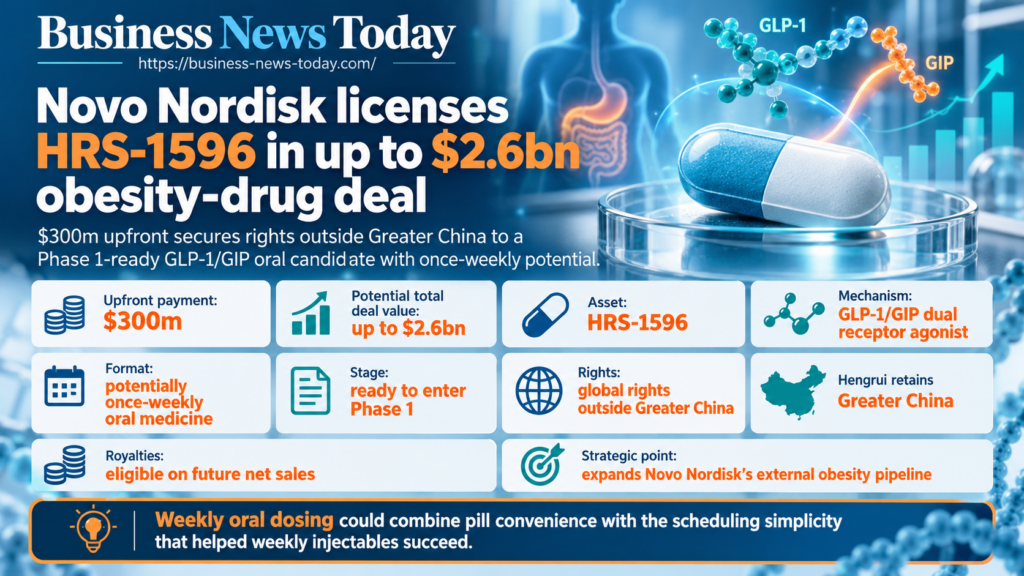
Novo Nordisk A/S (Nasdaq Copenhagen: NOVO-B; NYSE: NVO) has agreed to pay Jiangsu Hengrui Pharmaceuticals Co., Ltd. $300m upfront for global rights outside Greater China to HRS-1596, an experimental GLP-1/GIP dual receptor agonist being developed as a potentially once-weekly oral medicine. Development, regulatory and commercial milestones could lift the total value of the agreement to as much as $2.6bn, while Hengrui is also eligible for royalties on future net sales.
The asset is ready to enter Phase 1 development and has not yet demonstrated efficacy or safety in a large patient trial. The distinction is important because the $2.6bn headline is overwhelmingly contingent: Novo Nordisk is committing $300m immediately, while as much as $2.3bn depends on future progress and commercial success.
The transaction nevertheless illustrates how rapidly Novo Nordisk is supplementing its internal pipeline with external technology. It follows only days after the company’s agreement with Sweden’s Nanexa AB covering PharmaShell delivery technology aimed at monthly or quarterly injectable peptide medicines.
The two transactions target the same broad commercial problem from opposite directions. Nanexa could reduce injection frequency, while HRS-1596 could make an oral treatment dramatically less frequent than conventional daily tablets.
What is HRS-1596 and why does once-weekly oral dosing matter?
HRS-1596 is designed to activate the GLP-1 and GIP receptors, two metabolic pathways already validated commercially through medicines including Eli Lilly and Company’s tirzepatide.
What differentiates the Hengrui candidate at this stage is its intended route and schedule. Novo Nordisk describes HRS-1596 as having the potential for once-weekly oral dosing.
Oral medicines usually need to be taken daily because drug concentrations decline as the body processes the active ingredient. Extending effective exposure for an entire week could reduce treatment burden substantially if pharmacology, safety and efficacy remain acceptable.
A once-weekly tablet would require roughly 52 scheduled doses each year compared with 365 for a daily pill. That difference may sound small relative to whether a drug produces 15% or 20% weight loss, but convenience can materially influence persistence when patients remain on chronic therapy for years.
It could also differentiate oral treatment from injections. Some patients resist needles while others find weekly injections easier than remembering a daily tablet.
A weekly pill could theoretically combine the psychological convenience of oral administration with the scheduling simplicity that helped make weekly injectable GLP-1 treatments successful.
Why is Novo Nordisk licensing another obesity technology so soon after Nanexa?
Novo Nordisk’s recent business-development activity reflects an increasingly competitive metabolic-disease market. Eli Lilly has built an enormous franchise around tirzepatide while numerous pharmaceutical and biotechnology companies are developing injectables, oral drugs and combinations.
Novo Nordisk therefore cannot assume that semaglutide will preserve today’s competitive position indefinitely. Patent protection on important products becomes progressively more relevant during the next decade, while newer medicines may offer better efficacy, convenience or pricing.
The Nanexa and Hengrui agreements address different possibilities. PharmaShell could potentially extend injectable dosing to monthly or quarterly schedules across multiple peptide programmes. HRS-1596 is a specific oral GLP-1/GIP asset potentially taken once a week.
Owning multiple technical options is rational because nobody knows which format will dominate obesity treatment in the 2030s.
Patients may segment rather than converge around one product. Some could prefer a highly effective injection, others may choose an oral medicine, while still others could prioritise longer dosing intervals even if weight-loss differences are modest.
Novo’s job is therefore to build enough pipeline breadth that the company participates whichever preference wins.
The cost of that optionality is capital. The company is committing hundreds of millions of dollars upfront to programmes that can still fail clinically.
Why has China become so important to the global obesity drug pipeline?
Hengrui represents a wider shift in pharmaceutical innovation. Chinese biotechnology and pharmaceutical companies have developed increasingly sophisticated pipelines and are licensing international rights to multinational drugmakers while often retaining domestic commercial rights.
HRS-1596 follows that model. Novo Nordisk receives exclusive development, manufacturing and commercial rights outside mainland China, Hong Kong, Macao and Taiwan, while Hengrui keeps Greater China.
China’s metabolic-drug pipeline has expanded rapidly, with hundreds of GLP-1-related candidates under development across different mechanisms and delivery formats.
That creates a broad scouting ground for multinational companies looking for external innovation. Buying or licensing an asset after it has already generated substantial Phase 3 evidence would generally be much more expensive.
Early deals reduce upfront cost but transfer more scientific risk to the buyer.
The relationship can work well for both sides. A Chinese developer gains international funding and commercial infrastructure without surrendering its home market, while a multinational obtains another pipeline option without building the discovery programme from scratch.
Novo Nordisk is not alone in using this strategy. Global pharmaceutical companies have signed a growing number of licensing transactions with Chinese developers across oncology, immunology and metabolic disease.
How does the Hengrui deal fit Novo Nordisk’s post-Wegovy strategy?
Novo Nordisk recently told investors it wants more than five potential multi-blockbuster launches by 2030 and at least DKK150bn of pipeline sales by 2035. Those ambitions require significantly more than extending today’s Wegovy and Ozempic franchises.
The company already has CagriSema and multiple next-generation metabolic candidates, but external deals increase the number of shots on goal.
HRS-1596 is particularly interesting because oral obesity drugs could expand the addressable market beyond patients comfortable with injections. Pills are also potentially easier to distribute through traditional pharmacy channels, although peptide manufacturing and formulation can remain complex.
Convenience does not guarantee superior economics. Oral medicines may require larger quantities of active ingredient than injections, and adherence remains important even when dosing falls to once a week.
Novo must also prove that the drug can compete clinically with future standards rather than today’s medicines. By the time HRS-1596 could reach the market, rival therapies may offer higher weight loss, improved tolerability or additional cardiovascular and metabolic benefits.
That development lag is why Phase 1 assets are heavily discounted despite large headline licensing values.
Why did Novo Nordisk shares remain weak after another major pipeline deal?
Novo Nordisk’s US-listed shares closed September 29 at $38.31, down about 1%, while Hengrui shares gained around 2% in Hong Kong following the licensing announcement. Novo’s ADRs remained far below levels reached earlier in the year and close to the lower portion of their recent 52-week range.
The muted reaction suggests investors are demanding more than pipeline expansion. Novo’s strategy presentation earlier in September left questions around future pricing, competitive position and the ability of new products to offset eventual pressure on established franchises.
A Phase 1-ready asset cannot answer those questions immediately. Even an interesting once-weekly oral profile remains several development stages away from approval.
The deal does demonstrate urgency and financial capacity. Novo is using business development to increase pipeline breadth rather than relying entirely on internal research after competition in obesity intensified.
The next milestones are therefore scientific. Investors need Phase 1 data showing acceptable pharmacokinetics and tolerability, followed eventually by evidence that HRS-1596 delivers clinically competitive weight loss and metabolic benefits.
The $2.6bn maximum value attracts attention. The $300m upfront payment better represents today’s commitment. The potential value for Novo Nordisk will depend on whether one tablet can eventually do for an entire week what current oral treatments must do every day.
Discover more from Business-News-Today.com
Subscribe to get the latest posts sent to your email.