


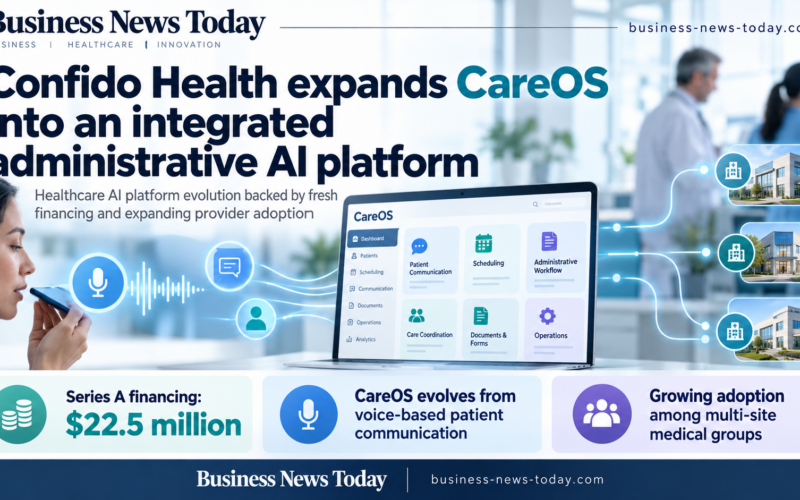
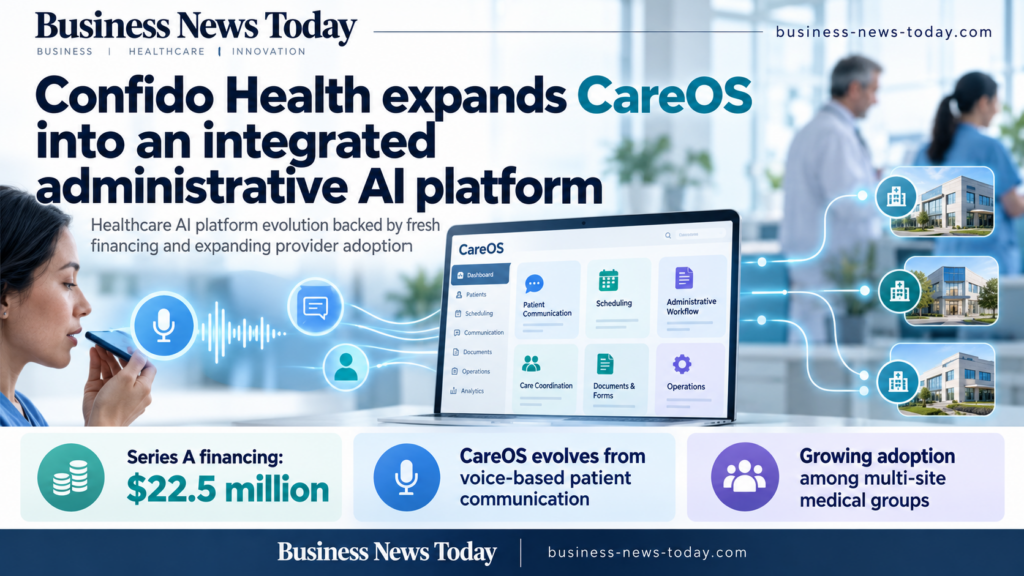
Confido Health, the New York-based healthcare technology company developing artificial intelligence agents for medical practice operations, has announced $22.5 million in total Series A financing to expand its CareOS agentic operating platform. The October 14, 2026 announcement includes a $12.5 million Series A extension led by Z47, formerly Matrix Partners India, with participation from existing investors Together Fund and Blume Ventures. The investment supports Confido Health’s expansion beyond automated patient phone calls into coordinated administrative workflows involving scheduling, insurance verification, referrals, billing and patient outreach. Its commercial significance lies in whether AI systems can reliably complete operational tasks across disconnected healthcare software, rather than merely answering patient enquiries.
The financing also brings healthcare private equity investor Justin Saks into the company as an investor and board advisor. Confido Health is positioning CareOS as an administrative operating layer that works alongside electronic health records, practice management applications and communication systems already installed by healthcare providers. The company says its technology integrates with more than 50 existing systems without requiring medical organizations to replace their underlying software infrastructure.
Co-founder and Chief Executive Officer Chetan Reddy has described the company’s strategy as addressing the administrative workload that persists despite extensive healthcare digitization. The underlying argument is that storing patient and financial information electronically does not automatically complete the activities required to deliver services. Confido Health is seeking to convert information captured during routine interactions into completed administrative actions that would otherwise require staff coordination.
The announcement comes as healthcare organizations face pressure to improve operating efficiency while maintaining patient access and service quality. However, the company has not disclosed annual recurring revenue, customer contract values, profitability or cash burn, limiting the ability to assess its financial performance independently. The Series A financing provides additional resources for expansion, but the commercial outcome will depend on customer retention, implementation economics and demonstrable operating improvements.
How does Confido Health’s CareOS platform move medical practices from systems of record to systems of action?
Healthcare providers increasingly depend on electronic health records and practice management systems to store clinical, scheduling and financial information. These applications maintain essential records, but administrative employees often remain responsible for transferring information, contacting patients and following up on incomplete requests. A patient interaction may therefore involve several applications and employees before the underlying administrative requirement is resolved.
Confido Health developed its initial business around AI-powered voice agents capable of handling patient communications. CareOS extends this model by connecting conversations with subsequent tasks across healthcare applications. Instead of treating a telephone call as a completed interaction once the conversation ends, the platform is intended to initiate or execute the administrative work associated with the patient’s request.
For example, appointment enquiries may require access to provider calendars, practice-specific scheduling rules and patient information stored in separate applications. Insurance-related requests can involve eligibility checks and follow-up communications, while referral management may require coordination between different healthcare offices. Confido Health says CareOS can carry information across these activities, reducing the need for employees to repeat routine data entry and coordination.
The architecture is commercially relevant because replacing an established electronic health record system is an expensive and operationally disruptive undertaking. Providers have already invested in software licenses, implementation, staff training and workflows associated with their existing applications. An additional operating layer that integrates with those systems may offer a less disruptive route to automation than requiring a comprehensive technology migration.
Nevertheless, integration breadth alone does not establish operational effectiveness. A connection to an existing software platform must support accurate data retrieval, appropriate permissions and reliable completion of the intended transaction. Medical practices will need evidence that CareOS can handle real-world exceptions and update the correct records without introducing additional administrative errors.
The model also creates a potential competitive challenge for established healthcare technology suppliers. If independent AI platforms become responsible for performing activities across multiple applications, the point at which users interact with healthcare software may gradually shift away from individual recordkeeping systems. That possibility does not imply that CareOS will replace electronic health records, but it could influence how providers evaluate new technology investments.
What do Confido Health’s 95% AI handling rate and reported staffing benefits actually demonstrate?
Confido Health says CareOS has achieved AI handling rates exceeding 95% across selected critical end-to-end office workflows. The company also reports that customers have gained additional operational capacity equivalent to three to five full-time employees on average within three months of deployment. These figures suggest meaningful automation potential, although the company has not published a detailed independent evaluation establishing how the measurements were calculated across different customer groups.
The distinction between handling a task and completing it successfully is especially important in healthcare administration. An AI agent may receive and process a patient request but still require an employee to resolve an exception, correct information or finalize an action. Measuring the amount of human intervention remaining after automation provides a stronger indicator of operating efficiency than the percentage of interactions initially handled by AI.
The reported staffing benefit is also expressed as additional capacity rather than confirmed workforce reductions. A medical practice may use that capacity to answer more calls, reduce backlogs, extend patient access or support higher patient volumes without recruiting additional employees. Actual payroll savings will depend on whether automation changes staffing requirements, overtime expenditure or the need for future hiring.
Confido Health reports average patient satisfaction of 4.55 out of five across approximately one million tasks. This provides a substantial company-reported measure of customer interaction experience, but it does not establish the complete range of clinical or operational outcomes associated with the platform. Satisfaction scores can also vary depending on the type of task, patient population and method used to collect feedback.
The company’s investor Z47 has separately reported that Confido Health operates across more than 1,500 care locations, supporting approximately 3,200 providers in 27 states. That distribution footprint indicates that the technology has progressed beyond isolated demonstrations into use across a geographically dispersed healthcare customer base. However, the number of locations does not establish the proportion of administrative activity automated at each site or the revenue generated per customer.
Confido Health has additionally reported approximately 15-fold growth since its previous funding round. The announcement does not define the underlying measure sufficiently to treat that figure as a verified increase in revenue, customer numbers or profitability. It is therefore more appropriate to interpret the disclosed growth as a company-reported indicator of expansion rather than a precise financial growth rate.
Why are private equity-backed medical groups central to Confido Health’s healthcare automation strategy?
Confido Health is focusing heavily on multi-location medical and dental organizations, particularly provider groups backed by private equity investors. These businesses often manage practices operating under different administrative arrangements while seeking greater consistency across scheduling, billing, insurance verification and patient communications. The combination of fragmented software infrastructure and repeated administrative processes creates opportunities for technology that can be deployed across multiple locations.
The company’s distribution strategy begins with relationships involving healthcare private equity investors. According to management, successful deployments within one portfolio company can help introduce CareOS to other healthcare businesses associated with the same investment organization. This approach may reduce the cost and complexity of identifying prospective customers compared with approaching every medical practice independently.
The strategy reflects the operational priorities of organizations managing multiple clinical sites. Centralized administrative processes can make it easier to support geographic expansion without increasing back-office staffing at the same rate as clinical activity. Technology that handles routine communication and coordination may also allow existing employees to concentrate on more complicated patient requests.
However, a multi-site healthcare business is not necessarily operationally uniform. Different specialties may have distinct appointment requirements, insurer rules, clinical workflows and patient communication preferences. A system capable of automating routine dental scheduling may require different configuration and oversight when deployed in ophthalmology, physical therapy or primary care.
Confido Health has identified ophthalmology and optometry, physical therapy, dental services, and primary and community healthcare as important areas of focus. These specialties contain substantial administrative activity but vary considerably in their operating requirements. The ability to reuse software capabilities while accommodating local differences will influence whether deployments become more economical as the customer base grows.
Private equity relationships also introduce commercial dependencies. A technology supplier may gain access to several portfolio companies through one investor relationship, but purchasing decisions can remain subject to the requirements of individual provider organizations. Adoption will depend on the economics of each deployment, information security assessments and the willingness of medical practices to change established workflows.
The involvement of Justin Saks provides Confido Health with an advisor experienced in healthcare investment and multi-site business operations. His participation may strengthen the company’s understanding of how investors evaluate operational improvement, although the appointment does not guarantee additional customer contracts. CareOS will need to demonstrate measurable benefits at the practice level even when investment organizations support its wider adoption.
Can CareOS improve medical practice revenue collection without creating new operational risks?
The platform’s commercial potential extends beyond reducing routine administrative activity. Billing follow-ups, outstanding patient balances and insurance-related tasks affect how effectively medical practices convert services into collected revenue. Delays or incomplete follow-up can create additional working-capital requirements and increase the administrative cost associated with receiving payment.
Confido Health has highlighted Vision Innovation Partners as an example of its technology supporting financial operations. Michael Pascetta, the healthcare group’s chief financial officer, reported that collections in its payments department doubled after deploying Confido Health. He attributed part of the improvement to stronger patient-balance follow-up supported by the platform’s outbound calling capabilities.
The reported improvement is commercially meaningful but requires careful interpretation. Confido Health has not disclosed the baseline collections amount, the measurement period or the contribution of other operational changes at Vision Innovation Partners. The example supports the company’s claim that automation can contribute to collections performance, but it does not establish that comparable results can be achieved across every healthcare organization.
Automated payment communications must also operate within appropriate privacy, consumer protection and billing requirements. Patient financial information can involve sensitive personal and healthcare data, while administrative communications may require identity verification and restrictions on what information can be disclosed. Healthcare providers remain responsible for ensuring that technology vendors operate under applicable contractual and regulatory requirements.
The platform’s ability to initiate actions also creates different risks from those associated with purely informational chatbots. An incorrect response from a conversational system may require clarification, while an incorrect transaction involving an appointment, patient balance or record update may create an operational problem requiring investigation and correction. Strong authorization controls, audit records and escalation processes become increasingly important as the number of automated actions grows.
Confido Health’s broader business will therefore depend on maintaining a balance between automation and oversight. Tasks involving ambiguity, conflicting information or higher operational consequences may still require human review. The strongest implementations are likely to be those in which the technology reduces routine work while preserving clearly defined responsibilities for exceptions and sensitive decisions.
How does the $12.5 million Series A extension change Confido Health’s funding position?
The latest financing consists of a $12.5 million Series A extension that brings Confido Health’s total disclosed Series A funding to $22.5 million. The cumulative amount includes the earlier $10 million Series A financing, so the full $22.5 million should not be characterized as entirely new capital received through the October announcement. The extension was led by Z47, with existing investors Together Fund and Blume Ventures participating.
The financing supports a business expanding from a narrower voice automation product into a more comprehensive healthcare operations platform. That transition can increase engineering requirements because the company must maintain integrations with different software systems, develop additional workflows and support customers operating in multiple specialties. Implementation and customer success resources may also become more important as deployments grow in scale and complexity.
Confido Health has emphasized its use of forward-deployed engineers who work with customers to configure the platform for existing operating environments. Such an approach can improve deployment relevance but may also introduce labor-intensive implementation requirements. The financial attractiveness of the business will depend partly on whether lessons from earlier deployments can be reused to reduce the cost of onboarding subsequent customers.
The investment may provide flexibility to expand its technical capabilities, develop customer relationships and support larger healthcare organizations. However, the company has not allocated the financing among specific product initiatives or provided a detailed capital expenditure budget. It has also not disclosed the valuation attached to the Series A extension.
The presence of venture capital and healthcare investment professionals indicates institutional interest in the company’s technology and market opportunity. Nevertheless, financing activity is not evidence that the platform has achieved profitability or that investors have independently verified every operational performance claim. Future financial progress will depend on recurring customer revenue, deployment costs and the ability to retain accounts over time.
For a private company, customer economics are particularly important because external investors have limited visibility into standardized quarterly financial disclosures. Contract expansion, retention rates, implementation margins and cash consumption would provide useful evidence of whether rapid growth is translating into a sustainable business. None of those measures has been publicly quantified in the October announcement.
What could determine whether agentic AI becomes a standard operating layer for healthcare providers?
The wider healthcare technology market increasingly includes vendors offering AI-assisted scheduling, patient communications, documentation and revenue cycle support. Some companies specialize in individual activities, while others are developing more integrated administrative platforms. Confido Health’s strategy is to compete through the ability to coordinate several related processes rather than relying on the automation of an isolated task.
Its integration-first approach may offer a commercial advantage where medical organizations are unwilling to replace existing systems. However, major electronic health record providers and healthcare technology companies also have incentives to develop additional automation capabilities within their own platforms. Confido Health will need to demonstrate that its independent operating layer provides functionality or implementation benefits that customers cannot obtain as effectively from existing suppliers.
Customer trust will be a critical factor in the adoption of more autonomous administrative systems. Healthcare organizations must understand how software handles patient information, applies operational rules and identifies situations requiring human intervention. Reliable performance across different patient populations, insurers and specialties is likely to matter more than conversational sophistication alone.
Regulatory obligations and contractual requirements may also influence deployment decisions. Access to protected health information, third-party system permissions and responsibilities for record accuracy can affect implementation. The company has not announced that CareOS possesses independent authority to diagnose patients, prescribe medication or replace licensed clinical decision-making.
The clearest evidence of competitive strength would be sustained reductions in administrative cost per completed task, improvements in patient access and demonstrable collection or scheduling benefits across multiple customers. Consistent performance with limited manual correction could support expansion into larger healthcare organizations. Conversely, high implementation costs or frequent exceptions could limit the scalability of the platform.
Confido Health has established a substantial disclosed footprint and secured additional investment to extend CareOS into a wider range of operations. Its next commercial test is to show that expanding automation does not merely move work from front-desk staff to technical support or exception-management teams. A growing base of customers demonstrating reliable, repeatable operational savings would provide stronger evidence of long-term value than the number of calls handled by AI.
What are the key takeaways from Confido Health’s $22.5 million Series A financing and CareOS expansion?
Confido Health announced $22.5 million in total Series A financing on October 14, 2026, including a $12.5 million extension led by Z47. The company is expanding CareOS beyond voice AI into administrative workflows involving appointments, insurance verification, referrals, patient outreach and billing. Its disclosed operating footprint covers more than 1,500 healthcare sites and approximately 3,200 providers in 27 U.S. states.
Management reports AI handling rates exceeding 95% across selected workflows and additional capacity equivalent to three to five employees on average within three months of deployment. Those figures remain company-reported performance measures rather than independently established outcomes across all customers. Confido Health’s longer-term growth will depend on the accuracy of completed workflows, implementation costs, customer retention, information security and measurable improvements in healthcare operating efficiency.
Discover more from Business-News-Today.com
Subscribe to get the latest posts sent to your email.