


PharmaResearch Co., Ltd. (KOSDAQ: 214450), the South Korean biopharmaceutical and skincare company behind REJURAN Cosmetics, has announced an expansion of its United States retail presence through Costco Wholesale Corporation’s (NASDAQ: COST) new Beauty Table program. The initiative, announced on October 23, 2026, introduces the brand’s proprietary c-PDRN skincare technology to a warehouse-club environment, with the display program currently operating across 25 U.S. warehouses. REJURAN Cosmetics plans to expand its participation to more than 150 locations, potentially increasing consumer exposure to its Korean dermocosmetics portfolio. The strategic opportunity lies in converting greater physical retail visibility into recurring product sales, although the company has not disclosed expected revenue, rollout timing or commercial terms.
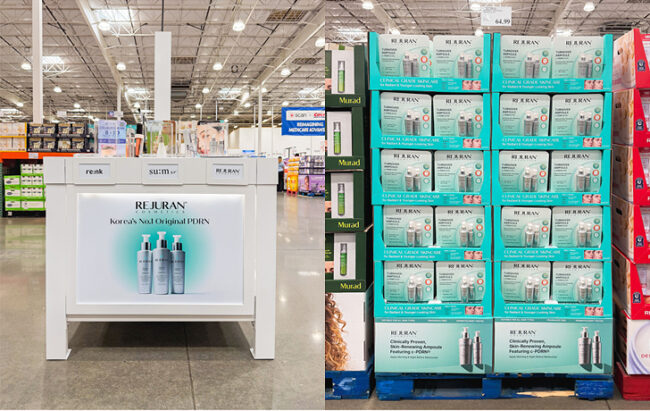
The introduction centers on a Costco-exclusive REJURAN Turnover Ampoule package containing a 50-milliliter full-size product and an additional 10-milliliter quantity. The formulation incorporates c-PDRN, an ingredient developed by PharmaResearch for cosmetic applications and marketed around skin hydration and texture improvement. The combined presentation is designed to provide additional product quantity to Costco members rather than simply introducing an unchanged retail package.
The initiative represents a distribution expansion for REJURAN Cosmetics rather than the launch of a new pharmaceutical treatment. The brand already operates in international beauty markets and draws upon PharmaResearch’s established experience in polynucleotide and polydeoxyribonucleotide technologies. Its entry into Costco’s Beauty Table program creates an opportunity to introduce the cosmetic brand to customers who may recognize Korean skincare trends but have not previously purchased REJURAN products.
Jooyeon Song, head of cosmetics at PharmaResearch USA, said the company intends to use the program to introduce its skincare products to more American consumers while adapting future offerings to local preferences. Management also expects customer feedback and purchasing activity to help guide subsequent assortment and marketing decisions. Those objectives indicate that the rollout has a market-development component extending beyond immediate product sales.
Why is Costco’s new Beauty Table program strategically important for REJURAN Cosmetics?
Costco’s membership-based retail model gives brands access to a large customer network through stores characterized by substantial merchandise turnover and value-oriented purchasing. Unlike conventional specialist beauty retailers, Costco serves customers across groceries, household essentials, electronics, healthcare and discretionary consumer categories. Beauty products appearing in this environment can reach shoppers who were not specifically planning a skincare purchase.
The Beauty Table format is intended to give selected cosmetics and skincare brands dedicated visibility within participating warehouses. For REJURAN Cosmetics, this creates an opportunity to communicate its product positioning in a physical retail environment where consumers can encounter unfamiliar brands during routine shopping trips. The display-based approach may help overcome the discovery challenge facing international beauty labels entering an established American market.
However, the disclosed rollout requires careful interpretation. PharmaResearch said Costco’s Beauty Table program was operating in 25 U.S. warehouses and outlined plans for REJURAN Cosmetics to expand its participation to more than 150 warehouses. The announcement does not establish that REJURAN products are already available in every proposed location, nor does it provide a confirmed completion date for the larger rollout.
The proposed expansion would represent a substantial increase in participating locations if fully implemented. Relative to the program’s initial 25-warehouse footprint, a network exceeding 150 locations would be more than six times as large. That comparison describes potential distribution scale rather than a forecast of sales growth, since individual store demand, product assortment and inventory allocation will vary.
Costco reported 647 warehouses in the United States and Puerto Rico at the end of its 2026 fiscal year. A rollout to more than 150 locations would therefore represent a meaningful but selective portion of its domestic network. The limited initial program offers an opportunity to test consumer response before committing resources across a broader geographical footprint.
For PharmaResearch, the channel could complement digital marketing and existing beauty distribution without requiring investment in standalone retail stores. The company can use Costco’s physical infrastructure and established shopping traffic to introduce products to customers. Whether the arrangement produces attractive returns will depend on distribution economics, promotional spending and the conversion of first-time purchases into repeat demand.
How does REJURAN’s Costco-exclusive Turnover Ampoule set fit the economics of warehouse-club retail?
The product selected for the rollout is REJURAN Cosmetics’ Turnover Ampoule, supplied in a package containing 60 milliliters across a 50-milliliter bottle and an additional 10-milliliter quantity. The combined offering provides 20% more product than a standalone 50-milliliter bottle. However, the announcement does not disclose the Costco selling price or a directly comparable standard retail price, preventing a reliable calculation of the customer’s percentage savings.
The package structure is consistent with a broader feature of warehouse-club merchandising, where larger quantities and exclusive configurations can help establish a distinct value proposition for members. Such products allow retailers to offer merchandise that may not be directly comparable with identical packages available through competing channels. For suppliers, exclusive configurations can also support channel differentiation while preserving the underlying product identity.
Commercial attractiveness depends on the price received by the supplier relative to manufacturing, distribution and promotional expenses. A larger package may encourage initial purchase but could reduce the amount of revenue generated per milliliter if it is offered at a substantial discount. Conversely, greater production volumes may improve manufacturing utilization or distribution efficiency if demand is sufficiently strong.
The company has not disclosed wholesale pricing, gross margins, manufacturing commitments or promotional allowances associated with the Costco program. Consequently, the expanded distribution should not automatically be interpreted as margin-accretive. A successful program would need to generate sufficient contribution from higher sales volumes to offset the costs associated with serving the warehouse channel.
Product replenishment will be another operational consideration. If a concentrated assortment performs well, the retailer may require reliable inventory availability across participating locations. Insufficient supply could interrupt sales momentum, while excessive inventory would expose the supplier to working-capital pressure and potential markdowns.
The arrangement also introduces a customer acquisition opportunity. Buyers discovering the brand through Costco may subsequently purchase other REJURAN Cosmetics products through existing channels. That broader customer relationship could support the economics of the rollout, but the company has not provided evidence establishing cross-channel purchasing behavior among customers acquired through the program.
What is c-PDRN skincare, and how does it differ from PharmaResearch’s injectable REJURAN products?
PharmaResearch has developed its business around technologies involving polynucleotides and polydeoxyribonucleotides, commonly referred to as PN and PDRN. The company markets REJURAN skin boosters in international aesthetic medicine markets and operates REJURAN Cosmetics as a separate consumer skincare offering. Both draw on the company’s expertise in nucleic-acid-derived materials, but their routes of administration and intended uses differ.
REJURAN Cosmetics uses a proprietary ingredient described as c-PDRN, which PharmaResearch developed specifically for cosmetic formulations. The Turnover Ampoule is positioned as a daily skincare product intended to help hydrate skin and improve its appearance and texture. These are cosmetic claims rather than evidence that the product delivers the same outcomes as an injectable treatment.
The distinction is relevant because scientific research involving PDRN delivered through medical procedures cannot automatically establish the effectiveness of a topical cosmetic formula. Skin penetration, ingredient concentration, molecular characteristics and the overall formulation can influence whether a substance produces measurable effects when applied to the skin’s surface. Evidence supporting one method of delivery should not be treated as proof of equivalent performance through another.
Independent dermatology and cosmetic-science commentary has highlighted the relatively limited clinical evidence available for many topical PDRN products compared with better-established skincare ingredients. This does not establish that REJURAN’s finished formulation is ineffective, but it reinforces the need to assess product-specific evidence rather than relying on the wider reputation of injectable polynucleotide treatments.
For PharmaResearch, the connection between its aesthetic medicine portfolio and consumer cosmetics may support brand recognition among customers familiar with Korean dermatology. However, the commercial benefit depends on communicating the relationship without creating confusion over product functionality. A consumer ampoule should be evaluated through its demonstrated cosmetic performance, safety and suitability for daily use.
The Costco expansion may therefore provide a test of whether the brand’s science-oriented positioning appeals to shoppers outside specialist skincare channels. Customer satisfaction, product reviews and repeat purchase behavior will be relevant indicators. Strong initial curiosity around an ingredient is commercially useful only if the finished product delivers an experience that customers consider worth repeating.
How does the expansion support PharmaResearch’s international beauty and healthcare strategy?
PharmaResearch operates across medicines, medical devices, cosmetics and healthcare-related products, with REJURAN representing one of its most recognizable international brands. Its portfolio combines products sold through professional healthcare channels with consumer-oriented skincare. This creates opportunities to reach different customer groups while drawing on related technological and brand capabilities.
The company’s REJURAN skin booster has been introduced in more than 50 countries, according to PharmaResearch. That international presence gives the broader brand recognition beyond South Korea, although the number of countries where a professional product is marketed does not establish the geographic distribution of REJURAN Cosmetics. Professional and consumer product availability must be considered separately.
The U.S. expansion is commercially relevant because American beauty retail offers multiple channels for Korean skincare brands. Specialist cosmetics chains, e-commerce platforms, social-media-driven sellers and membership retailers each serve different purchasing preferences. Participation in Costco’s program potentially introduces REJURAN Cosmetics to customers who may not routinely shop through its existing channels.
The initiative also creates opportunities to gather information about American purchasing preferences. A premium skincare brand developed for international markets may need to adapt product configurations, pricing and promotional methods to suit different retail environments. Feedback from Costco shoppers could help inform future decisions about product assortment and marketing.
PharmaResearch’s growth prospects will depend on balancing international expansion with the profitability of its established healthcare and cosmetics businesses. New retail distribution may increase revenue opportunities but can also create upfront marketing, logistics and inventory requirements. The company has not announced capital expenditure or financial guidance specifically associated with the Beauty Table program.
The commercial outcome will be influenced by how the company manages its wider distribution portfolio. Heavy discounting or inconsistent channel pricing could create friction with existing retailers, while effective differentiation may allow Costco to serve a separate customer segment. The exclusive Turnover Ampoule configuration offers one mechanism for distinguishing the warehouse proposition from other products.
What do Costco’s latest financial results suggest about the opportunity for Korean skincare brands?
Costco Wholesale Corporation reported net sales of approximately $297.2 billion for its fiscal year ended August 30, 2026, representing growth of 10.1% from approximately $269.9 billion in the previous year. Fourth-quarter net sales increased 11.2% to $93.9 billion, while annual net income reached approximately $9.23 billion. The results illustrate the scale and continuing growth of the retail platform through which REJURAN Cosmetics is seeking additional distribution.
The retailer reported a 6.6% increase in adjusted U.S. comparable sales for fiscal 2026, excluding the effects of gasoline prices and foreign exchange. Its membership model and high-volume operating structure create substantial exposure to recurring shopping activity. For an emerging beauty brand, access to even a selective portion of the network may provide opportunities to reach customers beyond traditional beauty retail.
Nevertheless, Costco’s overall financial performance cannot be used to estimate sales generated by a single skincare product. The company reports consolidated results across numerous merchandise categories and geographies. The Beauty Table program has not been accompanied by separate financial disclosures that would establish the size or profitability of this initiative.
Costco’s scale may create purchasing advantages for customers while placing commercial pressure on suppliers to deliver competitive pricing and consistent availability. Products must compete for attention and limited merchandising space alongside established brands. Continued distribution is likely to depend on customer demand and the retailer’s assessment of assortment performance, although Costco has not publicly detailed the program’s selection or continuation criteria.
The beauty initiative is therefore more financially significant as a distribution opportunity for PharmaResearch than as an identifiable earnings catalyst for Costco Wholesale Corporation. Costco’s annual sales base is too large to infer a material group-level financial impact from the announced REJURAN Cosmetics participation without substantial additional evidence.
How did PharmaResearch and Costco shares perform around the October 23 announcement?
PharmaResearch shares closed at KRW 239,500 on the KOSDAQ market on October 23, 2026, declining 6.1% from the previous session’s KRW 255,000 close. The stock had closed at KRW 278,000 on October 16, indicating a decline of approximately 13.8% over the following week. The movement illustrates a cautious recent trading backdrop, but the Costco distribution announcement cannot be identified as its cause.
The Korean market had already closed before the U.S.-timed October 23 announcement was distributed. Consequently, the reported Korean share-price decline should not be described as a reaction to the Beauty Table news. Subsequent market performance would need to be assessed alongside the company’s broader financial results, valuation and other corporate developments.
Costco shares closed at $1,003.32 on Nasdaq on October 23, declining 1.46% from $1,018.21 in the previous session. The announcement was released during U.S. trading hours, but no evidence establishes that the skincare program materially influenced Costco’s share-price performance. The company’s much larger earnings base means the individual distribution development is unlikely to provide a meaningful standalone explanation for a session’s trading.
For PharmaResearch, the more relevant indicators will be the number of warehouses actually carrying its products, replenishment activity, repeat demand and the contribution of international cosmetics sales. Retail visibility may support brand awareness, but sustainable revenue growth requires customers to purchase products repeatedly at commercially attractive margins.
An expansion beyond 150 participating warehouses would provide a wider platform for measuring demand across different U.S. markets. The company has not disclosed when that milestone will be reached or whether every location will carry the same assortment. The strongest validation would be evidence that the products continue selling after initial promotional activity and justify ongoing retail space.
What are the key takeaways from REJURAN Cosmetics’ expansion through Costco?
REJURAN Cosmetics has entered Costco’s new Beauty Table program, which is initially operating across 25 U.S. warehouses. PharmaResearch plans to expand participation to more than 150 locations, but the larger rollout remains a future objective rather than completed distribution. The program features an exclusive 60-milliliter Turnover Ampoule package built around the company’s cosmetic c-PDRN ingredient, with pricing and financial terms undisclosed.
The expansion gives PharmaResearch access to a large membership retail platform while creating additional inventory, pricing and replenishment requirements. The product is a topical cosmetic and should not be treated as equivalent to an injectable REJURAN treatment. For investors, the commercial test will be sustained customer demand, profitable international cosmetics growth and evidence that wider distribution strengthens the brand without undermining returns.
Discover more from Business-News-Today.com
Subscribe to get the latest posts sent to your email.