

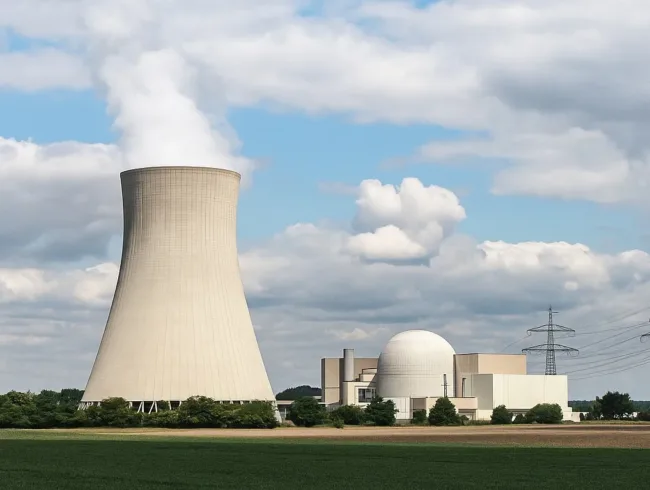
NextEra Energy, Inc. (NYSE: NEE) has reached financial close with the United States Department of Energy on a loan of up to $1.9 billion to support the restart of the 615 MW Duane Arnold Energy Center in Linn County, Iowa. The plant ceased operation in 2020 after approximately 45 years of service, but NextEra now plans to return Iowa’s only nuclear station to the grid no later than the first quarter of 2029, subject to United States Nuclear Regulatory Commission approvals. The financing removes a major piece of capital uncertainty from one of the most prominent American nuclear restart projects, while an existing 25-year power agreement with Google provides a long-term commercial destination for most of the plant’s electricity. Financing and demand are therefore increasingly defined, leaving regulatory execution and physical refurbishment as the central risks.
The Department of Energy estimates that the restart could create about 1,500 jobs during construction and refurbishment and support more than 460 permanent operating positions. NextEra previously cited an economic study estimating more than $9 billion of economic benefits to Iowa over 25 years. These are project and government estimates rather than guaranteed outcomes, but they explain why the restart has attracted both federal financing and local economic attention.
How large is the $1.9 billion federal loan relative to Duane Arnold’s 615 MW capacity?
Dividing the maximum $1.9 billion loan amount by the plant’s 615 MW capacity produces roughly $3.1 million of financing per megawatt. That ratio is useful for understanding the scale of the federal commitment but should not be confused with a restart cost per megawatt because the loan is described as financing support rather than the project’s definitive total capital budget.
Restarting a nuclear facility after years offline requires substantially more than refueling the reactor. NextEra needs to inspect and refurbish systems, restore staffing, perform regulatory work, rebuild supply chains and demonstrate that the plant can operate safely under current licensing requirements.
Some equipment may need replacement even when technically functional because operating standards, maintenance requirements or component life have changed since shutdown. Nuclear facilities also carry security, quality assurance and training requirements that differ substantially from restarting an ordinary thermal generator.
The federal loan can therefore absorb a broad range of restart expenditure while lowering the financing burden associated with bringing an idle generating asset back into productive use. The exact economics will become clearer when NextEra discloses additional capital, interest and operating-cost details.
Why does Google’s 25-year agreement materially reduce commercial risk?
Google and NextEra announced in 2025 that Google would purchase power from Duane Arnold under a 25-year arrangement once the plant returns to service. Central Iowa Power Cooperative is expected to purchase the remaining portion under similar terms, while NextEra has agreed to acquire minority interests that would take its ownership of the plant to 100%.
That structure creates unusually strong revenue visibility for a restart project. Instead of spending billions to recommission a plant and then selling all output into volatile wholesale electricity markets, NextEra has a long-term technology customer seeking around-the-clock electricity for growing cloud and artificial intelligence infrastructure.
The agreement also illustrates why nuclear restarts have become more financially interesting. Hyperscale data centers need large volumes of reliable power, while major technology companies have increasingly shown willingness to sign long-duration contracts that can support financing of generation projects.
Long-term contracting does not eliminate execution risk. Google does not begin receiving electricity until Duane Arnold successfully returns to service, meaning construction delays or NRC requirements can postpone the revenue stream even if customer demand is already secure.
Is 2029 realistic for a reactor that has been shut since 2020?
NextEra has targeted commercial operation no later than the first quarter of 2029. That gives the company roughly two and a half years from the September 2026 federal financing close to complete refurbishment and regulatory work.
The NRC is a crucial part of the schedule. Federal financing does not authorize the reactor to resume operation, and NextEra must satisfy licensing and safety requirements before electricity can return to the grid.
Duane Arnold’s history creates both advantages and challenges. It is an existing facility with established grid connections and decades of operating history, avoiding the long development process associated with constructing a completely new nuclear station. At the same time, years of shutdown require comprehensive review before systems can be trusted for another operating cycle.
The restart timetable therefore deserves more attention than the financing announcement alone. Meeting the first-quarter 2029 objective would demonstrate that closed nuclear capacity can return on a timescale significantly shorter than most new nuclear construction projects.
Can NextEra comfortably support the project alongside its enormous renewable development programme?
NextEra Energy reported second-quarter adjusted earnings of $2.407 billion, or $1.15 per share, up from $2.164 billion and $1.05 per share a year earlier. The company continues simultaneously expanding renewable generation, storage, transmission and regulated utility infrastructure, making Duane Arnold one project inside a much larger capital programme.
Federal financing reduces the amount of ordinary corporate funding required for the nuclear restart and can preserve NextEra’s balance-sheet capacity for those other projects. The long-term offtake structure further improves the restart’s financing profile by reducing merchant electricity-price exposure.
NextEra shares closed at $82.31 on September 11, down 0.16% for the day and around 2.1% below the September 3 close of $84.06. The loan was announced September 8, when the stock rose only 0.48%, suggesting the federal financing did not independently transform market expectations around a company of NextEra’s scale.
That muted reaction does not make the project strategically small. Nuclear baseload tied directly to technology demand is becoming an increasingly important part of the United States power market, and a successful Duane Arnold restart could influence how utilities evaluate other retired reactors.
What would materially de-risk the Duane Arnold restart from here?
NRC approval is the clearest remaining gate. A defined licensing pathway with no major technical obstacles would materially strengthen confidence in the 2029 timetable.
Visible refurbishment progress will provide another signal. Hiring, major equipment work and eventual fuel-loading milestones would show that federal financing is converting into physical execution rather than remaining largely financial capacity.
The Google contract has already addressed much of the customer question. NextEra therefore does not need to prove that electricity demand exists; it needs to prove the plant can safely and economically return to operation.
If Duane Arnold reaches the grid in early 2029, the project would combine a retired nuclear asset, federal credit and hyperscaler demand into a model that other utilities may try to replicate. If licensing or refurbishment costs push the restart materially beyond schedule, the economics of that model will be tested much more severely.
Key takeaways on NextEra Energy’s Duane Arnold restart
- The Department of Energy has closed a loan of up to $1.9 billion for the project.
- Duane Arnold is a 615 MW nuclear plant in Linn County, Iowa.
- The plant ceased operation in 2020.
- NextEra targets restart no later than the first quarter of 2029.
- The project remains subject to NRC approvals.
- Google has signed a 25-year agreement for power from Duane Arnold.
- The maximum federal loan equates to roughly $3.1 million per MW on a simple scale calculation.
- DOE estimates around 1,500 construction and refurbishment jobs and more than 460 permanent jobs.
- NextEra reported second-quarter adjusted earnings of $2.407 billion.
- Licensing progress and physical refurbishment are now more important than additional financing announcements.
Discover more from Business-News-Today.com
Subscribe to get the latest posts sent to your email.