



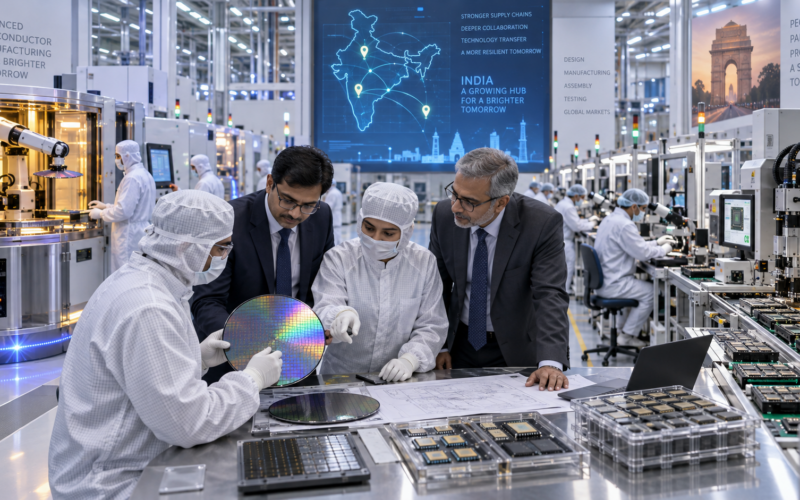
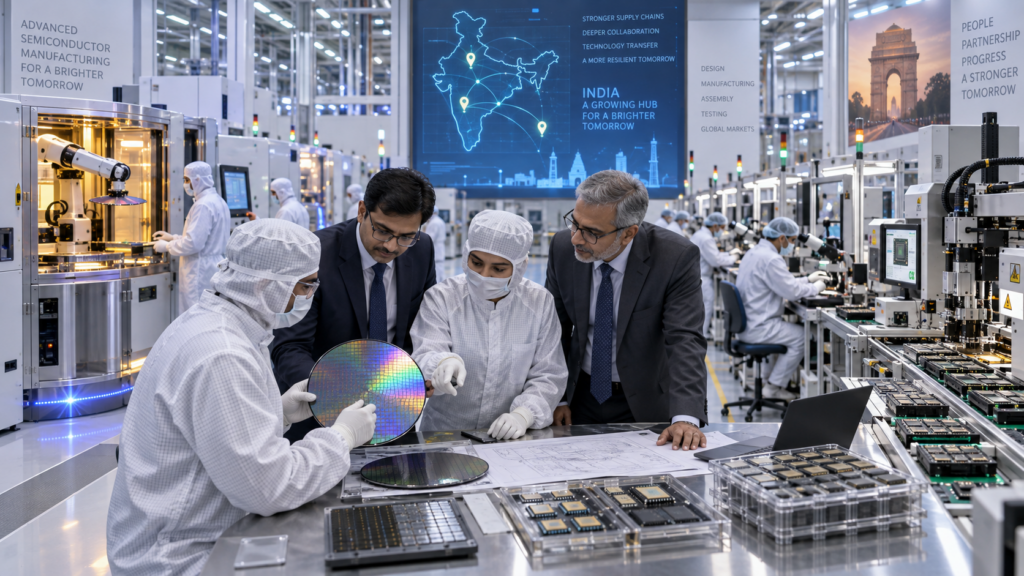
Nexperia and Tata Electronics have agreed to cooperate across front-end semiconductor fabrication, back-end packaging and testing, technology development and ecosystem building, creating one of the most significant customer relationships yet for India’s emerging semiconductor manufacturing industry. Nexperia said its MOSFET products are expected to be manufactured at Tata Electronics’ planned 300-millimetre fabrication plant in Dholera, Gujarat, while discrete semiconductor products will also be assembled and tested at Tata’s facility in Jagiroad, Assam. Financial terms were not disclosed.
The agreement is strategically notable because Nexperia ships more than 100 billion semiconductor devices annually, supplying components used across automotive, industrial, consumer, energy and communications applications. Tata Electronics, established only in 2020, is investing a combined $14 billion in the Dholera semiconductor fabrication plant and Jagiroad assembly-and-test facility as Tata Group attempts to build an integrated Indian electronics manufacturing platform.
Why is Nexperia’s partnership with Tata Electronics important for India’s chip ambitions?
India has attracted a growing list of semiconductor announcements, but the harder challenge is creating factories with real global customers and products. A fabrication plant without qualified demand can become an extremely expensive industrial asset, while international semiconductor companies need confidence that new manufacturing locations can meet rigorous quality and reliability requirements.
Nexperia provides that commercial connection. Its MOSFETs and discrete semiconductors are used in high-volume electronics and automotive applications where reliability, cost and continuous supply matter. Unlike the most advanced artificial-intelligence processors, many of these devices are manufactured using mature or specialised semiconductor processes, creating an opportunity for India to enter global chip supply chains without immediately competing with the most advanced Taiwanese fabrication nodes.
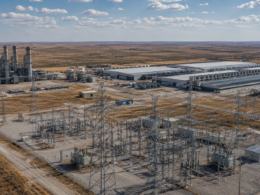
Tata Electronics’ Dholera facility is being built as India’s first commercial semiconductor fabrication plant under the country’s current manufacturing push. The Nexperia framework gives that factory a prospective global customer before commercial wafer production begins, while the Jagiroad arrangement creates an additional path through packaging and testing.
This matters for ecosystem development because semiconductor manufacturing is cumulative. Once a fab starts serving demanding global customers, suppliers of chemicals, gases, substrates, equipment, packaging materials and testing services gain stronger reasons to locate nearby.
What semiconductor products could Tata manufacture for Nexperia?
The front-end collaboration initially targets Nexperia’s MOSFET portfolio. MOSFETs are fundamental power-switching devices used across automobiles, industrial equipment, computing systems and power electronics. They control electrical current efficiently and are crucial in applications ranging from battery systems and electric motors to data centres and consumer electronics.
Nexperia also develops silicon carbide and gallium nitride power devices, analogue and logic products, diodes and protection technologies, although the initial partnership announcement specifically identifies MOSFET production at Dholera and discrete-semiconductor assembly in Assam. Any future expansion into additional technologies would depend on technical qualification and subsequent agreements.
The volume potential is substantial. Nexperia says it ships more than 100 billion products each year, illustrating how even relatively inexpensive semiconductor devices can create major manufacturing businesses when produced at enormous scale.
For Tata Electronics, those types of products could be particularly useful in the early ramp of a new fab. High-volume essential semiconductors provide opportunities to refine production processes, yields and quality systems while building relationships with automotive and industrial customers.
How does the deal connect to Nexperia’s split with Wingtech?
The India agreement also needs to be understood against Nexperia’s unusually complicated ownership history. Reuters reported that the Dutch semiconductor company’s partnership with Tata further reinforces its separation from Chinese parent Wingtech following intervention by the Netherlands in 2025. Dutch authorities had acted amid concerns about operations potentially shifting toward China, while Beijing subsequently restricted exports of Nexperia chips packaged in China, creating shortages for global automakers.
Those restrictions were later eased, but the corporate relationship remained fractured. A Dutch court stripped Wingtech of control over Nexperia, and the company’s current management board endorsed the Tata partnership.
The experience demonstrates why geographic diversification matters for even relatively simple semiconductor products. Automotive manufacturers learned during the pandemic that a shortage of low-cost chips can halt production of vehicles worth tens of thousands of dollars. Nexperia’s products therefore carry strategic importance far beyond their individual selling prices.
An Indian manufacturing base gives Nexperia another potential supply location outside existing European and Asian facilities. Tata gains technology and customer relationships, while Nexperia gains manufacturing flexibility.
Why could India benefit from manufacturing mature and power semiconductors instead of chasing only AI chips?
The semiconductor conversation is frequently dominated by advanced processors used by Nvidia, Advanced Micro Devices and hyperscale cloud companies. Yet most electronic systems contain many more power, analogue, connectivity and control chips than cutting-edge AI accelerators.
Cars illustrate this particularly well. A modern vehicle can use thousands of semiconductor components controlling everything from lighting and braking to battery management and infotainment. Electrification increases the importance of power semiconductors because efficient switching directly affects battery range, charging and motor performance.
Nexperia’s portfolio therefore aligns with markets India wants to develop domestically, including automobiles, renewable-energy systems, industrial electronics and communications infrastructure.
This can create a more defensible industrial strategy than attempting to leap immediately into the smallest manufacturing nodes. Mature and specialised processes still require enormous technical discipline, but equipment costs and competitive dynamics can differ from leading-edge logic.
How does the Nexperia agreement fit Tata Electronics’ broader investment programme?
Tata Electronics says the Dholera and Jagiroad semiconductor projects represent a combined investment of approximately $14 billion. The company is simultaneously building capabilities in semiconductor foundry operations, packaging and testing, electronics manufacturing services and design.
The strategy is vertically broader than simply constructing one fab. Tata wants to offer customers a trusted electronics supply chain within India, potentially serving companies looking to diversify production from China and other highly concentrated Asian manufacturing centres.
That creates natural connections with Tata Group’s wider businesses. Tata Motors and Jaguar Land Rover are major automotive semiconductor consumers, Tata Power is exposed to electrification and renewable infrastructure, and Tata Consultancy Services provides technology services. The semiconductor unit nevertheless needs third-party global customers if it is to become a commercially meaningful manufacturing platform rather than an internal group supplier.
Nexperia helps address that requirement.
What are the execution risks for Tata Electronics?
The most important risk is timing. India has announced major semiconductor investments, but commercial fabrication at large scale remains largely unproven. Building a clean room and installing equipment is only the beginning. The factory must reach acceptable yields, obtain customer qualification and maintain consistent performance across huge manufacturing volumes.
Reuters has reported delays of almost two years around the Dholera fabrication project compared with earlier expectations. That makes customer partnerships useful but also increases pressure on Tata to demonstrate that the facility can transition from construction to reliable production.
Semiconductor talent is another constraint. India has a large chip-design workforce but considerably less experience operating advanced high-volume fabs than Taiwan, South Korea, Japan or the United States. Tata and its partners will need to recruit, train and retain specialised manufacturing engineers.
Nexperia’s participation could help transfer practical knowledge, particularly because the partnership includes technology development and ecosystem collaboration rather than merely a purchase order.
What should investors watch next?
Neither Nexperia nor Tata Electronics is separately publicly listed, so there is no direct cashtag or daily share-price reaction to analyse. Wingtech is publicly traded in China, but it is not a party to the new India partnership and should not be treated as an investment proxy for it.
The important milestones are operational. Investors following Tata Group, India’s electronics sector and global semiconductor supply chains should watch the production timetable at Dholera, commissioning of Jagiroad, product qualification and whether Nexperia expands manufacturing beyond the initial MOSFET and discrete-device categories.
Additional third-party customers would be especially important. One global chipmaker validates the strategy. A portfolio of customers would begin to establish India as a genuine alternative semiconductor manufacturing location.
Discover more from Business-News-Today.com
Subscribe to get the latest posts sent to your email.