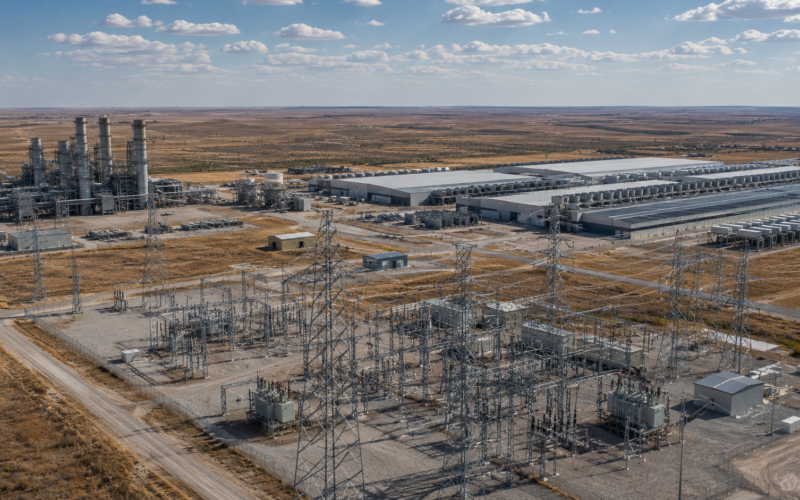
NEXTDC Limited (ASX: NXT) has outlined its largest annual investment program yet, guiding to FY27 net revenue of A$615 million to A$640 million and underlying EBITDA of A$385 million to A$410 million after record contracting activity transformed its forward demand profile. The August 27 results showed FY26 net revenue climbing 16% to A$405 million and underlying EBITDA increasing 15% to A$248.8 million, both above previous guidance. Contracted utilisation jumped 202% to 740.1MW, while the forward order book increased 322% to 565.1MW.
The release reached the Australian Securities Exchange at 5:38 p.m. on August 27, after that day’s trading session, making August 28 the first relevant market reaction. NEXTDC shares subsequently closed 2.14% higher at A$13.87, with about 4.70 million shares changing hands, compared with the pre-announcement A$13.58 close. The stock was approximately 4.8% above its July 28 close of A$13.23 but remained well below its A$18.22 52-week high.
Why does NEXTDC’s 565MW forward order book change the FY27 earnings equation?
NEXTDC finished FY26 with 175MW of billing utilisation but a 565.1MW forward order book consisting of binding contracted commitments, equivalent to more than 3.2 times the capacity already billing. The company expects 197MW to start billing during FY27 and another 221MW during FY28, meaning about 74% of the current order book is scheduled to convert within two years. Management estimates the existing contracted utilisation could ultimately support more than A$1 billion of contracted EBITDA, although the company stresses that delivery timing remains subject to execution risks.
That conversion profile explains why FY27 guidance is materially stronger than the FY26 growth rate. Net revenue is expected to rise 52% to 58%, while underlying EBITDA is forecast to expand 55% to 65%. At the midpoint of both ranges, the implied underlying EBITDA margin on net revenue rises to about 63.3%, compared with roughly 61.4% in FY26, suggesting management expects operating leverage as newly completed capacity starts generating revenue.
Artificial intelligence demand is part of the growth thesis but is not the only driver. NEXTDC identified hyperscalers, cloud providers, neocloud operators, enterprises and ICT partners among the sources supporting deployment activity, while its Australian metro network is being positioned for distributed AI inference workloads that need to remain close to enterprise and government data. The significance for investors is that current guidance is primarily tied to contracted capacity rather than depending entirely on future AI orders that have yet to materialise.
Can NEXTDC execute A$5.25bn to A$5.75bn of FY27 capital expenditure without stretching funding?
The scale of the construction program is the other side of the growth story. NEXTDC spent A$3.397 billion in FY26, double the prior year’s A$1.699 billion and A$397 million above the top of its final guidance range because construction and land spending accelerated. FY27 capital expenditure is now expected to reach A$5.25 billion to A$5.75 billion, including as much as A$500 million of customer-reimbursable fitout costs.
At the midpoint, A$5.5 billion of FY27 capex is nearly 8.8 times the midpoint of guided annual net revenue. That ratio illustrates why NEXTDC increasingly resembles a large infrastructure development platform rather than a conventional asset-light technology business, even though contracted customer demand provides substantial visibility. The company had 537MW under development at June 30 and more than another 240MW in planning, with expansion progressing across M2 and M3 Melbourne, S4 Sydney and KL1 Kuala Lumpur.
Funding capacity has grown alongside that buildout. Pro forma liquidity reached A$8.676 billion, up 58% year on year, after NEXTDC put A$9.75 billion of new capital commitments in place since August 2025 through senior debt, subordinated notes, hybrid securities and equity. That liquidity equates to roughly 1.6 times the midpoint of FY27 capex guidance, although the eventual economics will depend on construction timing, customer commissioning and the cost of the substantial debt and hybrid capital being deployed.
Why could power, water and grid policy become a bigger issue as NEXTDC expands?
Physical infrastructure constraints are becoming more relevant as NEXTDC’s development pipeline grows. The company said proposed New South Wales and Commonwealth reforms concerning data-centre grid connections and energy use do not affect its existing operating portfolio or current 565MW forward order book, while Transgrid has confirmed its new capacity-allocation policy does not apply to S4 Sydney. New connection and planning requirements could nevertheless affect later projects as governments respond to rapid growth in electricity-intensive data centres.
Environmental efficiency is also moving higher on the investor agenda. Reuters reported that NEXTDC’s water usage effectiveness worsened to 2.40 litres per kilowatt-hour from 2.25, while power usage effectiveness increased to 1.49 from 1.44 during FY26, continuing a multi-year deterioration as operating and commissioning activity expanded. Those trends do not alter the contracted demand opportunity, but they increase the importance of how quickly capacity growth can be matched by energy procurement, grid investment and resource-efficiency improvements.
The 2.14% post-results gain indicates that the market initially placed more weight on the order-book conversion and FY27 earnings outlook than on the capital intensity required to achieve it. NEXTDC’s market capitalisation stood at roughly A$10.54 billion on August 28, meaning the midpoint of next year’s capex program alone is equivalent to more than half the company’s equity value. Execution across that investment program is therefore likely to determine whether the unusually strong contracted growth ultimately translates into equally strong shareholder returns.
Discover more from Business-News-Today.com
Subscribe to get the latest posts sent to your email.