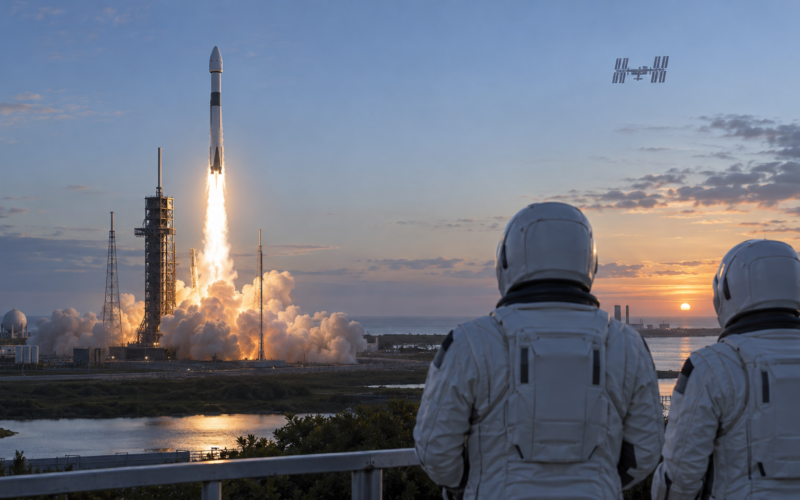
SpaceX has received a $946 million contract expansion from the National Aeronautics and Space Administration for three additional astronaut missions to the International Space Station, extending the company’s operational crew schedule through 2030. The modification increases SpaceX’s contracted NASA astronaut flights to 17 and raises the total value of its commercial crew transportation contract to $5.92 billion. It covers far more than the launch itself, including ground preparation for astronauts and spacecraft, in-orbit mission operations, return and capsule recovery, cargo carriage and the use of Crew Dragon as an emergency escape vehicle while docked. NASA confirmed the award on 18 September, according to Reuters, giving the agency a clearer transport plan as the space station approaches the end of its operating life.
The award reinforces a relationship that has become central to United States human spaceflight. NASA certified SpaceX for operational astronaut missions in November 2020 after selecting SpaceX and The Boeing Company (NYSE: BA) in 2014 to restore domestic crew-launch capability following the retirement of the Space Shuttle. Crew Dragon and the Falcon 9 rocket have since become NASA’s primary system for rotating astronauts to and from low Earth orbit. The new missions provide continuity, but they also underline the incomplete redundancy of a programme designed around two independent United States providers.
What does NASA receive under the expanded SpaceX crew contract?
The $946 million modification buys three end-to-end crew transportation services rather than three bare rocket launches. SpaceX must prepare and certify the spacecraft, integrate the crew and cargo, support training and ground operations, launch the mission, manage Crew Dragon while in orbit, bring the astronauts home and recover the capsule. Once attached to the International Space Station, the spacecraft remains available as a lifeboat if the crew needs to evacuate. That broad responsibility explains why dividing $946 million by three does not produce a meaningful standalone launch price.
The modification also extends programme certainty through 2030. NASA can align crew rotations with station operations, international partner assignments and research schedules while reserving trained vehicles and launch capacity years in advance. SpaceX gains a visible backlog from a highly credible government customer, which supports workforce planning, vehicle refurbishment and supply-chain commitments. Because the contract total now covers 17 astronaut flights, Crew Dragon has moved from a challenger in a development competition to the backbone of NASA’s operational transport architecture.
Mission reliability remains the central obligation. Human spaceflight requires repeated review of hardware, software, launch systems, recovery operations and any changes introduced across a reused fleet. SpaceX’s flight cadence gives it extensive operating data, but frequent service does not remove risk. NASA will continue to assess anomalies and certification requirements because a systemic issue affecting Falcon 9 or Crew Dragon could disrupt several planned rotations, precisely the concentration risk that a two-provider strategy was intended to reduce.
Why did NASA add more SpaceX missions before the International Space Station retires?
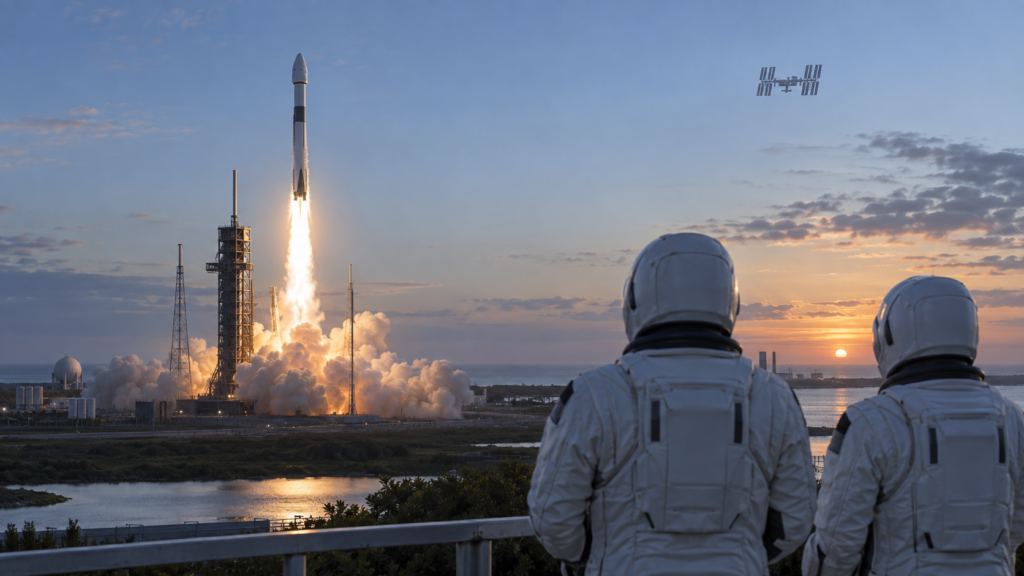
The International Space Station is expected to operate around the end of the decade, with a transition to commercial destinations anticipated thereafter. NASA still needs guaranteed crew access during that final period, and procurement must account for schedule slippage, vehicle readiness and the possibility that another provider is unavailable. Three additional SpaceX missions fill part of that planning window through 2030. They also reduce the risk that a late contract decision leaves NASA competing for launch slots or rushing mission integration.
Station retirement is a process rather than a single date. Partner governments must coordinate operations, research, logistics and a controlled deorbit while commercial station developers work toward replacements. If a successor platform is delayed or the existing station remains useful for longer, NASA may need further transportation flexibility. The current award does not guarantee additional missions beyond the contracted 17, but it preserves an experienced system through the most important transition years.
The commercial crew contract also supports broader policy. NASA’s use of purchased transportation services lets the agency focus resources on exploration programmes while private providers operate vehicles in low Earth orbit. SpaceX can use the same core launcher and capsule expertise across government, private-astronaut and commercial missions, spreading technical capability across a larger flight base. The model works best when more than one certified supplier is available, which is why Boeing’s progress remains strategically relevant even as SpaceX receives more work.
How did Boeing Starliner problems increase NASA’s reliance on SpaceX?
The Boeing Company was selected alongside SpaceX to give NASA dissimilar crew systems and prevent one technical failure from grounding all domestic access to orbit. That redundancy has not yet become fully operational. Boeing’s Starliner encountered serious problems during its 2024 crewed test flight, and NASA decided to return the capsule without its two astronauts. Butch Wilmore and Suni Williams, who had expected a mission of roughly 10 days, remained aboard the International Space Station for more than nine months before returning on a SpaceX Crew Dragon.
The episode did not end NASA’s interest in Starliner. The agency still wants Boeing to provide a second United States crew service because parallel systems reduce vulnerability to launch-vehicle failures, capsule anomalies or fleetwide inspections. Separate reporting indicates that NASA and Boeing have continued discussing future missions, but operational assignments depend on technical resolution and certification. Every additional SpaceX award gives NASA schedule protection while also making the gap between the programme’s intended two-provider structure and its current dependence more visible.
For Boeing, the pressure is strategic as well as financial. Starliner has absorbed cost overruns and engineering effort without reaching routine service, while SpaceX accumulates missions and performance history. A successful return to flight could still give Boeing a valuable role because NASA prizes redundancy more than a winner-takes-all outcome. Further delay would make it harder to justify the programme economically as the International Space Station approaches retirement and commercial low-Earth-orbit destinations remain under development.
What does the $5.92 billion contract mean for SpaceX’s wider business?
SpaceX is privately held, and NASA does not disclose the company’s internal margin on individual missions. The contract nevertheless provides long-duration government revenue, operational credibility and a recurring use case for Falcon 9 and Crew Dragon. Human-spaceflight success strengthens SpaceX’s standing in other civil and national-security competitions even when the hardware and procurement rules differ. It also gives the company a platform for training, safety and mission-control capability that cannot be built through satellite launches alone.
The financial value should be considered in context. SpaceX’s largest growth engine is widely understood to be Starlink, while Starship is absorbing substantial development capital for future exploration and commercial missions. A $946 million modification is meaningful, but it will be recognised over mission preparation and execution rather than as immediate cash profit. The award improves backlog visibility without revealing the cost of vehicle refurbishment, insurance, staffing or capital allocated to the crew programme.
The contract may also bridge SpaceX toward a different low-Earth-orbit market. NASA wants commercial stations to succeed the International Space Station, and those platforms will need reliable transportation for professional astronauts, researchers and private customers. Crew Dragon’s operational record gives SpaceX an incumbent advantage if it remains in service, while the company has indicated that Starship will eventually handle a broader range of missions. The transition creates opportunity, but it also introduces uncertainty over certification, customer demand and the timetable of replacement stations.
Is the expanded SpaceX award a negative signal for Boeing investors?
The award is competitively favourable to SpaceX but is not equivalent to NASA cancelling Boeing’s role. NASA has repeatedly emphasised the value of two independent providers, and the three additional missions primarily protect the agency’s schedule. Boeing investors should read the decision as evidence that NASA will not leave crew access dependent on an unresolved Starliner timetable. The commercial effect on Boeing depends on whether its vehicle wins and completes later operational assignments, not solely on the existence of more SpaceX flights.
Boeing shares closed at $198.20 on 18 September, up about 0.6% for the session. That move occurred amid broad market trading and cannot be attributed reliably to the SpaceX modification. Boeing’s valuation is driven mainly by commercial aircraft production, deliveries, cash flow, defence execution and balance-sheet repair, with Starliner representing a smaller but highly visible programme risk. A technical milestone or new NASA mission assignment would carry more direct sentiment value than a routine daily share move.
SpaceX has no publicly traded shares, so there is no direct stock-price reaction. Private-market valuations can respond to government backlog, Starlink growth and Starship progress, but those transactions are infrequent and not comparable with an exchange-traded price. Investors seeking public-market exposure to the crew programme should avoid treating Boeing or suppliers as simple SpaceX proxies because their revenue bases, risks and contract economics are different.
What milestones will determine whether NASA finally has two reliable crew providers?
SpaceX must continue delivering missions safely and on schedule while managing reused capsules and a high Falcon 9 launch cadence. NASA will watch vehicle anomalies, recovery performance and any design changes that could affect crew certification. The additional missions increase the consequence of fleetwide disruption, so reliability matters more than the headline contract value. Each successful rotation extends the evidence base, but each anomaly can trigger review across multiple scheduled flights.
Boeing’s milestones are more fundamental. Starliner must complete corrective work, satisfy NASA’s safety review and demonstrate that propulsion, software and other systems can support repeatable crewed service. A credible certified schedule would restore the redundancy envisioned in 2014 and give NASA more flexibility in assigning missions. Failure to achieve that before the station’s final operating years would leave SpaceX as the effective sole domestic provider for most of the remaining programme.
The final test reaches beyond the International Space Station. NASA needs a transport market that can serve future commercial stations without recreating dependence on one vehicle. The $5.92 billion SpaceX contract secures near-term access, but it does not by itself create durable competition. Its strategic importance lies in buying time for the agency, SpaceX, Boeing and commercial-station developers to complete a transition without interrupting continuous United States human presence in low Earth orbit.
Discover more from Business-News-Today.com
Subscribe to get the latest posts sent to your email.