

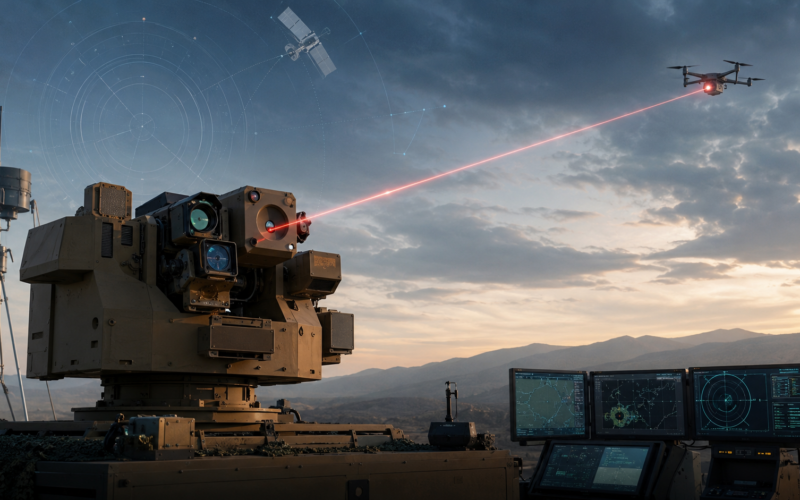
Electro Optic Systems (ASX: EOS) shares advanced 7.67 per cent to A$9.12 on Friday, taking the twelve-month return to 623 per cent and market capitalisation to A$1.76 billion. The Australian defence technology company added A$59 million of unconditional contracted work during Q1 2026, lifting backlog to A$518 million at 31 March, with the largest single order a US$42 million Slinger counter-drone Remote Weapon System contract for a Middle Eastern customer. With three product lines spanning cannon-based remote weapons, APOLLO high-energy lasers, and space situational awareness, EOS sits at the centre of the defence technology rotation that has lifted the ASX defence cohort. The defining near-term catalyst is whether the conditional US$80 million Goldrone Korean laser weapon contract converts to unconditional status during Q2 2026.
What is in the EOS Q1 2026 backlog, and where did the new orders come from?
EOS added A$59 million of unconditional contracted work during Q1 2026, lifting backlog to A$518 million at 31 March 2026. The largest single order was a US$42 million Slinger Remote Weapon System contract for a Middle Eastern customer, sold through a large defence prime contractor, with the customer’s identity withheld for national security reasons. Additional Q1 wins included a US$12 million R400 RWS order for a Middle East GCC government, a naval R800 order in India representing EOS’s first sale to the Indian defence industry, US$3 million of US counter-drone integration work, and US$12 million of US Army and Northrop Grumman related contracts. Customer receipts of A$72.6 million in Q1 were A$49.9 million higher than the prior corresponding period, reflecting both the larger backlog and faster delivery execution. The geographic breadth across Middle East, US, India, and Europe gives the revenue base more durability than a single-region book would.
How does the conditional Goldrone US$80 million high-energy laser contract change the EOS valuation case?
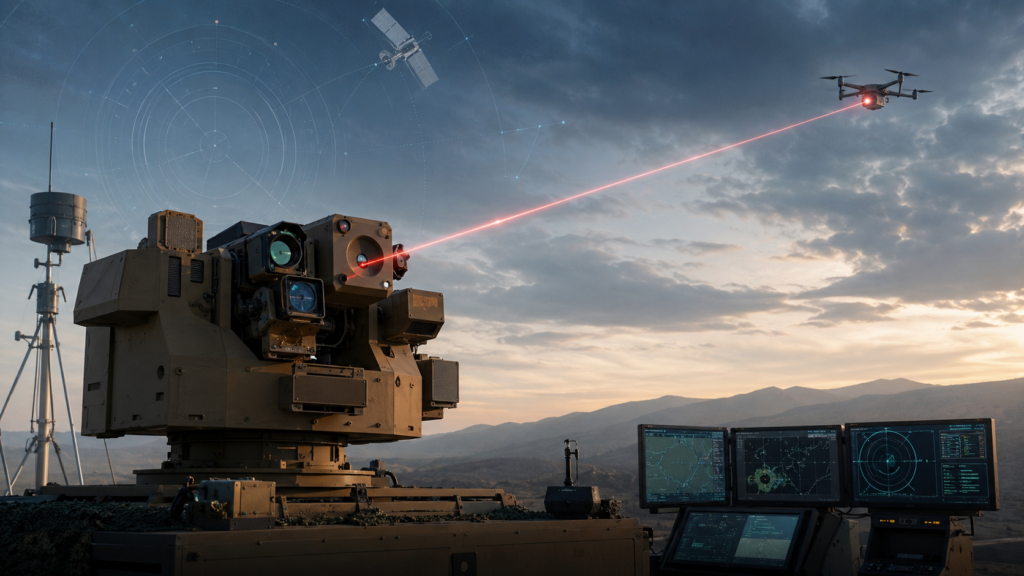
In December 2025, EOS signed a binding conditional agreement with Goldrone, a Republic of Korea customer, for a US$80 million contract covering the manufacture and sale of a 100kW High Energy Laser Weapon, the establishment of a Korea-focused joint venture, and IP licensing. The contract is conditional on the US$18 million initial deposit, a Letter of Credit for the balance, and customer inspection of the EOS Singapore Facility. During February and March 2026, EOS and Goldrone agreed a shared action plan including the possibility of manufacturing the first unit in Korea rather than Singapore, and EOS now believes conversion to an unconditional contract could occur during Q2 2026. The Goldrone deal is strategically significant because EOS is one of the few defence companies with export contracts on operational high-energy laser weapons rather than developmental programs. Conversion would validate the Singapore facility investment and the APOLLO product range.
What does the UAE and Korea defence industry partnership mean for EOS counter-drone exposure?
The UAE and South Korea announced a US$35 billion defence industry cooperation agreement covering supply chains for integrated air defence systems including counter-drone technology. EOS has been in discussions through 2025 and early 2026 with a UAE-based manufacturing partner to develop proposals for UAE-based production of EOS RWS products to support counter-drone requirements in both the UAE and Korea. The strategic logic is that local manufacturing reduces export friction and allows EOS to participate in regional industrial offsets that are now standard for major Middle Eastern defence procurement. Combined with the planned acquisition of MARSS, a European company specialising in AI-enabled command and control systems for counter-drone operations announced in January 2026 and expected to close in 2026, EOS is moving from component supplier toward integrated solutions provider.
How is the macro defence spending backdrop supporting EOS contract flow?
The combination of the ongoing Middle East military conflict, NATO defence budget increases, and Australian government counter-drone allocations has created sustained demand across EOS’s three primary product lines. Slinger has been validated as a kinetic counter-drone solution in operational use, the LAND 400 Phase 3 program in Australia delivered a A$108 million remote weapon stations contract in October 2025, and the US Army development work in Huntsville, Alabama positions EOS for follow-on US production. The risk on the macro side is symmetric. A de-escalation of conflict in the Middle East could reduce the tailwind that has driven a significant portion of recent order flow, and analysts have noted this concentration. The diversification across kinetic RWS, directed-energy lasers, and space products partially mitigates this, but a sustained Middle East peace would meaningfully slow contract velocity.
What separates EOS from other ASX defence technology names operationally?
EOS distinguishes itself by holding export contracts on commercial high-energy laser weapons while most competitors still operate at developmental stage, by maintaining complete in-house control over core laser technologies and intellectual property, and by combining kinetic hard-kill RWS with directed-energy solutions in a single integrated portfolio. The firm order backlog of A$518 million provides multi-year revenue visibility, the A$100 million Soul Patts facility remains undrawn, and operating cash flow turned positive during Q1 2026. The Singapore Laser Weapon Manufacturing Facility is purpose-built for laser weapon production, and current discussions span Germany, France, Italy, Turkey, Saudi Arabia, the UAE, India, Korea, Australia, and the United States. Not all conversations convert, but the breadth indicates the Singapore facility was not built for a single opportunity.
What execution risks remain on the path from backlog to revenue?
The first risk is Goldrone conversion. If the conditions are not satisfied during Q2 2026 or the contract is restructured, the share price reaction will be material because the laser weapon thesis is partly priced on this single transaction validating the category. The second risk is Middle East dependency. The geographic concentration of the largest recent orders means a sustained de-escalation would slow order velocity even if it would not reverse contracted backlog. The third risk is execution capacity. Converting A$518 million of backlog into deliveries requires manufacturing throughput across Australia, Singapore, and Huntsville, and any production delays compress margins. Analyst consensus price targets range from A$1.58 to A$12.44 with an average of A$8.26, a wide spread that captures the bull-bear divergence on conversion timing.
What are the key takeaways for retail investors watching Electro Optic Systems?
- Unconditional contract backlog reached A$518 million at 31 March 2026 after Q1 added A$59 million, with the US$42 million Middle East Slinger order as the largest single contract.
- The conditional US$80 million Goldrone Korean laser contract conversion is now targeted for Q2 2026, and outcome will materially affect the laser weapon valuation thesis.
- The MARSS acquisition, expected to close in 2026, expands EOS from component supplier to integrated counter-drone solutions provider.
- Geographic order diversification across Middle East, US, India, and Europe reduces single-region dependency, but Middle East concentration remains a sensitivity to conflict de-escalation.
- Operating cash flow turned positive in Q1 2026 with the A$100 million Soul Patts facility undrawn, supporting balance sheet resilience as backlog converts to deliveries.
Discover more from Business-News-Today.com
Subscribe to get the latest posts sent to your email.