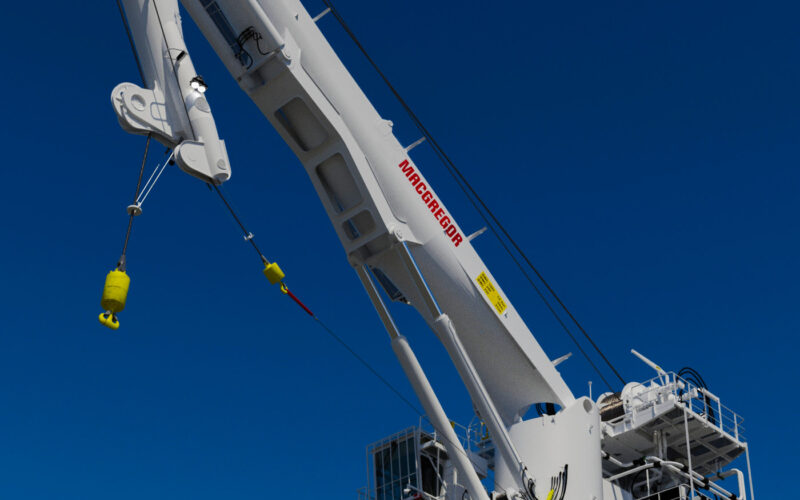
MacGregor has secured an order to supply a 165-tonne active heave compensated crane for a customised Ulstein SX121 offshore vessel ordered by Jan De Nul and being constructed at China Merchants Heavy Industry in China, adding another customer to a crane platform MacGregor has been commercialising across the offshore construction market. The contract forms part of a 1+1 vessel programme and will be recorded in MacGregor’s second-quarter 2026 order intake, with crane delivery scheduled for February 2028. Jan De Nul selected the equipment partly on MacGregor’s previous project performance, while the crane supplier is emphasizing the ability of its lightweight design to deliver higher lifting capability without imposing the weight associated with a larger conventional unit. The commercial significance extends beyond one crane because MacGregor is building this order pipeline during its first full year as a standalone Triton-owned company, with offshore newbuilds, modernisations and specialised construction vessels becoming increasingly important contributors to its €1 billion-plus order book.
The vessel itself is being designed for subsea trenching, where pipelines, power cables and telecommunications infrastructure are buried or protected below the seabed. Ulstein Design & Solutions was selected by Jan De Nul in March to provide the customised design, which is based on the proven SX121 subsea platform but adapted around Jan De Nul’s operational requirements. The ship is scheduled for delivery in 2028 and will incorporate Ulstein’s X-BOW hull, a dual-exhaust Ultra-Low Emission system and engines capable of operating on biofuel and green methanol. MacGregor’s crane therefore sits inside a vessel whose economic proposition is broader than lifting capacity alone, combining subsea construction versatility with lower-emission operating options and a configuration designed around long-duration offshore work.
Why did Jan De Nul choose MacGregor’s 165-tonne AHC crane for its new Ulstein SX121 vessel?
Active heave compensation is critical when a vessel lifts equipment in offshore conditions because the ship continues moving vertically with waves while the load may need to remain stable relative to the seabed. The crane’s control system compensates for that vessel motion, allowing subsea equipment to be lowered or recovered with much greater precision than a conventional lifting system would provide in the same sea state.
MacGregor’s current 165-tonne product is designed around another constraint that becomes increasingly important on multipurpose offshore vessels: weight.
The company says its lightweight architecture provides greater lifting capability for approximately the same equipment weight as competing 150-tonne systems. MacGregor has not published sufficient comparative engineering data in the latest announcement to independently quantify that advantage across competing products, but the underlying vessel-design logic is straightforward. Every tonne assigned to a large crane influences deck loading, vessel stability, fuel consumption and the amount of payload or specialist mission equipment the ship can carry.
For a trenching vessel, that trade-off can be particularly relevant because the crane is only one part of the working system. Deck space and deadweight also have to accommodate trenching equipment, remotely operated vehicles, subsea tools and supporting infrastructure.
Ulstein’s standard SX121 platform is designed as a modular offshore workhorse for activities including subsea construction, SURF installation, cable laying, trenching and diving. Its generic platform specifications support substantial deck areas and high-capacity offshore cranes, but Jan De Nul’s customised configuration has been developed specifically around trenching requirements rather than simply maximizing crane capacity.
That helps explain why a 165-tonne crane can be commercially attractive even when substantially larger offshore cranes exist. The optimum vessel is not necessarily the one carrying the biggest crane. It is the vessel that allocates weight, deck space and power most efficiently around the work it is expected to perform.

Why does the 1+1 Jan De Nul vessel programme matter for MacGregor beyond the first crane delivery?
MacGregor describes the order as part of a 1+1 vessel programme, meaning the current construction programme provides the possibility of another vessel beyond the first newbuild. The announcement does not disclose whether MacGregor already holds a firm crane order for that potential second ship, so the current contract should not be counted as two crane sales.
The option nevertheless creates valuable commercial leverage.
Equipment suppliers have an advantage once their system is engineered into the first vessel of a repeat series because vessel interfaces, installation arrangements, controls, documentation and yard procedures have already been developed. If Jan De Nul proceeds with the additional vessel and retains the same core equipment architecture, MacGregor would be well positioned to compete for the follow-on crane.
Repeat vessel programmes also improve execution economics for yards and suppliers. Engineering can be reused, commissioning experience carries forward and project teams become familiar with integration requirements. For specialised equipment such as an AHC crane, reducing engineering variation between sister vessels can help control both cost and delivery risk.
That makes the first Jan De Nul unit strategically more valuable than a completely isolated one-off crane sale, even though investors should not assign revenue to the optional vessel before an actual order is placed.
Is MacGregor’s 165-tonne crane becoming a repeatable product rather than a one-off engineering project?
The order history increasingly supports that interpretation.
MacGregor first announced a 165-tonne AHC crane contract in November 2025 for a 90-metre construction support offshore vessel being built at Hong Hua Yard in China for Atlantic Navigation. That contract included an option for another crane.
In April 2026, MacGregor confirmed a repeat order from Hong Hua Yard for another Atlantic Navigation vessel, with delivery scheduled for the third quarter of 2027. The company described the system as its next-generation lightweight 165-tonne crane and again highlighted the ability to provide higher lifting capacity without moving into the weight class associated with larger equipment.
Jan De Nul therefore expands the customer base beyond the Atlantic Navigation programme.
That matters commercially because specialist marine equipment can be expensive to develop when engineering costs have to be recovered across very small production runs. A design becomes more attractive when the same fundamental crane architecture can be sold to multiple vessel owners and shipyards while being adapted around individual vessel interfaces.
A repeatable product also improves aftermarket potential. Every additional crane entering service creates decades of possible spare-parts, inspection, maintenance, modernisation and technical-support demand.
That lifecycle opportunity is particularly relevant under Triton’s ownership because the private-equity group explicitly identified MacGregor’s aftermarket platform as an area with significant potential when it completed the acquisition in July 2025.
How does the Jan De Nul order fit into MacGregor’s broader offshore crane pipeline in 2026?
The 165-tonne product is only one part of MacGregor’s current offshore load-handling push.
In February, MacGregor secured an order for a 400-tonne active heave compensated subsea crane for a 127-metre floating wind farm construction vessel being built by Jiangsu Dajin Heavy Industry for operations managed by Hana Shipping. The vessel is intended for work including mooring, cable installation and other construction activities associated with floating offshore wind.
MacGregor has also reported a substantial volume of offshore load-handling modernisation and upgrade orders during the first half of 2026, demonstrating that demand is coming from both newbuild construction and equipment already operating in the global fleet. Those service contracts cover specialised engineering, modernisation and performance upgrades rather than new cranes alone.
The combination is strategically important.
Offshore vessel newbuilding is inherently cyclical. Shipowners invest heavily when utilization, day rates and project pipelines justify new capacity, but construction programmes can slow sharply when commodity markets, offshore wind economics or capital availability deteriorate.
Aftermarket services give equipment suppliers a more recurring revenue stream because installed cranes still require maintenance and upgrades even when new vessel contracting slows.
MacGregor’s long-term opportunity is therefore not simply to sell more cranes during the current offshore investment cycle. It is to increase the installed base that can feed service revenue throughout vessels’ operating lives.
Why is Jan De Nul adding another specialised trenching vessel to its offshore fleet?
Subsea infrastructure is becoming more diverse.
Traditional offshore oil and gas projects continue to require pipelines, umbilicals and subsea equipment, while offshore wind requires increasingly extensive power-cable networks connecting turbines, substations and shore. International telecommunications and electricity interconnectors add another source of seabed infrastructure requiring protection.
Trenching is one of the methods used to protect those assets from anchors, fishing equipment and other external hazards. Jan De Nul’s new vessel is specifically intended to support extensive trenching operations and combines that mission with enough modularity to serve wider offshore construction requirements.
That flexibility matters because specialised offshore vessels are expensive capital assets and need high utilization across long operating lives. A ship capable of adapting to multiple project types can theoretically access a wider contract pool than one designed around a very narrow task.
Jan De Nul already operates in offshore energy, dredging, marine construction and subsea infrastructure, providing a pipeline of potential work across both conventional and renewable energy.
The SX121 design also builds on a platform with a long operating history rather than an entirely untested hull concept. Ulstein describes the SX121 as designed for global subsea operations and capable of supporting construction, SURF work, cable laying, trenching and diving.
For Jan De Nul, the resulting proposition appears to be a specialised trenching vessel without sacrificing all of the optionality associated with a multipurpose offshore construction ship.
What does building the vessel at China Merchants Heavy Industry mean for MacGregor’s execution risk?
MacGregor has highlighted its local presence and manufacturing capabilities in China as part of the reason it can support the project through design, installation and commissioning. The vessel is being constructed at China Merchants Heavy Industry, placing the equipment supplier close to the yard during an integration process that can become highly complex when a large active heave compensated crane is involved.
That local capability can reduce several practical risks.
Crane foundations and vessel structures must be engineered together, power and control systems need to interface correctly, and commissioning requires coordination between the equipment supplier, shipyard, vessel designer and owner. Resolving those issues through teams operating in the same manufacturing region can help reduce delays associated with moving engineering personnel and equipment across continents.
China has also become an important construction base for specialised offshore vessels, which increases the value of local engineering support for equipment companies pursuing this market.
The flip side is supply-chain concentration. MacGregor operates globally, but a growing flow of offshore orders being built at Chinese yards increases exposure to trade restrictions, export-control requirements, currency movements and geopolitical disruption. The company itself has identified international trade tensions and export-control compliance among risks that can affect operations.
The advantage of Chinese yard proximity therefore comes with a broader requirement to maintain enough geographic flexibility to serve customers if trade conditions become more restrictive.
How strong is MacGregor financially as it adds offshore orders under Triton ownership?
MacGregor is no longer part of listed Hiab. Funds advised by Triton completed the acquisition on July 31, 2025, after the transaction was originally agreed at an enterprise value of €480 million. MacGregor now operates through MacGregor Group AB as a standalone business under Triton ownership.
Its first full standalone year began with improving profitability.
First-quarter 2026 sales increased 6% to €230.7 million, while adjusted EBITDA rose 22% to €34.9 million and adjusted EBIT increased 30% to €32.1 million. Adjusted EBIT margin improved from 11.3% to 13.9%. Orders received totaled €252.3 million and the quarter-end order book stood at €1.087 billion, providing more than a year of revenue coverage when compared with the company’s recent annual sales level.
MacGregor generated €827.6 million of sales in 2025, up 4%, while adjusted EBIT increased 33% to €98.5 million and the adjusted EBIT margin improved to 11.9% from 9.3%. Its year-end order book was €1.060 billion.
Those figures provide important context for the crane order. MacGregor does not disclose the contract value of individual equipment orders such as the Jan De Nul crane, so the direct revenue contribution cannot be calculated. What can be established is that the business enters the project with improving margins, a large backlog and lower leverage than at the beginning of its standalone transition.
At the end of Q1, net interest-bearing debt was €35.4 million and the leverage ratio had fallen to 0.30 from 0.54 at the end of 2025.
That balance-sheet position gives Triton-backed MacGregor room to invest in product development and execute its existing backlog without the crane business being driven primarily by financial pressure.
Why could MacGregor’s offshore installed base become more valuable than the initial crane sale?
Marine equipment economics extend far beyond ship delivery.
A crane entering service in 2028 could remain operational for decades, requiring inspections, replacement components, control-system support, maintenance and eventual modernisation. Offshore equipment operates under severe mechanical and environmental conditions, making lifecycle support particularly important.
MacGregor’s strategy under Triton places explicit emphasis on both portfolio leadership and service excellence. The company’s first-half 2026 offshore modernisation orders reinforce the potential value of that installed base because owners are already spending to upgrade equipment operating on existing vessels.
This creates a useful commercial flywheel.
New crane sales expand the equipment population. That installed base creates recurring service opportunities. Service relationships give MacGregor detailed knowledge of how its equipment performs in operation, which can feed future product development and increase the probability that owners select MacGregor again when ordering new vessels.
Jan De Nul’s decision itself illustrates that effect. MacGregor said its record on previous projects was an important factor in the equipment selection.
The strongest competitive advantage in offshore equipment may therefore come less from winning one technically impressive crane order and more from creating enough lifecycle performance evidence that customers choose the supplier repeatedly.
What will show whether MacGregor’s 165-tonne AHC crane becomes a meaningful growth platform?
The first proof point is execution on the existing Atlantic Navigation cranes. Those deliveries are scheduled during 2027, meaning MacGregor should have operating and commissioning experience from multiple units before the Jan De Nul crane is due in February 2028. Successful delivery would reduce perceived execution risk around the product platform.
The second is whether the Jan De Nul 1+1 programme converts into a second firm vessel and another crane opportunity. That would demonstrate that the current award can expand through a repeat-build architecture rather than remain a single contract.
The third is additional customer diversification. MacGregor now has its 165-tonne platform attached to Atlantic Navigation and Jan De Nul programmes. Winning another unrelated offshore operator would provide stronger evidence that the weight-versus-capacity proposition has broad market appeal.
The fourth is service conversion. The economic value of each crane becomes more attractive if MacGregor captures a significant share of lifetime maintenance, modernisation and spare-parts activity after vessel delivery.
The wider offshore market provides a supportive backdrop, but MacGregor still has to execute project by project. The company’s order book already exceeds €1 billion, its profitability has improved sharply and specialised offshore contracts are arriving across both new vessels and existing fleets.
The Jan De Nul award therefore matters because it connects several parts of that strategy at once. It puts a repeatable crane product onto a new customer’s 2028 trenching vessel, uses MacGregor’s Chinese execution footprint and creates another potential decades-long service asset. The strongest evidence that the strategy is working will come when the 165-tonne crane stops being described as a new product and starts appearing routinely across different offshore vessel programmes.
What are the key takeaways from MacGregor’s Jan De Nul 165-tonne AHC crane contract?
- MacGregor will supply a 165-tonne active heave compensated crane for a Jan De Nul vessel based on Ulstein’s SX121 platform.
- The vessel is under construction at China Merchants Heavy Industry in China and is scheduled for delivery in 2028.
- MacGregor expects to deliver the crane in February 2028 and will record the order in its second-quarter 2026 order intake.
- The newbuild forms part of a 1+1 vessel programme, creating a potential follow-on opportunity if the second vessel proceeds.
- Jan De Nul’s customised SX121 vessel is designed principally for subsea trenching while retaining broader offshore construction flexibility.
- MacGregor says the 165-tonne crane offers more lifting capacity without the weight penalty associated with larger conventional systems.
- Atlantic Navigation has already ordered the same 165-tonne crane platform for construction support offshore vessels, giving MacGregor repeat-product experience ahead of the Jan De Nul delivery.
- MacGregor also secured a 400-tonne AHC crane order for a floating wind farm construction vessel earlier in 2026, reinforcing broader offshore equipment momentum.
- MacGregor entered 2026 with a €1.06 billion order book and reported a further increase to €1.087 billion at the end of the first quarter.
- The longer-term value test is whether the crane platform wins more vessel programmes and converts its growing installed base into recurring aftermarket revenue.
Discover more from Business-News-Today.com
Subscribe to get the latest posts sent to your email.