


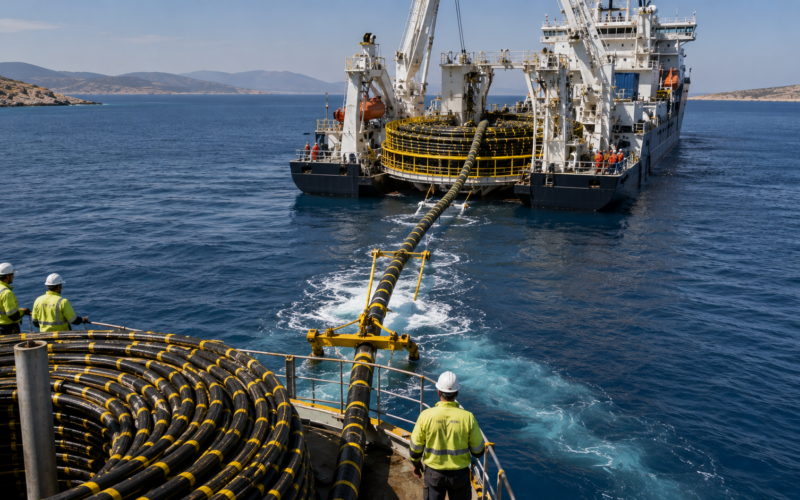
Cenergy Holdings S.A. (Euronext Brussels, Euronext Athens: CENER) said its Hellenic Cables segment has been awarded a turnkey Engineering, Procurement, Construction and Installation contract worth approximately €1.5 billion by Independent Power Transmission Operator, the Greek transmission system operator known as IPTO or ADMIE, for the 320 kV HVDC electrical interconnection between mainland Corinth and the Dodecanese island of Kos. The contract, awarded through wholly-owned subsidiary Fulgor S.A., covers approximately 1,260 kilometres of submarine cables and 30 kilometres of underground cables for a 1 GW bipolar link that will connect the Dodecanese to the Greek high-voltage system for the first time. Execution begins in the fourth quarter of 2026, with commissioning scheduled for 2030. The award is the single largest EPCI contract in Hellenic Cables’ history and pushes Cenergy Holdings’ consolidated backlog from the record €3.9 billion reported at 30 June 2026 toward the €5.4 billion mark. The central tension for investors is whether the group’s Corinth and Thiva production capacity, already absorbing the €1.15 billion IPTO Lot A framework agreement signed in June, can convert this stacked pipeline into the mid-teens to high-teens EBITDA margin the cables segment printed in the first half.
What does the €1.5 billion Corinth-Kos HVDC turnkey award mean for Hellenic Cables and Cenergy Holdings’ cables segment?
The Corinth-Kos award is, in scale terms, the most consequential single contract Hellenic Cables has ever booked. At approximately €1.5 billion in headline value it represents roughly 73% of Cenergy Holdings’ entire FY 2025 revenue of €2.06 billion, and it lands in the cables segment where H1 2026 adjusted EBITDA margins reached 19.5%, up 36% year on year in absolute terms to €164 million. Coming barely seven weeks after the €1.15 billion IPTO Lot A framework agreement for four AC island interconnections in the Dodecanese and North Aegean, it takes the cables segment backlog from €3.4 billion at 30 June 2026 to close to €4.9 billion, before any further order intake in the second half. For Cenergy Holdings’ Belgian parent structure, which trades on Euronext Brussels and Euronext Athens and sits inside the broader Viohalco group, the award converts what has been an investment thesis about HVDC cable market share into contracted revenue that will span the 2027 to 2030 execution window.

How does the 320 kV HVDC interconnection to the Dodecanese fit within IPTO’s 2030 grid programme?
The Corinth-Kos project is only the second HVDC line in Greece, following the Crete-Attica interconnection currently being commissioned through Ariadne Interconnection, an IPTO subsidiary. IPTO’s programme, articulated by chairman and chief executive Manos Manousakis, targets the connection of all major Aegean islands to the mainland by 2030, with the operator citing a €3.6 billion reduction in electricity costs for consumers between 2029 and 2053 as fuel-oil generation on the islands is phased out. The Dodecanese cluster, which will eventually extend from Kos to Rhodes, Karpathos and Patmos, sits alongside a separate €885 million North-East Aegean programme covering Skyros, Lesvos, Limnos, Chios and Samos. The original IPTO tender for Corinth-Kos, launched in November 2024, carried a budget of approximately €1.42 billion for cables plus two converter stations. The €1.5 billion award to Hellenic Cables covers the cable EPCI scope only, from converter station to converter station, meaning converter station awards to a specialist HVDC systems supplier remain a separate track and are likely to be announced in the coming quarters.
Which project scope does Fulgor S.A. deliver from converter station to converter station on Corinth-Kos?
Under the turnkey EPCI structure, Fulgor S.A. is responsible for the full end-to-end delivery of the submarine and underground cable systems, including engineering, manufacturing, transportation, installation and testing. The 320 kV HVDC configuration is expected to run as a bipolar 1 GW system, with cable manufacturing split between Hellenic Cables’ vertically integrated Corinth plant, which handles submarine production, and its Thiva plant, which manufactures the underground cable sections. Both facilities have benefited from recent capital expenditure programmes that expanded onshore cable capacity in Greece and, together with the new US land cables plant nearing completion in Maryland, form the manufacturing footprint Hellenic Cables is using to compete with Prysmian, Nexans, NKT and Sumitomo for tier-one HVDC awards. The 1,260-kilometre submarine cable requirement reflects the multi-cable bipolar configuration across the roughly 380-kilometre subsea route, and the 30-kilometre underground section covers landfall and converter station connections. The scope excludes marine survey and civil converter works, which sit with other IPTO contractors.
Why does the award extend an already record €3.9 billion backlog into a capacity question?
Cenergy Holdings’ order backlog, disclosed at €3.9 billion at 30 June 2026 and described by chief financial officer Alexandros Benos as expected to grow further, was itself a record built on the June €1.15 billion IPTO Lot A framework agreement covering the Thraki-Limnos, Kos-Rhodos, Lesvos-Limnos and Lesvos-Chios AC interconnections. Adding the Corinth-Kos HVDC award pushes cables segment backlog toward €4.9 billion, with steel pipes contributing a further €500 million from Corinth Pipeworks projects. The commercial question this raises is one Cenergy Holdings itself has flagged: capacity build-out. Management has stated that backlog is expected to grow further and that capacity investment is continuing, but the sequencing of two consecutive multi-year IPTO awards, alongside existing offshore wind commitments to Réseau de Transport d’Électricité’s Bretagne Sud project, DEME’s Polish offshore wind inter-array cables, and framework participation with National Grid, tests the Corinth and Thiva plant footprints simultaneously. The Maryland plant addresses US land cables demand rather than HVDC subsea, so it does not directly relieve the Greek plant load on IPTO awards.
How does the Corinth-Kos award reshape Cenergy Holdings’ revenue visibility through 2030 against the H1 2026 print?
The H1 2026 print gave the market a strong read on the run-rate. Revenue reached €1.15 billion, up 13% year on year, with adjusted EBITDA of €216 million, up 26%, and profit after tax of €138 million, up 45%. Earnings per share rose 45% to €0.65. On the back of this, management raised FY 2026 adjusted EBITDA guidance to a range of €390 million to €420 million, from a prior €370 million to €400 million range set after Q1 2026. Cables segment revenue reached €837 million in H1 2026, up 14% year on year, at a 19.5% adjusted EBITDA margin. The Corinth-Kos contract will not begin producing revenue until execution starts in Q4 2026, and given the 2030 completion timeline the contract is likely to be recognised progressively across four financial years, with the heaviest manufacturing quarters typically in 2027 and 2028. Layered on top of Lot A production expected to commence in 2027 and complete by 2031, the visibility window on the cables segment now extends into the early 2030s, provided execution stays on schedule.
What does the muted share-price reaction say about how the market was already pricing the Corinth-Kos tender?
Cenergy Holdings shares traded at €23.18 on Euronext Brussels intraday on 14 August 2026, up 1.05% on the day and down 0.26% over five days. Year to date, the stock is up 52.30%. The muted reaction to a €1.5 billion contract award is instructive. IPTO’s Corinth-Kos tender had been in the market since November 2024, Hellenic Cables was widely regarded as the front-runner given its Corinth plant proximity and prior Crete-Attica involvement, and the June €1.15 billion Lot A framework had already primed the market for a rolling wave of IPTO awards. Analyst consensus based on the four brokers covering the stock sits at BUY with an average target of €24.59, implying a 6.07% upside from the closing reference, though these estimates predate the Corinth-Kos announcement and are likely to be revised in coming weeks. The share-price behaviour on the day suggests investors were treating the award as anticipated pipeline conversion rather than an incremental upward surprise, with the more interesting question shifting to backlog margin and execution quality.
Where does Cenergy Holdings sit in the global HVDC cable competitive frame against Prysmian, Nexans and NKT?
The global tier-one HVDC submarine cable market is a narrow field. Prysmian, Nexans and NKT dominate the offshore wind export cable and cross-border interconnection segments, with Sumitomo and Hellenic Cables completing the group of manufacturers routinely bidding on 320 kV and above HVDC systems. Hellenic Cables’ recent trajectory includes the framework agreement with National Grid alongside Jan De Nul for UK and European HVDC tenders, and the consortium framework with Réseau de Transport d’Électricité for Bretagne Sud, both of which position the group as an accepted qualifier in the highest-voltage tenders. The Corinth-Kos win, however, remains a home-market award where Fulgor S.A.’s Corinth manufacturing proximity, existing supplier relationship with IPTO from the Crete-Attica programme, and Greek content considerations gave the incumbent structural advantages. The read-across to non-domestic tenders is real but should not be overstated. The award confirms Hellenic Cables can deliver a 320 kV HVDC EPCI at multi-year, multi-billion scale, which is a credential requirement for the largest North Sea and Mediterranean interconnector tenders now moving through procurement. It does not yet demonstrate that Fulgor can displace the top three in genuinely open bidding on offshore wind export cables at scale.
Which execution proof points will decide whether the Corinth-Kos contract translates into sustained margin?
Contract wins at this scale become margin only through disciplined execution. The measurable proof points fall in four windows. In Q4 2026, the notice-to-proceed and start of cable manufacturing at Corinth and Thiva will confirm the delivery schedule is holding. Through 2027 and 2028, the cables segment adjusted EBITDA margin needs to stay in the 18% to 20% range printed in H1 2026, indicating that the mix shift toward interconnection projects with semi-public credit counterparties such as IPTO is not diluting profitability against the previously offshore-wind-heavy book. In 2029, marine installation season execution will be the first stress test of Fulgor’s project management on a route length materially larger than Crete-Attica. Any slippage of commissioning beyond 2030 would push revenue recognition and cash conversion into a period where competitive pricing on subsequent IPTO awards, including the eventual Rhodes and Karpathos extensions, may already have tightened. The parallel converter station award, when it lands with a separate supplier, will also introduce an interface risk that sits outside Cenergy Holdings’ scope but affects the overall commissioning date.
What should investors track as Cenergy Holdings and Hellenic Cables move the Corinth-Kos HVDC award into execution?
- Cenergy Holdings’ Hellenic Cables segment, through wholly-owned subsidiary Fulgor S.A., has secured a turnkey EPCI contract worth approximately €1.5 billion from IPTO for the 320 kV, 1 GW HVDC electrical interconnection between mainland Corinth and the Dodecanese island of Kos.
- The contract covers approximately 1,260 kilometres of submarine cables and 30 kilometres of underground cables, with manufacturing at the Corinth and Thiva plants, execution beginning in Q4 2026 and completion scheduled for 2030.
- The scope runs from converter station to converter station, meaning the two converter stations planned for Corinth and Kos will be procured separately by IPTO from a specialist HVDC systems supplier.
- This is the second HVDC line in Greece after the Crete-Attica interconnection, and forms the anchor of IPTO’s programme to connect all major Aegean islands to the mainland by 2030, targeting a €3.6 billion consumer electricity cost reduction between 2029 and 2053.
- Cenergy Holdings’ consolidated backlog rises from €3.9 billion at 30 June 2026 toward €5.4 billion, with cables segment backlog reaching approximately €4.9 billion after this award and the €1.15 billion IPTO Lot A framework agreement signed in June 2026.
- H1 2026 results printed revenue of €1.15 billion, up 13% year on year, adjusted EBITDA of €216 million, up 26%, and profit after tax of €138 million, up 45%; management upgraded FY 2026 adjusted EBITDA guidance to €390 million to €420 million.
- Cables segment margin reached 19.5% adjusted EBITDA in H1 2026, and the Corinth-Kos contract’s margin quality through 2027 to 2030 will be the key test of whether interconnection mix sustains profitability against the previously offshore-wind-heavy book.
- The share-price reaction on 14 August 2026 was muted, with CENER up 1.05% intraday and down 0.26% over five days, reflecting a tender that had been in the market since November 2024 and a market already positioned for Hellenic Cables to win.
- The credential value against Prysmian, Nexans and NKT is real but incremental, since Corinth-Kos remains a home-market award where Fulgor S.A. carried structural advantages; the true competitive test lies in future non-domestic HVDC tenders including North Sea and Mediterranean interconnectors.
- Investors should track the Q4 2026 notice-to-proceed, the cables segment margin trajectory through 2027 and 2028, the parallel converter station award to a third-party supplier, and the 2029 marine installation season as the first genuine execution stress test, alongside the Q2 2026 earnings release scheduled for 15 September 2026.
Discover more from Business-News-Today.com
Subscribe to get the latest posts sent to your email.