


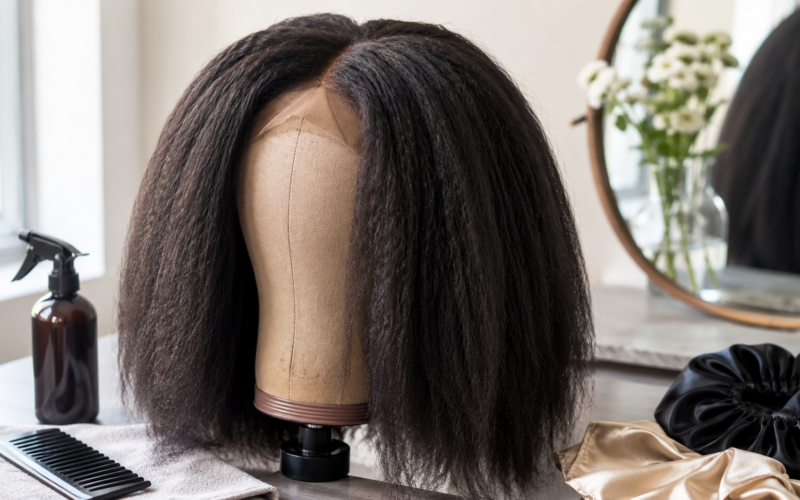
LUVME GUANGZHOU ECOMMERCE CO., LIMITED, which operates the Luvme Hair brand, has stepped up consumer education around kinky straight wigs as the premium human-hair category becomes increasingly competitive online. The company on August 6, 2026, published maintenance guidance designed to preserve the textured, blowout-style appearance of kinky straight human-hair wigs through moisture control, gentle handling and appropriate storage. While the announcement is primarily consumer-facing, it also highlights an important commercial issue for online wig brands: selling the product is only the first part of the customer relationship. How well a premium wig performs after repeated wear can influence reviews, returns, recommendations and future purchases. The strategic question is therefore whether education can become a meaningful part of Luvme Hair’s differentiation in a market where shoppers increasingly compare not only appearance and price, but also usability and durability.
Why is Luvme Hair focusing on kinky straight wig maintenance rather than simply selling more products?
Kinky straight wigs are designed to reproduce some of the volume and texture associated with natural hair after a blowout rather than the uniformly smooth appearance of conventional straight wigs. That characteristic also creates a maintenance challenge because excessive product use, aggressive brushing or unsuitable storage can alter the texture customers originally purchased.
Luvme Hair’s guidance recommends maintaining moisture without relying heavily on oils or creams, detangling from the ends upward, avoiding unnecessary washing and storing wigs in a way that reduces friction and compression. The company also argues that the underlying quality of human hair affects how well a wig retains softness, movement and styling flexibility over time. These recommendations are company guidance rather than independent product-testing conclusions, but they illustrate the type of after-sales information that increasingly accompanies premium beauty purchases online.
Commercially, this matters because premium beauty products often carry expectations that extend well beyond the first use. A customer buying a human-hair wig is purchasing not simply a finished hairstyle but an item expected to withstand washing, restyling, heat exposure and repeated wear.
That changes the economics of customer satisfaction. A visually impressive product can still generate disappointment if the buyer does not know how to maintain it, while a product that remains usable for longer can strengthen perceived value even if its initial price is higher.
For Luvme Hair, educational content therefore has the potential to function simultaneously as customer support, search-engine content and retention marketing.

How could better wig-care education improve customer retention for online beauty retailers?
The central advantage of post-purchase education is that it addresses problems after the transaction but before dissatisfaction necessarily develops.
Hair texture can change because of washing technique, excessive heat, product buildup, friction or storage. Some customers may interpret these changes as product-quality failures even when maintenance practices contributed to the deterioration. Clear care instructions can reduce that knowledge gap.
This is particularly important in direct-to-consumer beauty commerce because shoppers cannot always inspect texture, density, cap fit and movement before placing an order. Much of the initial decision is based on product photography, video, customer reviews and social content.
The post-purchase experience then determines whether the expectations created online survive contact with everyday use.
Independent community discussions show that questions about softness, washing frequency, moisture, fit and long-term durability remain active among wig buyers. Recent Reddit discussions involving Luvme Hair products, for example, include customers asking whether softness will last, how frequently wigs should be washed and how fit problems can be corrected. Such discussions should not be treated as representative satisfaction data, but they demonstrate the practical questions that can shape the ownership experience.
Providing answers before those issues develop can have commercial value. A consumer who understands how to care for textured human hair may be less likely to conclude prematurely that a product has deteriorated, while successful long-term use may improve the probability of recommendations and repeat orders.
The value of education, however, ultimately depends on product performance. Content cannot compensate indefinitely for inconsistent hair quality, construction problems or fit limitations. That makes instructional content most effective when it reinforces a reliable underlying product rather than attempting to substitute for one.
Why does human-hair wig durability matter more as shoppers pay a premium for natural-looking styles?
Human-hair wigs occupy a commercially attractive segment because they can generally support greater styling flexibility and a more natural appearance than many synthetic alternatives. Those characteristics can also support premium pricing, raising customer expectations around longevity.
Fortune Business Insights estimated the global human-hair wig market at about $1.81 billion in 2025 and projects it to reach approximately $2.37 billion by 2034. The research group estimated North America accounted for roughly 36% of the market in 2024. The broader global wigs and extensions category is considerably larger, with Grand View Research estimating a 2025 market size of $15.2 billion and projecting growth to $31.1 billion by 2033.
Different research firms use different definitions and methodologies, so these estimates should not be treated as directly interchangeable. What they do show consistently is a substantial commercial ecosystem around wigs, extensions and human-hair products.
For premium human-hair sellers, durability becomes particularly important because the comparison shoppers make is not limited to sticker price.
A higher-priced wig that maintains its appearance through extended use can produce a lower perceived cost per wear. Conversely, a product that deteriorates quickly may appear expensive regardless of how convincing it looked when first unpacked.
This helps explain why care education is becoming commercially relevant. Brands that sell products requiring maintenance have an incentive to make the maintenance process understandable, particularly as more first-time users enter the category through social media and e-commerce.
How does Luvme Hair’s consumer-education strategy support its position in the United States wig market?
The new guidance arrives shortly after Luvme Hair highlighted a separate market-positioning milestone.
In June 2026, the company said Euromonitor International had identified Luvme Hair as the number-one human-hair wig brand in the United States by 2025 retail sales value. The recognition was disclosed by the company and described as being based on Euromonitor research. It gives additional context to why customer retention and product education could become increasingly important as Luvme Hair attempts to defend its position rather than simply acquire new buyers.
Scale changes the challenge facing a consumer brand.
Early growth can be driven heavily by customer acquisition, advertising, influencer visibility and product expansion. As a brand becomes larger, incremental growth increasingly depends on whether acquired customers return and whether their experience generates positive word of mouth.
Educational content can help support that second stage.
A maintenance guide also creates search visibility around queries that occur after purchase, such as how to maintain kinky straight wigs, how often to wash a human-hair wig, how to prevent a kinky straight wig from becoming flat and how to store textured wigs.
These queries may appear less commercially valuable than searches such as “best human hair wig,” but they keep the brand involved throughout the customer lifecycle. That matters because the company providing useful advice after one purchase can remain visible when the customer begins considering the next one.
The strategy effectively turns customer support knowledge into searchable content.
Can educational content become a competitive advantage in crowded human-hair wig e-commerce?
The human-hair category contains a large number of online sellers offering products that can appear broadly similar to shoppers scrolling through product pages and social feeds.
That creates a differentiation problem.
Brands can compete through lace construction, cap comfort, density, texture, length, color, pricing, delivery, customer service and ease of installation. Yet as products become easier to compare, the surrounding customer experience becomes another potential competitive layer.
Education is one component of that experience.
The advantage is not necessarily that maintenance information is proprietary. Instructions such as using lightweight moisture, detangling carefully and limiting unnecessary washing are broadly understandable hair-care practices.
The competitive opportunity comes from execution. A retailer that consistently explains selection, installation, maintenance and styling can potentially reduce buyer uncertainty across the entire purchasing journey.
That is particularly useful for beginner customers, who may represent an important source of category expansion but also require more assistance than experienced wig users.
There is another strategic benefit. Educational content can generate organic search traffic without relying exclusively on high-intent shopping keywords where advertising and search competition may be intense.
A customer searching “how to keep a kinky straight wig from getting dry” may not immediately be shopping. But answering that question creates another point of contact between the brand and consumers interested in the category.
The risk is that education becomes indistinguishable from content marketing. To retain credibility, advice has to remain genuinely useful and should not exaggerate the performance or longevity of products beyond what customers experience in practice.
What are the key takeaways from Luvme Hair’s kinky straight wig maintenance strategy?
Luvme Hair’s August 6 guidance recommends balanced moisture, gentle detangling, limited unnecessary washing and careful storage to help preserve kinky straight texture. The announcement itself is modest, but it highlights how post-purchase support can become part of the value proposition surrounding premium human-hair wigs.
The commercial opportunity is customer retention. Better maintenance knowledge may help consumers preserve products for longer, improve perceived value and reduce avoidable dissatisfaction. Educational articles can simultaneously support customer service, organic search visibility and repeat engagement.
The larger test remains product performance. Brand-produced guidance can improve the ownership experience, but durable customer loyalty ultimately depends on whether hair quality, cap construction, fit and styling performance consistently match expectations. With the global human-hair wig market still expanding, those operational fundamentals are likely to matter more as competition for repeat customers intensifies.
What will show whether Luvme Hair can turn product education into lasting beauty-market loyalty?
Luvme Hair’s kinky straight wig guide illustrates a broader shift in beauty e-commerce from transaction-focused selling toward lifecycle engagement. Product discovery may begin on search engines, social platforms or creator videos, but customer value is increasingly determined by everything that happens after checkout.
For Luvme Hair, its recently claimed leadership in United States human-hair wig retail sales gives this strategy additional significance. Maintaining that position will require more than adding styles or increasing promotional visibility. It will require consistently translating product quality into satisfactory real-world wear.
Care education can help bridge that gap by giving consumers a clearer understanding of how human-hair products behave and what maintenance they require.
The measurable proof point will not be how many maintenance guides the company publishes. It will be whether product education contributes to stronger customer retention, repeat purchasing, favorable long-term reviews and sustained market relevance as the human-hair wig category expands.
Discover more from Business-News-Today.com
Subscribe to get the latest posts sent to your email.

