




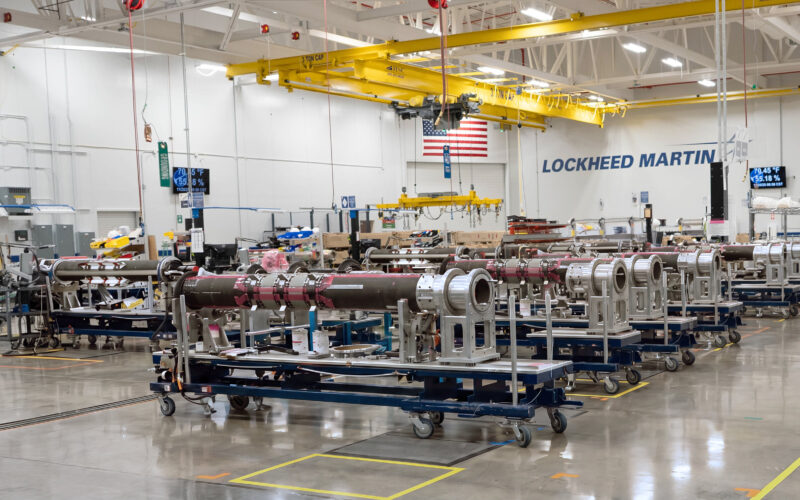
Lockheed Martin Corporation (NYSE: LMT) has been awarded a seven-year, up to $53.86 billion undefinitized contract action modification for continued production of PAC-3 Missile Segment Enhancement interceptors, taking the multiyear contract total to $58.62 billion once combined with the $4.7 billion year-one award booked in April 2026. The Department of War announced the modification on July 29, 2026 under its Acquisition Transformation Strategy, and Lockheed Martin says the funding will allow it to triple PAC-3 MSE production capacity by the end of 2030 while lifting employment at its Camden, Arkansas final-assembly plant by roughly 50 percent, from 1,200 to about 1,850. The award is the largest single Patriot-family missile procurement in the programme’s history and the second major multiyear Lockheed Martin has secured under the new acquisition model, following the $35 billion Terminal High Altitude Area Defense multiyear signed in June 2026. It transforms what had been an accelerating but still year-by-year demand signal into a hard, funded seven-year build plan. The central tension for investors is now execution rather than demand: whether Camden, the supporting supplier base, and Lockheed Martin’s broader $8 billion to $9 billion munitions capital programme can convert a locked-in order book into recurring margin and free cash flow at the pace management has committed to.
What exactly did the Department of War fund and how does the $58.62 billion break down across the seven-year contract window?
The July 29 modification is an undefinitized contract action, which allows the government to authorise production activity and long-lead purchases ahead of final pricing negotiation. Lockheed Martin said the modification covers up to $53.86 billion of additional PAC-3 MSE interceptor production, and that when combined with the $4.7 billion UCA awarded in April 2026 for year one of the same multiyear framework, the total programme value reaches $58.62 billion. Under Secretary of War for Acquisition and Sustainment Michael P. Duffey said the award “provides industry with the long-term demand signals it needs to build a resilient supply chain, scale production, and deliver critical capabilities to our Warfighters at the speed of relevance.” That framing is important, because the commercial value of a multiyear procurement for a defence contractor lies not only in the ceiling number but in the visibility it offers to sub-tier suppliers on rocket motors, seekers, guidance electronics and specialty materials. Definitisation of the contract, which will convert ceiling figures into firm unit pricing and profit rates, remains a separate future step and will shape how much of the $58.62 billion ultimately flows through as margin.

Why is tripling PAC-3 MSE capacity by 2030 more consequential than the headline dollar figure?
Chief Executive Officer Jim Taiclet has previously guided that the PAC-3 framework will lift annual production capacity from approximately 600 interceptors per year to roughly 2,000, and the fresh award is the funding backbone that makes that ramp deliverable rather than aspirational. Capacity, not demand, has been the binding constraint on PAC-3 since Ukraine, Israel and the Red Sea corridor began drawing down allied inventories at a pace that materially exceeded pre-2022 assumptions. Tripling output does three things at once for Lockheed Martin. It restores stockpile-replenishment credibility with U.S. services and Foreign Military Sales customers whose queue positions had become uncomfortably long; it locks in the PAC-3 MSE franchise ahead of any competing interceptor concept; and it creates the throughput base against which the newly launched, lower-cost PAC-3 Adapted Capability Effector variant can be scaled without cannibalising the premium interceptor line. Whether the ramp lands on schedule is the operational question the market will now grade the company on quarter by quarter.
How does the multiyear procurement model change Lockheed Martin’s operating economics and cash-flow profile?
Multiyear procurement contracts typically deliver better unit economics than annual awards because the contractor can commit to bulk purchase of long-lead components, hedge specialty materials, and amortise tooling and workforce investments over a defined build horizon. That is the commercial logic behind the Department of War’s Acquisition Transformation Strategy and behind Lockheed Martin’s willingness to invest ahead of definitised pricing. However, undefinitized contract actions initially compress margins because production begins before the profit rate is negotiated and because the company is fronting working capital for scale-up. Lockheed Martin’s Q1 2026 results already showed the effect of program-level pressures elsewhere: segment operating margin compressed to about 10.1 percent, and Chief Financial Officer Evan Scott flagged transient charges on F-16 and C-130. Missiles and Fire Control, the division that houses PAC-3, is being asked to absorb a very large physical ramp while maintaining segment margin at the divisional target. Management guided full-year 2026 sales of $77.5 billion to $80.0 billion and free cash flow of $6.5 billion to $6.8 billion, and the PAC-3 award does not change 2026 guidance directly; it changes the shape of 2027 through 2032.
What does the Camden, Arkansas expansion tell investors about defence industrial base bottlenecks?
The 50 percent headcount uplift at Camden, from 1,200 to about 1,850 employees, is arguably the most operationally revealing number in the announcement. All-up-round final assembly for PAC-3 MSE happens at Camden, and the site was already the throughput bottleneck for the programme. Lockheed Martin has broken ground on a Munitions Acceleration Center in Camden to support PAC-3, alongside a Munitions Production Center Building 47 in Troy, Alabama that supports THAAD and future Next-Generation Interceptor work. These are physical, permitted, funded facility programmes rather than press-release aspirations, and they map into the wider $8 billion to $9 billion Lockheed Martin plans to spend through 2030 modernising more than 20 U.S. munitions facilities. That capital commitment matters for two reasons. First, it is the company putting balance-sheet capacity behind demand signals, which lowers the risk that customer priorities change and leave stranded capacity. Second, it flags that free cash flow through 2027 will be pressured by munitions capital expenditure at a level materially above pre-2024 norms, which the market will need to reconcile against Lockheed Martin’s long-standing shareholder-return profile of a 23-year consecutive dividend increase and consistent buybacks.
How does this contract fit into Lockheed Martin’s broader munitions acceleration strategy alongside THAAD and PAC-3 ACE?
The July 29 award should not be read in isolation. It follows the $35 billion seven-year THAAD multiyear procurement announced on June 24, 2026, and precedes an expected framework agreement for Next-Generation Interceptor development. In parallel, Lockheed Martin launched PAC-3 ACE, a lower-cost interceptor variant priced at less than half the PAC-3 MSE unit cost, designed to plug into existing Patriot fire units and the Integrated Battle Command System and co-developed with European partners. The strategic architecture is now visible: PAC-3 MSE at the top of the interceptor mix for the most demanding threats, PAC-3 ACE below it for volume against cheaper drones and cruise missiles, THAAD for high-altitude terminal defence, and Next-Generation Interceptor for the strategic layer. Locking down MSE for seven years frees engineering and industrial bandwidth to industrialise ACE without diluting throughput on the premium line, which is the point of the ceiling number. Notably, L3Harris Technologies has separately signed a framework agreement to quadruple THAAD propulsion production and increase PAC-3 MSE motor supply, indicating that the tier-two industrial base is being locked in on the same multi-year clock.
What competitive and geopolitical dynamics is the Arsenal of Freedom framing responding to?
Chief Executive Officer Jim Taiclet described the award as “a once-in-a-generation moment” and said Lockheed Martin was moving “with wartime urgency to deliver the Arsenal of Freedom.” That language is aligned with the Department of War’s political framing but also reflects a concrete demand signal: PAC-3 MSE has performed above specification in Operation Epic Fury, in Ukraine and in Red Sea operations, and allied customers from Germany and Poland through to the Republic of Korea and Saudi Arabia are queuing behind the U.S. Army. The tension in the Arsenal of Freedom framing is that expanded U.S. production must be balanced against Foreign Military Sales allocation without either constituency feeling under-served. On the competitive front, Raytheon, an RTX Corporation subsidiary, produces the launcher and radar portion of the Patriot system and does not compete directly with Lockheed Martin on the PAC-3 interceptor; the ATACMS memorandum of understanding with Rheinmetall AG announced in early July 2026 also shows Lockheed Martin willing to localise long-range fires in Europe, which further widens the addressable market for the interceptor franchise attached to it.
What are the execution risks investors should watch as production ramps toward 2,000 interceptors per year?
Even with a fully funded seven-year ceiling, several execution risks remain. Rocket-motor supply from the tier-two base has been the single largest historical constraint on both PAC-3 and THAAD; the L3Harris Technologies framework partly addresses that, but any slippage there feeds directly into Lockheed Martin delivery schedules. Specialty materials, gallium and rare-earth-dependent components, and semiconductor content for the seeker and guidance sections all carry supply-chain and geopolitical exposure. Workforce recruitment in Camden and across the modernised facility footprint is a real constraint in a tight labour market. Definitisation of the UCA into firm-fixed-price or fixed-price-incentive terms is likely to be negotiated over the coming quarters, and the profit rate settlement will materially affect how the award translates into Missiles and Fire Control segment margin. Investors should also watch classified Aeronautics program charges, which have already accumulated approximately $1.8 billion in losses across recent quarters, because they compete for management attention and cash even as Missiles and Fire Control scales.
How is the market weighing the contract against valuation and the Q2 2026 setup?
Lockheed Martin shares traded between roughly $575 and $587 during the July 29 session, with the stock at around $576 in intraday trade against a 52-week range of $412.55 to $692.00 and an all-time closing high of $672.30 reached on March 2, 2026. The stock rallied approximately 9 to 11 percent on July 23 after Q2 2026 earnings, so the July 29 announcement lands on a market that has already re-rated Lockheed Martin higher on the munitions ramp thesis. Wells Fargo and TD Cowen trimmed price targets to $575 and $560 respectively in the run-up to Q2, even as consensus average target sits around $611 according to broker aggregates cited by third-party platforms. Business News Today has not identified a widely published post-announcement broker note materially revising numbers on the back of July 29, and consensus estimates will likely be updated as sell-side analysts fold the ceiling into their 2027 through 2030 revenue lines. On current market pricing and management guidance, the valuation implies the market is willing to pay for the ramp but is waiting for evidence of margin recovery from the 10.1 percent segment level recorded in Q1 2026 before rerating further.
Key takeaways: What does Lockheed Martin’s $58.62B PAC-3 MSE multiyear mean for LMT investors, defence peers and the industrial base?
- Lockheed Martin Corporation has secured a seven-year, up to $58.62 billion PAC-3 Missile Segment Enhancement multiyear procurement, the largest Patriot-family award to date and the second major multiyear under the Department of War’s Acquisition Transformation Strategy.
- The award enables Lockheed Martin to triple PAC-3 MSE production capacity by the end of 2030, moving annual output from roughly 600 to approximately 2,000 interceptors.
- Camden, Arkansas final-assembly headcount is projected to increase by around 50 percent, from 1,200 to about 1,850, anchored by the new Munitions Acceleration Center.
- The contract is structured as an undefinitized contract action modification, meaning production is authorised but firm unit pricing and profit rates remain to be negotiated.
- Lockheed Martin is committing $8 billion to $9 billion of capital through 2030 to modernise more than 20 U.S. munitions facilities, which will pressure near-term free cash flow but underpins durable segment growth.
- The PAC-3 MSE ceiling is the funding backbone that lets Lockheed Martin scale the lower-cost PAC-3 ACE variant in parallel without diluting premium-line throughput.
- Execution risks centre on tier-two rocket-motor supply, specialty materials, workforce ramp at Camden, definitisation of the UCA, and continued charge exposure on classified Aeronautics programmes.
- The next measurable proof points are Q3 2026 results on October 27, 2026, definitisation milestones on the UCA, and delivery data from Camden as new capacity comes online.
- Broader industry read-across benefits RTX Corporation on Patriot launcher and radar demand, L3Harris Technologies on PAC-3 and THAAD propulsion, and specialty component suppliers embedded in the interceptor bill of materials.
Discover more from Business-News-Today.com
Subscribe to get the latest posts sent to your email.