





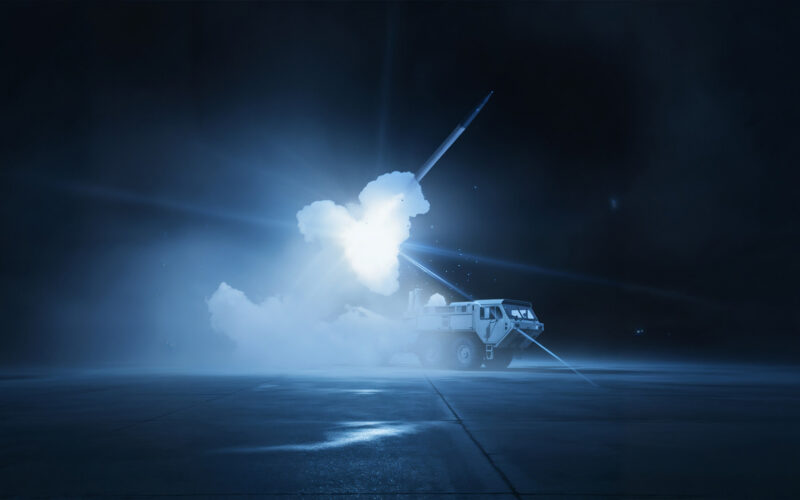
Lockheed Martin Corporation, listed on the New York Stock Exchange as LMT, has secured a seven-year U.S. government contract action worth up to $35 billion to accelerate production of Terminal High Altitude Area Defense interceptors. The award is intended to quadruple THAAD interceptor output and provide the long-term demand signal needed to expand missile-defence manufacturing capacity across Lockheed Martin’s U.S. industrial base. The contract was first announced on June 24, 2026, and gained additional market relevance after Lockheed Martin later reported a record $230 billion backlog that included the THAAD multiyear award. With Lockheed Martin shares trading near $586.68 on July 28 after a sharp post-earnings rebound, the market is increasingly treating missile production scale as one of the company’s most important growth and execution stories. The strategic issue is no longer whether governments want more interceptors, but whether Lockheed Martin and its suppliers can build enough of them without turning scarcity into a margin and delivery problem.
The THAAD award is not just another large defence contract. It is one of the clearest examples of how missile defence has moved from episodic procurement into an industrial-capacity contest. Wars and missile exchanges across Europe and the Middle East have exposed a basic problem for allied militaries: modern air defence can work, but it consumes expensive interceptors at a speed that legacy production systems were not designed to support.
Why does Lockheed Martin’s $35 billion THAAD contract matter beyond the original June announcement?
The June 24 announcement already made the THAAD award one of the largest missile-defence procurement events of the year. Its importance increased after Lockheed Martin’s July 23 earnings update showed that the contract formed part of a record $230 billion backlog, giving investors a clearer view of how missile-defence demand is converting into long-term revenue visibility.
The scale is material even for Lockheed Martin. The $35 billion THAAD award is equivalent to about 15% of the company’s $230 billion backlog and roughly 43% of the midpoint of its updated 2026 sales guidance of $79.75 billion to $81.75 billion. Spread evenly across seven years, the contract would imply an average annual value of $5 billion, although actual revenue recognition will depend on funded orders, production milestones and delivery schedules.
The award also landed in the company’s strongest near-term demand lane. Lockheed Martin’s Missiles and Fire Control segment generated second-quarter sales of $4.1 billion, up 19% from the prior-year quarter, supported by production ramps in integrated air and missile defence programmes including PAC-3 and THAAD. Segment operating profit rose 24% to $594 million, producing a 14.5% operating margin.
This means THAAD is not a distant strategic option buried in a backlog table. It is directly connected to the segment currently showing some of Lockheed Martin’s most visible growth and operating leverage. Investors are now watching whether the contract can convert from a powerful backlog signal into reliable production revenue, protected margins and stronger free-cash-flow visibility.
How does THAAD fit into the wider missile-defence architecture used by the United States and allies?
Terminal High Altitude Area Defense is designed to intercept ballistic missile threats in the final phase of flight, either inside or outside the atmosphere. This places THAAD above lower-tier systems such as Patriot in a layered missile-defence architecture and below longer-range strategic interceptors designed for homeland missile defence.
The system’s value lies in that middle ground. It protects forces, bases, cities and infrastructure against short-range, medium-range and select intermediate-range ballistic missile threats. In a real operational environment, commanders do not rely on one system to solve every problem. They combine sensors, command systems and interceptors across layers because a missile that leaks through one layer may still be engaged by another.
THAAD’s hit-to-kill interceptor approach is also strategically important. Rather than relying on an explosive warhead to damage an incoming missile, the interceptor is designed to destroy the threat through direct collision. This places high demands on guidance, tracking, seeker performance, propulsion and system integration.
For Lockheed Martin, the contract does not only support interceptor production. THAAD operates with launchers, fire-control and communications systems, radar interfaces and integration into wider missile-defence command networks. The interceptor may be the consumable item most directly affected by the new production ramp, but the overall system creates ongoing sustainment, upgrade and support opportunities.
The contract’s competitive significance is equally clear. Missile defence is becoming a procurement priority for the United States, NATO allies, Middle Eastern partners and Indo-Pacific governments. Customers are no longer asking only whether a system can intercept a target in a test. They are asking whether the industrial base can replace used interceptors fast enough during a prolonged conflict.
That question favours companies with established production lines, qualified suppliers and customer trust. It also exposes Lockheed Martin to a harsher performance standard. Once a company receives a $35 billion production runway, delivery excuses become less charming.
Can Lockheed Martin quadruple THAAD interceptor output without creating new bottlenecks?
Lockheed Martin says the contract is designed to quadruple THAAD interceptor production. That ambition is strategically valuable, but manufacturing missiles at that rate is far more complicated than adding another shift in a factory.
Interceptor production depends on rocket motors, seekers, guidance electronics, flight-control systems, power systems, thermal protection, structural components, test equipment and specialised materials. Some of these inputs come from supplier networks that are already under pressure from simultaneous demand for PAC-3 MSE, Precision Strike Missile, Javelin, long-range fires and other munitions.
The industrial risk is that one constrained component can slow the entire ramp. A factory can expand final assembly, but that does not solve shortages in propulsion, electronics or energetic materials. Missile manufacturing is a chain, and chains generally do not care which link was featured in the press release.
Lockheed Martin has been preparing for this shift. The company has highlighted more than $9 billion of investment through 2030 and more than 20 new or modernised facilities across the United States. It also pointed to new or expanded missile-related facilities in Troy, Alabama, Courtland, Alabama, and Camden, Arkansas.
Those investments suggest management understands that demand durability is no longer the main debate. Capacity is. The defence market is moving from a world in which customers asked contractors to conserve money to one in which customers increasingly ask contractors to conserve time.
The execution challenge is that capacity expansions require labour, supplier qualification, tooling, environmental approvals, test infrastructure and working capital. Skilled manufacturing employees cannot be hired and certified overnight. Suppliers may be reluctant to invest heavily without long-term demand certainty. The $35 billion contract helps solve that visibility problem, but it does not magically shorten every industrial lead time.
Why is the THAAD award central to Lockheed Martin’s Missiles and Fire Control growth story?
Lockheed Martin’s Missiles and Fire Control segment is now one of the company’s clearest demand beneficiaries. The segment’s second-quarter sales rose to $4.1 billion from $3.43 billion, with production ramps in integrated air and missile defence programmes driving most of the increase.
The margin profile is also important. The segment’s second-quarter operating margin improved to 14.5% from 14.0%. That is not a dramatic expansion, but it shows that higher missile-production volume did not immediately dilute profitability in the quarter.
This matters because defence investors have become more selective. They no longer reward every backlog increase equally. Backlog tied to troubled fixed-price development programmes may be viewed as risk. Backlog tied to mature production programmes can be more attractive if pricing, supply chains and execution remain stable.
THAAD sits closer to the latter category, but not without risk. It is an established system, but quadrupling output changes the operating problem. A production line that works at one rate may require new controls, additional suppliers and revised quality systems at a much higher rate.
The award also complements other missile contracts. Lockheed Martin received a $4.7 billion PAC-3 MSE production contract earlier in 2026 and has framework agreements tied to PAC-3, THAAD and Precision Strike Missile acceleration. The company is becoming increasingly leveraged to a broad munitions upcycle rather than one product line.
That portfolio effect can be powerful. Shared suppliers, facilities and engineering knowledge can improve scale economics. However, shared constraints can also create competition within the company’s own backlog. If multiple missile programmes require the same scarce inputs, prioritisation becomes a management issue as much as a procurement issue.
What does the THAAD contract signal about U.S. acquisition reform and multiyear procurement?
The THAAD award is important because it reflects a shift towards longer procurement commitments for munitions and interceptors. Traditional annual buying cycles can discourage suppliers from expanding capacity because demand may disappear after one budget year.
A seven-year contract action gives industry a clearer demand signal. It allows Lockheed Martin and its suppliers to justify facilities, workforce hiring, automation, tooling and long-term material purchases. This is exactly the type of structure suppliers often ask for before putting their own capital at risk.
The approach also changes bargaining dynamics. The government gains faster capacity growth and potentially more stable pricing, while the contractor gains visibility. The trade-off is that the government becomes more committed to one supplier and one production architecture for a longer period.
That concentration can be acceptable when the programme is mature and urgent. It can be risky if performance deteriorates or if emerging technologies change the preferred solution. Missile defence is moving quickly, with hypersonic threats, manoeuvring re-entry vehicles, decoys and electronic warfare increasing technical complexity.
The key policy question is whether multiyear procurement can combine speed with competition. For THAAD, Lockheed Martin is the established prime contractor, so the near-term answer is production acceleration rather than supplier diversification. Over time, however, the government will need to ensure that critical subcontractors, propulsion suppliers and electronics manufacturers are not single points of failure.
The contract may become a model for other high-demand munitions. If THAAD production scales successfully, similar frameworks could support Patriot interceptors, long-range strike weapons, counter-drone interceptors and naval missiles. If delays persist despite the long-term commitment, acquisition reform will look less like transformation and more like a larger purchase order with better branding.
How could allied demand shape the export and geopolitical value of THAAD?
THAAD is not only a U.S. Army capability. It has relevance for allies facing ballistic missile threats from regional adversaries. The system has already been a sensitive deployment issue in East Asia and a strategically valuable layer in the Middle East.
Allied demand matters because missile defence is increasingly collective. The United States may deploy systems to protect forward forces, while partner countries may buy or host systems to defend national territory and critical infrastructure. Interceptor availability becomes a shared concern because a crisis in one theatre can quickly consume inventory intended for another.
The $35 billion production ramp therefore has export and alliance implications. Higher output can support U.S. stockpiles, replenishment needs and foreign military sales without forcing every customer into the same production queue for scarce interceptors.
Export potential is strongest where governments face ballistic missile threats and already operate U.S.-aligned command-and-control architectures. However, THAAD is expensive, politically sensitive and technically complex. Not every country that wants missile defence will buy THAAD, and some may prefer Patriot, Aegis Ashore, Israeli systems or nationally developed alternatives.
There is also a diplomatic dimension. THAAD deployments can provoke regional opposition because its radar and interception capability may be seen as part of a broader strategic balance. Procurement decisions can therefore become foreign-policy events as much as defence acquisitions.
For Lockheed Martin, the export opportunity is attractive but dependent on U.S. government approvals, customer financing, basing decisions and alliance politics. The company benefits from rising demand, but it does not control the geopolitical environment that turns demand into contracts.
What does the THAAD ramp mean for suppliers, jobs and U.S. munitions manufacturing?
The manufacturing implications extend well beyond Lockheed Martin’s own facilities. Missile-production ramps create demand for propulsion companies, electronics suppliers, metal fabricators, composite manufacturers, test-equipment providers, energetics suppliers and logistics specialists.
Supplier health will be critical because many defence components come from smaller companies that lack the balance-sheet flexibility of prime contractors. A long-term contract helps, but suppliers still need working capital, skilled workers and confidence that purchase orders will flow predictably.
The workforce issue is equally important. Missile factories require machinists, quality inspectors, electronics technicians, engineers, software specialists and production managers who understand defence requirements. Expanding output quickly can increase the risk of quality escapes if training and oversight fail to keep pace.
Facility expansion also affects local economies. Lockheed Martin’s missile investments in Alabama and Arkansas, along with other modernisation projects, should support employment in manufacturing regions that are becoming central to the U.S. defence-industrial base.
The challenge is that industrial expansion is not linear. A new building may be completed before the workforce is fully qualified. A supplier may deliver components before test capacity is ready. A production line may increase output but require more rework until processes stabilise.
This is why the THAAD award should be read as a capacity-building contract rather than just an interceptor order. The United States and allies are effectively paying for the option to sustain missile-defence output at a higher tempo for years. That option has value even before every interceptor is delivered.
Why did Lockheed Martin stock rally after earnings despite the risks attached to missile-production scale?
Lockheed Martin traded near $586.68 during the July 28 session, up about 1.15% from the previous close, with a market capitalisation around $135.4 billion. The stock gained approximately 13.8% over the latest five-day performance window and about 14.3% over one month, while its 52-week range stood around $412.55 to $692.00.
The rally followed the company’s July 23 earnings update, which showed $20.1 billion in second-quarter sales, $1.8 billion in net earnings, $2.9 billion in free cash flow and a record $230 billion backlog. Lockheed Martin also raised its 2026 sales, earnings and free-cash-flow outlook.
The market reaction indicates that investors are treating missile-production demand as a higher-quality catalyst than many earlier defence headlines. The THAAD contract directly supports backlog, Missiles and Fire Control growth and the revised full-year outlook.
The stock remains below its March 2026 high, which suggests investors still discount execution risk, programme charges and the possibility that defence valuations have already priced in a large portion of geopolitical demand. The company’s history of fixed-price programme losses has not disappeared simply because missile orders are strong.
Still, the current sentiment is clearly more constructive than it was before earnings. Lockheed Martin is now showing an improving combination of sales growth, margin support, cash flow and backlog visibility.
The risk is that a backlog-driven rerating can reverse if production execution disappoints. Missile-defence contracts may be strategically urgent, but they still have to pass through factories, suppliers, inspectors and delivery schedules. Investors will want evidence that the $35 billion THAAD award converts into revenue without eroding margins.
What should investors watch as THAAD moves from contract award to industrial execution?
The first indicator is production-rate disclosure. Lockheed Martin has committed to quadrupling THAAD interceptor output, but investors will need clearer milestones showing when each stage of capacity becomes available.
The second indicator is supplier performance. Any bottleneck in propulsion, seekers, guidance electronics or testing could slow delivery. Watch whether Lockheed Martin announces additional supplier agreements, second-source qualifications or facility upgrades tied specifically to missile-defence production.
The third indicator is margin resilience. Missiles and Fire Control improved margins in the second quarter, but production ramps can introduce overtime, rework, material inflation and supplier price pressure. A falling margin despite rising sales would signal capacity strain.
The fourth indicator is allied participation. Foreign military sales or allied orders could increase the long-term value of the THAAD production base, but they could also intensify pressure on delivery schedules if U.S. stockpile requirements remain urgent.
The fifth indicator is funding continuity. The contract is described as worth up to $35 billion, but U.S. budgets, allied requirements and annual appropriations will still influence the pace of actual work.
The sixth indicator is product evolution. Missile threats are changing, and THAAD must remain relevant against more complex ballistic and potentially manoeuvring threats. Production scale alone is not enough if the threat set evolves faster than the interceptor and command architecture.
For now, the THAAD award gives Lockheed Martin one of the defence industry’s strongest long-term demand signals. The harder work begins in turning that signal into reliable output. In missile defence, a backlog is useful, but an interceptor sitting in the right launcher at the right time is the only metric that finally counts.
Key takeaways on Lockheed Martin’s $35 billion THAAD contract and missile-defence production ramp
- Lockheed Martin’s seven-year THAAD contract action is worth up to $35 billion and is intended to quadruple interceptor production.
- The award was announced on June 24, 2026, and later became part of the company’s reported record $230 billion backlog.
- The contract equals roughly 15% of Lockheed Martin’s reported backlog and about 43% of the midpoint of updated 2026 sales guidance.
- THAAD supports the highest-altitude terminal layer of missile defence, intercepting ballistic threats inside or outside the atmosphere.
- Lockheed Martin’s Missiles and Fire Control segment is already benefiting from PAC-3, THAAD and Precision Strike Missile production ramps.
- The company’s second-quarter Missiles and Fire Control sales rose 19% to $4.1 billion, while segment operating margin improved to 14.5%.
- The contract provides suppliers with a longer demand signal, which is essential for expanding propulsion, electronics, energetics and test capacity.
- Execution risk remains high because quadrupling output requires labour, supplier qualification, facility expansion and quality control at scale.
- Allied demand could deepen the long-term value of the THAAD production base, but export timing depends on U.S. approvals and geopolitics.
- Lockheed Martin stock has rallied sharply after earnings, but the valuation now depends on converting missile-defence backlog into margin-protected revenue and cash flow.
Discover more from Business-News-Today.com
Subscribe to get the latest posts sent to your email.

