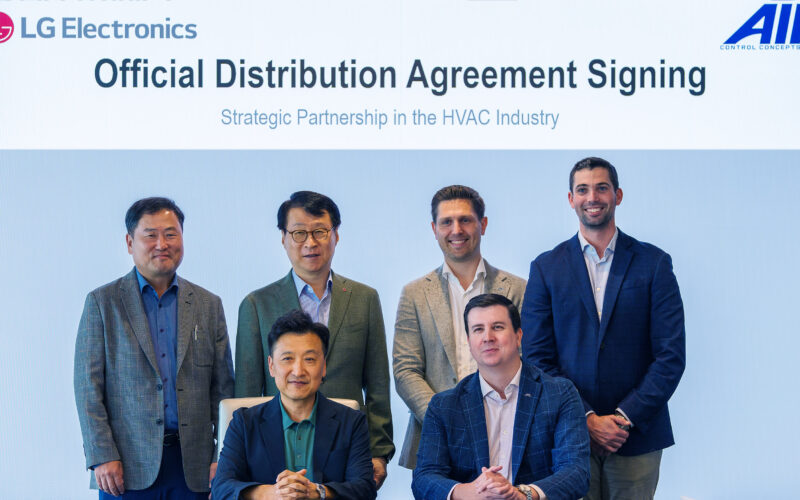
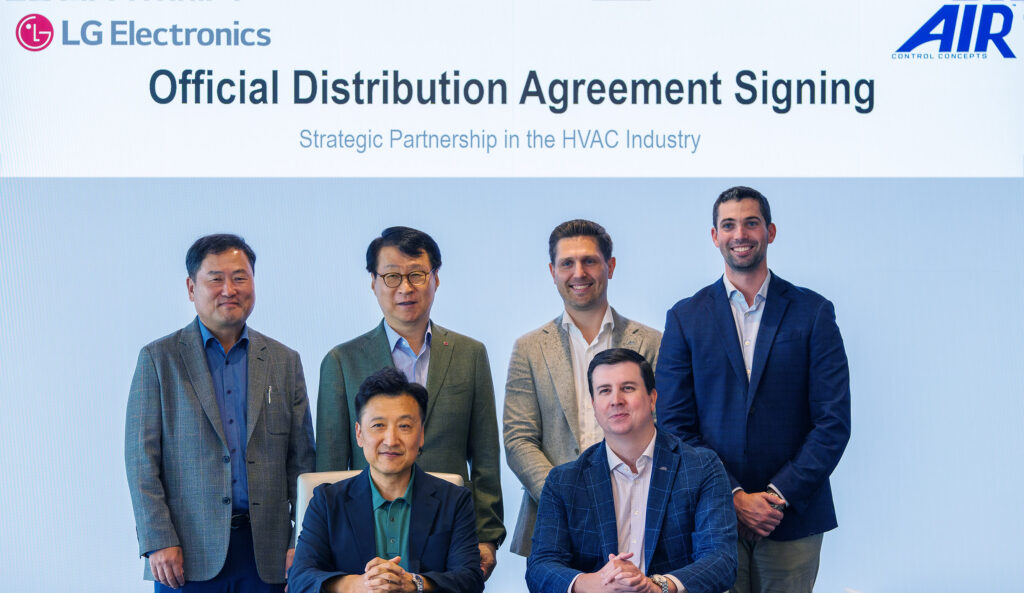
LG Electronics Inc. (KRX: 066570) has secured a long-term relationship with AIR Control Concepts that could place its cooling equipment across artificial intelligence data center projects representing more than 5GW of capacity in the United States and Canada. The agreement moves LG away from relying solely on individual project bids and gives the South Korean group a recurring route into AIR’s expanding hyperscale infrastructure portfolio. AIR will use LG chillers across qualifying projects as it scales cooling, electrical, controls and service capabilities for large data center customers, while LG is simultaneously adding local chiller production in Virginia to support North American demand. The contract value, guaranteed purchase volume, number of chillers and detailed delivery schedule have not been disclosed, meaning the 5GW figure represents the data center capacity the programme is intended to support rather than confirmed revenue already booked by LG.
The timing is significant because cooling is becoming one of LG Electronics’ fastest-developing business-to-business opportunities. The company reported more than US$428 million of AI data center cooling orders during the first half of 2026 and expects orders to reach several billion dollars by year-end. LG has also said its chiller business could reach approximately KRW1 trillion, around US$680 million, of annual revenue ahead of its previous 2027 target. The AIR agreement therefore arrives as LG is attempting to turn decades of heating, ventilation and air-conditioning expertise into a much larger infrastructure business tied directly to the capital spending behind artificial intelligence.
Why does AIR’s 5GW data center pipeline matter more than another individual LG chiller order?
The commercial significance comes from scale and duration rather than one named facility. AIR Control Concepts operates a network of more than 50 HVAC, electrical and controls businesses across dozens of North American markets, giving it relationships with contractors, developers and equipment manufacturers working on large infrastructure projects.
Instead of competing separately for each data center cooling requirement, LG can potentially participate through a multi-year supplier relationship covering a broader portfolio. That can improve demand visibility for manufacturing, component procurement and technical support, particularly when large AI facilities require dozens or even hundreds of cooling units across several construction phases.
The 5GW figure also illustrates the physical scale of the projects involved. It refers to the aggregate data center capacity that AIR says the programme will support, not the electrical consumption of LG equipment or a committed quantity of chillers. Neither AIR nor LG has identified the underlying data center operators, individual locations or the portion of the 5GW that has already reached construction.
That distinction prevents the agreement from being treated as a guaranteed 5GW equipment order. Its strategic value is nevertheless substantial because it places LG inside an infrastructure pipeline large enough to justify dedicated manufacturing, engineering and after-sales investment.
Why has cooling become one of the biggest bottlenecks in artificial intelligence infrastructure?
AI data centers concentrate substantially more computing power into each rack than conventional enterprise facilities. Graphics processing units and other accelerators generate significant heat while operating continuously, forcing cooling infrastructure to handle thermal loads that were far less common when data centers were dominated by conventional servers.
The industry is therefore shifting toward combinations of high-capacity chillers, coolant distribution units, direct-to-chip liquid cooling and other thermal-management systems. Cooling design increasingly needs to be considered alongside computing hardware, electrical architecture and building design before construction begins.
This transition benefits companies capable of supplying both large-scale central cooling and technologies closer to individual computing racks. LG has been positioning its portfolio around that combination, describing a chip-to-chiller model covering coolant distribution units, liquid cooling and large HVAC infrastructure.
The commercial opportunity extends beyond equipment sales. Hyperscale data centers require maintenance, controls, system optimization and long-term technical support because a cooling failure can affect extremely expensive computing equipment and interrupt revenue-producing workloads. AIR’s network adds local installation and service capabilities around LG’s manufacturing technology, giving the partnership a wider operating model than simply delivering chillers to construction sites.
How could LG’s new air-cooled centrifugal chiller improve AI data center energy economics?
One of the products expected to support LG’s AI data center push is its recently introduced air-cooled centrifugal chiller. The system combines an oil-free magnetic-bearing compressor with refrigerant free-cooling technology designed to reduce the compressor workload when outside temperatures allow the environment to contribute to cooling.
LG estimates that its refrigerant free-cooling configuration can consume roughly 30% less annual energy than waterside free-cooling under the specific climate and operating assumptions used in its internal simulation. That figure should not be interpreted as a guaranteed 30% saving for every North American data center because actual performance will vary according to climate, facility design, operating temperatures, load patterns and system configuration.
The underlying economic issue is nevertheless important. Cooling represents a material portion of data center energy consumption, meaning even modest efficiency improvements can become financially meaningful when facilities operate continuously at hyperscale.
LG has also designed the chiller around resilience. The company says the unit can return to full cooling capacity within three minutes after power is restored following an interruption, a capability intended for data centers where extended thermal disruption can create operational risk.
Those performance characteristics help explain why cooling technology is becoming strategically important rather than remaining a largely interchangeable building-services purchase. As GPU values and rack densities rise, thermal infrastructure increasingly affects how much computing capacity operators can install and how reliably they can use it.
Why is LG building chillers in Virginia just as the AIR programme begins scaling?
Only days before announcing the AIR agreement, LG confirmed that it is establishing its first United States production facility dedicated to chillers for artificial intelligence data centers. The Virginia operation will complement expanded manufacturing capacity at existing plants in Changwon and Pyeongtaek in South Korea.
The timing creates a clearer link between demand and manufacturing strategy. A multi-year North American programme becomes easier to serve if LG can produce equipment closer to customers rather than shipping every unit from Asia. Local manufacturing can shorten lead times, simplify logistics for very large equipment and give project teams greater flexibility when construction schedules change.
It could also reduce some exposure to trade and tariff uncertainty. LG has faced tariffs and other international cost pressures across parts of its business, making additional United States manufacturing strategically useful even beyond data center cooling.
The Virginia investment should not be interpreted as being constructed exclusively for AIR. LG is pursuing a broader North American data center customer base and has already supplied cooling solutions to hyperscale projects in the region. The AIR arrangement adds a large potential demand channel that can improve the rationale for expanding local capacity.
The company is simultaneously increasing production in South Korea, suggesting management expects the data center cooling opportunity to extend well beyond the United States. LG has cited project activity in the Middle East and Indonesia alongside North America as it seeks a larger global position in AI thermal management.
How does NVIDIA strengthen LG Electronics’ attempt to become an AI infrastructure supplier?
LG’s cooling strategy received another commercial endorsement shortly before the AIR announcement when the company joined the NVIDIA Partner Network as a Power and Cooling Solutions Preferred Partner. The designation connects LG more closely with an ecosystem centered on the high-density computing systems driving many of the thermal challenges that data center developers are trying to solve.
NVIDIA partnership status does not guarantee orders or mean that every NVIDIA-powered data center will use LG cooling technology. It does, however, improve LG’s visibility among developers designing facilities around increasingly powerful GPU platforms and signals that the company’s technology is being positioned for infrastructure supporting next-generation AI systems.
The sequence is commercially notable. LG launched its new air-cooled centrifugal chiller in September, became an NVIDIA preferred power and cooling partner, announced its first United States chiller production facility and has now revealed a long-term AIR supply programme covering more than 5GW of North American data center capacity.
Those developments suggest cooling has moved beyond an experimental diversification project inside LG Electronics. Manufacturing, product development and customer-channel expansion are now proceeding simultaneously.
The strategy may also help change how the market views LG’s business mix. Consumer electronics and household appliances remain important, but management has been deliberately expanding business-to-business activities that can provide different margins, longer customer relationships and less dependence on consumer replacement cycles.
What do LG Electronics’ latest financial results say about its capacity to fund the cooling expansion?
LG Electronics reported second-quarter 2026 revenue of KRW23.83 trillion, up 14.9% from a year earlier, while operating profit increased 147% to KRW1.58 trillion. Both were company records for a second quarter.
Its Eco Solution business, which contains the HVAC operations supporting the data center cooling strategy, generated revenue of KRW2.73 trillion and operating profit of KRW236 billion. That represents an operating margin of approximately 8.6%.
The division therefore already has meaningful financial scale before AI data center cooling becomes a major revenue contributor. This reduces the dependence of the new strategy on a single product or project because engineering, manufacturing and service capabilities are supported by an established HVAC business.
LG’s broader business-to-business revenue reached KRW6.50 trillion during the quarter, excluding LG Innotek, and represented 36% of company revenue on that basis. The expansion of cooling, vehicle components and other B2B operations is part of management’s effort to improve the quality and resilience of earnings beyond traditional consumer hardware.
The AIR programme could reinforce that shift if orders translate into sustained deliveries. Chiller manufacturing is capital intensive, but large data center projects can create multi-year demand visibility that differs from the shorter consumer electronics cycle.
How significant is LG’s $428 million AI cooling order book compared with its future ambitions?
LG said first-half orders for AI data center cooling solutions exceeded US$428 million. Management expects the figure to reach several billion dollars by the end of 2026, reflecting the pace at which hyperscale developers are seeking additional thermal-management capacity.
Orders and revenue need to be distinguished carefully. A large cooling project can be contracted well before equipment is manufactured, installed and recognized as revenue, meaning the order pipeline provides forward visibility rather than immediate earnings.
The AIR agreement could increase that visibility further, but the absence of a disclosed contract value means it cannot simply be added to the US$428 million first-half total. The companies have described a supply framework supporting more than 5GW of capacity without specifying minimum spending or purchase commitments.
LG’s separate guidance that it expects to reach approximately KRW1 trillion of annual chiller revenue ahead of the previous 2027 target provides a more measurable commercial benchmark. Progress toward that figure should indicate whether growing industry demand is converting from partnership announcements into reported sales.
The faster those revenues scale while the Eco Solution business maintains healthy margins, the stronger the case that AI cooling is becoming a meaningful earnings engine rather than merely another high-growth market narrative.
Why does Blackstone-backed AIR Control Concepts strengthen LG’s route into hyperscale projects?
AIR Control Concepts has grown by combining local HVAC, controls, electrical and service businesses under a larger platform while allowing those companies to maintain regional relationships and operating expertise. The business is backed by Blackstone and has expanded across North America while moving into additional international markets.
For equipment manufacturers, that structure offers an attractive distribution and execution network. Hyperscale data center construction frequently spans several regions at the same time, creating a need for suppliers capable of delivering consistent technical standards while providing local installation and service capacity.
AIR can potentially provide that interface. Its network reaches 36 US states and Canada, giving LG access to a field infrastructure that would be expensive and time-consuming to duplicate independently.
AIR benefits in the opposite direction because securing a long-term relationship with a major global manufacturer can improve equipment availability at a time when data center developers are competing for power systems, cooling equipment, transformers and other long-lead infrastructure.
The relationship therefore addresses two constraints simultaneously. LG gains a scaled channel into data center development, while AIR gains greater certainty around cooling technology and supply capacity.
What does LG Electronics’ share-price jump say about sentiment around its AI cooling strategy?
LG Electronics shares traded around KRW229,000 during the morning session on October 6, roughly 6% above the KRW216,000 close on October 2 before the latest North American cooling agreement was announced. The shares traded as high as approximately KRW234,500 during the session.
The move coincides with the AIR agreement, but it would be too strong to assign the entire increase to one announcement. Investors are digesting several closely spaced AI infrastructure developments, including the Virginia chiller factory, NVIDIA preferred-partner status and LG’s accelerating data center cooling order expectations.
The longer-term performance has also been volatile. The stock’s 52-week range spans approximately KRW76,400 to KRW438,000, meaning the latest rally still leaves shares substantially below the highest levels reached during the past year.
The recent response nevertheless indicates that investors are paying attention to LG’s attempt to build a higher-growth infrastructure business alongside its mature consumer franchises. The more durable valuation test will be whether data center orders produce revenue, margins and cash flow at a scale large enough to influence consolidated earnings.
What could prevent the AIR agreement from becoming as valuable as the 5GW headline suggests?
The first uncertainty is commercial commitment. Neither company disclosed minimum purchase quantities, total contract value or the proportion of AIR’s 5GW project pipeline that will ultimately use LG equipment.
Data center development schedules can also change. Power availability, financing, permitting and customer requirements can delay projects even after sites have been identified. A supply framework associated with planned capacity therefore does not guarantee that every gigawatt reaches operation according to the original timetable.
Competition is another factor. Data center cooling is attracting established HVAC companies, specialist liquid-cooling developers and infrastructure suppliers seeking exposure to AI capital expenditure. LG must continue demonstrating that its technology provides sufficient efficiency, reliability and service support to win deployment as the market becomes more crowded.
Manufacturing execution will also matter. The new Virginia plant and expanded Korean facilities need to scale without compromising quality at a time when customers view cooling reliability as mission critical.
LG has strengthened its position by aligning product development, manufacturing capacity, NVIDIA ecosystem participation and AIR’s customer network. The next stage requires those strategic pieces to translate into equipment deliveries.
What are the key takeaways from LG Electronics’ 5GW AIR data center cooling programme?
- LG Electronics USA has entered a long-term chiller supply arrangement with AIR Control Concepts for North American AI data center projects representing more than 5GW of capacity.
- The 5GW figure refers to supported data center capacity and should not be treated as a disclosed equipment order value or guaranteed purchase volume.
- Neither company has disclosed the contract value, minimum number of chillers or detailed delivery schedule.
- LG reported more than US$428 million of AI data center cooling orders during the first half of 2026 and expects orders to reach several billion dollars by year-end.
- LG expects to achieve approximately KRW1 trillion, or around US$680 million, of annual chiller revenue ahead of its previous 2027 target.
- The company recently announced its first United States chiller production facility in Virginia while expanding manufacturing capacity in South Korea.
- LG has also joined the NVIDIA Partner Network as a Power and Cooling Solutions Preferred Partner.
- AIR Control Concepts operates more than 50 HVAC, electrical and controls companies and is backed by Blackstone.
- LG Electronics generated second-quarter revenue of KRW23.83 trillion and operating profit of KRW1.58 trillion, while its Eco Solution business delivered an 8.6% operating margin.
- LG Electronics shares were around KRW229,000 in October 6 morning trading, approximately 6% above the October 2 close, although several recent AI infrastructure catalysts make it difficult to isolate the effect of the AIR agreement.
- Contract conversion, manufacturing execution and chiller revenue growth will determine whether cooling becomes a material new earnings engine for LG Electronics.
Discover more from Business-News-Today.com
Subscribe to get the latest posts sent to your email.