




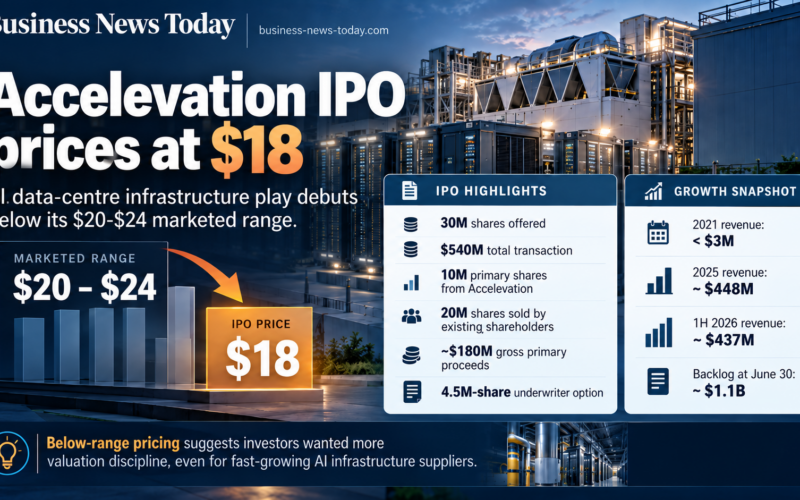
Accelevation Holdings Corp. (Nasdaq: ACCV), the Ohio-based designer and manufacturer of electrical, structural and mechanical systems for mission-critical infrastructure, priced its initial public offering at $18 per share, below the $20 to $24 range marketed to investors. The company and selling shareholders offered 30 million shares, producing a $540 million transaction as Accelevation tests public-market demand for another business positioned around the artificial intelligence data-centre construction boom.
Only one-third of the offered shares are being sold by Accelevation itself. Accelevation is issuing 10 million shares, while shareholders affiliated with private-equity owner Olympus Partners are selling 20 million shares and have granted underwriters an option covering another 4.5 million shares. Accelevation will receive no proceeds from the secondary stock sold by existing shareholders.
The allocation is an important part of the IPO story because the headline $540 million figure overstates how much new capital is flowing into the operating business. At $18 per share, Accelevation’s gross primary proceeds amount to approximately $180 million before underwriting discounts and other expenses.
Why did Accelevation price below its $20 to $24 IPO range?
The most obvious interpretation is that investors demanded a lower valuation than the company and its selling shareholders initially sought. The roadshow began with 30 million shares expected to price between $20 and $24, implying gross deal proceeds of between $600 million and $720 million before the final $18 pricing.
That repricing is noteworthy because Accelevation is exposed to one of the strongest capital-spending themes in global markets. The company produces infrastructure used inside data centres, including power-distribution equipment, thermal-management systems, modular packages and field installation services.
Artificial intelligence has driven extraordinary investment in data-centre power, cooling and electrical systems because increasingly dense accelerator racks require much more infrastructure than conventional enterprise servers.
Yet strong industry growth does not guarantee investors will accept every valuation. Public-market buyers must distinguish between semiconductor companies possessing scarce intellectual property and contractors or manufacturers whose growth ultimately depends on customers continuing to build facilities.
The IPO also arrives during a difficult financing backdrop. Reuters reported that higher interest rates and rising bond yields have made investors more selective toward new listings.
Accelevation therefore reached the public market at precisely the moment when investors were enthusiastic about artificial intelligence infrastructure but increasingly unwilling to accept aggressive pricing simply because a company sits somewhere in the AI supply chain.
How fast has Accelevation actually grown?
The growth numbers are exceptional. Reuters reported that Accelevation generated less than $3 million of revenue in 2021 before increasing revenue to almost $448 million in 2025.
Revenue reached approximately $437 million during the first half of 2026, nearly triple the comparable prior-year level, while backlog stood around $1.1 billion at June 30.
Those figures explain why Accelevation reached the IPO market so quickly. A company producing almost as much revenue in six months as it generated during the entire previous year is growing at a rate normally associated with software or semiconductor businesses rather than industrial manufacturing.
The underlying reason is the nature of the data-centre buildout. Hyperscalers, cloud providers and artificial intelligence companies are deploying facilities at enormous scale and need factory-built infrastructure that can shorten construction schedules.
Accelevation’s vertically integrated model combines manufacturing with installation, allowing customers to source systems and field execution from the same provider. That can help reduce coordination risk when construction schedules are extremely aggressive.
The backlog gives some forward visibility but should not be treated as guaranteed revenue. Projects can be delayed, modified or cancelled, particularly if customers alter data-centre capital spending.
Why is Accelevation an AI infrastructure company without making AI chips?
Artificial intelligence infrastructure spending flows through several layers. Nvidia Corporation and Advanced Micro Devices receive most public attention because they produce accelerators, but those processors cannot operate without power distribution, cooling, racks, buildings and network connections.
Accelevation participates in the physical layer. Its products include equipment needed to distribute electricity inside data centres and manage the increasingly difficult thermal requirements created by high-density computing.
This can be an attractive position because power density is rising. The more electricity delivered to each rack, the more sophisticated the supporting electrical and cooling systems need to become.
Factory-built modules can also reduce site labour and accelerate deployments. Instead of constructing every subsystem from individual components inside the data centre, customers can receive pre-engineered assemblies manufactured and tested elsewhere.
That model resembles trends across industrial construction where prefabrication shifts labour from expensive project sites into controlled manufacturing environments.
The trade-off is that physical infrastructure remains capital intensive and exposed to construction cycles. Accelevation must buy materials, maintain factories, manage employees and deliver projects even when customer schedules change.
What does Olympus Partners’ secondary sale mean for IPO investors?
Olympus Partners acquired Accelevation from LFM Capital during 2025 and will continue to hold significant influence after the offering. Reuters Breakingviews reported before pricing that Olympus was expected to retain majority ownership even after the IPO.
Secondary selling is not inherently negative. Private-equity firms are expected to monetise investments eventually, and an IPO naturally provides liquidity.
However, the composition of the transaction matters. Two-thirds of the 30 million shares in the base offering come from selling shareholders rather than the company itself.
That means $360 million of the $540 million gross offering value is associated with existing shareholders selling stock, while the company’s 10 million-share issuance accounts for $180 million before fees.
Accelevation intends to use its net proceeds to purchase newly issued units in Accelevation Holdings LLC, which expects to use the funds for debt repayment, transaction expenses and general corporate purposes.
Investors therefore need to judge the IPO partly as a balance-sheet transaction and partly as a private-equity exit, rather than viewing the entire $540 million as growth capital entering the business.
Is Accelevation’s $1.1bn backlog enough to justify an AI premium?
Backlog provides important visibility but not automatic profitability. Accelevation’s approximately $1.1 billion June backlog is more than twice its 2025 revenue and indicates substantial customer demand.
What investors ultimately need to understand is the margin attached to that backlog. Rapidly scaling industrial businesses can produce impressive revenue while consuming cash if labour, materials and project execution are poorly controlled.
Customer concentration is another issue worth monitoring. The hyperscale data-centre industry is dominated by a comparatively small number of enormous buyers whose procurement decisions can materially change supplier revenue.
The artificial intelligence capital cycle could also slow. Most major technology groups currently plan continued infrastructure spending, but the economics ultimately depend on artificial intelligence services generating returns that justify enormous capital expenditure.
A slowdown would affect suppliers unevenly. Companies with strong backlogs and specialised technology may hold up better, but construction-oriented businesses would eventually feel the effect if new projects were postponed.
What does the below-range IPO price tell investors?
Pricing at $18 rather than $20 to $24 is arguably the most useful sentiment signal available before an established trading history develops. Investors were willing to finance Accelevation, but only at a valuation below the original marketed range.
That is not the same as IPO failure. The company still completed a $540 million offering during a volatile market and secured access to public capital.
The lower price instead suggests artificial intelligence infrastructure is becoming a more discriminating investment category. Investors increasingly want evidence of margins, cash generation, customer diversification and defensible capabilities rather than simply exposure to rising data-centre construction.
Accelevation now has an opportunity to prove that the public market was too cautious. If revenue continues compounding rapidly and the $1.1 billion backlog converts into profitable sales, the initial pricing discount could become less important.
The opposite scenario is equally clear. If AI capital expenditure slows or project execution compresses margins, pricing below the range may look like an early signal that public investors correctly demanded additional protection.
That tension makes Accelevation one of the more revealing artificial intelligence IPOs of 2026. The company is not selling software expectations. It is selling physical infrastructure into an extraordinary construction boom, which means its future valuation should eventually be anchored in cash flow and execution rather than narrative alone.
Discover more from Business-News-Today.com
Subscribe to get the latest posts sent to your email.

