




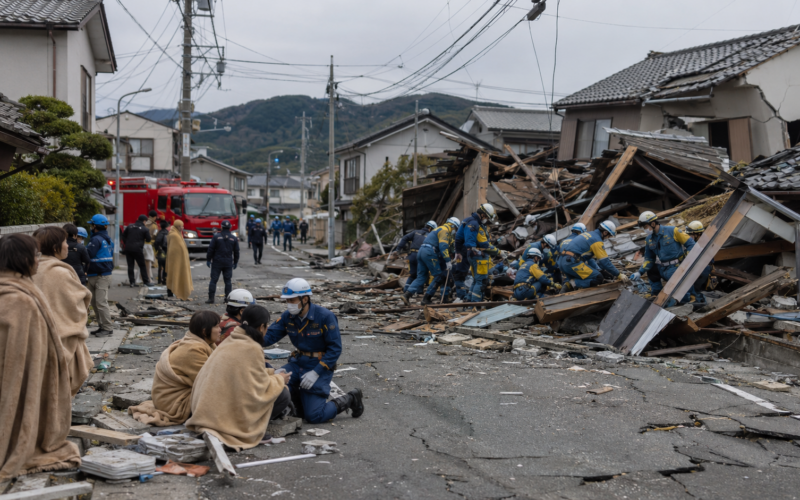
A powerful earthquake that struck southwestern Japan on July 28, 2026, has killed at least 18 people and injured dozens more as rescue teams search damaged homes, a partially collapsed shopping mall and an industrial facility in Kumamoto Prefecture. The Japan Meteorological Agency measured the earthquake at magnitude 7.1 and said it occurred at 4:27 p.m. local time in the Kumamoto region, with the strongest possible seismic intensity of 7 recorded in Uki City and Hikawa Town. International measurements have also described the earthquake as magnitude 6.8 because Japan’s domestic magnitude scale and the moment-magnitude system used internationally calculate seismic strength differently. Thousands of residents spent the night in evacuation centers while emergency workers faced continuing aftershocks, damaged roads, electricity outages and extreme summer heat.
The disaster has again exposed the limits of even Japan’s advanced earthquake preparedness. Strong building regulations and organized evacuation procedures appear to have prevented a substantially larger loss of life, but secondary hazards including an explosion at a shopping mall, falling industrial structures, fires and utility failures caused several of the most serious incidents. Rescue operations continued through Wednesday as officials warned that unstable buildings, landslides and additional earthquakes could endanger both survivors and emergency personnel.
Prime Minister Sanae Takaichi said the government was mobilizing national resources to locate missing people and deliver emergency assistance. Japan’s Self-Defense Forces joined police officers, firefighters and medical teams, while thousands of residents remained unable to return safely to their homes. The government established an emergency headquarters shortly after the earthquake and instructed authorities to collect information rapidly, prioritize lifesaving operations and provide the public with accurate safety guidance.
Kumamoto shopping mall explosion shows why danger can grow after the shaking ends
One of the deadliest incidents occurred at the Aeon Mall in Kashima, where part of the structure was damaged and an explosion followed the initial earthquake. More than 3,000 shoppers and workers were reportedly evacuated before the blast, but employees and emergency personnel were still inside or near the building when the explosion occurred. Authorities are investigating whether earthquake damage caused a gas leak that later ignited.

Rescue workers pulled several people from the damaged mall, but four deaths were ultimately confirmed there, according to the latest casualty information reported by the Associated Press. The sequence demonstrated why surviving the initial shaking does not necessarily end the emergency. Broken gas lines, electrical faults, damaged sprinkler systems and unstable ceilings can create new hazards minutes or hours after an earthquake.
The mall had been designed to meet Japan’s strict seismic standards, and the successful evacuation of thousands of occupants indicates that those protections worked to a considerable extent. However, building codes primarily reduce the likelihood of immediate structural collapse. They cannot eliminate every secondary threat created when underground utilities, industrial equipment or internal systems are violently displaced.
Another major rescue operation unfolded at a Nippon Paper Industries facility in Yatsushiro, where a large chimney collapsed. Five deaths were reported at the factory, while rescue teams continued searching for workers who remained unaccounted for. Elsewhere, falling buildings and industrial machinery caused additional fatalities and injuries, including among foreign workers employed in the region.
The concentration of deaths at a shopping center and industrial facility highlights how earthquake risk changes according to location. A modern structure may remain standing while individual components fail, heavy equipment falls or a utility rupture creates an explosion. Disaster planning must therefore address what happens after occupants leave a building, not merely whether the main structure survives the initial shock.
Aftershocks, damaged utilities and intense summer heat complicate rescue operations
The Japan Meteorological Agency recorded 61 earthquakes strong enough to be felt within the first several hours following the main shock, including three that reached lower 5 on Japan’s seismic-intensity scale. More than 100 aftershocks had been recorded by the following day, and authorities warned that another strong earthquake could occur in the same region.
Aftershocks create a dangerous dilemma for rescue workers. Teams must enter unstable structures quickly because people trapped beneath debris have a limited survival window, but further shaking can cause already weakened walls, roofs and towers to collapse. Heavy rain would add another threat by increasing the possibility of landslides in areas where the earthquake loosened soil and rock.
Electricity and water failures have made conditions more difficult for hospitals, evacuation centers and households. Tens of thousands of homes temporarily lost power, while communities also reported interruptions to water service. Some hospitals were forced to operate with restricted capacity while simultaneously receiving people injured in the earthquake.
Nearly 9,000 residents were staying in evacuation shelters by Wednesday, while substantially larger numbers had initially been instructed to leave vulnerable areas. Temperatures and humidity across Kyushu increased the risk of dehydration and heat-related illness, particularly for older residents and people with chronic medical conditions. Authorities therefore had to provide cooling, clean water, medicine and sanitation while continuing search-and-rescue operations.
Transportation across the region was also disrupted. Bullet-train services were suspended, flights were affected, roads cracked and bridges required safety inspections. These disruptions slowed the movement of relief supplies and prevented some residents from reaching relatives or returning home to evaluate damage.
Nearby nuclear facilities reported no safety irregularities, and a temporary tsunami advisory was lifted. The Japan Meteorological Agency later confirmed that no tsunami warning or advisory remained in effect. That reduced the risk of a broader coastal disaster, but officials continued urging people to avoid damaged buildings and areas vulnerable to landslides.
Why Kumamoto remains exposed despite Japan’s world-leading earthquake protections
Japan experiences unusually frequent earthquakes because it sits near the boundaries of several tectonic plates and forms part of the Pacific Ring of Fire. Movement between those plates produces enormous underground pressure that is eventually released through earthquakes and volcanic activity. Approximately 10% of the world’s earthquakes measuring magnitude 6 or higher occur in or near Japan, according to an earthquake specialist cited by CNN.
Kumamoto is especially familiar with destructive seismic activity. A series of earthquakes struck the prefecture in April 2016, killing more than 270 people when direct deaths and later disaster-related fatalities were included. Thousands of homes were destroyed or severely damaged, landslides cut through communities and Kumamoto Castle required years of restoration work.
The earlier disaster led to extensive rebuilding, stronger local preparedness and improvements in emergency response. Residents regularly participate in earthquake drills, schools teach evacuation procedures and modern structures use systems designed to absorb movement rather than resist it rigidly. Japan also operates rapid earthquake-warning networks capable of sending alerts to mobile phones and stopping trains before the strongest shaking arrives.
Those investments appear to have reduced the scale of the July 2026 catastrophe. A maximum-intensity earthquake striking populated communities could have caused far greater casualties if homes, schools, hospitals and commercial buildings had been constructed to weaker standards. The fact that thousands escaped the damaged mall before the explosion is one example of preparedness preventing a potentially much larger tragedy.
However, Japan’s experience also shows that earthquake resilience is not the same as earthquake immunity. Older wooden homes remain vulnerable, industrial sites contain heavy structures that can fail, underground gas and water lines can rupture and mountainous terrain can collapse after intense shaking. Communities must also plan for electricity shortages, interrupted communications and the medical needs of people displaced for days or weeks.
The latest earthquake is not directly connected to the anticipated Nankai Trough megathrust earthquake, which Japanese authorities have warned could eventually affect a much larger section of the country. Scientists cannot reliably predict the exact date or location of a major earthquake, and the occurrence of one event does not establish that another is imminent. The practical response remains continuous preparation rather than attempts to forecast a precise disaster date.
Japan now faces a prolonged recovery even after the survivor searches end
The immediate priority remains locating people who may still be trapped. Once rescue operations conclude, authorities will begin a wider assessment of homes, schools, hospitals, roads, factories and public utilities. Buildings that appear intact externally may require detailed inspections before residents are permitted to return.
The earthquake could also have significant consequences for Kumamoto’s regional economy. The prefecture has become an important manufacturing center, particularly for semiconductors, electronics and automotive components. Taiwan Semiconductor Manufacturing Company, Sony Group Corporation, Honda Motor Company and other manufacturers temporarily halted or assessed operations after the earthquake. Initial reports indicated that workers were safely evacuated from several major facilities, but production interruptions could continue while equipment and utility systems are inspected.
The larger humanitarian burden will fall on families whose homes have been destroyed or declared unsafe. Even where physical reconstruction moves quickly, survivors can experience anxiety, sleep disruption and fear during every aftershock. The return of a major earthquake to Kumamoto only a decade after the 2016 disaster is likely to reopen trauma for residents who endured both events.
Japan’s response will be closely studied because the country is widely regarded as a global model for earthquake resilience. The early evidence suggests that preparedness saved many lives, but the deaths caused by secondary failures reveal where additional protection may be needed. Stronger automatic gas shutoff systems, inspections of industrial towers, more resilient utility networks and improved shelter cooling could become important subjects during the official review.
The earthquake has therefore delivered two contrasting messages. Japan’s decades of investment in stronger buildings, public education and emergency coordination prevented the disaster from becoming even worse. At the same time, no level of preparation can remove every threat when violent ground movement damages an entire urban and industrial system at once.
Key takeaways from the deadly Kumamoto earthquake in Japan
- The earthquake struck Kumamoto Prefecture at 4:27 p.m. on July 28, 2026, giving the disaster a precise timeline and showing how a late-afternoon event placed homes, factories and shopping centers at immediate risk.
- The Japan Meteorological Agency measured the earthquake at magnitude 7.1, while international reports used a moment magnitude of approximately 6.8, reflecting different measurement systems rather than conflicting events.
- At least 18 people were confirmed dead by Wednesday, but the toll remained provisional because rescue teams were still searching damaged buildings and industrial sites.
- The highest possible Japanese seismic intensity of 7 was recorded in Uki City and Hikawa Town, indicating shaking powerful enough to destroy weaker structures and make movement extremely difficult.
- An explosion at the Aeon Mall after thousands of people had evacuated demonstrated that ruptured gas lines and other secondary hazards can remain deadly long after the main shaking stops.
- The collapse of a chimney at a Nippon Paper Industries facility showed that industrial structures and heavy equipment can pose major risks even when surrounding buildings remain standing.
- More than 100 aftershocks complicated rescue work by threatening additional collapses and forcing emergency teams to balance speed against their own safety.
- Power, water, road, rail and hospital disruptions expanded the disaster beyond the damaged buildings, increasing health risks for displaced residents during hot and humid weather.
- Japan’s strict building codes, warning systems and routine evacuation training probably prevented a much higher death toll, but the disaster exposed continuing weaknesses in utilities and industrial infrastructure.
- Recovery will extend well beyond the survivor searches because Kumamoto must inspect thousands of structures, restore essential services and support communities still carrying memories of the deadly 2016 earthquakes.
Discover more from Business-News-Today.com
Subscribe to get the latest posts sent to your email.