
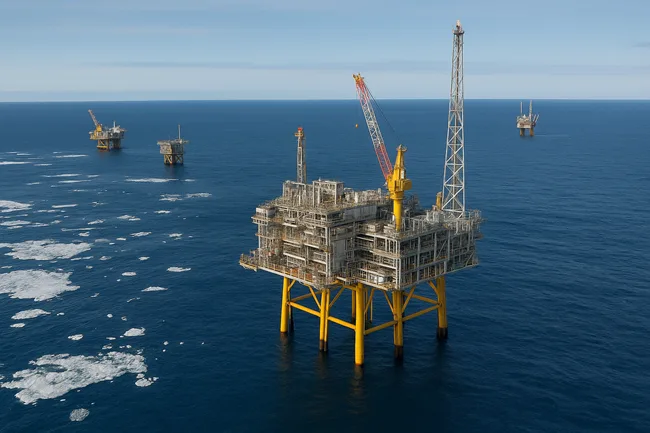


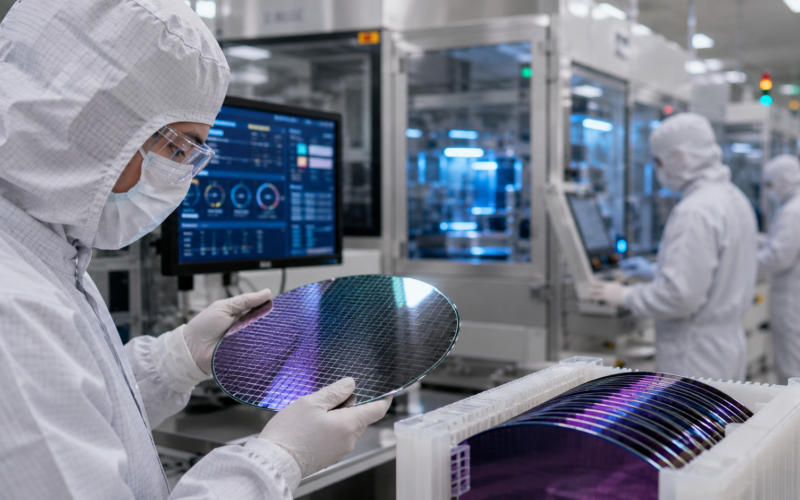
IQE plc (AIM: IQE) is a Cardiff-headquartered manufacturer of compound-semiconductor wafers and advanced materials used in artificial intelligence data centres, optical communications, smartphones, defence systems, satellites, automotive sensors, power electronics and emerging display technologies. The company does not normally manufacture completed semiconductor chips. Instead, it grows highly engineered crystalline layers on wafers that customers subsequently process into lasers, radio-frequency components, sensors, power devices and other specialised semiconductors.
The company entered 2026 after a difficult financial year in which revenue fell 17.6% to £97.3 million and adjusted EBITDA declined to £3.2 million. Its financial position changed materially following an approximately £81 million recapitalisation involving strategic customer MACOM Technology Solutions, existing convertible-note holders and other investors. The transaction allowed IQE to repay its bank revolving-credit facility, strengthen working capital and retain its manufacturing footprint across the United Kingdom, United States and Taiwan.
Commercial momentum subsequently improved. IQE expects first-half 2026 revenue of at least £64 million after stronger demand across its core markets, particularly indium phosphide products used in AI data-centre optical connectivity. Management upgraded its full-year outlook to revenue growth exceeding 30% and adjusted EBITDA in the low teens of millions of pounds. IQE reported £41.6 million of cash and no bank debt at June 30, although it continued to carry £15 million of secured convertible loan notes issued to MACOM.
The central investment question is whether IQE has entered a sustainable growth phase or is experiencing another cyclical recovery in a historically volatile semiconductor market. The company now has stronger funding, improving factory utilisation and an expanding AI infrastructure opportunity. Its valuation, however, already assumes that management can convert revenue growth into durable margins, cash generation and stronger returns for an enlarged shareholder base.
What does IQE manufacture, and why are compound-semiconductor wafers strategically important?
Most conventional computing processors and memory devices are manufactured primarily from silicon. Silicon is abundant, commercially mature and suitable for producing billions of transistors economically, but it does not offer the ideal physical characteristics for every semiconductor application.
Compound semiconductors combine two or more elements to create materials with properties that silicon cannot easily match. They can transmit and detect light, process higher-frequency signals, operate more efficiently at high power and withstand demanding environments. These characteristics make compound semiconductors important in optical communications, radar, infrared sensing, radio-frequency systems, satellite technology, electric vehicles and data-centre infrastructure.
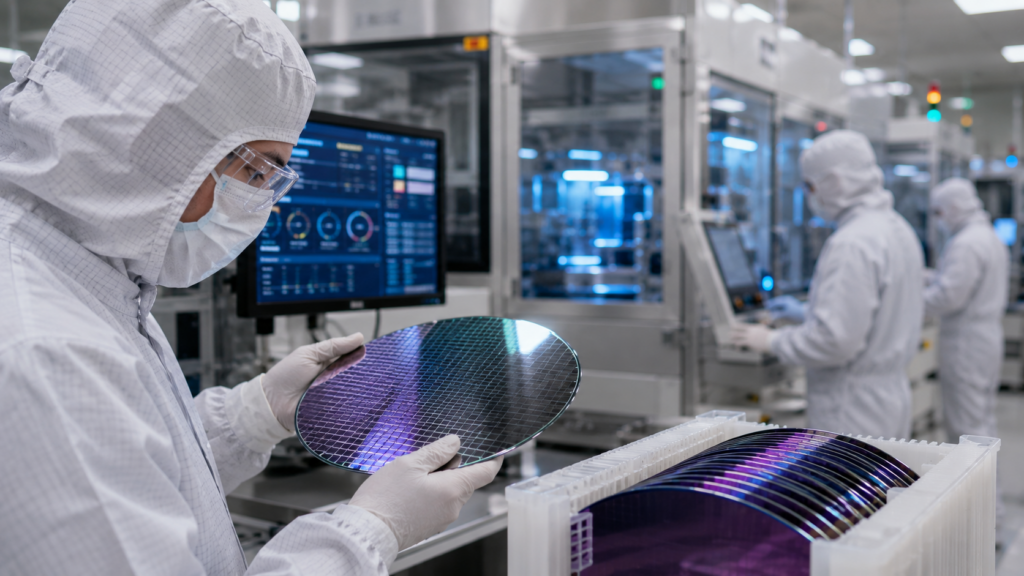
IQE specialises in epitaxy, which is the controlled growth of extremely thin crystalline layers on a base wafer. The composition, thickness and sequence of these layers determine the electrical and optical performance of the eventual semiconductor device.
The company works across several major material platforms. Indium phosphide supports high-speed optical communication, lasers and infrared applications. Gallium arsenide is used in radio-frequency products, optical components, 3D sensing and communications. Gallium nitride supports power electronics, radar, telecommunications infrastructure and microLED technology. Antimonide-based materials are used in infrared sensing and imaging.
This manufacturing process creates meaningful barriers to entry. Customers require atomic-level material consistency, manufacturing yields, reliability and traceability. Once an IQE wafer has been qualified for a particular chip architecture, replacing the supplier can require further development, testing and customer approval.
Qualification does not eliminate commercial pressure. Semiconductor customers may use multiple suppliers to improve resilience or negotiate pricing, while some large manufacturers can develop internal epitaxy capabilities. IQE must therefore continue improving its products, yields and manufacturing efficiency after securing each programme.
How did IQE evolve from a Welsh semiconductor start-up into a global wafer supplier?
IQE’s operating history traces back to Epitaxial Products International, which was established in Cardiff in 1988. The modern group was formed in 1999 through the combination of UK and United States operations, followed by a public-market flotation and further international expansion.
The company’s shares have been admitted to trading on AIM under the ticker IQE since September 30, 2003. Its public listing provided access to capital for acquisitions, technology development and the construction of manufacturing facilities serving increasingly specialised semiconductor markets.
IQE expanded its materials portfolio and geographic footprint through internal investment and acquisitions. The group now operates facilities in the United Kingdom, United States and Taiwan, giving it access to customers across several major semiconductor regions.
Its Newport manufacturing facility was announced as a major high-volume compound-semiconductor site in 2017. Equipment installation, commissioning and customer qualification progressed during 2017 and 2018. IQE announced full product qualification and the facility’s first mass-production order in May 2019.
Newport has since supported photonics, sensing and other high-volume applications. The facility is also expected to manufacture a recently announced $14 million multiyear production order serving AI and data-centre applications.
IQE’s geographic spread can provide customers with supply-chain resilience and regional production options. It also gives the company a substantial fixed-cost base. When customer demand weakens, underused factories and specialist equipment can quickly reduce margins.
That sensitivity was visible in 2025, when weaker wireless revenue and lower overall utilisation contributed to the fall in adjusted EBITDA. IQE’s current recovery therefore depends not only on winning orders, but also on filling its existing factories efficiently enough to absorb their operating costs.
How does IQE generate revenue from wafers, intellectual property and manufacturing capacity?
IQE earns most of its revenue by developing and manufacturing epitaxial wafers to customer specifications. Customers may initially place development orders while testing a new material or semiconductor architecture, followed by qualification work and higher-volume production if the product proceeds commercially.
The development stage can require substantial engineering resources without immediately generating large revenue. Once a product reaches commercial production, IQE may supply repeat wafer volumes throughout the life of the customer programme.
This creates relatively long sales and qualification cycles. An IQE wafer may pass through a semiconductor foundry, chipmaker, component supplier and equipment manufacturer before reaching the final consumer or industrial application. Commercial confidentiality frequently prevents IQE from identifying the ultimate end customer.
The company has historically divided its reported revenue between Wireless and Photonics. Wireless includes products used in mobile-handset radio-frequency systems, communications infrastructure and connected devices. Photonics covers technologies that generate, transmit or detect light, including optical communications, lasers, infrared sensing and 3D sensing.
Management also describes its wider strategy through the Connect, Sense, Display and Power application areas. Connect includes wireless communication and optical data transmission. Sense covers 3D sensing, infrared imaging, automotive applications and defence. Display includes microLED opportunities, while Power covers data centres, electric vehicles, industrial systems, aerospace and space applications.
IQE’s earnings are particularly sensitive to product mix and factory utilisation. Higher-value photonics and specialised defence products may support stronger margins, while declining demand in large but mature mobile markets can leave production equipment underused.
Why has indium phosphide become central to IQE’s AI data-centre growth opportunity?
Artificial intelligence infrastructure requires enormous amounts of data to move between processors, memory, storage and networking equipment. As data rates increase, conventional electrical connections face growing constraints from heat, power consumption and signal degradation.
Optical connectivity helps address these constraints by transmitting data using light. Indium phosphide is an important material for the lasers, modulators, detectors and other components used in high-speed optical systems.
IQE’s indium phosphide epiwafers can be combined with silicon-photonics platforms to support high-volume optical components. The company has reported multiple design wins and has described accelerating indium phosphide demand as an important growth driver for 2026 and beyond.
A major commercial development came through IQE’s multiyear agreement with Tower Semiconductor. IQE will supply indium phosphide epiwafers for Tower’s silicon-photonics platforms serving AI data centres and advanced optical connectivity.
The collaboration covers products supporting 200 gigabits per second per lane in pluggable transceivers, prototypes targeting 400 gigabits per second per lane and optical circuit-switching applications. Tower committed to minimum purchases during the first year and minimum volume levels in subsequent periods.
Neither company disclosed the contract value or precise duration. The agreement therefore strengthens IQE’s commercial visibility but should not be presented as a quantified backlog amount.
The companies also resolved earlier intellectual-property litigation. Tower granted IQE a broad worldwide royalty-free licence covering porous-silicon patents involved in the dispute, removing a legal uncertainty while enabling a new commercial relationship.
IQE’s AI exposure must be described accurately. It does not manufacture artificial intelligence processors or compete directly with companies designing graphics-processing units. Its products support the optical connectivity, sensing and power infrastructure required to operate increasingly large computing systems.
What does IQE’s $14 million AI and data-cententre order reveal about commercial momentum?
IQE announced a $14 million multiyear production order in July 2026 from an unnamed global technology customer. The products will be manufactured at the Newport facility and used in AI and data-centre applications involving high-performance storage technologies.
The award is important because it is a quantified production order rather than only a development agreement or design win. Revenue will be recognised over the life of the programme rather than immediately.
IQE also said it was discussing additional development work with the customer covering other stages of the data lifecycle. Those potential opportunities had not been announced as contracted orders and should not be included in backlog calculations.
The customer’s identity remains confidential. It should not be assumed to be MACOM, Tower Semiconductor, a hyperscale cloud operator or another named company unless IQE makes a formal disclosure.
The order also highlights the changing role of the Newport facility. A site associated historically with consumer sensing and photonics is becoming increasingly important to data-centre, AI infrastructure and advanced storage applications.
How did the MACOM investment end IQE’s strategic review and reshape its balance sheet?
IQE entered its strategic review after weaker demand, rising debt pressure and concerns about its ability to finance a global manufacturing network. The board considered potential offers for the entire company and transactions involving individual assets.
The review concluded with a strategic financing led by MACOM Technology Solutions, an existing customer and specialist semiconductor manufacturer. IQE remained independent rather than being sold or broken up.
The total fundraising was approximately £81 million, but the figure did not represent £81 million of entirely new cash retained by IQE. It included approximately £22.8 million reinvested by holders following the redemption of existing convertible notes, together with proceeds used to repay bank debt and complete the restructuring.
IQE expected an approximate net cash inflow of £27.9 million after repaying its HSBC revolving-credit facility.
MACOM contributed £45 million. It subscribed for 151,515,151 ordinary shares at 19.8 pence each, raising £30 million, and received £15 million of secured zero-coupon convertible loan notes with the same 19.8-pence conversion price.
The wider financing included the noteholder reinvestment and £13 million raised through a placing and retail offer. The 19.8-pence issue price represented a 58.4% discount to the 47.6-pence closing mid-market price immediately before the announcement and a 10.1% discount to the preceding 12-month volume-weighted average price.
Following completion, MACOM held approximately 11.38% of IQE’s issued shares. It also obtained rights to appoint two representatives to the board and entered long-term supply arrangements with IQE.
Robert Dennehy, MACOM’s senior vice-president and chief operating officer, and David O’Carroll, a MACOM vice-president, were appointed as IQE non-executive directors effective July 1, 2026.
The structure gives IQE a strategically aligned customer and investor. It also creates concentration because MACOM is simultaneously a shareholder, lender, customer, supply-agreement counterparty and source of board representation.
How much dilution did the £81 million recapitalisation create for existing IQE shareholders?
IQE issued 332,183,678 new shares through the May 2026 fundraising. Its issued share capital increased from 980,407,294 shares to 1,312,590,972 shares at admission, representing an increase of approximately 33.9%.
Subsequent warrant exercises increased the issued total to 1,331,036,951 ordinary shares by June 30. IQE also held 4,115 shares in treasury.
The additional capital allowed the company to repay bank debt, support working capital and retain its manufacturing footprint. Existing shareholders nevertheless own a smaller percentage of the business following the transaction.
Further dilution could arise if MACOM converts the £15 million secured loan notes. Full conversion at 19.8 pence would result in the issue of approximately 75.8 million additional shares, subject to the detailed terms and any contractual adjustments.
The refinancing must therefore be assessed on a per-share basis. IQE’s future earnings, cash flow and valuation must increase sufficiently to offset the effect of the larger share count for existing investors to receive a meaningful economic benefit.
Which markets beyond artificial intelligence could support IQE’s future growth?
IQE’s Photonics revenue increased 15% to £57.1 million during 2025, supported by aerospace and defence programmes and growing demand related to AI and data-centre infrastructure. Photonics represented the majority of group revenue after the decline in Wireless.
Aerospace and defence applications include gallium-nitride materials used in radar, secure communications, electronic warfare and satellite systems. IQE also produces antimonide-based materials for infrared detection and imaging.
Defence revenue can be uneven because programme timing may depend on government funding and appropriations. IQE reported that releases of funding for certain United States military programmes contributed to its second-half 2025 performance.
Wireless remains an important recovery opportunity. Revenue fell 40% to £40.1 million during 2025 because of weak mobile-handset demand and customers reducing existing inventory. Management subsequently reported stronger demand during 2026 and new design wins involving handset power amplifiers.
IQE has historically been associated with 3D-sensing components used in premium smartphones and facial-recognition systems. Commercial confidentiality means the company frequently cannot confirm the final consumer brand using its wafers, so references to particular smartphone manufacturers should remain qualified.
Automotive opportunities include vertical-cavity surface-emitting lasers used in driver-monitoring, cabin-sensing and other optical applications. IQE has reported production orders for automotive-qualified VCSEL products through a global optical-sensing customer.
Longer-term markets include gallium-nitride power electronics for data centres and electric vehicles, as well as microLED wafers for augmented reality, virtual reality and advanced displays. These opportunities may become commercially significant, but several remain in development or customer qualification rather than mature mass production.
What do IQE’s latest financial results reveal about the underlying condition of the business?
IQE reported revenue of £97.3 million for 2025, down from £118 million in 2024. Photonics revenue increased to £57.1 million, but the improvement was outweighed by the decline in Wireless revenue from £67.3 million to £40.1 million.
Adjusted EBITDA fell from £8.1 million to £3.2 million, producing an adjusted EBITDA margin of approximately 3%. The reported loss before tax was £37 million, compared with £36.9 million in the previous year.
The difference between adjusted EBITDA and the statutory loss reflects depreciation, amortisation, finance expenses and other charges. IQE operates capital-intensive production sites, meaning a positive adjusted EBITDA result does not automatically translate into net profit or positive free cash flow.
Operating cash inflow increased to £8.1 million from £1.3 million, supported partly by working-capital movements. Cash capital expenditure declined from £11.4 million to £5.1 million as management restricted investment and focused on selected technologies.
Cash stood at £15.7 million at the end of 2025, while adjusted net debt increased to £31.5 million. The subsequent recapitalisation allowed IQE to repay its HSBC revolving facility and report £41.6 million of cash and no bank debt at June 30, 2026.
The description “bank-debt free” should not be interpreted as meaning IQE has no financial obligations. It continues to carry the £15 million secured convertible loan notes issued to MACOM, lease liabilities and other operating commitments.
Can IQE convert its upgraded 2026 guidance into sustainable profitability and cash flow?
IQE expects first-half 2026 revenue of at least £64 million after performance exceeded management expectations. Growth was supported by indium phosphide products, aerospace and defence, 3D sensing and stronger wireless demand.
Management expects full-year revenue growth of more than 30%. Applied to the 2025 base of £97.3 million, this would imply revenue above approximately £126.5 million.
Adjusted EBITDA is expected to reach the low teens of millions of pounds. Achievement of approximately £12 million to £14 million would represent a substantial improvement from £3.2 million in 2025, although the phrase “low teens” remains company guidance rather than a completed result.
Higher factory utilisation could allow more revenue to be produced through IQE’s existing manufacturing network without a corresponding increase in fixed costs. A greater contribution from indium phosphide and specialised photonics products could also improve the revenue mix.
Several factors could prevent the anticipated operating leverage. Customer ramps may be delayed, mobile demand could weaken again, production yields may fall below expectations or specialised materials could become more expensive or difficult to source.
Adjusted EBITDA also excludes several costs that matter to shareholders. Depreciation, finance expenses, capital investment and working-capital requirements may continue to limit cash generation even if the operating guidance is achieved.
The decisive financial test is therefore not only whether IQE reaches its 2026 adjusted EBITDA target, but whether it can generate sustainable operating cash flow without requiring another major capital raise.
How has the IQE share price performed after its AI and MACOM transformation?
IQE shares closed at approximately 39.1 pence on July 31, 2026. That represented a decline of about 20% from the July 24 close of 48.85 pence and approximately 17.6% from the June 30 close of 47.45 pence.
Despite the late-July decline, the stock remained approximately 682% above its December 31, 2025 closing price of 5.00 pence. The performance illustrates the dramatic change in investor sentiment created by strategic-review developments, the MACOM-backed recapitalisation and improving demand linked to AI infrastructure.
The shares traded within an approximate 52-week range of 4.66 pence to 72.90 pence, showing the extreme volatility associated with IQE’s financial and strategic transformation.
Applying the July 31 closing price to IQE’s 1.331 billion issued shares produces an indicative equity-market value of approximately £520 million.
A conventional price-to-earnings ratio is not meaningful because IQE remained loss-making on a statutory basis. The market capitalisation was equivalent to approximately 5.3 times 2025 revenue and around 4.1 times the minimum full-year revenue implied by the updated 2026 guidance.
These are illustrative equity-value-to-revenue comparisons rather than enterprise-value multiples. They do not fully account for cash, convertible notes, leases or potential future dilution.
The valuation indicates that investors no longer view IQE primarily as a financially distressed wafer manufacturer. The market increasingly treats it as a scarce listed exposure to AI optical connectivity, compound semiconductors and Western technology manufacturing.
That shift creates significant downside risk if management misses its guidance. A company valued at more than four times prospective revenue generally needs to deliver sustained growth, improving margins and strong cash conversion to support the multiple.
Who owns and leads IQE following the company’s 2026 recapitalisation?
Jutta Meier serves as chief executive officer and continues to perform chief financial officer responsibilities while IQE searches for a permanent CFO. Her semiconductor-industry experience includes previous roles at Intel, GlobalFoundries and AMD.
Mark Cubitt is chair, while Carol Chesney serves as senior independent director. The board includes directors with experience in semiconductors, manufacturing, governance, finance and international technology markets.
Robert Dennehy and David O’Carroll joined the board as non-executive directors on July 1, 2026 under MACOM’s appointment rights. Their presence gives MACOM formal board representation alongside its commercial and financial relationships with IQE.
Artisan Partners was IQE’s largest disclosed shareholder at June 30 with approximately 12.92%. MACOM held 11.38%. Other disclosed positions included Lombard Odier Investment Managers and shares held through investment platforms including Interactive Brokers, Hargreaves Lansdown and Interactive Investor.
Some platform positions represent shares held for multiple underlying customers rather than a single beneficial owner.
MACOM’s influence is greater than its ownership percentage alone suggests because it combines equity ownership, convertible debt, supply arrangements, customer relationships and board representation.
What competitive advantages support IQE’s position in compound-semiconductor manufacturing?
IQE’s principal strength is the breadth of its materials portfolio. The company can manufacture indium phosphide, gallium arsenide, gallium nitride and antimonide-based products for communications, sensing, power, display and defence markets.
Its global manufacturing network provides regional production in Europe, North America and Asia. This can become more valuable as customers seek supply resilience and governments place greater emphasis on domestic and allied semiconductor capacity.
The company also benefits from decades of process knowledge. Commercial epitaxy depends not only on patents, but also on manufacturing recipes, equipment configuration, quality control, customer-specific engineering and experience improving production yields.
Customer qualification creates an additional barrier. Once a material has been incorporated into a semiconductor device and approved through the wider supply chain, changing the supplier can be costly and time-consuming.
IQE nevertheless occupies one stage of a much larger value chain. Semiconductor foundries, chip designers and component manufacturers may capture a greater share of the final product’s value, while IQE remains exposed to their inventory decisions, pricing pressure and technology choices.
The company’s advantages will therefore depend on maintaining technical differentiation and manufacturing reliability while improving margins in a sector where customers possess substantial negotiating power.
What are the biggest operational and financial risks facing IQE shareholders?
Customer demand remains cyclical. The 40% decline in Wireless revenue during 2025 demonstrated how rapidly handset weakness and inventory corrections can affect factory utilisation and profitability.
AI-related demand could also prove volatile. Data-centre customers frequently revise their network architectures, suppliers and deployment schedules as technology changes. Design wins and minimum orders do not guarantee uninterrupted multiyear growth.
Manufacturing execution is critical. Epitaxial materials must meet demanding specifications, and problems involving contamination, yields or production consistency can delay qualification and reduce profitability.
IQE’s international manufacturing footprint creates geopolitical exposure. Its operations in the United States and Taiwan serve supply chains affected by export controls, tariffs, industrial policy and national-security restrictions.
Access to specialised materials represents another risk. Compound-semiconductor manufacturing depends on inputs that may experience export restrictions, shortages or significant price changes.
MACOM concentration creates both opportunity and dependency. Its investment and long-term supply agreements strengthened IQE, but deterioration in the relationship could affect customer demand, financing and governance simultaneously.
Shareholder dilution remains important. The recapitalisation increased the issued share count by approximately 34%, and conversion of MACOM’s notes could create further shares.
Valuation is the most visible public-market risk. IQE’s market capitalisation has increased much faster than its revenue and profitability. Any guidance reduction, customer delay or failure to improve margins could lead to another sharp share-price adjustment.
What is IQE’s growth outlook through 2027 as AI photonics demand continues expanding?
IQE begins the next stage of its development with a materially stronger balance sheet than it had entering 2026. Repayment of the revolving bank facility reduced immediate liquidity pressure, while £41.6 million of cash provided additional working-capital capacity.
Indium phosphide is likely to remain the company’s most visible growth driver. The Tower Semiconductor agreement, the separate $14 million production order and IQE’s wider design-win pipeline connect the company to expanding optical infrastructure around artificial intelligence computing.
Aerospace and defence should provide a second growth pillar through radar, electronic warfare, infrared sensing, secure communications and satellite applications. These programmes can offer strong technical barriers but may produce irregular revenue because of government funding cycles.
Wireless recovery could add further operating leverage because IQE already owns the facilities required to serve higher handset volumes. The segment remains vulnerable to another inventory correction or weaker consumer demand.
Gallium-nitride power products and microLED materials provide longer-term optionality. Their financial contribution will depend on customer qualification, commercial adoption and the company’s ability to manufacture at competitive cost.
The decisive question is whether IQE can convert revenue growth above 30% into lasting margins and positive cash generation. Reaching low-teens adjusted EBITDA would represent a major improvement, but investors will then need evidence that profitability can persist beyond the initial recovery.
IQE has moved from strategic-review and liquidity pressure into a customer-backed growth strategy. The MACOM financing, stronger cash position and rising AI photonics demand have reduced immediate financial risk. They have also raised market expectations considerably.
Through 2027, investors are likely to focus on indium phosphide volumes, Tower Semiconductor purchases, delivery of the $14 million programme, wireless recovery, factory utilisation and cash conversion. Strong execution could establish IQE as an increasingly important Western supplier of specialised semiconductor materials. Order delays, weak margins or another funding requirement would expose the distance between the company’s improving operations and its expanded valuation.
Discover more from Business-News-Today.com
Subscribe to get the latest posts sent to your email.