


Invinity Energy Systems plc (AIM: IES) has secured a 32 MWh vanadium flow battery sale for Pacific Steel Group’s Mojave Micro Mill in Kern County, California. The United Kingdom and Canada-based long-duration energy storage manufacturer said the system will be supported by California Energy Commission funding and is expected to be the largest vanadium flow battery system in North America to date once delivered. The immediate strategic relevance is that Invinity Energy Systems plc is moving deeper into heavy industrial decarbonisation, where steelmaking, solar power and long-duration storage are converging. IES shares fell sharply despite the announcement, showing that investors are encouraged by the contract but still focused on delivery timing, manufacturing scale, cash needs and when large project wins turn into recognised revenue.
Why does Invinity Energy Systems’ 32 MWh California battery deal matter for IES investors?
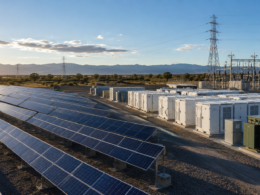
Invinity Energy Systems plc’s 32 MWh sale matters because it places the company’s vanadium flow battery technology inside an energy-intensive industrial application rather than a more conventional grid demonstration project. Pacific Steel Group’s Mojave Micro Mill is designed to recycle 500,000 tons of scrap metal annually into rebar for the United States construction industry. The battery system will be co-located with a 40 MWp solar array and used to supply on-demand, locally generated low-carbon power to the mill.
That use case is important because long-duration batteries are increasingly being judged on whether they can serve real industrial loads, not simply balance renewables in policy presentations. Steel mills require reliable, high-throughput power. A storage system serving that environment has to cycle heavily, operate safely and perform predictably over time. Invinity Energy Systems plc’s selection therefore strengthens the company’s claim that vanadium flow batteries can serve demanding commercial and industrial applications where lithium-ion batteries may face limits around duration, cycling intensity, fire safety or degradation.
For IES investors, the deal provides a valuable proof point, but not an immediate earnings transformation. Delivery is expected to begin in Q1 2027, with associated revenue recognised at that point. That means the announcement supports future visibility rather than current-year cash flow. The share price fall suggests the market understood the difference. Investors liked the project, but they also noticed that invoices do not become revenue just because the headline looks shiny.
How does the Pacific Steel Group project strengthen Invinity’s industrial decarbonisation case?
The Pacific Steel Group project is strategically useful because it links Invinity Energy Systems plc to two major investment themes at once: clean power for heavy industry and domestic manufacturing in the United States. Steel production is energy-intensive, and even recycled steel requires reliable electricity. By helping the Mojave Micro Mill use solar power more flexibly, Invinity Energy Systems plc can position its technology as an enabler of lower-carbon industrial production rather than only a renewable-grid balancing asset.
This matters because industrial customers may become one of the most important demand pools for long-duration storage. Factories, mines, data centres, ports and heavy manufacturing sites increasingly want cheaper, cleaner and more resilient power. Many of these users cannot rely only on daytime solar or short-duration batteries. They need systems that can shift energy over longer periods and operate through demanding cycles.
The competitive implication is that Invinity Energy Systems plc is trying to occupy a differentiated place within storage. Lithium-ion batteries dominate many short-duration and high-power applications, but vanadium flow batteries can be more attractive where long life, frequent cycling and safety are decisive. The Pacific Steel Group award gives Invinity Energy Systems plc another chance to prove that distinction in a high-visibility industrial setting.
Why did IES shares fall despite a major United States battery contract win?
The negative share price reaction shows that investors are separating contract wins from near-term financial delivery. IES shares traded around 30.50p to 31.50p, down more than 10%, even though the project announcement was strategically positive. That is not necessarily irrational. The stock had already rallied strongly in recent months, and investors may have taken profits after the news rather than re-rate the company immediately.
The second issue is revenue timing. Battery delivery is expected in Q1 2027, which means the financial benefit is not immediate. For an early-stage growth manufacturer, contract announcements are encouraging, but cash flow timing, working capital and production execution are just as important. Investors want to know when projects will move through backlog, manufacturing, delivery, installation and revenue recognition.
The third issue is scale risk. Invinity Energy Systems plc has a promising technology and a growing order book, but manufacturing flow batteries at commercial scale is a different challenge from winning individual projects. The market is asking whether the company can deliver larger systems on schedule, expand United States manufacturing, manage supply chains and protect margins. Contract wins are applause. Manufacturing execution is the exam.
What does the California Energy Commission backing reveal about long-duration storage policy?
The California Energy Commission’s support is strategically significant because California has become one of the most important testing grounds for long-duration energy storage. The state has high renewable penetration, grid reliability challenges, electrification demand and an industrial base that needs cleaner power. Grant-backed projects can therefore help push emerging storage technologies from demonstration toward commercial adoption.
For Invinity Energy Systems plc, public funding support reduces customer-side risk and validates the role of long-duration storage in California’s clean energy plans. It also helps create reference projects that can be used in future sales conversations. In energy technology markets, policy-supported deployments often act as bridges between early commercial adoption and wider private-sector demand.
The risk is that policy support can also create lumpy demand. Grant-backed projects are valuable, but investors will want to see whether Invinity Energy Systems plc can win projects without depending heavily on public funding programmes. The strongest long-term investment case would involve a mix of grant-backed projects, commercial industrial buyers, utilities and energy developers adopting vanadium flow batteries because the economics stand on their own.
How could United States manufacturing ambitions reshape Invinity Energy Systems’ strategy?
Invinity Energy Systems plc said the batteries for the project are planned to be manufactured in the United States, which is a major strategic signal. United States-based manufacturing could improve the company’s ability to serve American customers, qualify for domestic content preferences, reduce logistics complexity and align with industrial policy incentives. In a market increasingly shaped by local supply chains, that matters.
The United States opportunity is particularly important because long-duration storage demand is expected to grow as grids add more renewable power and industrial users seek cleaner energy. A local manufacturing footprint could position Invinity Energy Systems plc more competitively against domestic and international storage providers. It may also strengthen relationships with California customers, project developers and public-sector agencies.
The risk is capital intensity. Expanding manufacturing in the United States requires investment, operational discipline, supply-chain planning and quality control. For a company still scaling commercially, manufacturing expansion can be both a growth enabler and a cash demand. Investors will watch whether Invinity Energy Systems plc can expand capacity without stretching the balance sheet or creating margin pressure. “Made in America” is a strong slogan, but the factory still has to pay for itself.
Why are vanadium flow batteries relevant for steel mills and other heavy power users?
Vanadium flow batteries are relevant for heavy power users because they are designed for long-duration, high-throughput applications where cycling intensity and system life matter. Unlike lithium-ion batteries, vanadium flow batteries store energy in liquid electrolyte and can be cycled repeatedly with limited degradation over long operating lives. That makes them suitable for applications where the battery may need to charge and discharge frequently to match industrial demand and renewable generation.
For a steel mill using solar power, this matters because production loads do not always align neatly with solar output. A long-duration battery can help shift power, smooth supply and reduce dependence on grid electricity during periods when renewable generation is not available. The technology can also support resilience, which is valuable for industrial facilities where downtime can be expensive.
The competitive challenge is cost. Vanadium flow batteries must prove that durability, safety and cycle life justify upfront project economics. Industrial users will not adopt the technology out of kindness to the energy transition. They need a business case around power costs, reliability, emissions, incentives and operating life. The Pacific Steel Group project gives Invinity Energy Systems plc a chance to show that the business case can work in a serious industrial setting.
How should investors read Invinity Energy Systems’ valuation after the latest contract?
IES stock remains a high-expectation clean energy growth story rather than a mature industrial company. Market data showed the shares around 30.50p to 31.50p after the announcement, with a 52-week range of roughly 15.50p to 40.50p and market capitalisation around £175 million. That valuation reflects investor belief in long-duration storage demand, but it also leaves the company exposed to disappointment if commercialisation is slower than expected.
The stock’s pullback after the announcement suggests investors are becoming more selective. The company has delivered a strong project milestone, but the market wants evidence of repeat orders, revenue conversion, manufacturing throughput and cash discipline. This is a healthy tension. It prevents the investment case from becoming only a technology dream and forces attention back to operating delivery.
For retail investors, the attraction is obvious: a small listed company with exposure to grid storage, industrial decarbonisation, United States energy policy and alternative battery technology. For institutional investors, the question is whether Invinity Energy Systems plc can become a scalable manufacturer with durable margins. The company now has another reference project. The market wants a commercial machine.
What does this deal mean for the wider long-duration energy storage market?
The deal highlights the growing role of long-duration energy storage in decarbonising hard-to-electrify industrial activity. Grid-scale batteries are often discussed in the context of renewable integration, but industrial applications may become equally important. Heavy users need power that is clean, reliable and available when production requires it. That creates a role for storage technologies that can cycle deeply and frequently.
The project also shows how steel, solar and storage are beginning to converge. A micro mill recycling scrap metal with on-site solar and long-duration battery storage represents a different industrial model from traditional high-emission steel production. If the model works economically, it could influence how future industrial facilities are designed, especially in regions with strong renewable resources and supportive policy.
For competitors, the announcement reinforces that long-duration storage is no longer only a utility procurement topic. It is moving into industrial decarbonisation, manufacturing resilience and corporate energy strategy. That could create opportunities for vanadium flow batteries, iron-air systems, thermal storage, sodium-based batteries and other emerging technologies. Invinity Energy Systems plc now has a seat at that table. The question is whether it can serve enough meals.
What should investors watch next after Invinity’s Pacific Steel Group contract win?
The first thing to watch is whether the project remains on schedule for Q1 2027 battery delivery and H2 2027 mill operations. Any delay could affect revenue recognition and investor confidence. Large industrial projects involve many moving parts, and the storage system is only one component of the wider mill and solar installation.
The second thing to watch is United States manufacturing progress. Invinity Energy Systems plc has signalled that the project can accelerate its plans to expand American production capability. Investors will need details on capacity, cost, funding, supply chain and timing. United States manufacturing could become a major strategic advantage, but only if executed without excessive cash strain.
The third thing to watch is order momentum. A single 32 MWh project is important, but the larger valuation case depends on whether similar industrial and grid customers follow. If Invinity Energy Systems plc converts this project into a repeatable sales template, the stock could regain momentum. If contract flow remains uneven, the market may continue to discount the long-duration storage promise.
Key takeaways on what Invinity Energy Systems’ California battery win means for IES stock
- Invinity Energy Systems plc has secured a 32 MWh vanadium flow battery sale for Pacific Steel Group’s Mojave Micro Mill in Kern County, California.
- The project is supported by California Energy Commission long-duration energy storage funding and is expected to become the largest vanadium flow battery system in North America to date.
- The battery system will be paired with a 40 MWp solar array to support lower-carbon power for a steel mill designed to recycle 500,000 tons of scrap metal annually.
- Revenue from the project is expected to be recognised when battery delivery begins in Q1 2027, which explains why investors are focused on timing rather than only headline contract scale.
- IES shares fell sharply despite the announcement, showing that the market wants evidence of manufacturing execution, cash conversion and repeatable order flow.
- The deal strengthens Invinity Energy Systems plc’s position in industrial decarbonisation, especially for energy-intensive users that need long-duration and high-throughput storage.
- United States manufacturing plans could improve competitiveness, domestic-content positioning and customer access, but they also add capital and execution demands.
- Vanadium flow batteries may have advantages over lithium-ion systems in heavy cycling, safety and long operating life, but project economics must still prove compelling.
- The wider long-duration energy storage market is moving beyond grid balancing into industrial power resilience and clean manufacturing.
- The next re-rating catalyst for IES stock will likely depend on delivery progress, United States manufacturing updates and further large-scale project wins.
Discover more from Business-News-Today.com
Subscribe to get the latest posts sent to your email.