



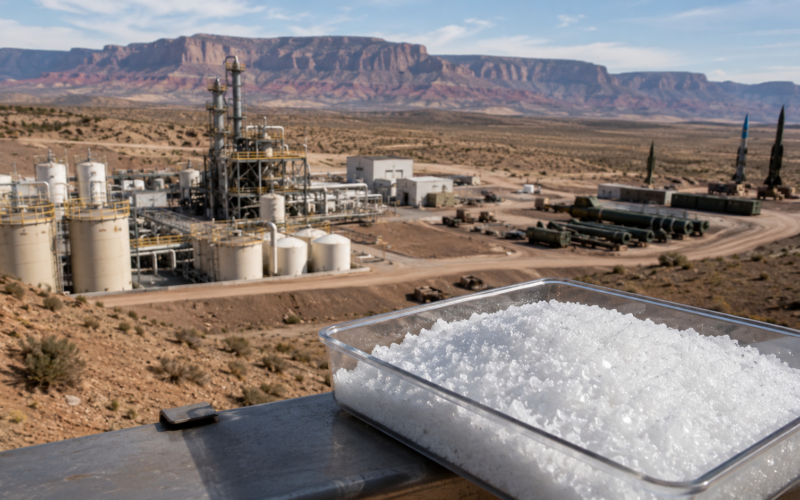
The most consequential vulnerability in the United States defence industrial base is not a missile, a fighter jet, or a shipyard, but a single white crystalline oxidiser produced at one operational facility in Cedar City, Utah, by one company. American Pacific Corporation, a subsidiary of NewMarket Corporation (NYSE: NEU), is the sole North American producer of aerospace-grade ammonium perchlorate, the chemical compound that powers the solid rocket motors inside Tomahawk cruise missiles, Patriot interceptors, Terminal High Altitude Area Defence systems, Guided Multiple Launch Rocket Systems, and the Space Shuttle generation of NASA launch vehicles before retirement. Every Patriot Advanced Capability-3 interceptor fired in defence of Israel during the 2026 Iran war traced its propellant chemistry back, in some part, to American Pacific Corporation’s Cedar City facility. NewMarket Corporation’s board approved a USD 100 million capital expansion in April 2025 to add a new production line and lift capacity by more than 50 percent, with completion scheduled for 2026, but the structural reality remains: a single 170-employee facility sits at the foundation of American precision strike capability, and the cost of that concentration has been clear since at least May 1988.
Why is American Pacific Corporation the only North American producer of aerospace-grade ammonium perchlorate?
American Pacific Corporation’s monopoly position in North American ammonium perchlorate production is the direct legacy of industrial consolidation that occurred in 1998. The company’s own Securities and Exchange Commission filings from that era confirm that in March 1998, American Pacific Corporation acquired the perchlorate production assets and rights of Kerr-McGee Chemical Corporation, by virtue of which acquisition American Pacific Corporation effectively became the only North American commercial producer of perchlorate chemicals. The strategic logic at the time was straightforward: post-Cold War demand for solid rocket motor propellant had collapsed, and a single producer at scale was viewed as more economically viable than two competing facilities. The competitive implication of that consolidation is that for more than 25 years, American programmes ranging from Minuteman intercontinental ballistic missiles to commercial Atlas and Delta launch vehicles to virtually every tactical missile in the Department of War inventory have depended on a supply chain with no domestic alternative. The second-order risk, identified in defence industrial base analysis from defence data firm Govini, is that requalifying solid rocket motors for an alternative ammonium perchlorate source is a costly process taking many months, which means even if a competitor entered the market today, US programmes could not pivot supply for years.

What does NewMarket Corporation’s January 2024 acquisition of American Pacific Corporation reveal about the chemistry layer’s strategic value?
NewMarket Corporation’s January 2024 acquisition of American Pacific Corporation Intermediate Holdings from private equity firm AE Industrial Partners, valued at approximately USD 700 million in cash and disclosed in NewMarket’s Form 8-K filing, is the clearest signal that capital markets have begun to price the strategic importance of energetics chemistry into specialty chemicals valuations. Defence Daily reported the transaction in January 2024, noting that NewMarket Corporation, headquartered in Richmond, Virginia, was adding American Pacific Corporation to a portfolio that already included Afton Chemical Corporation and Ethyl Corporation, both petroleum additives businesses. The competitive implication is significant: a specialty chemicals holding company with no prior defence sector exposure paid USD 700 million for a single ammonium perchlorate producer with one facility and 170 employees, a valuation that only makes sense if the buyer expects sustained pricing power and contracted demand for at least a decade. NewMarket’s subsequent disclosures show that AMPAC was accretive to net income in 2024, and the Net Debt to EBITDA ratio rose from 0.9 at the end of 2023 to within the company’s target operating range of 1.5 to 2.0 after the acquisition, indicating the deal was financed through borrowings against expected cash flow. The risk for NewMarket Corporation shareholders is concentration: if anything happens to the Cedar City facility, the company’s defence exposure, and a non-trivial portion of US strategic deterrence, runs through the same insurance policy.
What lessons did the May 1988 PEPCON disaster teach about ammonium perchlorate concentration risk?
The historical precedent for what concentration risk looks like in practice is the May 4, 1988 Pacific Engineering and Production Company of Nevada disaster, known as PEPCON, which destroyed one of only two American ammonium perchlorate producers operating at the time. The Clark County Fire Department’s published account of the incident records that approximately 4,500 tons of ammonium perchlorate were present at the Henderson, Nevada plant on the day of the disaster, and that 1,500 tons were consumed in the resulting fire and explosions. The Lawrence Livermore National Laboratory’s analytical paper on the incident calculated that two of the explosions registered the equivalent of more than two kilotons of TNT, with seismic activity reaching 3.0 and 3.5 on the Richter scale at observatories in California. The proximate cause was a welding torch igniting fiberglass material near accumulated ammonium perchlorate dust, but the underlying cause was structural: NASA had paused Space Shuttle launches following the January 1986 Challenger disaster, ammonium perchlorate production at PEPCON had not been correspondingly reduced, and approximately 4,500 tons of the oxidiser had accumulated on site over 15 months with no government plan for storage or shipment. American Pacific Corporation acquired PEPCON in 1982, which means the disaster directly affected what would later become the parent company of the eventual sole North American producer. Two employees died, more than 300 people were injured, and property damage exceeded USD 70 million in 1988 dollars. The historical takeaway, observable in real time during the current expansion debate, is that ammonium perchlorate facilities are not just industrial assets but strategic ones whose loss propagates through the entire US missile inventory.
Why is the AMPAC Cedar City expansion scheduled for 2026 not enough to resolve the bottleneck?
The USD 100 million capital expansion approved by NewMarket Corporation’s board on April 15, 2025, will add a new production line at the Cedar City, Utah facility and increase capacity by more than 50 percent, according to American Pacific Corporation’s official announcement. The project is scheduled for completion in 2026. AMPAC President Kris Griffith stated in the announcement that the additional production line will introduce valuable redundancy and enhanced security of supply within the existing production framework. NewMarket Corporation’s chief executive Thomas E. Gottwald framed the investment as a long-term commitment to AMPAC and its stakeholders. The competitive implication, however, is that even with successful 2026 completion, American Pacific Corporation will remain the only North American producer, and the additional production line will sit at the same Cedar City site, meaning the geographic concentration risk identified in the PEPCON precedent is not addressed by the expansion. The second-order issue is qualification: ammonium perchlorate produced from a new line typically requires testing and certification cycles before it can be incorporated into qualified solid rocket motor designs, which means the practical impact on missile production timelines extends well beyond the announced facility completion date. For Patriot, Tomahawk, and Standard Missile programmes ramping toward the production targets RTX Corporation announced in February 2026, the AMPAC expansion is necessary but not sufficient, because it solves the upstream constraint without addressing the qualification, transportation, and storage layers that sit between Cedar City and finished weapon delivery.
How does ammonium perchlorate concentration risk interact with the broader solid rocket motor industrial base?
The American Pacific Corporation chokepoint is the most acute example of a broader pattern of concentration risk identified across the United States solid rocket motor supply chain. Govini’s defence industrial base research found that over the past two decades, the American solid rocket motor prime contractor base shrank from six manufacturers to two primary firms, Northrop Grumman Corporation (NYSE: NOC) and a combined entity now operating through several joint ventures including the Lockheed Martin Corporation and General Dynamics Corporation Camden, Arkansas facility that broke ground in April 2025. The competitive implication is that even as new entrants such as Anduril Industries, X-Bow Systems, and Ursa Major attempt to expand the supplier base, they all depend on the same ammonium perchlorate input from Cedar City. The Defence Production Act Title III investment programme, through which the US Department of War announced USD 32.7 million in awards in December 2025 to Systima Technologies in Mukilteo, Washington and R.E. Darling in Tucson, Arizona, has targeted nozzles, cases, and insulation components but has not yet resolved the upstream chemistry layer. Department of War Under Secretary for Acquisition and Sustainment Michael Duffey publicly acknowledged in the December 2025 announcement that the surge in demand for propellant-based weaponry, combined with a narrow supplier base, had created a bottleneck in solid rocket motor production. The risk is that without a second qualified ammonium perchlorate source, the entire US missile production ramp remains vulnerable to a single facility, a single labour action, a single permit dispute, or a single industrial accident at one location in southern Utah.
What does the ammonium perchlorate story signal for retail investors and defence sector capital allocation?
For investors looking beyond the obvious prime contractor exposures of RTX Corporation, Lockheed Martin Corporation, and Northrop Grumman Corporation, the ammonium perchlorate story illustrates how concentrated value capture can occur at the chemistry layer of the defence supply chain. NewMarket Corporation, listed on the New York Stock Exchange under ticker NEU, is a specialty chemicals holding company that returned USD 127.9 million to shareholders in 2023 through dividends and share repurchases before the AMPAC acquisition closed. The acquisition has effectively given NewMarket Corporation shareholders exposure to defence production trends without the political, contracting, and project execution risks that sit at the prime contractor level. The competitive implication is that while public attention focuses on the announcements of new missile production agreements and headline contract awards, the actual production capacity for those weapons depends on whether AMPAC can deliver oxidiser at the volumes contracted programmes require. The risk is symmetrical: any disruption at the Cedar City facility would simultaneously affect every prime contractor’s missile delivery schedule and would compound rather than diversify portfolio risk for any investor holding multiple defence names. The deeper structural observation is that the chemistry layer of the defence industrial base, long invisible in financial markets, is now arguably the single highest-leverage point in the entire US precision strike enterprise.
What are the key takeaways from the ammonium perchlorate concentration risk in the United States defence industrial base?
- American Pacific Corporation, headquartered in Cedar City, Utah, is the sole North American producer of aerospace-grade ammonium perchlorate, the oxidiser used in virtually every solid rocket motor in the United States military inventory.
- NewMarket Corporation (NYSE: NEU) acquired American Pacific Corporation in January 2024 for approximately USD 700 million, signalling that capital markets have begun to price the strategic value of defence chemistry inputs.
- The May 1988 PEPCON disaster in Henderson, Nevada destroyed approximately 1,500 tons of ammonium perchlorate, killed two employees, injured more than 300 people, and demonstrated the systemic risk that single-site concentration represents for US missile production.
- NewMarket Corporation’s board approved a USD 100 million capital expansion in April 2025 to add a new production line and lift Cedar City capacity by more than 50 percent, with completion scheduled for 2026.
- The expansion does not address geographic concentration risk because the additional production line will sit at the same Cedar City facility, meaning a single industrial accident or natural disaster could still disrupt the entire US ammonium perchlorate supply.
- Requalifying solid rocket motors for an alternative ammonium perchlorate source takes many months and substantial expense, which means the United States cannot quickly pivot supply even if a second producer emerges.
- The Defence Production Act Title III programme has invested in solid rocket motor component manufacturers including Systima Technologies and R.E. Darling but has not yet underwritten a second domestic ammonium perchlorate source.
- AMPAC operates one facility with approximately 170 full-time employees, a labour footprint that does not scale linearly with the missile production targets RTX Corporation, Lockheed Martin Corporation, and Northrop Grumman Corporation have announced for the 2026 to 2030 period.
- AMPAC’s monopoly position dates to its 1998 acquisition of Kerr-McGee Chemical Corporation’s perchlorate assets, which closed during a post-Cold War period of structural underinvestment in the defence industrial base.
- For investors, NewMarket Corporation offers indirect exposure to defence sector demand without the political and project execution risks at prime contractors, but the concentration of risk at one facility means the company’s defence revenue stream is structurally fragile.
Discover more from Business-News-Today.com
Subscribe to get the latest posts sent to your email.