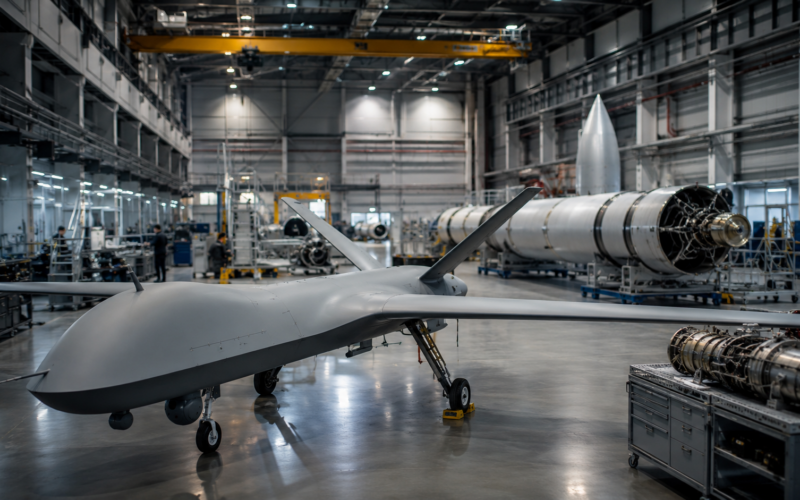
Kratos Defense & Security Solutions, Inc., listed on Nasdaq as KTOS, raised its full-year 2026 revenue outlook after reporting stronger second-quarter results across hypersonics, rocket systems, turbine technologies, microwave electronics, space, training, cyber and unmanned systems. The company reported Q2 revenue of $458.8 million, up 30.5% from the prior year, with organic revenue growth of 19.1% and adjusted EBITDA of $38.2 million. Kratos also reported consolidated bookings of $492.2 million, backlog of $2.084 billion and a bid and proposal pipeline of $15.0 billion, signalling that demand continues to build across defence manufacturing, drones, propulsion and national-security systems. The company raised 2026 revenue guidance to $1.75 billion to $1.81 billion, but also forecast negative free cash flow as it funds production ramps, inventory and facilities tied to Valkyrie drones, jet engines, rocket motors and hypersonic infrastructure. With $KTOS closing at $55.34 on August 5 after a 6.69% post-results gain, investors are being asked to weigh a high-growth defence story against the cash, margin and execution burden of scaling several advanced programmes at once.
The quarter gives Kratos a stronger claim to be one of the more direct public-market plays on affordable drones, hypersonic test infrastructure, tactical propulsion and defence electronics. It also makes the investment case more complicated. Revenue is accelerating, bookings remain healthy and the company is gaining traction in several high-priority U.S. national-security markets, but Kratos is deliberately spending ahead of revenue to build capacity for programmes that may not fully mature until 2027 and 2028.
Why do Kratos’ Q2 2026 results matter beyond the headline revenue beat?
Kratos’ second-quarter numbers matter because the company is moving from concept-driven defence optionality into measurable revenue acceleration. Revenue of $458.8 million exceeded the prior-year quarter by $107.3 million, and the 19.1% organic growth rate shows that the improvement was not only acquisition-driven.
The scale of growth is particularly important because Kratos operates in markets where investors have been waiting for proof that demand for drones, hypersonic systems and defence electronics can become revenue rather than just policy enthusiasm. Q2 provided that proof, at least at the top line. The company’s last 12-month bookings reached $1.99 billion, producing a 1.3 times book-to-bill ratio and showing that orders are still running ahead of revenue.
Adjusted EPS of $0.21 nearly doubled from $0.11 a year earlier, while adjusted EBITDA rose to $38.2 million. That provides evidence of operating leverage, although the margin picture remains early-stage because Kratos is still investing aggressively in infrastructure, staffing, research and development, and inventory.
The GAAP result was more restrained. Kratos reported net income of $4.4 million and an operating loss of $1.6 million. The gap between adjusted and reported performance is important because investors cannot ignore stock compensation, amortisation, company-funded research and development, and production-ramp costs indefinitely.
The quarter therefore strengthens the growth case, but it does not make Kratos a mature margin story yet. The company is still in the investment phase of a defence cycle that could be highly valuable if production programmes scale as expected. The risk is that spending arrives before full programme conversion, placing pressure on cash flow and valuation.

How did Kratos Government Solutions drive the company’s strongest Q2 growth?
Kratos Government Solutions was the main growth engine in the quarter. Segment revenue increased to $379.7 million from $278.3 million a year earlier, representing total growth of 36.4% and organic growth of 22.0% after excluding the Nomad Global Communication Solutions and Orbit Technologies acquisitions.
The most important growth drivers were defence rocket systems, turbine technologies, microwave products, and space, training and cyber. Defence rocket systems grew organically by 50.2%, turbine technologies by 43.3%, microwave products by 29.5%, and space, training and cyber by 8.7%.
That mix matters because these are not isolated revenue pockets. They map directly onto the defence-industrial priorities now shaping U.S. procurement: hypersonic testing, missile propulsion, electronic warfare, radar, missile defence, space communications, training and secure network infrastructure.
Kratos Government Solutions also reported adjusted EBITDA of $33.1 million, up from $24.7 million a year earlier. The segment’s profitability is therefore improving with volume, although the company is still investing heavily to support future production.
The segment backlog reached $1.710 billion at the end of Q2, compared with $1.676 billion at the end of Q1. That sequential increase supports the view that Kratos is not simply pulling forward revenue from earlier awards. New work continues to refresh the base.
The broader strategic signal is that Kratos’ fastest growth is tied to the supply-chain and infrastructure layer of modern defence. The company is not trying to compete with large primes across every major platform. It is positioning itself around systems, subsystems and manufacturing capacity that larger programmes increasingly need.
Why is the Unmanned Systems segment still central despite slower growth than Government Solutions?
Kratos Unmanned Systems generated Q2 revenue of $79.1 million, up from $73.2 million a year earlier, reflecting 8.1% organic growth. That growth rate was well below Government Solutions, but the segment remains central to the company’s market narrative because it houses the Valkyrie and other jet-powered tactical drone activities.
The segment’s growth was driven primarily by Valkyrie-related activity. This is important because the XQ-58A Valkyrie remains one of the most visible examples of the company’s affordable, attritable aircraft strategy. Defence customers are increasingly interested in uncrewed systems that can complement crewed aircraft, expand mass and reduce risk to pilots.
The segment reported operating income of $1.2 million, compared with an operating loss of $0.3 million a year earlier. Adjusted EBITDA improved to $5.1 million from $3.6 million. This suggests that the business is moving gradually toward better profitability, but it remains much smaller than Government Solutions and still has to prove production scale.
Backlog in Unmanned Systems was $374.6 million at the end of Q2, almost unchanged from $375.4 million at the end of Q1. That stable backlog is not a negative by itself, but it shows why investors are watching future Valkyrie and drone awards closely. The stock’s valuation depends heavily on the belief that unmanned aircraft demand will expand materially.
Kratos expects to begin producing approximately 40 Valkyries annually by the beginning of 2028. That is one of the most important forward-looking production targets in the company’s disclosure because it offers a measurable way to track whether the drone thesis is moving from demonstration and low-rate production into scalable manufacturing.
The strategic opportunity remains substantial. The risk is that customer decisions, budget timing, testing outcomes and prime-contractor partnerships will determine how quickly Kratos can convert drone interest into recurring revenue.
Why is Kratos spending heavily even after raising full-year guidance?
Kratos raised full-year revenue guidance to $1.75 billion to $1.81 billion, with expected organic revenue growth of about 18% to 23% compared with 2025. That is a strong upgrade, but the company’s cash-flow guidance shows the cost of getting there.
The company expects 2026 operating cash flow of $30 million to $50 million, capital expenditures of $125 million to $135 million, and negative free cash flow of $85 million to $105 million. It also expects total 2026 investments for new programmes and opportunities of $250 million to $275 million.
Those numbers are central to the investment case. Kratos is not merely growing revenue. It is funding capacity ahead of expected demand in rocket systems, unmanned systems, jet engines, microwave electronics, secure space and satellite infrastructure, hypersonic integration and advanced manufacturing.
The spending includes capital expenditures for hypersonic and engine test capacity, payload integration, Nomad-related plant improvements, C5ISR equipment, BladeWorks turbofan facilities and test cells, microwave electronics facilities, secure space and satellite build-out, and a second lot of 12 Valkyrie aircraft.
Kratos also expects major working-capital investments, including $40 million to $45 million for Zeus and Oriole rocket-system inventory, $19 million to $21 million for small jet engine production inventory, and additional spending tied to drone opportunities.
This is what makes the story both attractive and risky. If the programmes convert, the company could emerge with scarce production capacity in exactly the markets U.S. defence customers are prioritising. If awards are delayed or production ramps slower than expected, the same investments can pressure cash flow and returns.
How do Valkyrie drones and jet engine production shape Kratos’ 2027 and 2028 growth story?
The clearest forward indicators in Kratos’ Q2 disclosure are the planned ramp to 3,000 jet engines in 2027 and the plan to begin producing approximately 40 Valkyrie aircraft annually by early 2028.
The jet engine target is significant because small propulsion systems are becoming central to cruise missiles, drones, loitering munitions, decoys and affordable strike systems. Modern militaries need more expendable or attritable systems, and those systems require engines that can be produced at scale without the cost structure of traditional aircraft engines.
Kratos’ turbine technologies growth of 43.3% in the quarter suggests that propulsion demand is already accelerating. The company’s BladeWorks engine facilities and test-cell investments are tied directly to this opportunity. If Kratos can produce thousands of engines annually, it could become an important supplier inside multiple missile and drone programmes.
The Valkyrie target addresses a different but related market. Collaborative combat aircraft, attritable drones and autonomous wingmen are becoming major areas of defence experimentation and procurement. Kratos has long argued that affordability and production readiness are central advantages for its unmanned aircraft.
Producing 40 Valkyries annually would not make Kratos a mass-scale aircraft manufacturer in the commercial sense, but it would be meaningful in the tactical drone market. It would also provide a clearer proof point for customers considering larger fleet architectures built around lower-cost uncrewed aircraft.
The risk is that both production targets depend on customer demand materialising at the right time. Building capacity before final orders arrive is often necessary in defence, but it can be financially painful if procurement cycles move slower than expected.
Why does Kratos’ hypersonic infrastructure matter for the defence-industrial base?
Kratos completed its $50 million Indiana Payload Integration Facility in Crane, Indiana ahead of schedule in July. The 68,000 square foot site is designed for advanced manufacturing, integration and testing of experimental hypersonic payloads and can simultaneously integrate, test and prepare up to six experimental payloads.
That facility matters because hypersonic development is constrained not only by missile design but by test cadence. The United States needs more flight tests, more payload integration capacity, more ground support and more affordable experimental systems if it wants to accelerate hypersonic development.
Kratos is positioned in this market through systems such as Erinyes, Dark Fury, Zeus and Oriole, along with rocket motors, propulsion and test support. The company’s role is not the same as a large prime building an operational weapon programme. It is more focused on enabling faster experimentation, test vehicles, hardware and industrial support.
That position can be valuable because hypersonic weapons remain technically demanding and schedule-sensitive. Governments need cheaper and more frequent ways to test materials, sensors, seekers, payloads, propulsion and thermal protection. A company that can reduce test bottlenecks can become strategically important even without owning the final weapon system.
The facility is also expected to create more than 100 high-tech jobs, with estimated average annual wages above $80,000. That makes the investment relevant not only to Kratos but also to the broader U.S. defence-industrial workforce.
The challenge is that hypersonic programmes have a mixed procurement record. Technical ambition is high, but operational fielding, budgets and programme priorities can shift. Kratos’ infrastructure is well aligned with national-security goals, but investors should still watch whether test demand becomes sustained, funded revenue.
How does the $156 million Project Solar Shield award expand Kratos’ counter-drone opportunity?
Kratos’ July award from the U.S. Department of Energy’s National Nuclear Security Administration Office of Secure Transportation gives the company another important growth lane in mobile counter-unmanned aircraft systems. The approximately $156 million sole-source, single-award IDIQ contract supports Project Solar Shield, a mobile C-UAS platform for missions involving the secure transportation of nuclear weapons, weapon components and special nuclear materials.
This contract is strategically important because it moves counter-drone protection from fixed-site defence into mobile national-security operations. Traditional perimeter systems can protect bases, power plants or fixed infrastructure, but secure transportation missions require protection that can move with the convoy or mission package.
Project Solar Shield is designed to detect, track, identify and respond to potentially hostile unmanned aircraft systems in real time. That requirement combines sensors, command and control, platform integration, power management and sustainment into one mission-ready architecture.
The award also supports Kratos’ claim that it can integrate hardware, software and mobility into practical systems rather than selling only isolated drone-defence components. That distinction matters because counter-drone buyers increasingly want deployable operational capability, not demonstrations that work only under controlled test conditions.
For investors, the contract is not large enough to redefine Kratos by itself, but it helps validate the company’s broader strategy. Kratos is trying to win in markets where affordable systems, speed and production practicality matter more than the largest platform relationships.
The risk is that counter-drone technology evolves quickly. Small drones, autonomy, swarming, electronic countermeasures and low-cost air threats are changing fast. Kratos must keep Project Solar Shield and related systems upgradeable if the platform is to remain relevant across the contract life.
How should investors interpret $KTOS after the August 5 post-results rally?
Kratos shares closed at $55.34 on August 5, up 6.69% for the session, after rising from $51.87 on August 4. The stock also rebounded sharply from its July 29 close of $43.88, gaining about 26.1% over five trading sessions.
The one-month picture is more modest. Compared with the July 6 close of $53.54, the August 5 close represented a gain of about 3.4%. The stock remains far below its 52-week high of $134.00, although it has moved well above the 52-week low of $43.09.
This context matters because $KTOS is still a volatile defence-growth stock. The earnings rebound shows renewed confidence after the company raised guidance and demonstrated strong organic growth. However, the share price remains dramatically below the January high, indicating that investors still discount valuation, cash burn and execution risk.
The stock’s market capitalisation was about $10.4 billion at the August 5 close, while trailing 12-month revenue was about $1.52 billion. That means the market continues to value Kratos at a premium sales multiple, despite relatively modest GAAP profitability.
Investors are therefore not buying Kratos only for current earnings. They are buying the possibility that the company becomes a scaled supplier of affordable drones, tactical propulsion, hypersonic systems and defence electronics. That future may be attractive, but the valuation depends on execution.
The next phase of the stock story will likely depend less on whether Kratos can announce interesting programmes and more on whether it can improve free cash flow, expand adjusted EBITDA margins and convert the $15.0 billion bid and proposal pipeline into funded awards.
What execution risks could limit Kratos’ ability to convert demand into profitable growth?
The first risk is cash consumption. Kratos expects negative free cash flow of $85 million to $105 million in 2026 because of capital expenditures, inventory investments and working-capital needs. That may be justified if growth materialises, but it reduces flexibility if awards are delayed.
The second risk is production complexity. Kratos is scaling rocket systems, jet engines, Valkyrie aircraft, microwave electronics, hypersonic integration and counter-drone systems at the same time. Each requires different suppliers, facilities, engineers and manufacturing controls.
The third risk is customer timing. The company depends heavily on government funding cycles, programme awards and national-security priorities. A government shutdown, continuing resolution or delayed customer decision can shift revenue and cash flow between quarters.
The fourth risk is margin pressure from investment. Kratos expects adjusted EBITDA margin improvement, but it is also increasing staffing, research and development, bid and proposal activity, and facility spending. Growth can dilute margins if fixed-cost leverage takes longer than expected.
The fifth risk is competitive response. Larger defence primes and well-funded private companies are also moving into drones, hypersonics, counter-drone systems and missile propulsion. Kratos has speed and affordability advantages, but it does not have unlimited capital.
The sixth risk is technology transition. Programmes such as Valkyrie, hypersonic test vehicles, small jet engines and counter-drone platforms operate in fast-changing markets. A design that is attractive today may need rapid upgrades as threats and customer concepts evolve.
The seventh risk is valuation. A stock with high growth expectations can react sharply to small execution disappointments. Kratos has to deliver not only better results, but sustained evidence that its investment cycle is creating durable earnings power.
What should executives and investors watch after Kratos’ Q2 2026 results?
The first signal will be second-half revenue acceleration. Kratos expects stronger revenue in the second half of 2026 as long-lead materials and customer-funded hardware arrive. Delivery against that expectation will determine whether the guidance upgrade looks conservative or aggressive.
The second signal will be adjusted EBITDA margin expansion. Management expects margins to improve as scale increases and product mix strengthens. Investors will watch whether that happens despite higher bid, proposal and staffing costs.
The third signal will be free cash flow. Negative free cash flow may be acceptable during a capacity-build phase, but only if it leads to visible contract conversion. If cash burn persists without awards, the market will become less patient.
The fourth signal will be jet engine production readiness. The target of 3,000 engines in 2027 is a major industrial milestone. Facility progress, supplier readiness and customer demand will be critical.
The fifth signal will be Valkyrie production. The plan to produce approximately 40 Valkyries annually by early 2028 gives investors a concrete metric to track in unmanned systems.
The sixth signal will be hypersonic test demand. The Indiana Payload Integration Facility should support higher testing cadence. Investors should watch whether it drives funded programme activity and recurring revenue.
The seventh signal will be counter-drone awards. Project Solar Shield shows that mobile C-UAS can become a meaningful government market. Additional awards would support the case that Kratos can scale integrated counter-drone platforms.
Kratos’ Q2 results were strong enough to revive market confidence, but the company’s next challenge is tougher than an earnings beat. It must turn defence urgency into production scale, production scale into margins, and margins into cash. That is where the $KTOS story will be decided.
Key takeaways on Kratos’ Q2 2026 results, guidance upgrade and defence production ramp
- Kratos reported Q2 2026 revenue of $458.8 million, up 30.5% year over year.
- Organic revenue growth reached 19.1%, with Government Solutions growing 22.0% organically and Unmanned Systems growing 8.1% organically.
- Adjusted EBITDA was $38.2 million, while adjusted EPS rose to $0.21 from $0.11 a year earlier.
- Consolidated bookings reached $492.2 million, and last 12-month bookings reached $1.99 billion.
- Total backlog was $2.084 billion, including funded backlog of $1.572 billion.
- Kratos raised 2026 revenue guidance to $1.75 billion to $1.81 billion and expects organic growth of about 18% to 23%.
- The company expects negative 2026 free cash flow of $85 million to $105 million because of investments in production capacity, inventory and new programmes.
- Key production targets include 3,000 small jet engines in 2027 and approximately 40 Valkyrie aircraft annually by early 2028.
- The $50 million Indiana hypersonic payload integration facility and the $156 million Project Solar Shield counter-drone award support Kratos’ industrial-base expansion story.
- $KTOS closed at $55.34 on August 5, rebounding sharply after earnings but still trading far below its 52-week high of $134.00.
Discover more from Business-News-Today.com
Subscribe to get the latest posts sent to your email.