


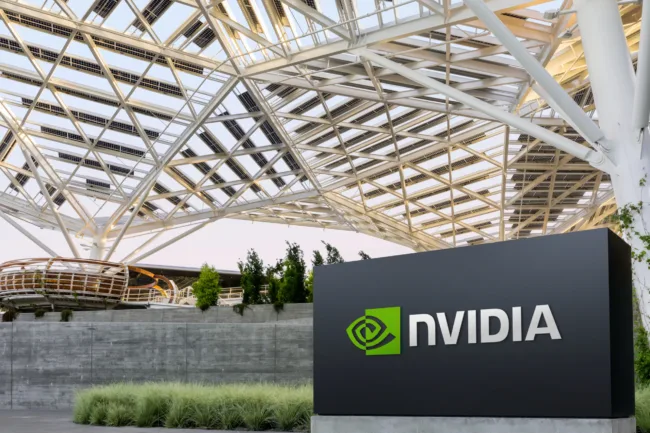
Nvidia Corporation (NASDAQ: NVDA) is reportedly in advanced discussions to acquire Israel-based generative AI company AI21 Labs for between $2 billion and $3 billion, according to Israeli financial publication Calcalist and confirmed by outlets including Reuters and Seeking Alpha. The potential deal, if finalized, would mark a major expansion of Nvidia’s AI software ambitions and deepen its operational footprint in Israel, a region it already prioritizes for research and development.
The reported acquisition is being interpreted as both a talent acquisition and a platform play, with AI21 Labs offering Nvidia access to an experienced team of approximately 200 AI researchers and a suite of enterprise-focused large language models (LLMs). It would be Nvidia’s most significant AI-focused software deal to date and comes as the company ramps up its shift from hardware supplier to full-stack AI enabler.
Why would Nvidia acquire AI21 Labs—and why now?
While Nvidia has been the dominant supplier of GPUs used in generative AI model training, its strategic intent in recent quarters has been to move up the stack. Acquiring AI21 Labs, which develops proprietary language models for text generation, summarization, and contextual enterprise tools, would provide Nvidia with deeper vertical integration—similar to moves seen with its partnerships around inference-optimized software and chip-level optimization for model deployment.
AI21 Labs was founded in 2017 and last raised capital at a reported $1.4 billion valuation. The company has been backed by Google and has released its own LLMs such as Jurassic-2, positioned as enterprise-grade alternatives to OpenAI’s GPT and Meta’s LLaMA families. Nvidia’s interest likely stems from three angles: model IP, fine-tuning infrastructure, and elite research talent. The Israeli startup’s team includes many PhDs and former academic researchers with specialization in natural language understanding and semantic modeling.
The timing also reflects growing enterprise demand for vertically optimized LLM stacks—tools that combine inference-optimized silicon, domain-specific models, and integrated deployment environments. Nvidia’s acquisition of AI21 Labs would mirror its efforts to align hardware with software in the AI ecosystem, creating end-to-end systems that compete with Microsoft’s Azure–OpenAI stack or Google Cloud’s Vertex AI platform.
How does this fit into Nvidia’s broader Israel strategy?
If confirmed, this would be one of Nvidia’s largest transactions in Israel since its 2020 acquisition of Mellanox Technologies for $6.9 billion—a deal that has since become central to its networking and data center business. Nvidia has over 3,000 employees in Israel and is in the process of building a major new R&D campus that will reportedly house up to 10,000 people. The company’s Israeli operations have become critical in networking, cybersecurity, inference optimization, and emerging AI stacks.
Bringing AI21 Labs into the fold would reinforce Nvidia’s strategy of leveraging Israel not just for hardware design or IP, but for software, AI research, and productization. Unlike Mellanox, which gave Nvidia an edge in data throughput and low-latency networking, AI21 Labs would represent a leap in natural language capabilities, model refinement, and enterprise AI product development.
The deal, if finalized, would signal that Nvidia is betting on Israel as a key geography for next-gen AI beyond chips—targeting value capture across the stack, from silicon to software to services.
What are the competitive implications for other AI players?
The rumored acquisition positions Nvidia to compete more directly in the model layer, moving closer to players like OpenAI, Cohere, Anthropic, and Mistral. However, unlike OpenAI or Anthropic, AI21 Labs has maintained a focus on enterprise utility rather than general-purpose public models. This aligns with Nvidia’s preferred posture: supporting secure, controllable, and customizable AI deployments for regulated industries and vertical markets.
If Nvidia successfully integrates AI21 Labs, it could offer optimized AI appliances or model-serving platforms bundled with both Nvidia silicon and a proprietary LLM. This could undercut current software-only players and change how customers approach AI deployment—especially in scenarios where tight GPU–model optimization is required.
The acquisition could also force hyperscalers like Microsoft and Google to reassess their alliances. Microsoft’s bet on OpenAI has led to tight Azure integration. Google, a previous investor in AI21, may find itself watching a former portfolio company be absorbed into Nvidia’s orbit. This intensifies the power struggle over AI developer ecosystems, inference toolchains, and deployment platforms.
What could go wrong? Execution risks and valuation concerns
While the acquisition would strengthen Nvidia’s position in enterprise AI, there are risks. Valuation is a key question. A price tag of $2 billion to $3 billion represents more than double AI21 Labs’ last reported valuation. In a market where VC-backed AI startups have seen valuation corrections, Nvidia may be viewed as overpaying—though its own market capitalization and cash flow position offer ample buffer.
Integration is another concern. AI startups often operate with academic cultures and fast-moving product cycles. Nvidia, while agile for a public company, will need to ensure that AI21 Labs’ research freedom and product roadmap are preserved while aligning with broader platform goals. Misalignment could slow innovation or lead to talent churn.
Finally, regulatory friction is always a possibility. While a $2 billion to $3 billion transaction likely avoids antitrust flags in the U.S. or EU, Nvidia’s acquisition track record—particularly its abandoned Arm Holdings deal—means that any major move will be scrutinized for ecosystem control risks.
What does this signal about Nvidia’s long-term AI strategy?
Markets have responded cautiously to the report. Nvidia stock did not show a major swing in after-hours trading following the news, suggesting investors are waiting for official confirmation and deal terms. Analysts are likely to focus on how the acquisition affects Nvidia’s AI monetization strategy, particularly in enterprise SaaS and inference economics.
This move reinforces the broader narrative: Nvidia is not content to simply be the chip provider behind AI. It is actively building, buying, and orchestrating the next layer of the stack—software, models, platforms, and services. Whether that effort translates into sustainable margin expansion or new revenue streams will depend on execution.
What is clear is that Nvidia’s AI ambitions are expanding in both scope and geography—and that the company sees strategic value in securing AI model talent and infrastructure before others do.
Key takeaways on what Nvidia’s potential AI21 Labs acquisition means for its AI strategy and the market
- Nvidia is reportedly in advanced talks to acquire AI21 Labs for $2–$3 billion, signaling deeper AI platform integration beyond chips.
- AI21 Labs develops enterprise-grade large language models and employs over 200 AI specialists, making it a valuable talent and IP acquisition.
- The deal would strengthen Nvidia’s position in enterprise AI software, especially for inference-optimized and domain-specific deployments.
- Israel continues to be a critical geography for Nvidia, with this acquisition reinforcing its broader R&D and AI strategy in the region.
- Competitive pressure may increase on OpenAI, Cohere, and Anthropic as Nvidia expands into the model layer of the AI stack.
- Potential risks include high valuation premiums, cultural integration challenges, and strategic misalignment on product vision.
- The move supports Nvidia’s full-stack AI ambitions, potentially enabling it to offer bundled model + chip deployments for key enterprise sectors.
- Market reaction has been muted so far, but institutional investors are closely watching for confirmation and execution signals.
Discover more from Business-News-Today.com
Subscribe to get the latest posts sent to your email.