



Hindustan Aeronautics Limited (NSE: HAL; BSE: 541154) delivered a stronger-than-expected start to FY27, with consolidated profit rising 14.9% year on year to ₹1,589.68 crore and revenue from operations increasing 14.4% to approximately ₹5,515 crore. Total consolidated income climbed 15.3% to ₹6,415 crore, while the result exceeded several brokerage forecasts and reinforced management’s earlier expectation of double-digit FY27 revenue growth. The more important number, however, sits outside the June-quarter income statement: Hindustan Aeronautics entered the year with an order book of approximately ₹2.55 lakh crore, equivalent to roughly 7.7 times FY26 revenue. That enormous backlog shifts the central investment question away from order visibility and toward how quickly the company can convert Tejas Mk1A fighters, helicopters, engines, trainers and other defence programmes into deliveries, revenue and cash.
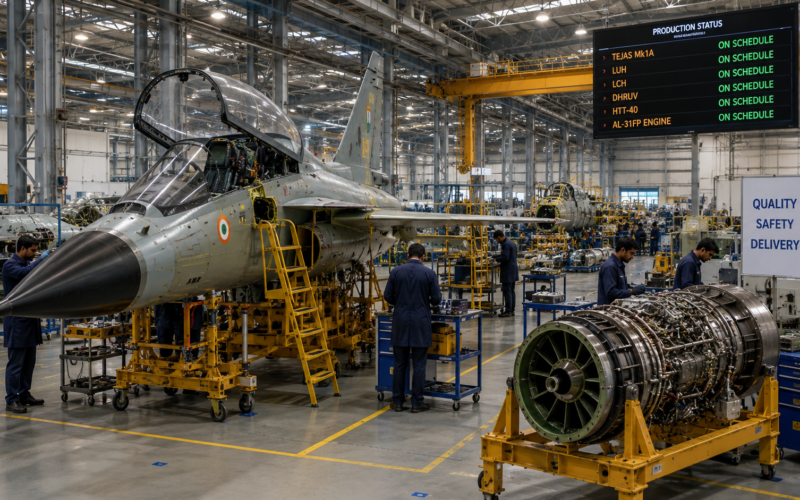
The timing makes the execution issue particularly important. Hindustan Aeronautics has received seven GE Aerospace F404 engines and is targeting the first Tejas Mk1A delivery around August or September 2026, while installed Light Combat Aircraft manufacturing capacity has already been increased to 24 aircraft annually. Brokerages increasingly expect easing engine availability to unlock a production bottleneck that has constrained the programme for several years. If that happens, the next stage of Hindustan Aeronautics’ growth could be driven less by additional headline orders and more by recognising revenue against contracts already sitting in the backlog.
How strong were Hindustan Aeronautics Q1 FY27 earnings beneath the 15% profit-growth headline?
Hindustan Aeronautics’ standalone revenue from operations rose to ₹5,515.28 crore from ₹4,819.14 crore in Q1 FY26, an increase of approximately ₹696 crore. Standalone profit after tax increased to ₹1,580.61 crore from ₹1,377.15 crore, while consolidated profit reached ₹1,589.68 crore. Earnings per share increased to ₹23.77 on a consolidated basis from ₹20.69 a year earlier.
Other income remained significant at ₹902.81 crore on the standalone accounts. Business News Today calculates that this represented approximately 14.1% of total standalone income and was equivalent to about 57% of standalone profit after tax. That does not mean the ₹903 crore should simply be removed from profit, because Hindustan Aeronautics carries substantial cash and investments and treasury income is a recurring feature of its financial structure. It does mean that investors analysing operating profitability should distinguish manufacturing and service earnings from income generated outside core revenue from operations.
Market estimates of quarterly EBITDA place it at roughly ₹1,530 crore, with brokerage calculations showing operating margins around the high-20% level. The precise year-on-year EBITDA comparison varies between research providers because of differences in classification, but the broader conclusion is consistent: Q1 profitability came in ahead of Street expectations rather than merely tracking revenue growth. Nomura said revenue and EBITDA both exceeded its estimates, while Citi and other brokerages similarly characterised the quarter as stronger than expected.
The earnings result is therefore useful not because 15% profit growth is spectacular in isolation, but because Hindustan Aeronautics produced it before meaningful Tejas Mk1A revenue recognition began. Citi specifically highlighted that Q1 growth was achieved without Tejas Mk1A contributing to revenue, leaving the programme as an incremental catalyst rather than something already embedded in the reported quarter.

Why does Hindustan Aeronautics’ ₹2.55 lakh crore order book make execution more important than new orders?
Hindustan Aeronautics ended FY26 with an order book of approximately ₹2,54,538 crore against standalone FY26 revenue from operations of about ₹33,050 crore. Business News Today calculates that the backlog therefore represented approximately 7.7 times annual revenue. On a simple annualisation of Q1 FY27 revenue, the order book is equivalent to more than 11 times the June-quarter revenue run-rate.
That scale radically changes the strategic problem facing the company. A manufacturer with one year of backlog needs new orders to protect future revenue. Hindustan Aeronautics already has many years of contracted visibility, meaning production capacity, component availability, customer acceptance and delivery schedules become more important variables.
Nomura’s analysis illustrates the point even more sharply. The brokerage estimated Hindustan Aeronautics’ manufacturing backlog at roughly ₹2.3 lakh crore and calculated a manufacturing book-to-bill ratio of approximately 25 times. The implication is not that every order will be converted quickly, but that insufficient demand is currently far less important than the speed at which the company can manufacture and deliver contracted platforms.
The backlog also contains several different execution cycles. Tejas Mk1A aircraft, Light Combat Helicopter Prachand, HTT-40 basic trainers, AL-31FP and RD-33 engine work, Su-30MKI aircraft and substantial repair and overhaul activity do not move through production on identical timelines. That diversification reduces dependence on one programme, but Tejas remains especially important because of its scale and the visibility surrounding delayed deliveries.
For shareholders, the most useful measure in FY27 will therefore be backlog conversion rather than backlog growth alone. Another large order can extend visibility, but accelerated revenue growth requires existing contracts to pass through manufacturing lines and into customer deliveries.
How much does Hindustan Aeronautics need to deliver in the remaining nine months to meet FY27 revenue guidance?
Management previously indicated that FY27 revenue could grow approximately 10% to 12%, supported by greater manufacturing revenue from programmes including Tejas Mk1A and HTT-40. Applying that range to FY26 standalone revenue of roughly ₹33,050 crore produces an FY27 revenue objective of approximately ₹36,355 crore to ₹37,016 crore.
After ₹5,515 crore of Q1 revenue, Business News Today calculates that Hindustan Aeronautics would need another ₹30,840 crore to ₹31,501 crore during the remaining nine months to land within that growth range. That works out to average revenue of approximately ₹10,280 crore to ₹10,500 crore in each of the final three quarters, around 86% to 90% above the Q1 level.
That calculation looks demanding until Hindustan Aeronautics’ pronounced seasonality is considered. Revenue was approximately ₹13,942 crore in Q4 FY26 alone, more than 42% of full-year FY26 revenue. Government defence manufacturing contracts frequently produce milestone-driven and back-loaded revenue recognition, making a simple comparison between Q1 and the average required for the rest of the year potentially misleading.
Nevertheless, the calculation explains why Tejas Mk1A timing matters. Management does not need Q1 revenue growth simply to repeat quarter after quarter. It needs manufacturing execution to accelerate materially as FY27 progresses, consistent with the normal seasonal pattern but also supported by platforms that were previously constrained.
Failure to start Tejas deliveries would not erase the company’s order book, but it could place more pressure on other programmes and the traditional Q4 execution surge to deliver the targeted annual growth rate.
Can improving GE F404 engine availability finally unlock Tejas Mk1A production at Hindustan Aeronautics?
The GE Aerospace F404 engine has been the most visible constraint on Tejas Mk1A deliveries. Hindustan Aeronautics had already manufactured and flown multiple aircraft while waiting for sufficient engines, creating a situation where airframe production was progressing faster than complete aircraft could be handed over to the Indian Air Force. Earlier in 2026, the company said five aircraft were fully ready for delivery while another nine had been manufactured and flown but were awaiting engines.
The supply position has since improved. By the Q1 FY27 results period, Hindustan Aeronautics had received seven GE F404 engines, and management was targeting the first Tejas Mk1A delivery around August or September. The company has increased installed Light Combat Aircraft production capacity to 24 aircraft annually, while brokerage expectations envisage further expansion toward 30 aircraft as the supply chain stabilises.
The distinction between production capacity and actual deliveries is critical. A factory capable of assembling 24 or 30 fighters a year cannot generate corresponding aircraft revenue if imported engines, avionics or customer-acceptance milestones remain unavailable. Conversely, once external bottlenecks ease, existing airframes and installed manufacturing capacity create the possibility of a relatively rapid acceleration in deliveries.
Broker expectations differ on exactly how quickly this will happen. Nomura models six Tejas Mk1A deliveries in FY27, followed by 16 in FY28 and 20 in FY29. Motilal Oswal expects the more significant ramp-up from FY28, while PL Capital sees improving GE F404 availability as the key enabler for higher production rates over the medium term. These remain analyst forecasts rather than confirmed delivery schedules.
The next milestone is therefore unusually tangible. Unlike many industrial growth stories where investors wait for abstract demand improvement, Hindustan Aeronautics can be measured aircraft by aircraft. The first Mk1A handover and the subsequent pace of deliveries will indicate whether the engine constraint has genuinely moved from structural bottleneck to manageable supply issue.
Why could Hindustan Aeronautics’ ₹12,000 crore investment plan become as important as its existing backlog?
Order visibility alone cannot solve a capacity problem. PL Capital estimates that Hindustan Aeronautics plans cumulative investments of roughly ₹12,000 crore through 2030 across manufacturing capacity, aero-engine infrastructure and next-generation platforms. The programme accompanies plans for higher production rates, greater localisation and additional automation across major defence programmes.
This investment cycle is strategically different from spending to create speculative capacity ahead of uncertain demand. Hindustan Aeronautics already possesses an exceptionally large order backlog, so additional manufacturing infrastructure is being deployed against visible domestic defence requirements and expected future platforms.
The economic test, however, remains the same as for any capital-intensive manufacturer. New capacity must increase throughput sufficiently to justify the capital committed. Building 24-aircraft or 30-aircraft annual capacity has substantially greater value if engines, fuselage sections, wings, avionics and testing resources move through the system at matching rates.
The private-sector supply chain is also becoming more important. Hindustan Aeronautics has been expanding the role of domestic suppliers for major Tejas structural assemblies, which can reduce the need for every production stage to remain inside the public-sector company. Greater localisation also supports the government’s wider defence-indigenisation strategy while potentially removing production constraints over time.
This means FY27 and FY28 should increasingly reveal whether Hindustan Aeronautics is evolving from a defence manufacturer with an enormous backlog into a higher-throughput aerospace production system capable of monetising that backlog at a faster rate.
Is HAL stock already pricing in successful Tejas execution after reaching a new 52-week high?
HAL shares were trading around ₹5,080 during the afternoon of August 17 after touching a fresh 52-week high of ₹5,149.90 earlier in the session. The stock closed at ₹5,029.90 on August 14 and had traded at ₹4,500.70 on July 17, implying a rise of roughly 13% over one month. From the August 10 close of ₹4,928, the shares were up approximately 3% by August 17.
The stock is now approximately 46% above its ₹3,479.10 52-week low and was trading within roughly 1% to 2% of the new yearly high during the August 17 session. Market capitalisation has moved to around ₹3.4 lakh crore, while current market-data services place the trailing price-to-earnings multiple in the mid-30s.
The Q1 market reaction was positive but not one-directional. HAL gained 1.75% on August 12 and reached ₹5,055 intraday, declined 1% on August 13 and recovered 1.72% on August 14. The subsequent move to another 52-week high on August 17 suggests that expectations around execution and the easing engine constraint remain important components of current sentiment.
Broker targets have also moved higher. Nomura increased its target to ₹6,314 from ₹6,040 and retained a Buy rating, Motilal Oswal increased its target to ₹5,800 from ₹5,500, PL Capital lifted its target to ₹5,795 from ₹5,423, while Citi maintained a ₹5,550 target and CLSA carried a ₹5,481 target. These prices are analyst forecasts rather than independently validated future values, and their assumptions depend heavily on manufacturing execution and delivery schedules.
The valuation therefore increasingly reflects confidence rather than distress. With HAL trading near a yearly high, merely possessing a ₹2.55 lakh crore order book is unlikely to be enough for a sustained rerating. Investors now need evidence that the backlog can be converted faster.
What are the key takeaways from Hindustan Aeronautics Q1 FY27 results and Tejas Mk1A outlook?
- Hindustan Aeronautics Limited reported consolidated Q1 FY27 net profit of approximately ₹1,590 crore, up 14.9% year on year.
- Revenue from operations increased around 14.4% to ₹5,515 crore, while total consolidated income rose 15.3% to ₹6,415 crore.
- Q1 revenue growth was already above the 10% to 12% full-year growth range previously indicated by management, although Hindustan Aeronautics’ revenue remains heavily weighted toward later quarters.
- The FY26 order book stood at approximately ₹2.55 lakh crore, equivalent to about 7.7 times FY26 standalone revenue.
- Business News Today calculates that Hindustan Aeronautics needs roughly ₹30,840 crore to ₹31,501 crore of revenue over Q2 to Q4 to achieve 10% to 12% FY27 growth.
- The company has received seven GE Aerospace F404 engines and is targeting the first Tejas Mk1A delivery around August or September 2026.
- Light Combat Aircraft manufacturing capacity has increased to 24 aircraft annually, with further expansion toward approximately 30 units discussed by brokerages.
- Q1 growth was achieved without meaningful Tejas Mk1A revenue recognition, meaning successful aircraft deliveries could provide an additional execution catalyst.
- HAL shares reached a fresh 52-week high of ₹5,149.90 on August 17 after rising approximately 13% over the preceding month.
- With the stock near its yearly high and the order book already exceptionally large, future valuation gains increasingly depend on production, deliveries and cash conversion rather than further order announcements.
What would prove that Hindustan Aeronautics can turn its ₹2.55 lakh crore backlog into faster earnings growth?
Hindustan Aeronautics has largely solved the demand-visibility side of its growth equation. A ₹2.55 lakh crore order book equivalent to almost eight years of FY26 revenue provides a level of contracted visibility that few large industrial companies possess. Q1 FY27 also showed that the existing portfolio can produce mid-teens revenue and profit growth even before Tejas Mk1A begins making a meaningful contribution.
The unresolved issue is throughput. Hindustan Aeronautics needs engines to arrive on schedule, private-sector structural suppliers to keep pace, aircraft testing and customer acceptance to proceed without major delays, and new manufacturing capacity to translate into actual deliveries. The company’s challenge is therefore increasingly industrial rather than commercial.
That distinction also changes how the stock should be assessed. Another ₹50,000 crore or ₹60,000 crore defence award would extend an already enormous backlog, but it would not solve the central constraint if existing production programmes remain slower than planned. The stronger catalyst is evidence that annual Light Combat Aircraft output can move progressively toward the 24-aircraft installed capacity and eventually beyond it while other helicopter, trainer and engine programmes accelerate simultaneously.
The next measurable proof point is the first Tejas Mk1A delivery. After that, the relevant number becomes the pace of subsequent aircraft handovers. If engine supplies stabilise and Hindustan Aeronautics converts that production capacity into sustained deliveries, the company could finally begin closing the gap between its extraordinary ₹2.55 lakh crore order visibility and a revenue base of only about ₹33,000 crore in FY26. That conversion, rather than the backlog headline itself, is now the most important test of the next phase of Hindustan Aeronautics’ growth.
Discover more from Business-News-Today.com
Subscribe to get the latest posts sent to your email.
