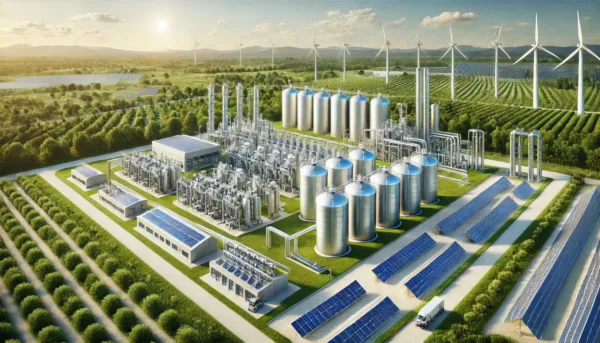





Eos Energy Enterprises (NASDAQ: EOSE) has secured perhaps its most visible commercial validation yet after Google joined MN8 Energy in a West Virginia clean-energy project combining 86MW of solar generation with 380MWh of battery storage. The development, known as Mammoth Solar, is expected to involve up to $350 million of capital investment and is designed to support electricity demand associated with Google’s data-centre infrastructure in the region.
MN8 Energy will own and operate the project in Kanawha County, while Google will purchase its energy, capacity and clean-energy attributes under a long-term arrangement. The storage configuration is unusual because the project will combine 70MW/280MWh of lithium-ion batteries with a smaller 10MW/100MWh deployment of Eos Energy Enterprises’ Z3 zinc-based long-duration energy storage technology. Solar operations are targeted for 2028, lithium-ion storage for 2029 and the Eos long-duration component for 2030.
The announcement produced an immediate market response. Eos Energy Enterprises shares were reported about 19% higher at $3.63 during September 3 trading, suggesting investors viewed Google’s involvement as commercially significant even though the zinc component represents only a fraction of the total project capacity.
Why is Google combining lithium-ion and zinc batteries at the same West Virginia project?
The most interesting feature is not simply the amount of storage being installed, but the decision to use two battery technologies with different operating profiles. The 280MWh lithium-ion system provides four hours of storage at its 70MW power rating, while Eos’ 100MWh zinc system is designed to discharge over approximately 10 hours at 10MW. Together, the two systems create 380MWh of storage capacity alongside the 86MW solar project.
That architecture addresses a growing problem for large power users such as data-centre operators. Solar generation can deliver substantial daytime electricity but does not naturally align with the continuous load profile of computing infrastructure. Short-duration batteries can move renewable output by several hours, while long-duration storage is intended to extend that usable generation deeper into periods when solar production has declined.
Google said the project forms part of its effort to bring additional clean capacity onto grids where it operates while accelerating the commercialisation of long-duration storage. The company is planning infrastructure in West Virginia, making the project both an energy-procurement arrangement and a practical test of whether emerging storage technologies can support increasingly power-intensive digital infrastructure.
Why does a 100MWh Eos deployment matter despite being smaller than the lithium system?
Eos’ zinc system accounts for roughly 26% of the project’s combined 380MWh storage capacity, even though it represents only 10MW of the combined 80MW storage power rating. That difference captures the commercial proposition behind long-duration energy storage: lower instantaneous power but the ability to sustain discharge for substantially longer periods.
The Mammoth Solar deployment is also the first project under the previously announced master supply agreement between MN8 Energy and Eos Energy Enterprises and the first Google project to use Eos’ Z3 technology. The companies describe it as West Virginia’s first commercial-scale long-duration energy storage deployment.
For Eos, the Google association could carry value beyond the immediate megawatt-hours involved. Long-duration storage developers need reference projects that demonstrate performance under commercial operating conditions, particularly as utilities, infrastructure owners and hyperscale technology companies consider alternatives to conventional lithium-ion batteries.
The real commercial test therefore comes after installation. The project will need to show that zinc storage can deliver the required availability, cycling performance, operating life and economics while integrating successfully with both solar generation and lithium-ion storage.
Can the Google project help Eos convert its record backlog into profitable growth?
The West Virginia announcement arrives as Eos Energy Enterprises is already scaling rapidly. The company reported second-quarter 2026 revenue of $68.8 million, up 351% year over year, while backlog reached a record $807 million, representing approximately 3.4GWh of contracted business. Cash including restricted cash stood at $364.1 million at June 30.
However, the financial picture remains far from fully de-risked. Eos reported a second-quarter gross loss of $48.8 million and a negative gross margin of 71%, although management said manufacturing economics were improving as production volumes increased. The company also tightened full-year 2026 revenue guidance to $300 million to $350 million from an earlier $300 million to $400 million range.
That contrast helps explain why investors may attach disproportionate importance to a project associated with Google. Eos does not merely need additional orders. It needs deployments that strengthen customer confidence while manufacturing scale moves the company toward sustainable margins.
The company has expanded production and is consolidating manufacturing around its Thorn Hill operations in Pennsylvania. If deployments such as Mammoth Solar demonstrate reliable performance, they could help Eos compete for a larger share of the emerging long-duration storage market. If manufacturing costs or project execution remain difficult, high-profile customers alone will not solve the profitability challenge.
What milestones will determine whether Mammoth Solar becomes more than a showcase project?
The staged commissioning schedule means investors and industry customers will have to wait several years for the full configuration to operate. Solar generation is expected in 2028, followed by lithium-ion batteries in 2029 and Eos’ long-duration storage in 2030. Development, permitting, interconnection, financing, procurement and construction therefore remain material execution dependencies.
MN8 estimates the project could create approximately 200 construction jobs. The company also expects about $4 million of property-tax revenue for Kanawha County and local schools during the first 20 years of operation, equivalent to an average of roughly $200,000 annually over that period before considering additional revenue expected later in the asset life.
The site itself adds another layer of symbolism: Mammoth Solar is planned on a reclaimed coal mine in a state historically associated with fossil-fuel production. More importantly for the energy market, the project connects three rapidly converging themes: hyperscale data-centre demand, renewable generation and the search for storage technologies capable of extending clean-power availability beyond conventional four-hour battery windows.
For Eos Energy Enterprises, the 100MWh installation is not enormous relative to the company’s 3.4GWh backlog. Its significance comes from who is supporting the project and what it is intended to prove. The next question is whether that validation can translate into repeat hyperscale customers, larger deployments and eventually better unit economics.
Discover more from Business-News-Today.com
Subscribe to get the latest posts sent to your email.