



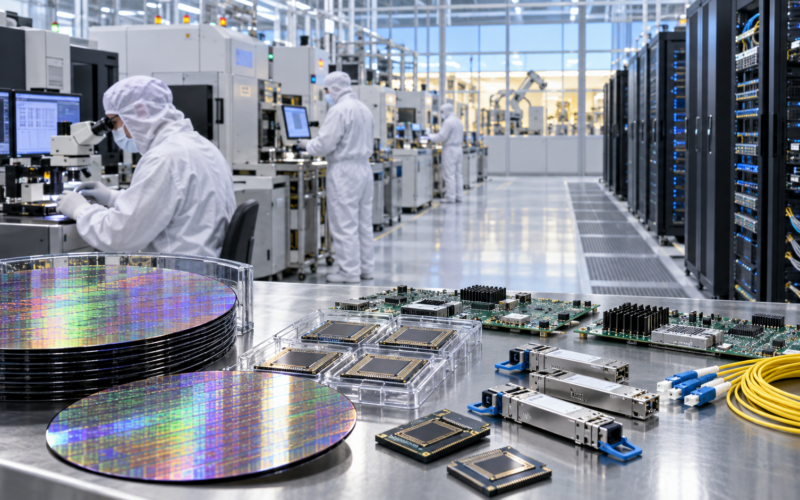
GlobalFoundries Inc. (NASDAQ: GFS) and Marvell Technology Inc. (NASDAQ: MRVL) are expanding semiconductor manufacturing capacity in Vermont under a multi-year agreement targeting one of the increasingly important bottlenecks inside artificial-intelligence data centres: moving enormous volumes of data between processors. The companies said on September 17 that additional capacity at GlobalFoundries’ Burlington facility will produce silicon-germanium technology used in advanced optical transceivers, near-packaged optics and co-packaged optics. Financial terms and the precise amount of incremental capacity were not disclosed.
The agreement arrives as artificial-intelligence infrastructure moves beyond a simple race to install more GPUs. Large AI clusters function as distributed computing systems containing thousands or potentially hundreds of thousands of accelerators, and overall performance increasingly depends on how efficiently those processors communicate with memory, storage and one another. Marvell is therefore treating optical connectivity as a core component of AI economics rather than a peripheral networking product.
Why is optical connectivity becoming so important inside AI data centres?
AI processors create value only when they remain busy performing calculations. If accelerators spend excessive time waiting for data to travel between servers or across a computing cluster, an operator can own extremely expensive hardware without using it efficiently. As cluster sizes increase, the networking layer therefore becomes a larger determinant of utilisation, latency, power consumption and ultimately the return generated on data-centre capital expenditure.
Traditional electrical connections become increasingly difficult to scale across longer distances and higher bandwidth requirements because of power consumption and signal degradation. Optical systems transmit information using light, making them attractive as data rates rise. Marvell has been building products spanning switches, optical connectivity, custom silicon and memory infrastructure precisely because modern AI facilities require the entire data movement system to scale alongside raw compute.
GlobalFoundries’ silicon-germanium technology is used in components that translate signals inside high-speed optical systems. Its current roadmap supports 200-gigabit-per-second-per-lane connectivity and is intended to move toward still faster generations as cloud and AI workloads grow. GlobalFoundries has manufactured silicon-germanium technology for more than a decade and is increasingly combining it with silicon photonics and advanced packaging for new optical architectures.
That gives the expansion a different strategic character from leading-edge logic manufacturing. GlobalFoundries does not compete directly with Taiwan Semiconductor Manufacturing Company at the smallest transistor geometries used for the latest Nvidia accelerators. Instead, it concentrates on specialised technologies that remain essential around those processors, including radio-frequency chips, power management, photonics and connectivity.
How large is Marvell’s AI data-centre opportunity becoming?
Marvell’s recent financial results show why management is securing additional supply. The company generated record fiscal second-quarter 2027 revenue of $2.739 billion, an increase of 37% from a year earlier, while data-centre revenue growth accelerated to 46%. Marvell reported $605.5 million of quarterly operating cash flow and guided fiscal third-quarter revenue to approximately $3.15 billion, subject to its stated range.
Management also raised revenue expectations for fiscal 2027 and fiscal 2028, citing strong AI-related bookings and accelerating demand across custom silicon and connectivity. That matters because Marvell is not relying on a single processor programme. Its AI exposure spans the infrastructure required to connect accelerators, move information between memory and compute, and build customised chips for hyperscale customers.
Optical networking could become increasingly valuable as data-centre architecture evolves toward near-packaged and co-packaged optics. In conventional designs, optical modules sit farther from switching chips. Moving optical components closer to the processor or switch can improve bandwidth and energy efficiency, but it requires tighter integration among semiconductor manufacturing, photonics, packaging and networking technologies.
The expanded GlobalFoundries arrangement therefore supports a technology transition rather than simply replenishing existing components. If co-packaged optics becomes widely adopted, companies already manufacturing qualified silicon-germanium products at volume could gain a stronger position inside the next generation of data-centre infrastructure.
What does the agreement mean for GlobalFoundries’ manufacturing strategy?
GlobalFoundries generated second-quarter 2026 revenue of $1.786 billion, up 6% from a year earlier, while gross margin increased to 28.3% from 24.2%. Non-IFRS gross margin reached 29.9%, demonstrating improved economics even before the latest AI optical-capacity expansion contributes materially.
The Burlington facility has become strategically important because specialised chip technologies can create attractive manufacturing niches even when they do not use the smallest process nodes. Artificial intelligence is increasing demand not only for computation but also for networking, power delivery, analogue components and connectivity technologies.
GlobalFoundries has been reinforcing that positioning through several agreements during 2026. The company has expanded power-semiconductor partnerships, secured US government research funding around quantum technologies and pursued additional silicon-photonics investment, indicating that management sees specialised infrastructure chips as an important route to growth.
The Marvell deal adds a major commercial customer to that strategy. Production commitments from customers can improve factory utilisation and make incremental capacity investments more attractive because demand visibility is stronger before equipment is installed.
Why did GlobalFoundries and Marvell shares rise after the announcement?
Investors reacted positively as the agreement provided fresh evidence that AI spending is extending beyond headline GPU suppliers. Reuters reported GlobalFoundries shares up around 4% and Marvell approximately 6.3% during morning trading, while other market data showed Marvell gaining more than 6% during the September 17 session.
The reaction is especially relevant for Marvell because its valuation increasingly depends on investors believing that artificial-intelligence infrastructure will create sustained demand across networking and custom silicon. Every capacity agreement that supports future production gives that growth narrative more physical backing.
For GlobalFoundries, the announcement reinforces a somewhat different investment case. Rather than trying to win the race for the world’s most advanced CPU or GPU manufacturing, the foundry can participate in AI through differentiated technologies surrounding those devices.
That may produce less spectacular headlines than a new accelerator, but it can create a durable industrial position if optical networking becomes one of the constraints determining how quickly AI clusters can scale.
What should investors watch next in the GlobalFoundries-Marvell partnership?
The first question is how rapidly Marvell’s optical revenue grows relative to its broader data-centre business. Continued data-centre growth above companywide revenue growth would strengthen the argument that connectivity is becoming a structural AI infrastructure category rather than a temporary capacity cycle.
The second issue is manufacturing utilisation at Burlington. GlobalFoundries has not disclosed the amount of capacity being added, meaning investors will need to monitor capital expenditure, customer commitments and future revenue commentary for evidence of scale.
Marvell’s October 6 investor day should provide another useful milestone because management has said it plans to discuss its longer-term strategy for AI infrastructure. Investors will be looking for more detail on custom silicon, optical connectivity and how much revenue can ultimately be generated from increasingly complex data-centre architectures.
The broader industry message is already becoming clear. The artificial-intelligence infrastructure race started with accelerators, but the next performance problem is increasingly about everything required to connect them.
Discover more from Business-News-Today.com
Subscribe to get the latest posts sent to your email.