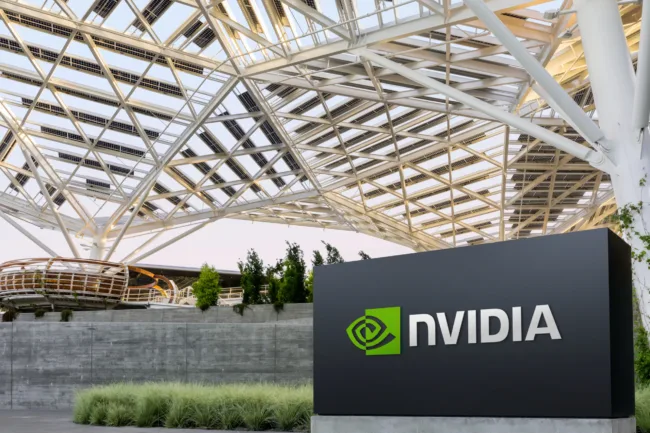
NVIDIA Corporation (NASDAQ: NVDA) delivered a record third quarter for fiscal year 2026, reporting revenue of 57.0 billion dollars, a 22 percent rise from the previous quarter and 62 percent growth year-over-year. The performance was powered by soaring demand for Blackwell GPUs, which continue to dominate AI infrastructure deployments across hyperscalers, sovereign AI projects, and industrial cloud platforms. Investors responded immediately to the results, with NVIDIA Corporation closing at 186.52 dollars on November 19, 2025, up 2.85 percent for the day. In after-hours trading, the stock climbed further to 196.00 dollars, rising by more than 5 percent as the market absorbed the company’s guidance and accelerating growth momentum.
The earnings have set a defining tone for NVIDIA Corporation’s role as the anchor of global AI investment cycles. While semiconductor stocks have seen periods of volatility this year, NVIDIA Corporation has continued to demonstrate that demand for accelerated computing remains on a steep upward curve across training, inference, scientific computing, robotics, and physical AI systems.

How NVIDIA’s 51 billion dollar data center business is redefining the economics of AI compute in 2025 and driving hyperscaler demand at scale
The Data Center segment generated 51.2 billion dollars in Q3, marking a sequential increase of 25 percent and a 66 percent jump from a year earlier. Founder and Chief Executive Officer Jensen Huang noted that Blackwell GPUs have effectively sold out across cloud service providers and enterprise buyers. He added that both AI training and AI inference workloads continue to grow exponentially, creating a reinforcing cycle of adoption across nearly every major industry.
The Blackwell architecture delivered major leaps in capability, including a tenfold improvement in throughput per megawatt compared to the prior generation, demonstrated through the SemiAnalysis InferenceMAX benchmark. NVIDIA Corporation is also scaling deployments with partners including OpenAI, Microsoft Corporation, Google Cloud, Oracle Corporation, and xAI, accelerating the creation of massive compute clusters across North America, Europe, and Asia. OpenAI alone has committed to more than 10 gigawatts of NVIDIA compute for its next-generation models.
New product introductions played a critical role as well. The Rubin CPX processor was unveiled as a high-context AI accelerator, and NVQLink was introduced as a universal bridge between GPUs and quantum processors. Arm’s Neoverse platform will integrate NVLink Fusion to drive AI-ready server architectures. These additions reinforce NVIDIA Corporation’s leadership position in the rapidly expanding stack of advanced compute components.
What partnerships are turning NVIDIA into the backbone of global sovereign AI infrastructure plans and reshaping national compute strategies
NVIDIA Corporation has begun structuring its global roadmap around national AI investments and sovereign compute strategies. In the United Kingdom, the company announced a 2 billion pound commitment to support the next wave of domestic AI infrastructure alongside CoreWeave, Microsoft Corporation, and Nscale. In South Korea, partnerships with Hyundai Motor Group, Samsung Electronics, SK Group, and NAVER Cloud will result in deployments that exceed 250,000 GPUs.
The company also revealed its work with Oracle Corporation to build Solstice, the largest AI supercomputer ever planned by the United States Department of Energy, equipped with 100,000 Blackwell GPUs. The firm will additionally support Europe’s industrial transformation through the launch of the first Industrial AI Cloud in Germany in collaboration with Deutsche Telekom.
NVIDIA Corporation is further expanding its telecom footprint. Nokia Corporation will integrate NVIDIA-powered AI-RAN products to power 5G Advanced and future 6G networks. Meanwhile, collaborations with Booz Allen Hamilton, MITRE, Cisco Systems, T-Mobile, and ODC are helping create an all-American AI-RAN stack designed for next-generation wireless systems.
These partnerships represent the shift from NVIDIA Corporation being viewed as a chip provider to becoming the core infrastructure layer of national AI strategies.
How NVIDIA is using gaming, AI PCs, and industrial robotics to build a multi-platform AI future despite data center dominance
Although the Data Center segment continues to lead, NVIDIA Corporation expanded other revenue streams this quarter. Gaming revenue reached 4.3 billion dollars, increasing 30 percent year-over-year. Major game launches including Borderlands 4, Battlefield 6, and ARC Raiders featured enhancements through NVIDIA DLSS 4 with Multi Frame Generation and NVIDIA Reflex. The company rolled out updates to its RTX Remix platform and provided performance upgrades for AI workflows on RTX AI PCs.
In Professional Visualization, revenue climbed to 760 million dollars, up 26 percent sequentially and 56 percent year-over-year. The commercial release of DGX Spark, the smallest AI supercomputer from NVIDIA Corporation, contributed to this growth. The Automotive and Robotics segment delivered 592 million dollars in revenue, an increase of 32 percent from a year earlier. Launches included the NVIDIA DRIVE AGX Hyperion 10 platform designed for Level 4 autonomous vehicles and a partnership with Uber Technologies to scale a Level 4-ready mobility network targeting 100,000 vehicles by 2027.
Industrial robotics also gained momentum through partnerships with Amazon Robotics, Agility Robotics, Caterpillar, Foxconn, Toyota, and Lucid Motors. NVIDIA Corporation is positioning its Omniverse platform as the control layer for digital twin operations, with Siemens AG and PTC integrating Omniverse into their industrial software ecosystems. The new NVIDIA IGX Thor platform brings real-time physical AI to edge deployments, supporting factories, logistics systems, and autonomous robotics.
What NVIDIA’s Q3 margins, cash flow, and capital returns say about its business model strength and long-term AI profitability
Financially, NVIDIA Corporation posted a GAAP net income of 31.91 billion dollars and a non-GAAP net income of 31.77 billion dollars. Diluted earnings per share reached 1.30 dollars, while gross margins remained strong at 73.4 percent under GAAP and 73.6 percent on a non-GAAP basis. Operating income rose to 36.01 billion dollars as the company continued to demonstrate strong operating leverage.
Operating expenses totaled 5.84 billion dollars under GAAP. Free cash flow reached 22.1 billion dollars. NVIDIA Corporation returned 12.46 billion dollars to shareholders during the quarter and 37.0 billion dollars in the fiscal year to date through buybacks and dividends. The balance sheet remains robust with 60.6 billion dollars in cash and marketable securities as of the quarter’s end.
The stock had fallen during the previous five trading days but rebounded strongly on the earnings report. Institutional investors appear to be rotating back into AI infrastructure names as long-term demand indicators remain healthy.
Why NVIDIA’s Q4 guidance is bullish and what investors should track for the next phase of AI growth and infrastructure expansion
For the fourth quarter of fiscal 2026, NVIDIA Corporation has guided for revenue of 65.0 billion dollars with a margin range of plus or minus 2 percent. Gross margins are expected to expand to 74.8 percent under GAAP and 75.0 percent under non-GAAP. Operating expenses are estimated at 6.65 billion dollars GAAP and 5.0 billion dollars non-GAAP. The company anticipates 500 million dollars in other income and an effective tax rate of 17 percent.
Analysts will watch for improvements in Blackwell supply availability, sustained hyperscaler spending, Spectrum-X Ethernet networking adoption, and updates on NVIDIA Corporation’s work with OpenAI, Anthropic, and Meta Platforms. The company’s progress on domestic semiconductor manufacturing through Taiwan Semiconductor Manufacturing Company’s Arizona plant will also be closely monitored.
If demand and execution trends continue, NVIDIA Corporation may not only extend its lead in the AI hardware market but also determine the direction of global AI infrastructure planning for the rest of the decade.
Key takeaways from NVIDIA’s Q3 FY2026 results and what investors should track in Q4
- NVIDIA Corporation reported record revenue of 57.0 billion dollars for Q3 FY2026, up 22 percent sequentially and 62 percent year-over-year, driven by Blackwell GPU demand and AI infrastructure growth.
- The Data Center segment contributed 51.2 billion dollars, with strong sales to OpenAI, Microsoft Corporation, Oracle Corporation, and Google Cloud powering hyperscale deployments.
- Gross margins held firm at 73.6 percent non-GAAP, while diluted earnings per share reached 1.30 dollars, reflecting a 67 percent increase over the same quarter last year.
- NVIDIA Corporation announced major regional initiatives in the United Kingdom, South Korea, Germany, and the United States, supporting sovereign AI infrastructure and industrial AI cloud development.
- The company expanded into telecom and robotics through strategic alliances with Nokia Corporation, Uber Technologies, Amazon Robotics, Siemens AG, and others.
- Gaming, professional visualization, and automotive revenues grew, with new launches such as DGX Spark and NVIDIA DRIVE AGX Hyperion 10 pushing AI into edge devices and autonomous mobility.
- NVIDIA Corporation generated 22.1 billion dollars in free cash flow and returned 12.46 billion dollars to shareholders in Q3. Year-to-date returns reached 37.0 billion dollars through buybacks and dividends.
- Q4 FY2026 revenue is guided at 65.0 billion dollars, with margins forecasted at 75 percent non-GAAP. Operating expenses are expected to remain tightly controlled.
- Investors are expected to watch Blackwell GPU availability, Spectrum-X Ethernet adoption, U.S. manufacturing progress, and hyperscaler ramp activity with OpenAI, Meta Platforms, and Anthropic.
- The stock rose 5.08 percent in after-hours trading following the earnings release, suggesting bullish sentiment heading into the final quarter of fiscal 2026.
Discover more from Business-News-Today.com
Subscribe to get the latest posts sent to your email.