
Hyundai Motor Company (KRX: 005380) has unveiled the Genesis GV90, a full-size electric luxury SUV that gives the Korean automaker its most ambitious attempt yet to push Genesis into the highest-value end of the global premium vehicle market. Revealed in San Francisco on August 19, the GV90 combines a 123.5 kilowatt-hour battery, up to 490 kilowatts of combined motor output and a technology-heavy cabin with a more radical GV90 Neolun variant featuring coach doors and a hidden B-pillar. The launch arrives as Genesis is pursuing 350,000 annual sales by 2030 and expanding beyond its current dependence on a relatively small number of successful SUV models and core markets. For Hyundai Motor Company, the strategic question is therefore larger than whether the GV90 can attract luxury electric vehicle buyers: it is whether Genesis can command substantially higher pricing and customer expectations at a time when its parent company is trying to defend profitability against softer global volumes, intense competition and rising costs.
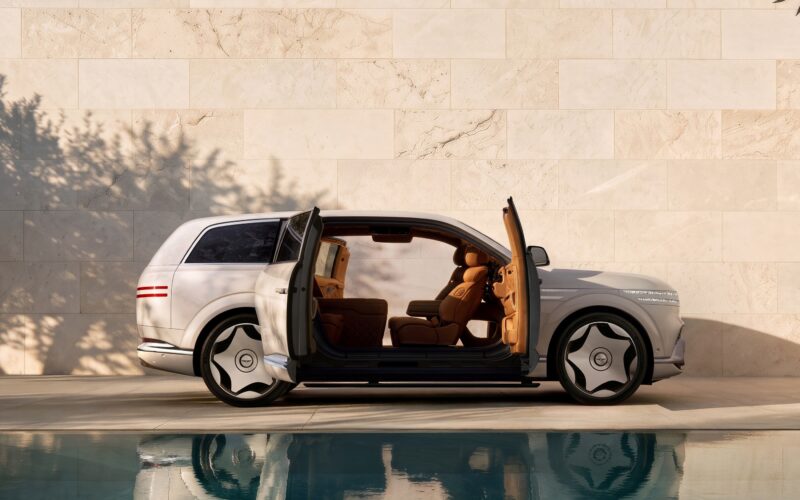
Genesis is offering two principal versions, the conventional-door GV90 and the more exclusive GV90 Neolun. The Neolun introduces what Genesis describes as the first independently opening and closing hidden B-pillar coach-door system in a production vehicle, branded the Neolun Arch Gate. Instead of retaining a conventional fixed central pillar between the front and rear doors, Genesis has built structural reinforcement into the doors and passenger compartment, including dual high-strength steel beams, reinforced tubing, structural foam and a cabin frame that the company says is 1.5 times thicker than in conventional vehicles. That engineering is commercially significant because the dramatic door architecture is not merely a styling flourish. It becomes one of the clearest ways Genesis can visually distinguish a six-figure-class luxury product from less expensive vehicles using broadly similar electric drivetrain technologies.
Can the Genesis GV90 move the brand from premium alternative to genuine top-tier luxury competitor?
Genesis has spent much of its first decade establishing that it can compete with established premium manufacturers on design, equipment and value. The GV90 presents a harder test because customers shopping at the top of the luxury SUV market are not evaluating vehicles solely by horsepower, range or screen size. Brand heritage, dealership experience, personalization, residual value, perceived exclusivity and the credibility of the ownership experience become increasingly important as prices rise.
That explains why the GV90 Neolun is built around a stronger rear-passenger proposition than most previous Genesis vehicles. The four-seat Executive Suite includes a real wood veneer floor with radiant heating inspired by Korea’s ondol underfloor heating tradition, a partition separating passengers from the luggage area, privacy blinds, a six-zone variable-transparency Smart Vision Roof, a refrigerator and integrated tables. The front seats can rotate 180 degrees while parked, creating a face-to-face seating arrangement. Genesis has also developed a Neolun First Edition with additional materials, two-tone exterior treatments and limited-production positioning.
These details point toward a vehicle intended to compete not merely with conventional premium SUVs but with chauffeured and executive-oriented luxury products. That shift matters strategically. Genesis has historically benefited from offering substantial equipment at prices below more established European luxury brands. The GV90 gives Hyundai Motor Company an opportunity to test whether Genesis can capture more value per vehicle instead of relying primarily on volume growth.
Pricing will therefore be one of the most important missing pieces. Genesis had not disclosed United States pricing in its unveiling announcement, leaving investors without the variable that will ultimately reveal how aggressively management intends to reposition the brand. If the GV90 is priced too cautiously, Genesis could undermine the exclusivity it is trying to establish. If pricing moves too close to deeply entrenched ultra-luxury competitors without sufficient brand pull, demand could become more difficult to sustain.
Does a 123.5 kWh battery and 490 kW output give the Genesis GV90 enough technical credibility?
The underlying specifications suggest Hyundai Motor Company has avoided building its most expensive Genesis around ordinary electric vehicle hardware. The GV90 uses an eMP architecture developed specifically for the Genesis flagship and carries a 123.5 kilowatt-hour battery, the largest battery installed in a Hyundai Motor Group electric vehicle to date. Genesis estimates that the seven-seat GV90 can travel approximately 500 kilometres on a charge based on internal research and development testing, while a 350 kilowatt fast charger can take the battery from 10% to 80% in about 22 minutes.
Front and rear motors generate a combined maximum output of 490 kilowatts and 800 Newton-metres of torque. Genesis has paired that output with electronic limited-slip differentials on both axles, multi-chamber air suspension and active rear-wheel steering capable of turning the rear wheels by as much as five degrees. At 5,285 millimetres long with a 3,245 millimetre wheelbase, the GV90 is an unusually large electric SUV, meaning chassis control and low-speed manoeuvrability will matter almost as much as straight-line performance.
The battery specification also illustrates one of the unavoidable tensions in very large luxury electric vehicles. A 123.5 kilowatt-hour pack provides the energy capacity needed to move a heavy, powerful SUV meaningful distances, but larger packs increase material requirements, weight and cost. Genesis is attempting to offset some of that penalty through extensive use of cast, extruded and body-panel aluminium, while the wireless battery management system is designed to improve packaging efficiency.
This is where the GV90’s commercial proposition differs from a mass-market electric vehicle. Efficiency per kilowatt-hour is important, but customers at this end of the market may place greater value on effortless performance, isolation, space and charging convenience. The business case depends on whether the additional battery, chassis and interior costs can be recovered through a sufficiently high transaction price.

Why are Pleos Connect and Gleo AI almost as important to Hyundai Motor Company as the luxury cabin?
The GV90 is also becoming a showcase for Hyundai Motor Group’s software-defined vehicle strategy. It uses Pleos Connect, the group’s next-generation Android Automotive Operating System-based infotainment platform, including access to third-party applications through the Pleos App Market. Gleo AI adds a generative artificial intelligence assistant intended to let occupants search for information and control vehicle functions through natural conversation.
The broader importance is that Hyundai Motor Company wants Pleos to become more than another infotainment interface. The company has said it intends to deploy Pleos Connect across approximately 20 million vehicles by 2030, creating the potential for software updates, personalization, apps and additional digital services to extend the commercial relationship with customers beyond the original vehicle purchase. The GV90 provides a high-margin environment in which those technologies can be introduced without the same cost sensitivity found in mass-market vehicles.
The cabin further includes a 23.6-inch central display that can extend vertically into a 24.6-inch cinematic screen when the vehicle is parked, together with a 25-inch head-up display replacing the conventional instrument cluster. Remote Smart Parking Assist 3 and Memory Reversing Assist add automated low-speed manoeuvring functions, while the vehicle also eliminates the traditional start button through a new power-control system that activates the vehicle as the occupant enters.
Luxury buyers may eventually care less about which manufacturer has the largest display than about whether the software remains fast, intuitive and useful several years after delivery. The longer-term test for Hyundai Motor Company will therefore be software quality and continuous improvement rather than launch-day novelty.
How important is the Genesis GV90 to Hyundai Motor Company’s 350,000-unit luxury growth target?
Genesis delivered more than 222,000 vehicles globally in 2025, its strongest annual performance, while Hyundai Motor Company has set a goal of reaching 350,000 Genesis sales annually by 2030. Moving from roughly 222,000 units to 350,000 would require an increase of about 128,000 vehicles, or roughly 58%, equivalent to compound annual growth of approximately 9.5% if measured from the 2025 base.
The GV90 will not need to account for all of that incremental volume. In fact, a high-end SUV should not be judged primarily by unit sales. Its more valuable role could be to lift the ceiling of the Genesis brand, strengthen dealer economics and improve customer perception of cheaper models lower in the range.
That halo effect becomes more important because Genesis is simultaneously broadening its powertrain strategy. Hyundai Motor Company has moved away from treating battery electric vehicles as the only route to premium electrification, with Genesis expected to add hybrids and extended-range electric vehicles alongside full battery electric models. The company is also expanding geographically and has outlined broader European ambitions while strengthening the brand in the United States, Korea, the Middle East and other markets.
The United States is particularly important. Genesis recorded 39,088 United States sales during the first half of 2026, its strongest first half in that market, with the GV70 and GV80 SUVs providing much of the momentum. That existing SUV demand gives the GV90 a credible customer base from which to start, although success at substantially higher pricing cannot be assumed simply from the performance of cheaper models.
Can a more profitable Genesis mix help Hyundai Motor Company while group margins remain under pressure?
The GV90 arrives against a more complicated financial backdrop than its elaborate launch presentation might suggest. Hyundai Motor Company generated record second-quarter 2026 revenue of KRW49.22 trillion, up 1.9% from a year earlier, but operating profit fell 20.8% to KRW2.85 trillion. The operating margin declined to 5.8%, while worldwide wholesale volume fell 6.9% to 991,885 vehicles. Hyundai nevertheless maintained its 2026 guidance for revenue growth of 1% to 2%, a 6.3% to 7.3% operating margin and 4.16 million wholesale vehicle sales.
That combination of record revenue and lower profit helps explain why premium mix is economically important. Genesis cannot by itself offset every tariff, commodity, supply-chain or production pressure affecting Hyundai Motor Company, but successful high-margin luxury models can improve product mix and reduce the amount of volume required to generate incremental earnings.
The challenge is scale. Genesis remains relatively small compared with Hyundai Motor Company’s broader vehicle business, meaning even strong profitability on the GV90 would initially have a modest impact on consolidated earnings. The strategic value becomes greater if GV90 technology, software, safety systems and luxury positioning support higher prices across the wider Genesis portfolio.
Hyundai Motor Company shares have meanwhile remained volatile. The stock was around KRW420,000 in early August 20 trading after falling approximately 4.8% in the previous session during a broad decline in South Korean equities. At that early-session reference price, the shares were roughly flat compared with their August 13 close of KRW418,500 and around 5% above the KRW399,000 close recorded on July 20, while remaining well below the 52-week high of KRW783,000. The 52-week range has extended down to roughly KRW212,000, illustrating how dramatically valuation expectations around Hyundai Motor Company have moved during the past year.
Broker sentiment remains constructive but is not uniform. Recent consensus data showed 26 Buy ratings, five Hold ratings and no Sell ratings among 31 analysts, with an average 12-month target around KRW676,843. JPMorgan maintained a Buy rating on August 12 while cutting its target to KRW530,000, while several Korean brokers reduced targets after the second-quarter results even as they continued to expect improving second-half profitability. The spread between current prices and many analyst targets suggests expectations remain positive, but the target reductions also show that investors are distinguishing between long-term strategic opportunities and the near-term earnings pressure facing the core automotive business.
What will determine whether the Genesis GV90 becomes a commercial breakthrough rather than an expensive halo vehicle?
The next phase will be less glamorous than the unveiling but far more useful for judging the strategy. Pricing, production ramp-up, market-by-market availability, order intake and the proportion of customers choosing the higher-value Neolun versions will reveal whether Genesis has genuinely created pricing power at the top of its range.
The vehicle itself gives Genesis credible material with which to attempt that move. It combines large-scale electric architecture, high output, fast charging, unusual safety engineering, software integration and a rear-passenger environment intentionally designed to distance the vehicle from mainstream luxury SUVs. What cannot be engineered into the product as quickly is decades of prestige, customer loyalty and resale confidence.
That makes the GV90 an unusually revealing test of Genesis’ second decade. The first decade established the brand and proved that Hyundai Motor Company could build competitive premium vehicles at global scale. The next phase requires Genesis to demonstrate that customers will pay materially more for the badge, not simply recognize that its vehicles offer strong value.
If the GV90 attracts buyers at premium prices while supporting higher Genesis volumes, the model could become a disproportionately important contributor to Hyundai Motor Company’s 350,000-unit luxury target and help strengthen the economics of its broader electrification and software strategy. If customers admire the technology but resist the pricing required to justify it, Genesis will have created an impressive halo model without proving that its brand has fully crossed into the industry’s highest-value tier. Pricing and early order conversion will provide the first measurable answer.
Key takeaways on the Genesis GV90 and Hyundai Motor Company’s luxury EV strategy
- Hyundai Motor Company has unveiled the Genesis GV90 as its luxury brand’s first full-size electric SUV and most ambitious upmarket product to date.
- The GV90 uses a 123.5 kilowatt-hour battery and produces up to 490 kilowatts and 800 Newton-metres from its dual-motor system.
- Genesis estimates approximately 500 kilometres of range for the seven-seat GV90 based on internal testing, with 10% to 80% fast charging in about 22 minutes.
- The GV90 Neolun differentiates itself through coach doors and a hidden B-pillar structure supported by substantial body reinforcement.
- A four-seat Executive Suite pushes Genesis toward the chauffeur-driven luxury market with privacy, heating, refrigerator and rear-cabin features.
- Pleos Connect and Gleo AI make the GV90 an important early showcase for Hyundai Motor Group’s broader software-defined vehicle strategy.
- Genesis is targeting 350,000 annual sales by 2030, roughly 58% above its more than 222,000 global deliveries in 2025.
- Hyundai Motor Company’s record second-quarter 2026 revenue was accompanied by a 20.8% decline in operating profit, increasing the importance of richer vehicle mix.
- The GV90’s biggest unresolved commercial variable is pricing, because Genesis must balance volume expansion against the exclusivity required to move higher in the luxury hierarchy.
- Early order conversion, regional launch execution and Neolun trim demand will show whether GV90 technology translates into sustainable Genesis pricing power.
Discover more from Business-News-Today.com
Subscribe to get the latest posts sent to your email.