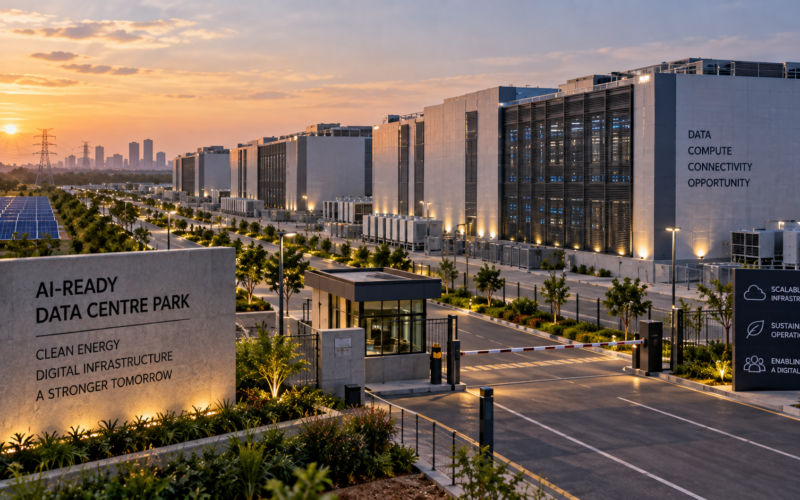
Hyderabad’s emerging AI infrastructure pipeline has gained another enormous proposed project, with Fortune Hospitality & Infra LLP planning an initial investment of approximately ₹60,000 crore in a hyperscale data-centre park at Kandukur mandal in Telangana’s Ranga Reddy district. Swati Bharadwaj of The Times of India reported on September 10 that the Fortune Data Center Park is planned across about 170 acres and could ultimately involve cumulative investment of as much as ₹1 lakh crore as later phases and operator infrastructure are developed. The project is being taken forward through special-purpose vehicle Sudeeksha Estates LLP.
The project is no longer simply a search for land. Bharadwaj reported that the Telangana government allotted the site under Industries and Commerce Department G.O. Rt. No. 125 dated July 17, 2026. The planned campus is designed for an IT load of approximately 1,200 MW to 1,600 MW across four independently operable hyperscale modules, each capable of supporting as much as 400 MW for artificial intelligence, cloud computing, colocation and high-performance computing.
Why is Fortune’s 1,200-1,600 MW IT-load target extraordinary for one campus?
Data-centre scale is better understood through electrical load than acreage alone because computing equipment, cooling and supporting systems require enormous power availability. Fortune’s proposed 1,200-1,600 MW IT load would place the Kandukur campus among the largest planned digital-infrastructure developments in India if it reaches full build-out.
The four-module design reduces some of the all-or-nothing execution risk. Each module can support up to 400 MW and operate independently, allowing development to proceed in stages rather than requiring the full 1.6 GW campus to become operational simultaneously.
That distinction is important when interpreting the ₹60,000 crore initial investment. The developer has also said cumulative capital deployment could ultimately reach ₹1 lakh crore, indicating that the initial figure and the full 1.6 GW build-out may not occur in one construction phase.
The project therefore should not be described as ₹60,000 crore already under construction. Land allocation has progressed and the development concept is highly specific, but module-level construction awards, operator commitments and commissioning schedules remain the milestones that will determine actual deployment.
Does Fortune already have enough power infrastructure for a hyperscale AI campus?
Fortune says the project has sanctioned power capacity of 2,000 MVA from TGTRANSCO. The site is located less than 500 metres from POWERGRID’s 765/400 kV infrastructure and close to TGTRANSCO’s 400/220 kV substations, giving the project unusually direct access to large-scale transmission infrastructure.
That proximity matters because power availability is increasingly one of the largest constraints on hyperscale data-centre development. Securing land without access to sufficient grid capacity can leave projects waiting years for transmission upgrades.
AI computing makes the issue even more demanding. GPU-heavy data centres can require far greater power densities than conventional enterprise facilities, meaning electrical design, backup systems and cooling infrastructure become central to the economics of the campus.
The 2,000 MVA sanctioned figure is therefore one of the strongest pieces of project evidence currently available. It does not mean all four modules are ready to consume power immediately, but it indicates that the development has been planned around the transmission capacity required for hyperscale operation.
How will Fortune deal with the water and electricity intensity of AI data centres?
The developer says the campus will use treated greywater for cooling and other non-potable requirements and employ closed-loop cooling systems with recycling and continuous monitoring. Fortune also plans to procure renewable electricity through long-term solar and wind power-purchase agreements and is evaluating round-the-clock renewable solutions.
These commitments are commercially important because data centres can face scrutiny over both electricity consumption and water usage. High-density AI workloads increase heat generation, potentially raising cooling requirements unless operators use more efficient thermal-management technologies.
Renewable procurement does not eliminate the need for reliable grid power because data centres operate continuously. The more complex task is combining solar and wind contracts, storage or firming mechanisms and conventional grid supply without compromising uptime.
Fortune’s project will therefore need substantial supporting energy infrastructure beyond the server buildings themselves. Electricity sourcing, grid resilience and cooling design will be critical to determining whether the campus can deliver the claimed AI-ready capacity efficiently.
Why should the ₹60,000 crore investment be treated as developer-planned capital rather than awarded project value?
The investment figures originate from Fortune Hospitality & Infra’s project announcement and related company documents reported by publications including The Times of India, The Economic Times and Business Standard. They do not represent a single EPC award or ₹60,000 crore already spent.
This distinction matters because large data-centre parks often combine developer capital with investment by individual operators, hyperscalers and infrastructure partners. Fortune has said the full build-out could reach ₹1 lakh crore as additional phases and operator infrastructure are commissioned.
The ultimate capital therefore depends on how many hyperscalers sign up, how quickly modules are developed and what computing infrastructure those tenants install.
For contractors and suppliers, the investment opportunity becomes tangible when civil, electrical, cooling, transmission, fibre and equipment packages are actually tendered or awarded. The current announcement establishes a very large pipeline but not a ₹60,000 crore contractor backlog.
What could the Fortune project mean for Hyderabad’s growing data-centre cluster?
Hyderabad already has several large digital-infrastructure projects under development or planning, and Fortune’s proposed campus would add another potentially gigawatt-scale cluster to the metropolitan region.
The Kandukur site also sits within the broader southern Hyderabad growth corridor, which is attracting large infrastructure and technology investment. Direct highway connectivity, airport access and proximity to major electricity infrastructure strengthen the location’s data-centre economics.
Fortune estimates approximately 4,000-5,000 direct and indirect employment opportunities, including roughly 1,000 technical, engineering and operational positions. Data centres are capital intensive rather than exceptionally labour intensive, so the larger regional effect could come through construction, electricity infrastructure, fibre networks and supporting services.
The next decisive milestone is operator participation. A 170-acre campus with 2,000 MVA of sanctioned power has infrastructure credibility, but hyperscale data-centre economics ultimately depend on signing customers willing to install and operate computing capacity across those four 400 MW modules.
Discover more from Business-News-Today.com
Subscribe to get the latest posts sent to your email.